

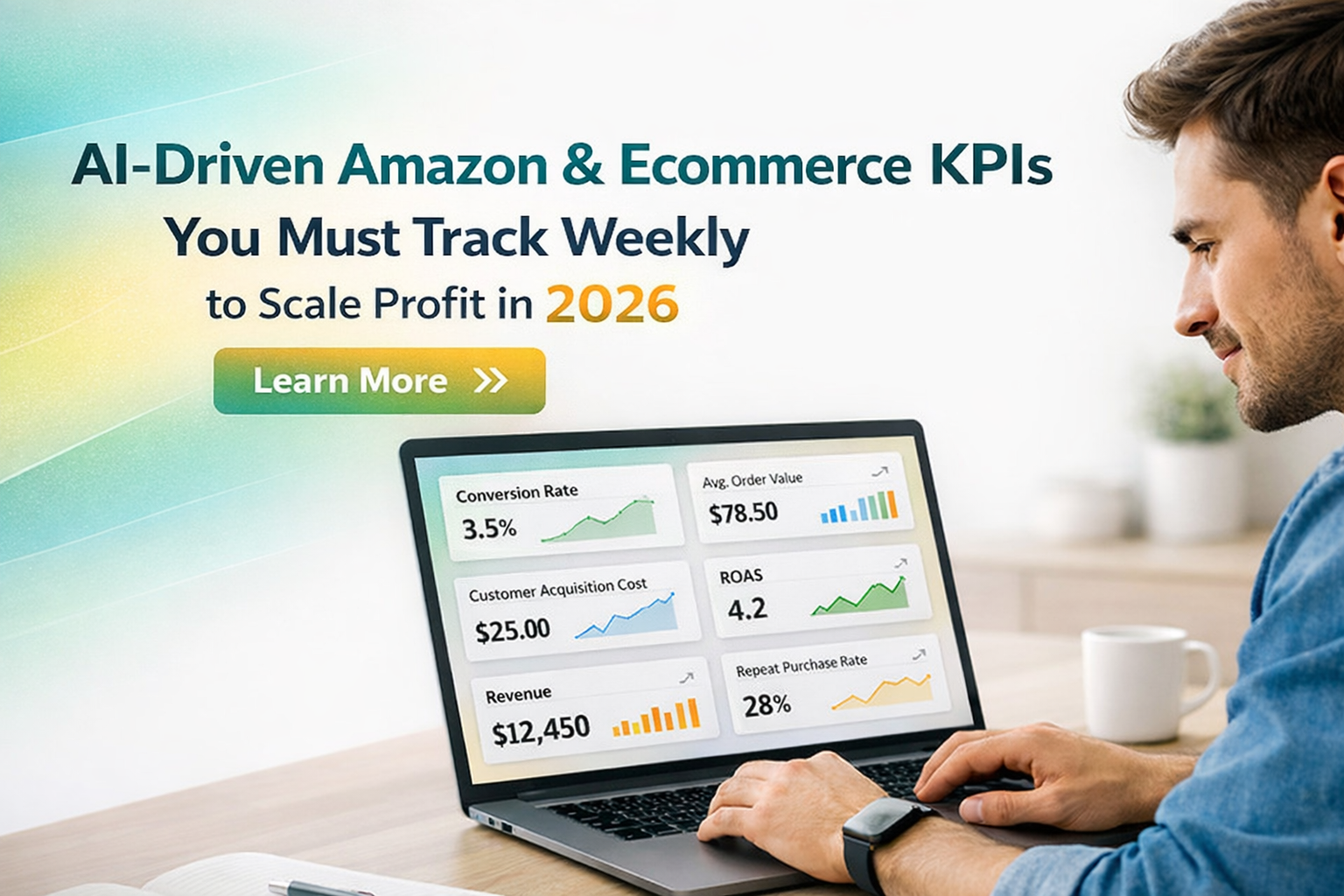
Weekly tracking of the right Amazon & Ecommerce KPIs is the difference between scaling profitably and burning ad spend. In 2026, with AI-driven optimization and rising competition, brands that ignore their numbers will see shrinking margins, higher CAC, and stalled growth. Those that track, predict, and act on data weekly will win.
This guide breaks down the essential AI-driven Amazon & Ecommerce KPIs you must monitor every week to scale profit, not just revenue. You will see how leading ecommerce teams, ecommerce marketing agency India partners, and ecommerce consulting services structure their dashboards to make fast, confident decisions.
Why Weekly KPI Tracking Matters More Than Ever in 2026
Digital marketplaces are changing faster than monthly reports can keep up. Algorithms update, competitors adjust bids, and consumer behavior shifts in days, not quarters. Weekly monitoring of core Amazon & Ecommerce KPIs lets you react before small issues become expensive problems.
AI tools now surface patterns that humans miss, but they still depend on clean, timely data. When you review KPIs weekly, you feed your AI models better signals, improve predictions, and unlock compounding gains in ad efficiency, conversion rate, and lifetime value.
Core Revenue and Profit Amazon & Ecommerce KPIs to Track Weekly
Most teams obsess over top-line sales, but profit-focused brands go deeper. They track a tight set of Amazon & Ecommerce KPIs that connect traffic, conversion, and margin. This weekly view reveals whether growth is sustainable or just paid for with discounts and ad spend.
For ecommerce kpis for growth, focus on metrics that show both scale and efficiency. AI can then model which levers to pull: pricing, bids, creatives, or inventory. The goal is to protect contribution margin while still pushing for aggressive revenue targets.
1. Net Revenue, Contribution Margin, and Profit per Order
Start with net revenue after discounts and refunds, then layer in contribution margin. This shows how much money remains after variable costs like COGS, shipping, and marketplace fees. Profit per order reveals if your growth is actually worth the effort.
Weekly, compare revenue and margin trends across channels: DTC, marketplaces, and paid media. AI models can flag SKUs where revenue is up but margin is collapsing, helping you adjust pricing, bundles, or promotions before profitability erodes.
2. AOV, Units per Transaction, and Repeat Purchase Rate
Average order value and units per transaction are foundational Amazon & Ecommerce KPIs for scaling profit. Small lifts here compound across thousands of orders. AI-driven recommendations and cross-sell engines can increase AOV without heavy discounts.
Repeat purchase rate, measured weekly on a rolling cohort basis, shows whether your acquisition spend is justified. Ecommerce consulting services often build dashboards that connect AOV, repeat rate, and CAC to model payback periods and guide budget allocation.
AI-Driven Traffic and Conversion KPIs for Amazon and Ecommerce
Traffic without intent wastes budget; intent without conversion wastes opportunity. AI-powered optimization focuses on the Amazon & Ecommerce KPIs that link audience quality with on-site performance. Weekly reviews help teams refine targeting, creatives, and landing experiences.
Modern ecommerce advertising agency partners rely on granular data from search, social, and marketplace ads. They feed this into AI systems that predict which segments, keywords, and placements will convert profitably, not just drive clicks.
3. Sessions, Click-Through Rate, and Search Visibility
Sessions and CTR remain core ecommerce kpis for growth, but the context has changed. AI can now cluster traffic by intent, device, and funnel stage, revealing which segments deserve more budget. Weekly, review sessions by channel and campaign, not just in aggregate.
On Amazon, search visibility for priority keywords is a critical Amazon kpis for profit signal. Track organic rank and share of voice for branded and non-branded terms. AI tools can simulate how changes in bids or content might impact visibility and downstream sales.
4. Conversion Rate by Channel, Device, and Funnel Stage
Instead of a single sitewide conversion rate, segment by channel, device, and landing page. These segmented Amazon & Ecommerce KPIs reveal friction points that broad averages hide. Weekly, identify outliers where traffic is strong but conversion lags.
AI-driven experimentation platforms can then test new creatives, offers, and layouts. By feeding them weekly conversion data, you accelerate learning cycles. Over time, this compounds into higher ROAS and stronger profitability across all acquisition channels.
Critical Amazon Advertising and Marketplace KPIs for Profit
Marketplace growth often hinges on Amazon marketing services for scale sales. Yet many brands chase revenue and ranking while ignoring true profitability. Weekly tracking of the right Amazon & Ecommerce KPIs inside your ad accounts prevents overspending.
Amazon advertising services now lean heavily on AI bidding and audience tools. However, these systems still require clear guardrails. You must define the profit thresholds and KPI targets that AI should optimize toward, not just let it chase attributed revenue.
5. TACoS, ROAS, and Blended Cost of Sale
Advertising Cost of Sales (ACoS) is useful, but Total ACoS (TACoS) is more strategic. It measures ad spend against total revenue, including organic sales. This Amazon kpis for profit view shows whether ads are lifting the whole account or just cannibalizing existing demand.
Weekly, compare campaign-level ROAS with blended cost of sale across the account. If TACoS rises while organic rank falls, your strategy may be too dependent on paid. AI tools can then reallocate budget toward campaigns that drive incremental, profitable growth.
6. Share of Voice, Buy Box Win Rate, and Listing Health
Share of voice across sponsored and organic placements is a leading indicator of future sales. These Amazon & Ecommerce KPIs show whether competitors are outbidding you or outranking you on critical terms. Weekly tracking helps you defend your most profitable keywords.
Buy Box win rate and listing health metrics, such as content quality, reviews, and stock status, complete the picture. AI systems can scan thousands of listings to flag gaps, from missing images to weak titles. Fixing these quickly protects both revenue and ad efficiency.
Customer-Centric KPIs: LTV, CAC, and Retention
In 2026, the most advanced ecommerce advertising agency teams optimize for customer lifetime value, not just first-order profit. They treat LTV, CAC, and retention as core Amazon & Ecommerce KPIs that guide every budget and channel decision.
AI excels at predicting LTV based on early behavior signals. When you feed it accurate weekly data, it can identify high-value cohorts and recommend where to increase bids, improve offers, or build tailored retention journeys.
7. LTV:CAC Ratio, Churn, and Subscription Health
The LTV:CAC ratio is one of the most important ecommerce kpis for growth. It tells you how much value each acquired customer generates relative to the cost of acquiring them. Weekly, monitor this ratio by channel and campaign, not just overall.
For subscription or repeat-purchase brands, churn rate and subscription health metrics are vital Amazon & Ecommerce KPIs. AI can predict which customers are at risk of churning and trigger personalized win-back flows, improving retention and long-term profitability.
Building an AI-Ready Weekly KPI Dashboard
To make these Amazon & Ecommerce KPIs actionable, consolidate them into a single weekly dashboard. Pull data from your ecommerce platforms, ad accounts, and analytics tools into one source of truth. This reduces reporting time and increases decision speed.
Then, layer AI models on top to surface anomalies, forecast trends, and recommend actions. Many ecommerce consulting services now specialize in building such AI-ready KPI stacks, enabling leadership teams to move from reactive reporting to proactive, profit-focused optimization.
Conclusion: Turn Weekly KPIs into a Profit Engine
Tracking Amazon & Ecommerce KPIs weekly is no longer optional for brands that want to scale profitably in 2026. When combined with AI, these metrics become a powerful engine for smarter bidding, sharper targeting, better customer experiences, and stronger margins.
By aligning your teams, tools, and partners around a clear KPI framework, you create a culture of data-driven growth. If you are ready to turn your weekly numbers into a competitive advantage, HRL Infotechs can help you design and execute an AI-first KPI strategy tailored to your ecommerce business.