

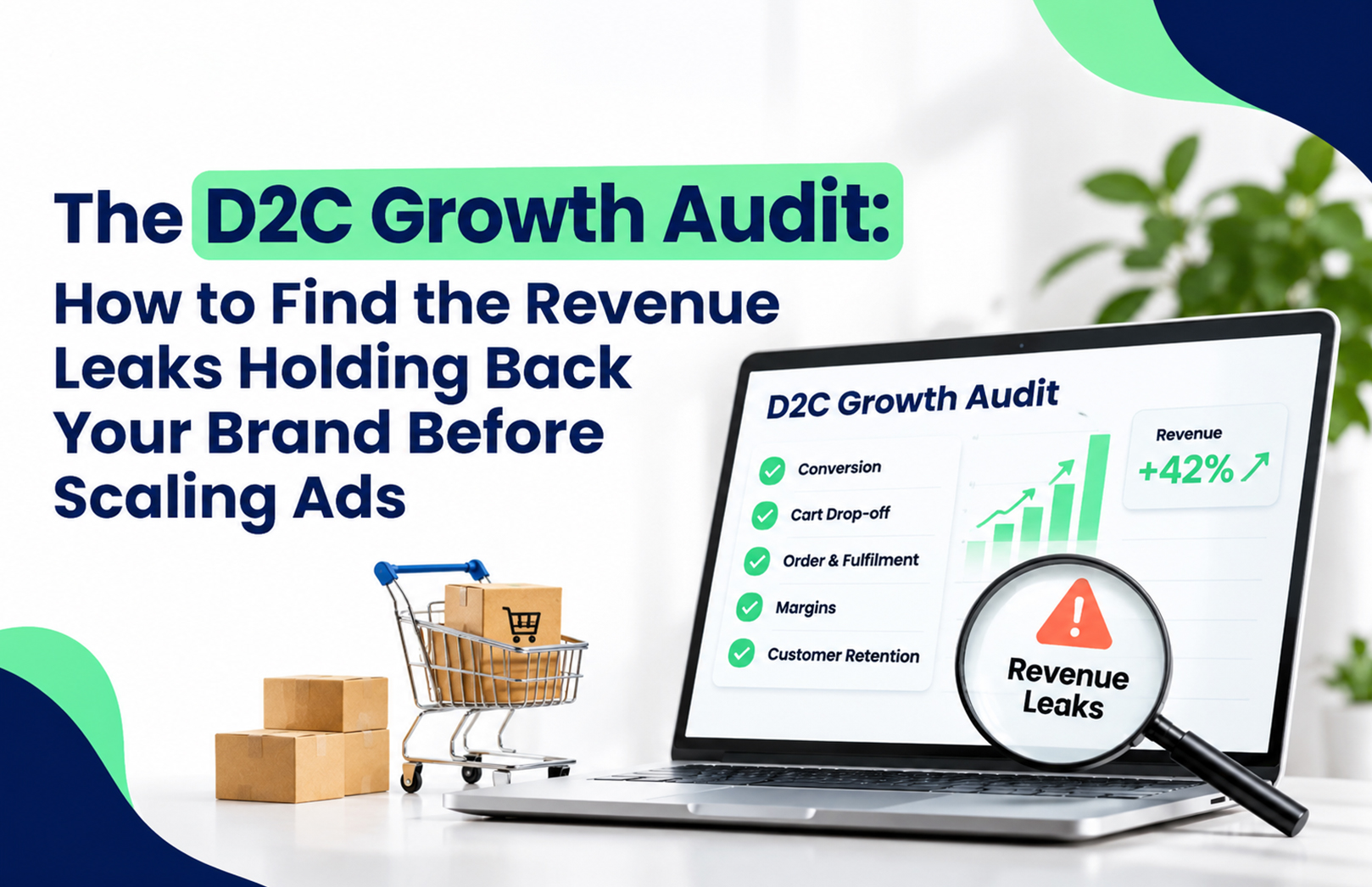
Your ads may be bringing traffic, but if product pages do not convert, checkout creates doubt, or repeat purchases stay low, more ad spend will only make the leak larger. Many Indian D2C brands scale paid media before checking whether the funnel can handle profitable growth. The result is familiar: rising CAC, unstable ROAS, COD returns, and revenue that looks good in a dashboard but disappears after discounts, shipping, returns and payment fees.
A practical D2C Growth Strategies audit starts before you increase budgets. It examines traffic quality, conversion paths, offer economics, tracking accuracy, retention and fulfilment. This article gives you a framework to locate the revenue leaks holding your brand back, so you scale ads only when the underlying system can turn spend into profitable customers.
What Is a D2C Growth Audit?
A D2C growth audit is a structured review of every stage between ad click and repeat purchase. Its purpose is to find where money is lost: low-intent traffic, weak product pages, checkout friction, poor attribution, unprofitable orders, or absent retention journeys.
Think of it as a diagnostic before treatment. If conversion is low only from paid social but strong from branded search, the issue may be audience, creative or landing-page intent. If every channel converts poorly, the problem is more likely your offer, product page, mobile experience or checkout. A successful growth audit recommends evaluating traffic quality, device-wise conversion rates, checkout abandonment, repeat customer rates, product margins, returns, and operational bottlenecks before investing heavily in customer acquisition.
A useful audit answers four questions:
- Which channels bring customers who actually buy and stay?
- Where do visitors drop off between landing page and payment?
- Does each order contribute positive margin after discounts, shipping, returns and fees?
- Can current systems support higher order volume without service or delivery failures?
Which Revenue Leaks Should You Check First?
Start with the leaks that affect cash flow, not vanity metrics. Platform ROAS can look healthy while contribution margin remains negative, especially when discounts, COD failures, return logistics and payment costs are excluded from reporting.
Traffic Quality And Acquisition Economics
Review CAC by channel, not only blended CAC. Include media spend, creative production, influencer fees, affiliate commissions, agency fees, returns, support costs and failed deliveries where relevant. This prevents you from celebrating a channel that acquires buyers who later return products.
Check these signals:
- Conversion rate by source, campaign, device and landing page
- New customer share versus repeat customer revenue
- CAC after refunds and returns
- ROAS at 30, 90 and 180 days, particularly for consumables and replenishment products
- Contribution margin per order, not just revenue per order
If paid social converts far below direct and branded search, pause before raising budgets. First test tighter audiences, clearer creative promises and a landing page that matches the ad message.
Product Page And Offer Leaks
Your product detail page must answer buyer objections quickly. In India, common friction points include unclear COD terms, hidden shipping charges, missing size guidance, weak reviews, limited payment options and unclear return policies. These issues often show up as high add-to-cart rates but low completed purchases.
Review your top five revenue-generating product pages on a mobile device. Look for slow loading, unclear benefits, buried trust signals, poor variant selection, absent delivery information and a checkout that asks for unnecessary information. Shopify’s CRO guidance highlights funnel auditing, mobile experience, page speed, social proof, checkout simplification and surprise fees as core conversion issues.
A simple product page checklist:
- Is the primary benefit clear within the first screen?
- Are reviews, ratings and user-generated content visible without excessive scrolling?
- Does the page state delivery timelines, COD availability and return terms?
- Are bundles, quantity offers and upsells relevant rather than disruptive?
- Does the add-to-cart button remain accessible on mobile?
For marketplace-led brands, product pages also compete with similar listings and price comparisons. A focused approach to D2C ecommerce conversion can reduce hesitation by making product benefits, proof and comparisons easier to scan on a phone.
How Do You Audit Conversion Rate Optimization?
Audit conversion rate optimization in the order customers experience it: landing, browsing, product selection, cart, checkout and post-purchase. Start with GA4, heatmaps and session recordings to identify pages with high traffic but poor progression.
Step 1: Segment conversion by channel and device
Compare conversion rates for Meta, Google, email, direct, organic search and marketplace traffic. Then split each by mobile and desktop. A page that performs well on desktop but poorly on mobile often has layout, speed or thumb-reach problems.
Step 2: Map the funnel
Track these stages separately:
- Landing page views
- Product page views
- Add to cart
- Checkout started
- Shipping information completed
- Payment initiated
- Purchase completed
A large drop from add to cart to checkout usually points to shipping cost, trust, COD clarity or cart design. A drop at payment often points to payment options, form length, errors or slow loading.
Step 3: Test one variable at a time
Run controlled tests on high-traffic pages. Test shipping communication above the fold, a simplified variant selector, clearer return messaging, a sticky mobile add-to-cart button, or a shorter checkout. Avoid changing several elements together, because you will not know which change caused the result.
A realistic example: an apparel brand with strong traffic but weak mobile conversion may discover that size charts are hidden below reviews. Moving fit guidance closer to the size selector, adding model measurements and clarifying exchange terms can reduce hesitation without changing the ad budget.
Are Retention and Fulfilment Leaks Hiding Growth?
Acquisition is only half of D2C economics. If customers do not return, every new sale must replace a lost customer, which keeps CAC pressure high. Track repeat purchase rate by acquisition source, revenue per customer, time between orders and win-back performance.
For Indian D2C brands, retention often depends on practical communication rather than generic email campaigns. WhatsApp works well for order updates, replenishment reminders and support. Email can carry education, reviews and margin-friendly offers. SMS should remain focused on transactional and time-sensitive communication.
Check whether you have:
- A welcome journey that explains product use and builds trust
- Post-purchase updates that reduce support queries
- Replenishment reminders for consumable products
- A win-back flow for customers who have not purchased recently
- A review request timed after delivery, not immediately after payment
Fulfilment is another hidden leak. Late dispatch, stockouts, wrong addresses, RTO and poor packaging damage both margin and future purchase behaviour. Review RTO by pin code, product category and payment method. If COD orders return frequently, consider prepaid incentives, address verification, clearer delivery expectations or selective COD restrictions.
If your brand sells through Amazon, Flipkart or quick commerce alongside its website, audit each channel separately. A clear understanding of D2C brand growth helps you see whether marketplace orders support profit or absorb it through commissions, discounts, returns and logistics costs.
When Should You Scale Ads?
Scale ads when the funnel proves it can convert profitably, not when a campaign has one strong week. A safer trigger is consistent performance across enough orders to make the data meaningful, combined with positive contribution margin and stable fulfilment.
Before increasing spend, confirm that:
- Tracking captures purchases, add-to-carts, checkout steps and key events accurately
- CAC remains acceptable after refunds, discounts, shipping and payment costs
- Product pages convert across mobile and desktop
- Inventory, dispatch and customer support can handle higher volume
- Retention flows are active and measurable
- Creative testing has a clear process, rather than relying on one winning ad
If these basics are weak, fixing them first creates more room for profitable scaling. Structured ecommerce growth consulting can help prioritise the changes with the highest revenue impact instead of treating every metric as urgent.
Build a 30 Day Revenue Leak Audit
Use this sequence to create a prioritised action plan.
- Pull 90 days of data by channel, device, campaign and landing page.
- Calculate CAC, AOV, repeat rate, refund rate and contribution margin.
- Identify the five highest traffic product pages and audit them on mobile.
- Map funnel drop-offs from landing page to completed purchase.
- Review checkout, COD messaging, shipping disclosure, payment options and error states.
- Inspect tracking events, attribution setup and revenue reconciliation.
- Review RTO, delivery performance, stockouts and support tickets.
- Audit welcome, abandoned cart, post-purchase, replenishment and win-back flows.
- Select three fixes with the highest expected revenue impact.
- Test, measure and only then increase acquisition spend.
This approach turns D2C Growth Statergies from a collection of tactics into a decision system. It also makes ecommerce sales optimization measurable, because every change connects to a funnel stage and a financial outcome.
Conclusion
The fastest growing D2C brands do not simply spend more on ads. They find the points where interested shoppers leave, fix the economics behind each order, and build retention systems that make future acquisition less expensive. A disciplined D2C Growth Statergies audit gives you that clarity before budget increases amplify existing problems.
HRL INFOTECHS helps D2C brands review acquisition, conversion, retention, analytics and marketplace performance through a practical, full-funnel approach. If you want an outside view of the revenue leaks in your funnel, request a consultation through the D2C brand growth services page.
FAQs
What is a D2C growth audit?
A D2C growth audit reviews traffic quality, conversion paths, unit economics, retention, fulfilment and tracking. It identifies where revenue is lost before a brand increases advertising budgets, helping teams prioritise fixes that improve profitable growth.
Why is my D2C ROAS high but profit low?
Platform ROAS can ignore discounts, shipping, returns, COD failures, payment fees, creative costs and support expenses. Calculate contribution margin per order and CAC after refunds to understand whether campaigns are creating profit or only reported revenue.
How often should a D2C brand run a CRO audit?
Run a detailed conversion rate optimization audit at least every six months, and review funnel metrics monthly. Shopify recommends regular audits, especially after major traffic changes, new campaigns, redesigns or checkout updates.
What are common conversion leaks on Indian D2C websites?
Common issues include slow mobile pages, unclear COD terms, unexpected shipping charges, weak reviews, missing size guidance, complicated checkout, limited payment options and unclear return policies. These problems often appear as cart abandonment or payment drop-offs.
Should I fix conversion before scaling ads?
Usually yes. If traffic converts poorly, additional spend increases wasted impressions and CAC. Fix high-impact product page, checkout, offer and tracking issues first, then scale campaigns with clearer performance data and healthier unit economics.
What metrics matter most in a D2C audit?
Focus on CAC by channel, contribution margin, conversion rate by device and source, AOV, repeat purchase rate, refund rate, RTO, LTV and ROAS over longer windows. These metrics connect marketing activity to actual profitability.