

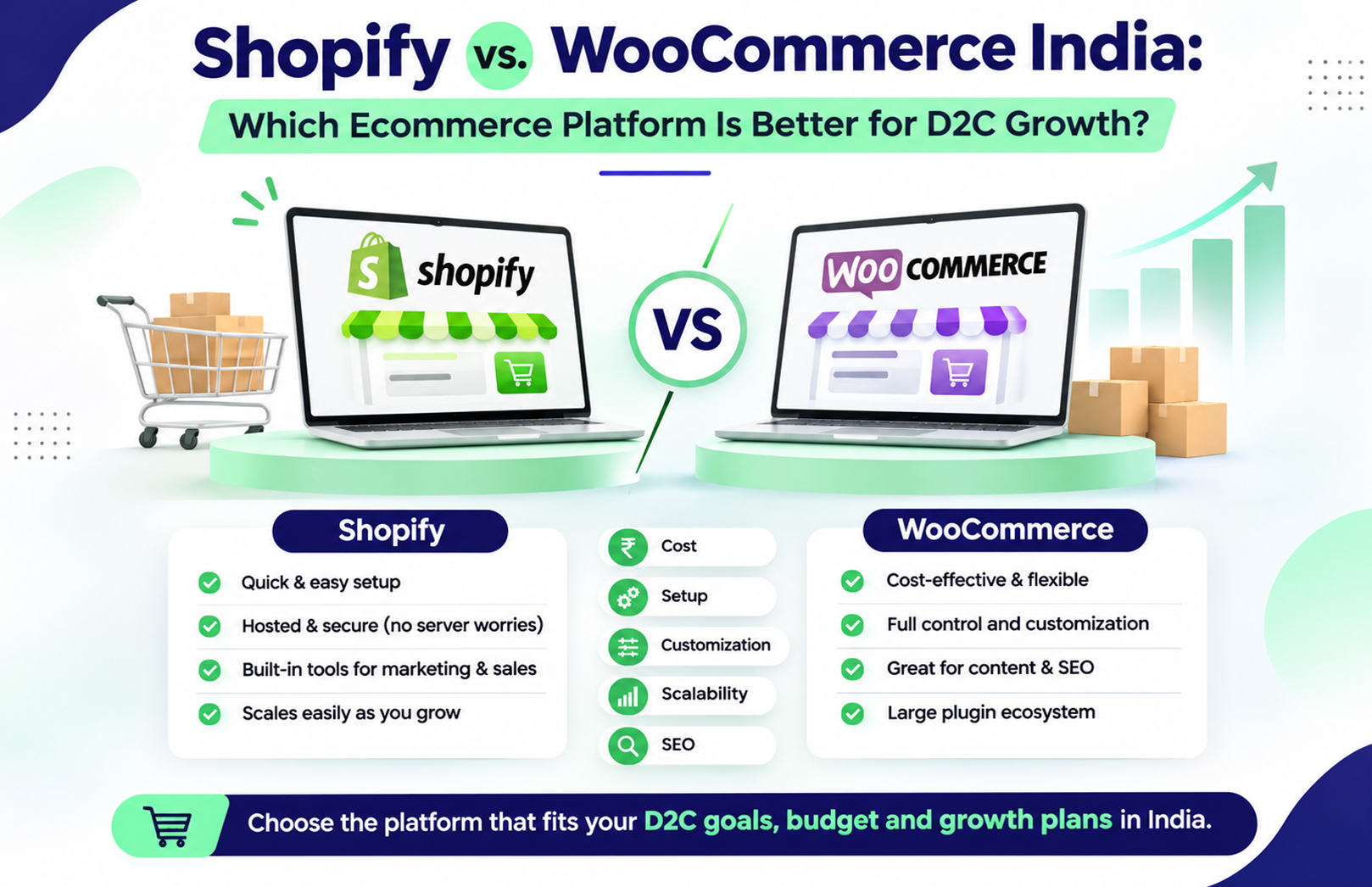
You are launching a D2C brand in India and need to decide between Shopify and WooCommerce. One promises a managed ecommerce platform with less technical work. The other offers more control, but requires hosting, plugins, updates and ongoing maintenance. The wrong choice can slow launches, complicate payments and make scaling harder.
This comparison explains Shopify vs WooCommerce for Indian D2C growth, including setup, costs, SEO, checkout experience, migration and long term scalability. It also explains when professional Shopify Development Services make sense, especially if you plan to grow product ranges, run campaigns or expand across markets.
Shopify vs WooCommerce: Which Ecommerce Platform Wins?
Shopify is usually better for D2C brands that want a managed ecommerce platform, faster launch and fewer technical responsibilities. WooCommerce is usually better for businesses that already use WordPress, need deep customisation and have technical resources to maintain the site.
Neither platform is automatically better. Shopify reduces infrastructure work because hosting, security updates, payment infrastructure and core platform maintenance are managed. WooCommerce gives you more control because it is a WordPress plugin, but that control comes with responsibility for hosting, security, performance and plugin compatibility.
| Factor | Shopify | WooCommerce |
| Best suited for | D2C brands focused on growth | WordPress based businesses with technical support |
| Hosting | Managed by Shopify | Self managed or third party hosting |
| Setup | Faster and more standardised | More configuration and technical decisions |
| Maintenance | Platform handles core updates | Owner manages WordPress, plugins and security |
| Customisation | Theme and app based, with custom development options | Highly flexible through code and plugins |
| Checkout | Streamlined hosted checkout | More customisation possible, but requires setup |
| SEO | Strong foundations with Shopify SEO | Strong potential with the right technical setup |
| Scaling | Managed infrastructure and app ecosystem | Depends on hosting, plugins and development quality |
For most D2C ecommerce brands, Shopify is the simpler choice when speed to market, reliability and operational focus matter more than owning every technical detail.
Why Shopify Suits Indian D2C Brands
Indian D2C brands often need to move quickly: launch collections, test offers, manage festive demand, integrate logistics partners and run performance campaigns. Shopify supports these needs through a managed ecommerce platform, app ecosystem and custom development options.
A Shopify store can connect with payment gateways, shipping partners, marketing tools, ERP systems and customer support platforms. HRL Infotechs’ Shopify service lists integrations including Razorpay, Stripe, PayPal, Klaviyo, Mailchimp, Google Analytics 4, Meta Pixel, Zoho, Salesforce, Unicommerce, GoKwik and Shiprocket.
For a growing D2C brand, this reduces the need to build every operational connection from scratch. Instead of managing hosting, security patches and plugin conflicts, your team can focus on products, creative, customer experience and marketing.
What Shopify handles well
- Store setup, product catalogues, collections and navigation
- Mobile responsive themes and checkout flows
- Payment gateway and shipping integrations
- App based marketing, reviews, loyalty and analytics tools
- Scalable infrastructure during campaign traffic
- Shopify SEO foundations such as URLs, metadata, canonical tags and product schema
Shopify is particularly useful when your team does not have an in house WordPress developer. It lets marketing and operations teams make changes without relying on a developer for every small update.
When WooCommerce Is the Better Choice
WooCommerce can be the better choice if your business already runs on WordPress and needs highly specific content, membership, booking or custom functionality. It can also suit teams with experienced developers who can manage hosting, security and performance.
WooCommerce gives you more control over the database, code and plugin stack. That flexibility can be valuable for complex content led websites, niche business models or brands that need unusual workflows. However, it also means more decisions: hosting quality, caching, backups, plugin updates, security monitoring and compatibility testing.
A WooCommerce migration may make sense when your existing WordPress site has strong content equity, complex editorial workflows or custom features that would be costly to rebuild. But moving to WooCommerce is not automatically cheaper. A poorly maintained plugin stack can create speed, security and checkout problems that affect sales.
Choose WooCommerce if:
- Your website is already built on WordPress
- You have a reliable developer or technical team
- You need custom features beyond standard ecommerce needs
- You want full control over hosting and code
- You can commit to regular maintenance and security updates
How Shopify Migration and WooCommerce Migration Work
Shopify migration is the process of moving products, customers, orders, content and URLs from another ecommerce platform to Shopify. WooCommerce migration is the reverse process, moving a Shopify store into WordPress.
A migration should protect more than product data. It should preserve customer records, order history, SEO URLs, metadata, redirects and analytics continuity. HRL Infotechs’ Shopify service describes migrations from WooCommerce and Magento, including product, variant, customer, order and metadata transfer, along with 301 redirect mapping and Google Search Console verification.
Before migrating, prepare this checklist:
- Export and audit products, variants, images and inventory
- Back up customer, order and review data where permitted
- Map old URLs to new URLs
- Set up 301 redirects for every changed URL
- Rebuild essential pages, collections and navigation
- Test payment gateways, shipping rules and tax settings
- Verify analytics, pixels and tracking events
- Monitor indexing and rankings after launch
A common mistake is treating migration as a simple data transfer. If redirects, metadata and tracking are missed, the store may lose organic visibility even after the new site goes live.
Which Platform Supports Better SEO and Checkout?
Both platforms can support strong SEO and checkout performance. The difference is how much work is required to achieve it.
Shopify provides foundational Shopify SEO features such as editable metadata, canonical tags, sitemaps and structured data support. WooCommerce can also rank well, but SEO quality depends more heavily on the theme, plugins, hosting and technical configuration.
Shopify checkout optimization focuses on reducing friction in the buying journey: fewer steps, clear shipping information, trusted payment options, mobile friendly forms and relevant upsells. HRL Infotechs’ Shopify development Services highlights mobile first design, streamlined checkout steps, compressed imagery, clean Liquid code and performance tuning as part of its approach.
For D2C brands, checkout experience often matters more than platform branding. A shopper may tolerate a slightly less flexible backend, but not a slow, confusing or unreliable checkout.
Checkout Checklist For Either Platform
- Test the full purchase journey on mobile devices
- Show delivery estimates and shipping costs early
- Offer trusted Indian payment options where relevant
- Reduce unnecessary form fields
- Use clear error messages
- Add trust signals near payment fields
- Test discount codes, taxes and shipping rules
- Track abandoned carts and checkout drop offs
A high converting store also needs strong product pages, fast loading pages, relevant recommendations and useful search. These features work together rather than in isolation. The guide to must have Shopify features explains how checkout, mobile design, trust signals and analytics affect conversion.
Which Platform Is Better for Long Term D2C Growth?
For most Indian D2C brands, Shopify is the better long term choice when growth depends on speed, reliability, integrations and operational simplicity. WooCommerce is better when deep WordPress customisation and full technical control are more important than managed convenience.
As a D2C ecommerce brand grows, complexity increases. You may need multiple warehouses, subscription products, B2B pricing, international shipping, advanced discounts, loyalty programmes and better reporting. Shopify can support these needs through apps and custom development, while WooCommerce requires more direct technical ownership.
Professional Shopify Development Services become valuable when a brand needs more than a basic theme setup. They can help with custom theme design, app integrations, performance tuning, migration, Shopify SEO and Shopify checkout optimization. HRL Infotechs’ Shopify service describes custom store setup, theme design, platform migration, app development, third party integrations, checkout optimisation and ongoing performance tuning.
Platform choice is only part of the decision. Marketing, analytics, retention and conversion optimisation also determine whether traffic turns into profitable sales. HRL Infotechs’ ecommerce marketing services describes services across listings, advertising, reporting, inventory, customer support and marketplace management.
Conclusion
For most Indian D2C brands, Shopify is the stronger ecommerce platform when you want a managed, scalable and conversion focused storefront. WooCommerce remains a valid choice for WordPress based businesses that need deep customisation and have the technical resources to maintain it.
If you choose Shopify, invest in a strong foundation from the beginning: clean structure, fast mobile experience, proper Shopify SEO, reliable integrations and a checkout that removes friction. HRL Infotechs provides Shopify Development Services for D2C brands, including store setup, custom theme development, migration, integrations and performance optimisation. Explore our Shopify development solutions and request a consultation to build a high converting, scalable store for your D2C brand.
FAQs
Is Shopify better than WooCommerce for Indian D2C brands?
Shopify is often better for Indian D2C brands that want managed hosting, faster setup, reliable infrastructure and a large app ecosystem. WooCommerce can be better for WordPress based businesses that need deep customisation and have technical support.
Can I migrate from WooCommerce to Shopify?
Yes. A WooCommerce migration to Shopify can transfer products, variants, customers, orders and metadata. A proper migration should also include URL mapping, 301 redirects, analytics setup and post launch testing.
Is Shopify good for SEO in India?
Yes. Shopify supports important SEO foundations such as metadata, canonical tags, sitemaps and structured data. Results still depend on content quality, site speed, internal linking, backlinks and technical implementation.
Does Shopify support Indian payment gateways?
Yes. Shopify supports integrations with payment providers including Razorpay, Stripe and PayPal. The right payment setup depends on your business model, target customers and transaction requirements.
Is WooCommerce cheaper than Shopify?
WooCommerce software is free, but the total cost can be higher once you include hosting, themes, plugins, developer time, security and maintenance. Shopify has subscription costs but reduces many hosting and maintenance responsibilities.
When should a D2C brand migrate to Shopify?
Consider Shopify migration when WooCommerce maintenance, plugin conflicts, slow performance, limited integrations or operational complexity are slowing growth. Migration makes most sense when the benefits of a managed ecommerce platform outweigh the cost and effort of moving.