

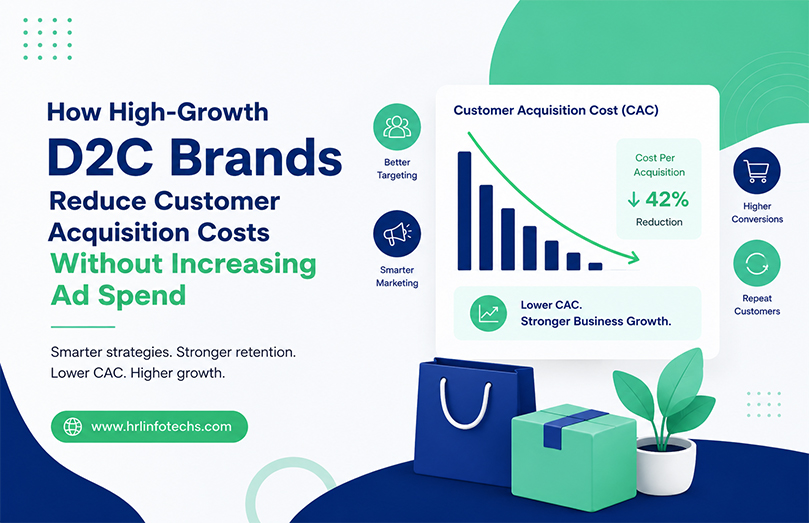
The founders running India’s fastest-growing direct-to-consumer brands are not the ones with the largest advertising budgets. Mamaearth did not build a ₹9,000 crore valuation by outspending competitors. boAt did not capture 30% of the Indian wearables market by buying its way to the top. What they built and what the D2C brands quietly outperforming their categories are building right now are systems that extract more value from every visitor, every rupee, and every customer relationship rather than simply purchasing more traffic.
D2C brand growth in India has reached an inflexion point. Meta CPCs have increased by over 40% in the last two years. Google Shopping costs in competitive categories like beauty, supplements, and electronics have followed. Brands that built their customer acquisition models around cheap paid traffic are discovering that the model no longer holds at scale. The ones growing profitably are asking a different question entirely.
Why Customer Acquisition Costs Keep Climbing
The economics are straightforward and uncomfortable. Here’s how it works. Each new D2C brand entering the market adds pressure on ad space. Instead of working together, they bid against one another online. Platforms like Meta, Google, and Amazon rely on auctions where bids go up when more players show interest. With steady inventory but growing competition, costs climb without warning.
Most Indian D2C companies in crowded markets now spend anywhere from ₹400 to ₹1,200 just to win one sale – prices shift based on what they sell. If their typical transaction earns less than ₹800, turning a profit right away isn’t realistic, unless customers come back often enough to boost long-term income.
The instinctive response to increase the budget typically produces diminishing returns. More spend at the same conversion rate and same AOV generates the same unit economics at higher absolute cost. Customer acquisition cost optimisation does not come from spending more. It comes from improving what happens to traffic after it arrives.
The Shift Towards Smarter D2C Growth
India’s most efficient D2C operators have stopped treating their paid channels as the primary growth lever and started treating their website as one.
The shift in thinking is simple but consequential. A brand spending ₹5 lakh per month on Meta ads with a 1.8% conversion rate generates roughly 450 customers, assuming ₹2,500 AOV and ₹1,100 CAC. The same ₹5 lakh spend with a 2.7% conversion rate generates 675 customers at ₹740 CAC. No additional spend. No new creative. No new audience. The difference is entirely in what happens after the click.
This is the foundation of sustainable D2C brand growth, improving the denominator rather than increasing the numerator.
Improving Conversions Before Increasing Ad Spend
eCommerce conversion rate optimisation is the highest-leverage activity available to most D2C brands because it improves the efficiency of every existing marketing channel simultaneously.
Sugar Cosmetics, one of India’s most efficiently scaled D2C beauty brands, invested heavily in product page optimisation and mobile checkout experience before scaling its paid budget. The result was a conversion rate well above the Indian beauty e-commerce average, which meant every rupee of paid spend generated more customers than competitors buying similar traffic.
One thing that really shifts results for Indian D2C brands? Faster page loading – studies from Google say even a single second of lag on mobile can cut conversions nearly one-fifth. Instead of long processes, shorter checkouts tend to work better, getting people from basket to done with fewer clicks. Pages that tackle doubts early, like hidden fees or sizing issues, often prevent drop-offs before they start. Then there are cues built right into the buying path: real customer feedback, clear returns info, secure payment badges – all shown just when someone might pause and rethink hitting buy.
Why Customer Retention Matters More Than Ever
D2C customer retention is where the unit economics of Indian direct-to-consumer brands either become sustainable or collapse. A customer who purchases once at ₹1,100 CAC and never returns is a loss. A customer who purchases four times over eighteen months at zero additional acquisition cost is the foundation of a profitable business.
The brands getting retention right are not doing anything complicated. MyGlamm built its retention model around community and content; customers who engage with the brand’s content convert at significantly higher rates on second and third purchases. Boat’s loyalty mechanics are embedded into the product experience itself: warranty registration, exclusive member pricing, and early access to new products create habitual re-engagement.
Buy patterns shape better emails and messages, not fixed dates. Repeat buys earn rewards faster, making loyalty feel real. Items used up over time? Subscriptions turn single purchases into steady income streams. Past choices guide future picks, replacing broad top-seller lists with smart suggestions tied directly to what someone already bought.
When retention improves, the pressure on eCommerce customer acquisition campaigns decreases. You need fewer new customers to hit the same revenue targets.
Building a Smarter Customer Acquisition Strategy
A customer acquisition strategy built entirely around paid channels is a cost centre. A strategy that integrates organic, referral, and content alongside paid channels is a growth engine.
Lowest customer costs among Indian D2C brands? Not always tied to slick Meta ads. Often it is when paid efforts boost already-moving organic traction instead of dragging growth alone. Content built for search pulls in ready buyers – no extra cost per visit. Happy users turn into promoters through smart referral setups. Influencers help more when deals include content reuse and slow-burn brand presence, not just single flashes of attention.
Audience segmentation within paid channels also matters significantly. Broad targeting at scale generates volume. Tightly defined lookalike audiences built from high-LTV customer cohorts the top 20% of customers by purchase frequency and AOV generate volume with better unit economics. The difference in CAC between these two approaches in the same brand account is frequently 30–40%.
The Role of Performance Marketing in Reducing CAC
Performance marketing for D2C brands in 2026 is not about running more ads. It is about running better-structured campaigns against better-defined audiences with better creative that lands on better-optimised pages.
Some brands beat their category in paid media by sticking to clear routines. Instead of guessing, they try new creatives through organised methods – each test built to reveal cause and effect. One step follows another, so results teach something real about performance. When people leave the journey early, these teams look closely – not at volume but at weak spots – and fix what matters most. Rather than boosting early-stage spending blindly, effort goes where it counts. Data isn’t averaged across all users; instead, groups are studied separately to see who truly drives returns.
Customer acquisition cost reduction through performance marketing optimisation is not a one-time project. It is a continuous operating discipline.
Combining Acquisition and Retention for Sustainable Growth
The D2C marketing strategies delivering the strongest results in India right now treat acquisition and retention as a single integrated system rather than separate functions with separate budgets and separate owners.
eCommerce marketing services that address only one side of this equation running ads without improving retention, or building retention programmes without fixing acquisition efficiency deliver partial results. The compounding effect happens when both sides improve simultaneously. Lower CAC means more customers at the same budget. Higher retention means each of those customers generates more revenue over time. The product of these two improvements is a business that grows faster while becoming more profitable, which is precisely the outcome that distinguishes India’s best D2C brands from everyone else competing in the same categories.
Conclusion
Customer acquisition cost reduction without increasing ad spend is not a theoretical possibility for Indian D2C brands. It is what the best operators in the market are demonstrating right now with measurable results.
The path is consistent across categories. Fix conversion before buying more traffic. Build retention before assuming you need more new customers. Improve performance marketing structure before increasing budgets. Integrate acquisition and retention into a single growth framework rather than managing them as separate silos.
At HRL Infotechs, we help Indian D2C brands build exactly this kind of integrated growth system, combining eCommerce conversion rate optimisation, performance marketing strategy, retention architecture, and data-driven customer acquisition strategy to improve profitability and scale efficiently. The brands growing most effectively right now are not outspending competitors. They are outsmarting them.