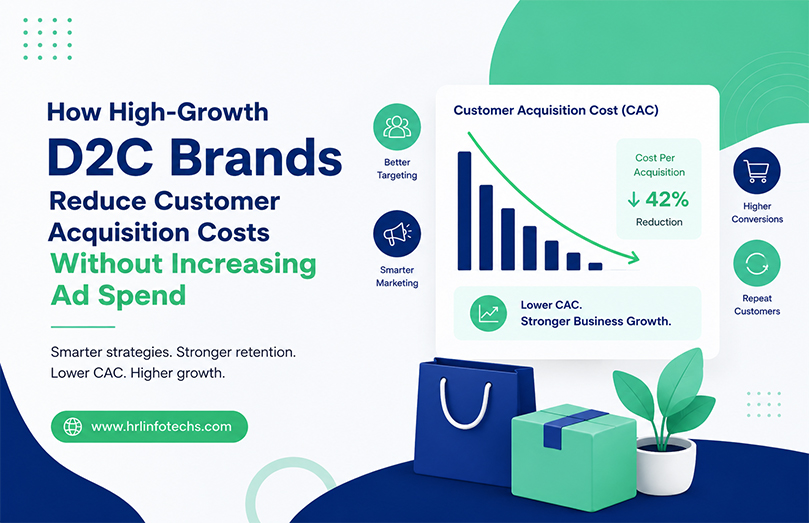
How High-Growth D2C Brands Reduce Customer Acquisition Costs Without Increasing Ad Spend


The founders running India’s fastest-growing direct-to-consumer brands are not the ones with the largest advertising budgets. Mamaearth did not build a ₹9,000 crore valuation by outspending competitors. boAt did not capture 30% of the Indian wearables market by buying its way to the top. What they built and what the D2C brands quietly outperforming their categories are building right now are systems that extract more value from every visitor, every rupee, and every customer relationship rather than simply purchasing more traffic.

D2C brand growth in India has reached an inflexion point. Meta CPCs have increased by over 40% in the last two years. Google Shopping costs in competitive categories like beauty, supplements, and electronics have followed. Brands that built their customer acquisition models around cheap paid traffic are discovering that the model no longer holds at scale. The ones growing profitably are asking a different question entirely.

Why Customer Acquisition Costs Keep Climbing

The economics are straightforward and uncomfortable. Here’s how it works. Each new D2C brand entering the market adds pressure on ad space. Instead of working together, they bid against one another online. Platforms like Meta, Google, and Amazon rely on auctions where bids go up when more players show interest. With steady inventory but growing competition, costs climb without warning.

Most Indian D2C companies in crowded markets now spend anywhere from ₹400 to ₹1,200 just to win one sale – prices shift based on what they sell. If their typical transaction earns less than ₹800, turning a profit right away isn’t realistic, unless customers come back often enough to boost long-term income.

The instinctive response to increase the budget typically produces diminishing returns. More spend at the same conversion rate and same AOV generates the same unit economics at higher absolute cost. Customer acquisition cost optimisation does not come from spending more. It comes from improving what happens to traffic after it arrives.

The Shift Towards Smarter D2C Growth

India’s most efficient D2C operators have stopped treating their paid channels as the primary growth lever and started treating their website as one.

The shift in thinking is simple but consequential. A brand spending ₹5 lakh per month on Meta ads with a 1.8% conversion rate generates roughly 450 customers, assuming ₹2,500 AOV and ₹1,100 CAC. The same ₹5 lakh spend with a 2.7% conversion rate generates 675 customers at ₹740 CAC. No additional spend. No new creative. No new audience. The difference is entirely in what happens after the click.

This is the foundation of sustainable D2C brand growth, improving the denominator rather than increasing the numerator.

Improving Conversions Before Increasing Ad Spend

eCommerce conversion rate optimisation is the highest-leverage activity available to most D2C brands because it improves the efficiency of every existing marketing channel simultaneously.

Sugar Cosmetics, one of India’s most efficiently scaled D2C beauty brands, invested heavily in product page optimisation and mobile checkout experience before scaling its paid budget. The result was a conversion rate well above the Indian beauty e-commerce average, which meant every rupee of paid spend generated more customers than competitors buying similar traffic.

One thing that really shifts results for Indian D2C brands? Faster page loading – studies from Google say even a single second of lag on mobile can cut conversions nearly one-fifth. Instead of long processes, shorter checkouts tend to work better, getting people from basket to done with fewer clicks. Pages that tackle doubts early, like hidden fees or sizing issues, often prevent drop-offs before they start. Then there are cues built right into the buying path: real customer feedback, clear returns info, secure payment badges – all shown just when someone might pause and rethink hitting buy.

Why Customer Retention Matters More Than Ever

D2C customer retention is where the unit economics of Indian direct-to-consumer brands either become sustainable or collapse. A customer who purchases once at ₹1,100 CAC and never returns is a loss. A customer who purchases four times over eighteen months at zero additional acquisition cost is the foundation of a profitable business.

The brands getting retention right are not doing anything complicated. MyGlamm built its retention model around community and content; customers who engage with the brand’s content convert at significantly higher rates on second and third purchases. Boat’s loyalty mechanics are embedded into the product experience itself: warranty registration, exclusive member pricing, and early access to new products create habitual re-engagement.

Buy patterns shape better emails and messages, not fixed dates. Repeat buys earn rewards faster, making loyalty feel real. Items used up over time? Subscriptions turn single purchases into steady income streams. Past choices guide future picks, replacing broad top-seller lists with smart suggestions tied directly to what someone already bought.

When retention improves, the pressure on eCommerce customer acquisition campaigns decreases. You need fewer new customers to hit the same revenue targets.

Building a Smarter Customer Acquisition Strategy

A customer acquisition strategy built entirely around paid channels is a cost centre. A strategy that integrates organic, referral, and content alongside paid channels is a growth engine.

Lowest customer costs among Indian D2C brands? Not always tied to slick Meta ads. Often it is when paid efforts boost already-moving organic traction instead of dragging growth alone. Content built for search pulls in ready buyers – no extra cost per visit. Happy users turn into promoters through smart referral setups. Influencers help more when deals include content reuse and slow-burn brand presence, not just single flashes of attention.

Audience segmentation within paid channels also matters significantly. Broad targeting at scale generates volume. Tightly defined lookalike audiences built from high-LTV customer cohorts the top 20% of customers by purchase frequency and AOV generate volume with better unit economics. The difference in CAC between these two approaches in the same brand account is frequently 30–40%.

The Role of Performance Marketing in Reducing CAC

Performance marketing for D2C brands in 2026 is not about running more ads. It is about running better-structured campaigns against better-defined audiences with better creative that lands on better-optimised pages.

Some brands beat their category in paid media by sticking to clear routines. Instead of guessing, they try new creatives through organised methods – each test built to reveal cause and effect. One step follows another, so results teach something real about performance. When people leave the journey early, these teams look closely – not at volume but at weak spots – and fix what matters most. Rather than boosting early-stage spending blindly, effort goes where it counts. Data isn’t averaged across all users; instead, groups are studied separately to see who truly drives returns.

Customer acquisition cost reduction through performance marketing optimisation is not a one-time project. It is a continuous operating discipline.

Combining Acquisition and Retention for Sustainable Growth

The D2C marketing strategies delivering the strongest results in India right now treat acquisition and retention as a single integrated system rather than separate functions with separate budgets and separate owners.

eCommerce marketing services that address only one side of this equation running ads without improving retention, or building retention programmes without fixing acquisition efficiency deliver partial results. The compounding effect happens when both sides improve simultaneously. Lower CAC means more customers at the same budget. Higher retention means each of those customers generates more revenue over time. The product of these two improvements is a business that grows faster while becoming more profitable, which is precisely the outcome that distinguishes India’s best D2C brands from everyone else competing in the same categories.

Conclusion

Customer acquisition cost reduction without increasing ad spend is not a theoretical possibility for Indian D2C brands. It is what the best operators in the market are demonstrating right now with measurable results.

The path is consistent across categories. Fix conversion before buying more traffic. Build retention before assuming you need more new customers. Improve performance marketing structure before increasing budgets. Integrate acquisition and retention into a single growth framework rather than managing them as separate silos.

At HRL Infotechs, we help Indian D2C brands build exactly this kind of integrated growth system, combining eCommerce conversion rate optimisation, performance marketing strategy, retention architecture, and data-driven customer acquisition strategy to improve profitability and scale efficiently. The brands growing most effectively right now are not outspending competitors. They are outsmarting them.

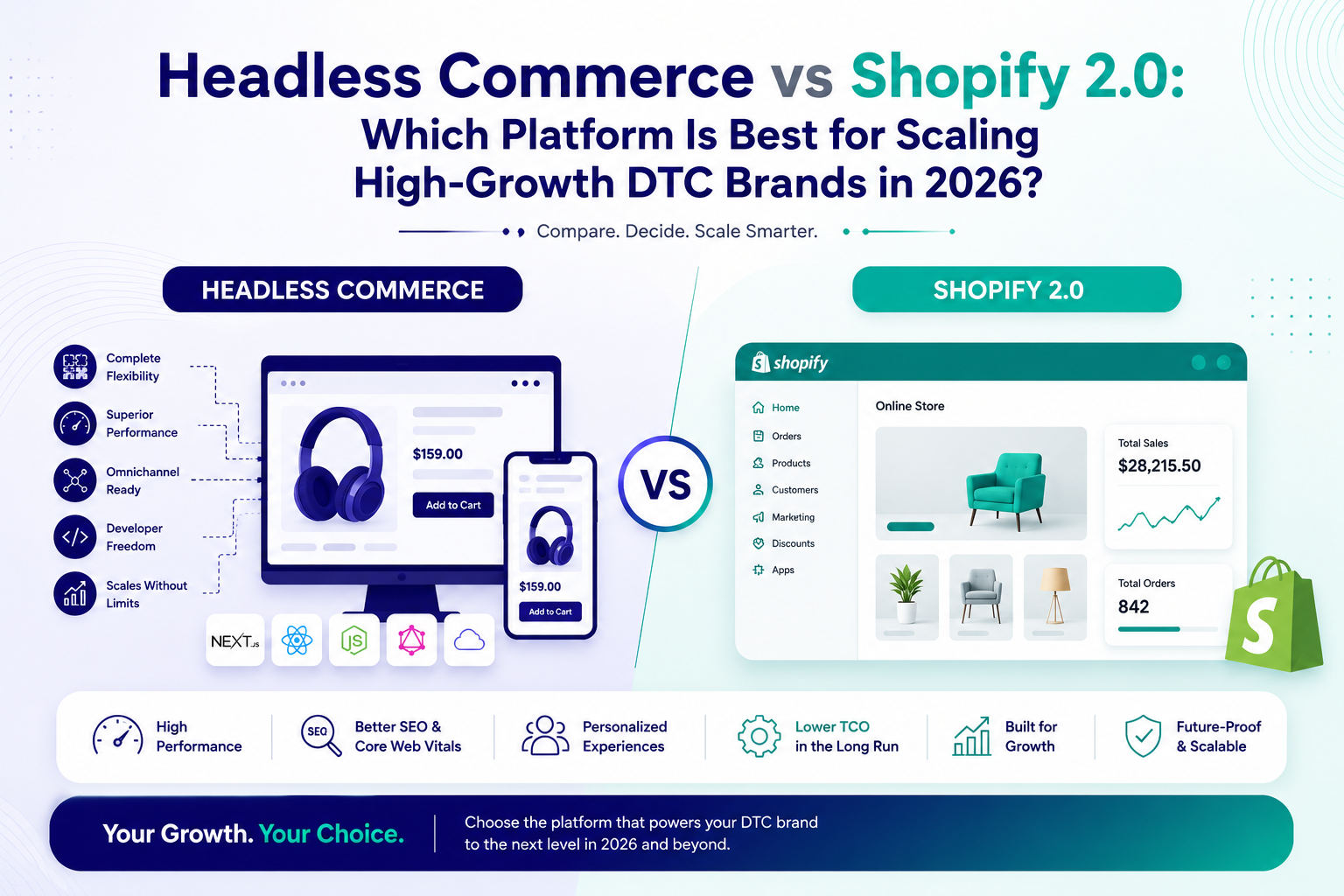
Headless Commerce vs Shopify 2.0: Which Platform Is Best for Scaling High-Growth DTC Brands in 2026?


Scaling a high-growth DTC brand in 2026 is not just about great products. It is about choosing the right ecommerce architecture that can handle traffic spikes, deliver fast experiences, and support advanced marketing. For many founders and CMOs, the big question is whether Shopify 2.0 is enough or if it is time to move to headless commerce.

This guide breaks down Shopify 2.0 vs headless commerce in practical terms, using real-world scenarios for growing brands. You will understand what headless commerce is, when to switch, and whether your Shopify store should go headless or stay on a well-optimized Shopify 2.0 stack.

Understanding Shopify 2.0 For Scaling DTC Brands

Shopify 2.0 is the upgraded version of Shopify’s online store framework, designed to give brands more flexibility, better performance, and improved customization. For many DTC brands in India and globally, Shopify 2.0 is often the first serious ecommerce platform for scaling brands beyond the early stage.

With Shopify 2.0, merchants get improved theme architecture, faster storefront rendering, and more control over sections and blocks. When combined with expert Shopify website development agency support, it can deliver fast ecommerce websites for conversions without needing a complex headless setup.

Key Features That Make Shopify 2.0 Attractive

Shopify 2.0 brings a more modular theme system, better metafields, and improved app integrations. These changes make it easier for marketers to launch landing pages, run campaigns, and test offers without relying heavily on developers for every small change.

For growing DTC brands, this means faster experimentation and better alignment between ecommerce marketing services and the storefront. Shopify performance optimization is also easier with built-in tools, CDN delivery, and a mature ecosystem of performance-focused apps.

When Shopify 2.0 Is Enough For Growing Brands

Many founders ask if Shopify 2.0 is enough for growing brands that are scaling aggressively. In most cases, Shopify 2.0 can comfortably support brands up to mid-market level, especially when the store is well optimized and uses high-quality themes and apps.

If your current challenges are related to basic speed issues, checkout friction, or limited merchandising, improving Shopify performance optimization, cleaning up apps, and working with a specialist agency often solves the problem without needing to go headless.

What Is Headless Commerce In Simple Terms

To decide between Shopify 2.0 vs headless commerce, you need a clear view of what headless actually means. Headless commerce separates the frontend experience from the backend platform, so your storefront is built using modern frameworks while Shopify or another engine manages products, orders, and payments.

In this model, the frontend communicates with the backend via APIs. This gives brands more control over design, performance, and omnichannel experiences. Headless ecommerce for high traffic stores is popular because it can deliver extremely fast, custom experiences tailored to specific audiences and markets.

Headless Commerce Advantages And Disadvantages

Headless commerce advantages and disadvantages must be weighed carefully before making a decision. On the positive side, headless allows pixel-perfect design, lightning-fast page loads, and deep personalization. It is ideal for enterprise ecommerce brands that need unique experiences across web, mobile, apps, and other channels.

However, the disadvantages include higher development costs, more complex maintenance, and greater dependency on engineering teams. For many DTC brands, the question is not just is headless commerce worth it, but whether the team has the capacity to manage a more technical stack over the long term.

Headless Commerce For Enterprise Ecommerce And High Traffic

Headless commerce for enterprise ecommerce shines when brands operate across multiple regions, languages, or storefronts. It allows centralized logic with localized experiences, which is difficult to achieve with a single traditional theme-based store. This is especially relevant for brands planning global expansion.

Headless ecommerce for high traffic stores also helps when performance requirements are extreme, such as flash sales, influencer drops, or large-scale campaigns. In these situations, a decoupled frontend can be tuned for speed and resilience, while the backend handles order processing reliably.

Shopify 2.0 Vs Headless Commerce: How To Decide

Choosing between Shopify 2.0 vs headless commerce should start with your business goals, not just technology trends. The dominant search intent around this topic is informational with a commercial angle, which means leaders want clarity before committing budgets to a new architecture.

Instead of asking only should my Shopify store go headless, it is better to map your current pain points, growth targets, and team capabilities. Then you can match those needs to what Shopify 2.0 or a headless setup can realistically deliver in the next 12 to 24 months.

When To Switch To Headless Commerce

There are clear signals that indicate when to switch to headless commerce. If your brand has hit the limits of Shopify 2.0 themes, needs highly custom user journeys, or is planning a multi-country rollout with complex content, headless may be a strong option.

You should also consider headless if your marketing team needs advanced experimentation that standard Shopify templates cannot support. In these cases, a modern frontend with API-driven content and product data can unlock new growth opportunities and higher conversion rates.

When To Double Down On Shopify 2.0 Instead

On the other hand, if your main issues are slow load times, cluttered apps, or poor UX, Shopify 2.0 is often still the right foundation. A focused Shopify performance optimization project can dramatically improve speed and conversions without a full rebuild.

For many Indian DTC brands, investing in a strong Shopify website development agency, better CRO, and integrated ecommerce marketing services delivers a higher ROI than moving to headless too early. This approach keeps your stack simpler while still supporting aggressive growth.

Practical Evaluation Checklist For DTC Founders

To make a confident decision, it helps to use a structured checklist. This reduces bias and keeps the conversation grounded in numbers, not hype. You can review this list with your internal team and external partners to align on the right path forward.

Consider the following factors before choosing Shopify 2.0 or headless commerce for your next phase of growth. Revisiting this checklist every 6 to 12 months also helps you decide if your current architecture is still serving your goals.

Key Questions To Ask Before Going Headless

Use these questions to clarify whether headless commerce is worth it for your specific situation and stage of growth. Honest answers will prevent overbuilding or underinvesting in your ecommerce platform.

  • Is my current Shopify 2.0 store truly maxed out, or can optimization still deliver gains
  • Do I have or plan to build an in-house or retained engineering team to manage a headless stack
  • Are my performance issues due to architecture or poor implementation and heavy apps
  • Do I need unique experiences across multiple regions, brands, or channels
  • Will a headless build directly support revenue, AOV, or LTV growth in the next 12 months

Which Path Is Best For Scaling In 2026

Looking ahead to 2026, the best ecommerce platform for scaling brands will be the one that balances flexibility, speed, and operational simplicity. For many DTC brands, a well-optimized Shopify 2.0 store, supported by strong partners, will remain a powerful and cost-effective choice.

Headless commerce will continue to grow among larger and more complex brands that need advanced personalization, global rollouts, or highly custom experiences. The key is to avoid rushing into headless just because it is a trend and instead align your technology roadmap with clear business outcomes.

Conclusion: Making A Confident Platform Decision

Deciding between Shopify 2.0 and headless commerce is ultimately a strategic choice, not just a technical one. If your brand is still unlocking growth through better UX, faster pages, and smarter campaigns, doubling down on Shopify 2.0 with expert support is often the smartest move.

When your brand reaches a stage where standard templates and apps limit innovation, exploring headless commerce for enterprise ecommerce can be the next logical step. Partnering with HRL Infotechs can help you evaluate both paths objectively, design a scalable architecture, and build a store that is ready for the demands of high-growth DTC in 2026.

Importance of Ecommerce Marketing Services For Your Business


In today’s digital age, more and more businesses are turning to e-commerce to reach new customers and increase sales. With the rise of online shopping, it’s become essential for companies to have a robust online presence to stay competitive. However, simply setting up an e-commerce website is not enough. Businesses must have a well-planned and effective e-commerce marketing service strategy to succeed. That’s where e-commerce marketing services come in. We will learn about the advantages of using the e-commerce marketing services, and the steps to hire the best ecommerce marketing agency in this article.

How Do Online Shops Benefit From Ecommerce Marketing Services?

Using thorough digital marketing tactics, an e-commerce marketing company assists e-commerce enterprises in expanding their online presence. 

  • Bespoke marketing campaigns.
  • Good content.
  • Automation.

In addition to a multi-channel strategy to increase revenue and leads. Moreover, they pull in: 

  • Unique viewpoints
  • Innovative concepts
  • Practical proficiency with a broad range of solutions that an eCommerce company requires.

Hiring an Ecommerce Marketing Agency Helps Your Business

E-commerce marketing services are designed to help businesses market their products and services online through various channels, such as social media, email marketing, and search engine optimization. By effectively leveraging these channels, businesses can reach new audiences, build brand awareness, and drive more sales. But e-commerce marketing is not a one-size-fits-all solution. Every business is unique and therefore requires a tailored marketing approach considering its specific needs, goals, and target audience. That’s why hiring an e-commerce marketing agency often offers a range of customizable packages that can be tailored to fit the needs of individual businesses. 

Employing the proper ecommerce marketing services will enable you to outperform the competitors in the face of the thousands of eCommerce businesses operating on the web.

When you hire an e-commerce expert you get reliable solutions on:   

  • Saving you time & expense
  • Assist you in finding chances
  • It enables you to adjust and adapt to current commercial patterns

Hiring an e-commerce marketing agency that is soundest has numerous more advantages in addition to these.

How do I Choose the Top Ecommerce Firm?

So that you understand the wonders an e-commerce marketing service may perform for you. The method to pick the best one for yourself is outlined below in sequence.

Step 1: Determine your needs

Step 2: Research their offerings.

Step 3: Recognize the expertise of the eCommerce company.

Step 4: Examine the eCommerce company’s history.

Step 5: Collaboration and openness

Step 6: Ask about the equipment and methods used

Step 7: Verify that the prices are reasonable.

Step 8: Take the eCommerce firm’s size into account

Importance of Hiring Ecommerce Marketing Services

1. Brand-New Perspectives

You are pretty likely to run into repetitive concepts with internal staff. However, a private eCommerce advertising agency may provide you with new viewpoints.

E-commerce merchants occasionally become so engrossed in the goods that they fail to consider the buyer’s viewpoint. However, the ideal eCommerce marketing agency partnership can go above the advantages of your item and comprehend whatever is required to make it popular with your target audience. A diverse viewpoint can bring forth novel marketing materials and tactics that might have gone unnoticed. 

Working with a marketing firm with experience working with customers in a similar sector allows you to take advantage of their knowledge and market-standard methods to keep your business on the leading trend.

2. Accessibility to Cutting-Edge Services and Equipment

The top eCommerce marketing agency uses the newest recent solutions and techniques to assist its customers in stepping up their advertising initiatives.

Most organizations find engaging in their internal team’s development and equipment implementation difficult. Furthermore, it is impossible to estimate the achievement of such a technique.

Below are some benefits of working with such a filled eCommerce marketing firm:

  • Real Time Experience: Direct knowledge of recently released offerings on the marketplace. They are aware of what succeeds and what fails in practice.
  • Tailored Approaches: They can provide suggestions to match your company’s needs. It reduces time spent and increases marketing performance.
  • Improved Techniques: Ads on Google, Facebook, and Instagram may be made extremely specialized using automated processes, SEO optimization techniques, and content analysis technologies.

3. Reduce Explicit Operating Expenses

An internal branding system’s running costs can initially be persuasive. However, it can be unexpected in the lengthy period because engaging eCommerce agencies only charge a small portion of your initial operating expenses.

  • No Waste: Because it eliminates pointless attempts and capital wasting, an eCommerce agency may serve as your sole shop for every demand throughout the life of your firm.
  • 0% Increased Expenditure: The ongoing costs involved in tool licenses, medical services, salary, recruiting, and taxes are eliminated when you hire the best eCommerce marketing firm.
  • Specific Assets: Similar to hiring an attorney to handle all tax preparation and reporting, this will free up your time to focus on other aspects of the business.
Hire the best ecommerce marketing services

4. Reputation Management

With e-commerce marketing services, you can manage your online reputation and respond to negative reviews or feedback. It can help you build customer trust and protect your brand image.

5. Analytics and Reporting

E-commerce marketing services can provide you with detailed analytics and reporting, allowing you to track the success of your campaigns and make data-driven decisions. It can help you identify areas of improvement and optimize your e-commerce strategy over time.

6. Conversion Rate Optimization

 E-commerce marketing services can help you optimize your website to increase conversions and maximize your return on investment. It includes improving website design and layout to create compelling product descriptions and calls to action.

7. Improve User Experience

 By improving the user experience on your website, e-commerce marketing services can help increase the number of visitors who become paying customers. It includes optimizing website speed and performance to provide user-friendly navigation and checkout features. 

8. Targeted Advertising

With targeted advertising, you can reach the right audience and increase the chances of converting visitors into customers. E-commerce marketing services can help you run effective advertising campaigns across multiple channels, including social media, search engines, and email.

Summing Up


In today’s digital age, e-commerce marketing services have become a game-changer for businesses of all sizes. By utilizing these services, businesses can increase their online presence and boost sales and revenue. The best Amazon account management agency HRL Infotechs can help you in this shifting market as competition continues to grow. Businesses must adapt to the ever-changing market and take advantage of the benefits of e-commerce marketing services. Don’t get left behind in the race. Invest in our e-commerce marketing services and take your business to new crowns!