

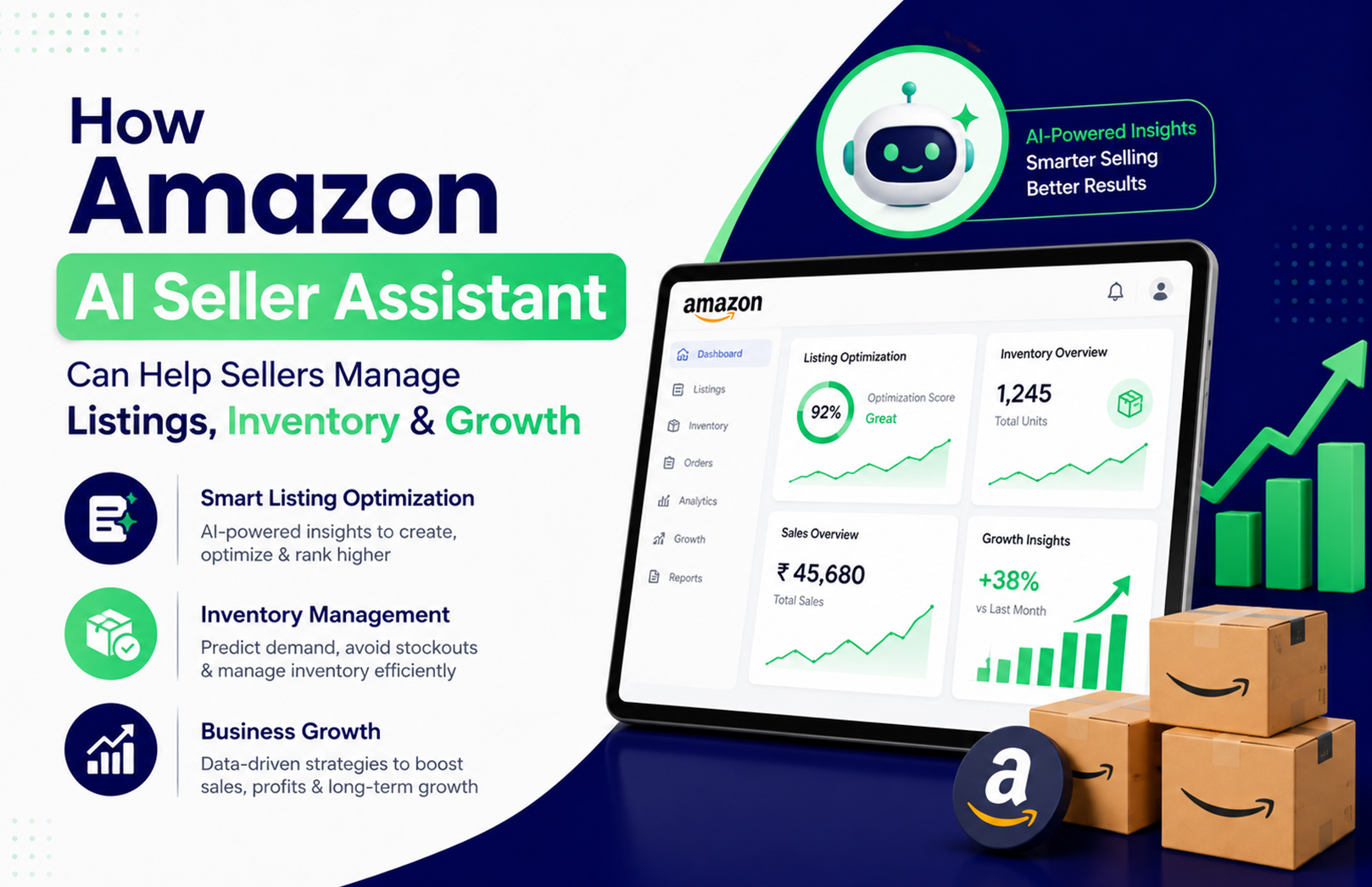
Amazon selling in India is becoming increasingly data-driven. Managing product listings, inventory, orders, pricing, advertising and account health manually can quickly become overwhelming, particularly as a seller’s catalogue grows.
Amazon is responding to this complexity with Seller Assistant, an AI-powered, conversational tool designed to help sellers launch, manage and grow their businesses. Amazon says the assistant can provide business insights across areas such as sales performance, inventory management, listings and catalogues, shipments and returns, orders and fees, while also helping sellers take certain actions with their approval.
For Indian sellers, this creates an important opportunity: AI can reduce the time spent analysing Seller Central data and help identify problems and opportunities faster. However, AI should complement not completely replace structured amazon seller account management and marketplace expertise.
What Is Amazon Seller Assistant?
Amazon Seller Assistant is an AI-powered assistant available within the Amazon selling ecosystem. Sellers can interact with it using natural-language questions instead of manually searching through multiple Seller Central reports and menus.
Amazon describes it as an always-on, generative AI and agentic system that can understand seller needs, surface relevant insights and, where supported, take actions with seller approval. Its capabilities cover areas including listings, inventory, sales performance, orders, fees, shipments and returns.
For Indian sellers, Amazon has also introduced Seller Assistant with support for English and Hinglish, making it more accessible to sellers who prefer conversational guidance over complicated dashboards. Amazon says the tool is available at no cost to sellers in India.
How AI Can Improve Amazon Listing Management
Product listings are one of the most important parts of an Amazon business. A seller can have a strong product and competitive price, but poor titles, bullet points, images or product information can still reduce visibility and conversions.
Seller Assistant can help sellers understand listing and catalogue-related issues and obtain guidance about their products. This makes AI particularly useful for sellers managing large catalogues where manually reviewing every ASIN is time-consuming.
However, AI recommendations should be reviewed against keyword strategy, customer intent, competitor positioning and Amazon’s listing requirements. This is where professional amazon listing management services can add significant value.
An experienced team can combine AI-assisted analysis with keyword research, backend keyword optimisation, content improvements and ongoing listing monitoring. HRL Infotechs’ Amazon SEO & Listing Optimization service, for example, focuses on improving listing visibility through listing optimisation, keyword research and backend keyword additions.
Using AI for Better Inventory Management
Inventory problems can quickly turn into lost sales.
Too little stock can create out-of-stock situations, while excessive inventory can tie up working capital and increase storage-related costs. Amazon’s Seller Assistant provides sellers with insights related to inventory management and can help identify actions associated with inventory and business performance.
Indian sellers can use these insights to ask practical questions such as:
- Which products need immediate replenishment?
- Which SKUs are selling slower than expected?
- Where could inventory costs become a concern?
- Which products require closer monitoring before major sales events?
- How should inventory decisions align with expected demand?
AI can make the analysis faster, but sellers still need accurate sales history, lead times, supplier information and business context before making purchasing decisions.
Turning Seller Central Data Into Growth Insights
One of the biggest advantages of AI tools for Amazon sellers is the ability to turn large amounts of marketplace data into easier-to-understand insights.
Instead of checking multiple reports individually, sellers can use conversational questions to explore areas such as sales performance, orders, fees, inventory and catalogue performance. Amazon specifically highlights these business-insight capabilities within Seller Assistant.
For example, a seller could investigate why a product’s sales have declined, identify inventory-related concerns or understand which areas require attention.
But growth does not come from data alone. Sellers need to connect those insights with pricing, advertising, content, customer behaviour and profitability.
This is where amazon account management services become valuable. A professional account management team can continuously monitor performance, identify opportunities and coordinate different parts of the Amazon strategy instead of treating each metric separately.
Can AI Replace Amazon Seller Account Management?
Not completely.
AI can significantly reduce repetitive analysis and help sellers access information faster, but successful marketplace growth still requires strategic decision-making.
Professional amazon seller management services can cover areas such as account health monitoring, case management, FBA reimbursement, catalogue management and ongoing marketplace optimisation. HRL Infotechs’ Amazon Account Management service includes account health monitoring, case log management and FBA reimbursement support.
Think of AI as an additional layer of intelligence rather than a replacement for experienced Amazon professionals.
AI can identify a potential issue. A human expert can determine why it happened, assess its commercial impact and decide what should happen next.
Combining AI With Amazon Marketing Services
AI-assisted account management becomes even more powerful when combined with a structured advertising strategy.
A listing with strong organic visibility can still underperform if advertising campaigns are poorly structured. Similarly, increasing ad spend will not necessarily solve a conversion problem caused by weak product content.
Professional amazon marketing services can connect listing optimisation, keyword targeting, PPC management, competitor analysis and conversion improvements into one growth strategy.
An amazon marketing agency can also use Seller Central insights alongside advertising data to determine where budget should be increased, reduced or reallocated.
HRL Infotechs provides Amazon Advertising Services designed around campaign performance, conversions, traffic and ROI.
The Best Approach for Indian Amazon Sellers
For sellers in India, the strongest approach is not simply choosing between AI and human expertise. It is combining both.
A practical Amazon growth system can look like this:
AI insights → human analysis → strategic action → performance monitoring → continuous optimisation
Seller Assistant can help surface information and opportunities. A professional team can then validate those insights against business objectives, margins, competition and marketplace strategy.
This approach is particularly useful for established sellers managing multiple SKUs, advertising campaigns and fulfilment requirements.
Why Sellers Should Start Using AI Now
The Amazon marketplace is becoming increasingly dependent on automation, data and AI-driven experiences. Amazon is already expanding Seller Assistant’s capabilities beyond simple question answering into business insights and approved actions.
For Indian sellers, learning how to work alongside these tools can create an operational advantage.
The objective should not be to automate every decision. Instead, sellers should automate repetitive analysis while keeping important commercial decisions under expert control.
This can help teams spend less time navigating Seller Central and more time improving products, customer experience, profitability and growth.
Final Thoughts
Amazon AI Seller Assistant represents an important development for sellers who want faster access to marketplace insights. From listings and inventory to sales performance and account operations, AI can help simplify many parts of the selling process.
However, AI alone is not an Amazon growth strategy. Sellers still need strong listings, effective advertising, inventory planning, account health management and ongoing optimisation.
The most effective model is therefore a combination of AI tools for Amazon sellers and professional amazon seller account management. AI provides speed and insights, while experienced marketplace specialists provide strategy, context and execution.
If your Amazon business is growing and managing Seller Central is becoming difficult to handle internally, professional support can help you build a more structured and scalable marketplace operation.
Frequently Asked Questions
Q1. What is Amazon Seller Assistant?
Ans. Amazon Seller Assistant is an AI-powered conversational tool that helps Amazon sellers access information, receive business insights and manage aspects of their selling operations. Amazon says it covers areas including sales, inventory, listings, orders, fees, shipments and returns.
Q2. Is Amazon Seller Assistant available to Indian sellers?
Ans. Yes. Amazon India announced Seller Assistant for Indian sellers, with support for English and Hinglish. Amazon describes it as a free AI tool available to sellers in India.
Q3. Can Seller Assistant manage Amazon listings?
Ans. Seller Assistant can provide insights and guidance related to listings and catalogues. Sellers should still review AI-generated recommendations for accuracy, compliance, keyword relevance and brand positioning before implementing important changes.
Q4. Can AI replace Amazon account managers?
Ans. AI can automate and simplify many analytical and repetitive tasks, but it does not eliminate the need for strategic account management. Human expertise remains important for advertising, catalogue strategy, account health, profitability and complex marketplace decisions.
Q5. What are the best AI tools for Amazon sellers?
Ans. Amazon Seller Assistant is one of the key AI tools available within the Amazon seller ecosystem. Sellers can also use specialised AI and analytics solutions for keyword research, listing optimisation, advertising analysis and forecasting, depending on their requirements.
Q6. When should an Amazon seller consider professional account management?
Ans. Professional support becomes particularly valuable when a seller is managing a growing catalogue, increasing advertising spend, experiencing account-health issues, struggling with inventory or lacking the internal resources to monitor Seller Central consistently.