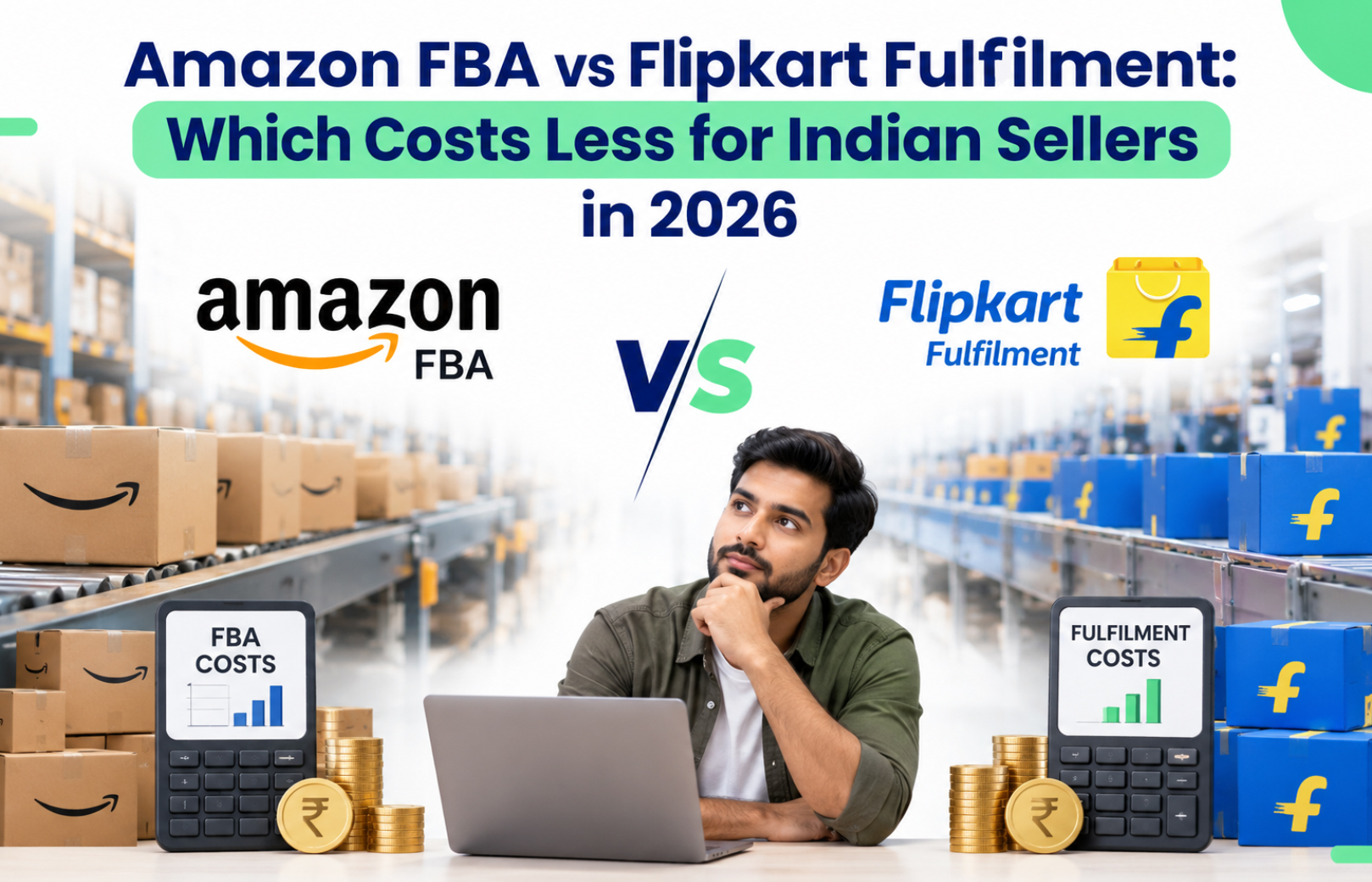
Amazon FBA vs Flipkart Fulfilment: Which Costs Less for Indian Sellers in 2026?


A seller selling a ₹999 kitchen product can look profitable on both Amazon and Flipkart until the first settlement arrives. Referral or commission fees are only one part of the calculation. Fulfilment, closing or fixed fees, shipping, storage, GST, returns and advertising can change the actual contribution per order.

So, which costs less in 2026? There isn’t one platform that is cheaper for every Indian seller. Amazon FBA can make sense for fast-moving, compact products where delivery speed and operational convenience matter. Flipkart Fulfilment (FBF) can be attractive where its fee structure and category economics leave more room after fulfilment. The only reliable answer comes from comparing the same SKU, selling price, weight, dimensions and expected return rate on both platforms.

What should you compare before choosing FBA or FBF?

Start with net fulfilment cost per delivered order, not the headline marketplace fee. Your comparison should include marketplace commission or referral fee, fulfilment or shipping charges, fixed or closing fees, storage, GST on applicable fees, returns and advertising.

Amazon’s current seller pricing separates referral fees, closing fees, weight-handling fees and other applicable charges. Amazon also states that its FBA fulfilment fee depends on product weight, dimensions and shipping distance.

Flipkart’s seller rate card similarly separates commission and fixed fees, while FBF handles storage, packing, shipping and delivery through the fulfilment network. Flipkart says its published standard rate card can change and sellers should check Seller Hub for the applicable rates to their account.

For a deeper look at how fulfilment choices affect the wider Amazon cost structure, HRL Infotechs also covers the practical differences between FBA, FBM and 3PL in its guide to Amazon fulfilment options in 2026.

How does Amazon FBA cost work in India in 2026?

Amazon FBA means Amazon stores your inventory, picks and packs orders, ships them and handles customer service and returns. The cost therefore includes more than the basic FBA handling charge.

Amazon’s current FBA information lists a standard-size pick-and-pack fee of ₹11 per unit and storage at ₹33 per cubic foot per month, alongside weight-handling charges that vary by shipment distance and weight. Amazon applies 18% GST to the applicable fee calculation.

The weight-handling component matters more than many new sellers expect. A compact 300-gram product and a bulky product with the same selling price can have very different economics because shipping and storage are affected by physical dimensions and weight.

Amazon’s fee structure also changed during 2026. From September 7, 2026, Amazon says closing fees increased by ₹1 for products priced up to ₹500 and by ₹3 for products above ₹500 across Fulfilment Centre, Easy Ship and Seller Flex channels.

That makes an old Amazon FBA fee calculator result unreliable if you simply copy figures from an older blog post or spreadsheet. Check the live Amazon rate card before finalising your selling price.

For sellers already dealing with reconciliation, reimbursements and account-level operational work, Amazon account management services can fit naturally into this stage because fulfilment costs need to be reviewed alongside inventory, returns and account performance.

What are Flipkart fulfilment fees and FBF costs?

Fulfilment by Flipkart, or FBF, is Flipkart’s platform-managed fulfilment option. Flipkart states that FBF covers storage, packing and shipping, with Flipkart handling customer returns and customer service as part of the fulfilment process.

Flipkart’s published standard rate card currently shows fixed fees for FBF of ₹14 for orders priced up to ₹500, ₹30 for ₹501–₹1,000 and ₹50 above ₹1,000. The corresponding published NFBF fixed fees are ₹16, ₹30 and ₹55. These are only one part of the seller’s total cost, not the complete FBF cost.

This distinction is easy to miss. A lower fixed fee does not automatically mean a lower fulfilment cost. Commission, shipping, returns, storage and applicable taxes still need to be included before comparing FBF with FBA.

Flipkart also describes FBF as providing warehouse storage, packaging, faster delivery and a FAssured badge, subject to the platform’s conditions.

Amazon FBA vs Flipkart FBF: which one costs less?

For a like-for-like SKU, neither FBA nor FBF is universally cheaper. The result changes with category, selling price, package size, weight, order destination, inventory turnover and return behaviour.

A useful comparison should look like this:

  1. Start with the actual selling price, not MRP.
  2. Subtract marketplace commission or referral fee.
  3. Add fulfilment, shipping and fixed or closing charges.
  4. Add storage cost based on realistic inventory days.
  5. Estimate returns and reverse-logistics impact.
  6. Add advertising cost per order.
  7. Apply applicable GST and other deductions.
  8. Compare the final contribution per delivered order.

This is where many seller comparisons go wrong. They compare Amazon’s FBA charge with Flipkart’s fixed fee and stop there.

The better question is: “After every predictable marketplace cost, how much money remains from one delivered order?”

Which products usually need a different fulfilment calculation?

Small, lightweight and fast-moving products are often easier to model under FBA because storage consumption stays relatively controlled while fulfilment handles the operational workload. High-volume SKUs can also make platform fulfilment more attractive because you aren’t manually processing every order.

Large, slow-moving or low-margin products require more caution. Storage can become meaningful when stock sits for months, and a low selling price leaves less room to absorb fulfilment and return costs.

One practical judgement call from marketplace work is to avoid moving the entire catalogue into FBA or FBF at once. Test the economics on your top-selling SKUs first. A product that sells 500 units a month deserves a different fulfilment decision from one that sells 20 units.

Another common mistake is calculating storage using average monthly sales but ignoring the inventory sitting between replenishment cycles. Your real working-capital requirement can be considerably higher than the simple “units sold × unit cost” calculation suggests.

HRL Infotechs’ Amazon seller profit calculation guide for India also recommends accounting for selling fees, COGS, GST, advertising, returns, storage and operational expenses rather than judging profitability from revenue alone.

Does FBF make more sense than FBA for low-priced products?

Low-priced products need especially tight fulfilment economics because a ₹10–₹20 difference in cost can represent a large percentage of the selling price.

Amazon introduced major fee changes in 2026, including expanded zero-referral-fee coverage for eligible products priced up to ₹1,000 across many categories. Amazon also reduced certain Easy Ship fees for products under ₹300. These benefits don’t mean every low-priced product will be cheaper through FBA because the applicable fulfilment and other charges still depend on the product and fulfilment channel.

Flipkart’s current rate card also shows fixed-fee differences by selling-price band, but commission and fulfilment-related charges still need to be calculated for the individual SKU.

For a ₹299 product, therefore, don’t ask which platform has the lower percentage. Ask how many rupees remain after every deduction.

How do advertising costs change the fulfilment comparison?

Fulfilment cost cannot be viewed separately from sales generation. A platform may leave you with a slightly higher contribution per order but require more paid traffic to generate those orders.

Amazon and Flipkart both provide advertising options, but campaign economics depend heavily on category, competition, conversion rate and listing quality. HRL Infotechs provides Flipkart advertising services covering campaign management, bid adjustments and performance reporting, which becomes relevant when fulfilment savings are being evaluated alongside paid acquisition.

The same principle applies on Amazon. If a cheaper fulfilment setup produces weaker conversion because your delivery proposition or listing is less competitive, the apparent saving may disappear in the advertising account.

That is why experienced sellers measure contribution after advertising, not just marketplace fees.

That is why experienced sellers measure contribution after advertising, not just marketplace fees.

What should Indian sellers do before switching fulfilment?

Take one representative SKU and build two complete cost calculations. Use the same selling price, product cost, packed weight, dimensions, monthly units, average inventory and estimated return rate.

Then check the current Amazon and Flipkart seller dashboards for the exact charges applicable to that product. Public rate cards are useful for planning, but account-specific charges and program eligibility can differ.

Next, run the calculation again for your top five SKUs. If the same platform wins across most of them, you have a stronger operational case. If the results are mixed, don’t force a single fulfilment model across the catalogue.

For Amazon sellers, also check reimbursement, storage and inventory-age issues separately. For Flipkart sellers, monitor the actual settlement deductions rather than relying only on the published standard rate card.

If listing quality is affecting conversion, fulfilment isn’t the only lever. HRL Infotechs’ Amazon SEO and listing optimisation services and Flipkart SEO and listing optimisation services are relevant when the next problem is not fulfilment cost but getting profitable traffic to the product.

A practical 2026 action plan for sellers

Step 1: Pick your five highest-volume SKUs.

Step 2: Record selling price, packed weight, dimensions, monthly sales and average inventory.

Step 3: Pull the current Amazon and Flipkart fee information from the respective seller dashboards.

Step 4: Calculate contribution per delivered order after fulfilment, marketplace fees, returns and advertising.

Step 5: Test the winning fulfilment model on selected SKUs before moving the whole catalogue.

Step 6: Review the numbers monthly because fee cards, promotions, shipping costs and product mix can change.

The goal isn’t to find the platform with the cheapest headline fee. It’s to find the fulfilment setup that leaves enough contribution after the complete cost of getting one order delivered and retained by the customer.

If your calculations show that fulfilment isn’t the only margin problem, HRL Infotechs can review the wider marketplace setup across Amazon and Flipkart. The company’s approach combines marketplace marketing, account management, listing optimisation and performance analysis rather than treating fulfilment as an isolated expense.

FAQs

Is Amazon FBA cheaper than Flipkart FBF in India?

Not consistently. Amazon FBA and Flipkart FBF use different fee structures, and the final cost depends on category, selling price, weight, dimensions, storage, shipping distance, returns and other deductions. Compare the complete per-order contribution for the same SKU rather than comparing one fulfilment fee.

How can I calculate Amazon FBA fees accurately in 2026?

Use Amazon India’s current fee and profitability tools or Seller Central rate information, then enter the actual product category, selling price, dimensions and weight. Include referral, closing, fulfilment, storage and applicable taxes. Amazon’s published FBA charges are subject to updates, so older calculators may produce outdated results.

What are Flipkart fulfilment fees?

Flipkart fulfilment fees are charges associated with using Fulfilment by Flipkart, where Flipkart manages storage, packing and shipping. The complete seller cost can also include commission, fixed fees, applicable shipping or service charges and taxes. Flipkart advises sellers to check their Seller Hub because standard published rates can change.

Is FBF better for low-priced products?

It can be worth evaluating for low-priced products, but there is no universal threshold at which FBF becomes cheaper. At lower selling prices, even small fixed or fulfilment charges can materially affect margin. Calculate the final rupee contribution after all marketplace deductions and returns before choosing the fulfilment method.

Should I use FBA or FBF for slow-moving inventory?

Slow-moving inventory needs extra caution under any marketplace fulfilment programme because storage ties up cash and can reduce margin over time. Start with faster-moving SKUs and monitor inventory ageing. For slow sellers, compare platform storage costs against your own warehouse or a suitable third-party logistics option.

Can marketplace advertising change which platform is more profitable?

Yes. A fulfilment model with a lower logistics cost can still produce a weaker business result if the product requires substantially more advertising to generate each order. Compare contribution after advertising, not only fulfilment fees. Conversion rate, organic visibility, competition and category demand all influence the final economics.

Amazon AI Prompts Went Live: How to Optimize Listings for Amazon’s New Contextual Ad Feature


Amazon has moved advertising closer to the actual shopping conversation. Sponsored Products Prompts and Sponsored Brands Prompts use AI to surface relevant product information around shopper questions and decision points. Amazon says the feature became generally available in the U.S. on March 25, 2026, and prompts can appear in shopping results and product detail pages. For Indian sellers, the key takeaway is simple: start improving the information Amazon’s AI can understand, but don’t assume every U.S. advertising feature is already available on Amazon.in.

If you’ve been treating your Amazon listing as a collection of keywords, this update is a good reason to change that approach. A shopper may ask whether a water purifier suits a family of four, whether a laptop is suitable for students, or whether a skincare product works for oily skin. Your listing needs to answer those questions clearly through titles, bullets, attributes, product information, reviews and supporting content. Amazon says its prompts use signals from product detail pages, Brand Stores and campaign data.

What Are Amazon AI Prompts and Why Do They Matter?

Amazon AI Prompts are AI-powered advertising enhancements that can present relevant product information during shopping interactions. They are designed to help shoppers move from a question or comparison to a more informed purchase decision.

This is different from a traditional keyword-triggered ad. Amazon determines which prompts and products are relevant using its own signals, while existing Sponsored Products and Sponsored Brands campaigns can become eligible automatically. Amazon also provides prompt-level reporting in the Ads Console and through its reporting system.

For sellers, this makes listing quality more closely connected with advertising quality. Your campaign can generate visibility, but the product information still needs to explain why the item fits the shopper’s requirement.

This is where Amazon Rufus ads become relevant. Amazon’s conversational shopping experience has evolved into Alexa for Shopping, but the underlying shift remains the same: shoppers can use natural questions rather than relying only on short search terms. Amazon’s current guidance describes prompts as conversational advertising that can help customers discover relevant product information.

How Should You Optimize Listings for Amazon AI Shopping?

To optimize listings for Amazon AI shopping, make your product information specific, consistent and useful for real buyer questions. Start with the highest-value ASINs rather than changing your entire catalogue at once.

Think about the questions a customer would ask before buying. If you sell a mixer grinder, for example, your listing should clearly communicate capacity, wattage, jar sizes, intended usage and relevant limitations. If you sell office chairs, explain weight capacity, adjustability, material, seat dimensions and suitable use cases.

This is also where how to optimize listings for Rufus AI becomes a practical exercise rather than a keyword trick. Amazon has not published a guaranteed formula such as a specific keyword density or content length that makes a product appear in AI recommendations. The safer approach is to make the product data complete enough for Amazon’s systems to understand what the product is, who it suits and how it differs from alternatives.

HRL Infotechs’ Amazon SEO and listing optimization services follow a similar foundation, covering keyword research, title enhancement, backend search terms, visual optimization and performance-based content improvements. The objective is not to stuff a listing with phrases. It is to make the listing relevant and understandable.

Which Parts of Your Amazon Listing Should You Change First?

Start with the title, bullets, attributes and backend search terms because these areas provide structured information about the product. Then review your images and A+ Content to make sure the visual and written information tell the same story.

A useful sequence is:

  1. Identify your 10 to 20 highest-value ASINs.
  2. Collect common customer questions from reviews, Q&A and support interactions.
  3. Compare those questions against your existing product content.
  4. Add missing factual information where Amazon’s policies allow.
  5. Remove vague or contradictory claims.
  6. Review PPC search-term data after the content changes.
  7. Measure conversion, sales and advertising efficiency before making another major change.

One trade-off experienced sellers learn quickly is that more content isn’t automatically better. A listing packed with repetitive keywords can be harder for shoppers to understand. Clear information about compatibility, size, use case, materials and limitations is often more valuable than another repetition of the main keyword.

Your Rufus AI listing optimization strategy should therefore focus on information quality first. Keyword research still matters, but the keyword should support the buying question rather than replace the answer.

What Is the Amazon Rufus Prompts Report and How Can Sellers Use It?

The Amazon Rufus Prompts Report provides prompt-level performance information for eligible campaigns. Amazon says the report can include prompt text, associated ads, impressions, clicks, CTR, CPC, spend, sales, ACoS, ROAS and orders or units.

If the feature is available to your marketplace and account, don’t treat this report as another dashboard to download and forget. Read the actual prompt language. It can show you the kinds of questions Amazon is connecting with your products.

For example, if your prompts repeatedly revolve around “Does this product work for…” while your listing barely explains that use case, you’ve found a content gap. If shoppers interact with comparison-style prompts, review the bullets and A+ Content to make your product’s differentiators easier to understand.

This is one of the most useful applications of Amazon Rufus prompts report data. The report can become a feedback loop between advertising and listing optimization rather than simply another performance report.

Amazon’s documentation also says prompts can be viewed from the Ads Console through Campaign, Ad Group, Ads and the Prompts tab when applicable.

Does A+ Content Help With AI-Driven Shopping?

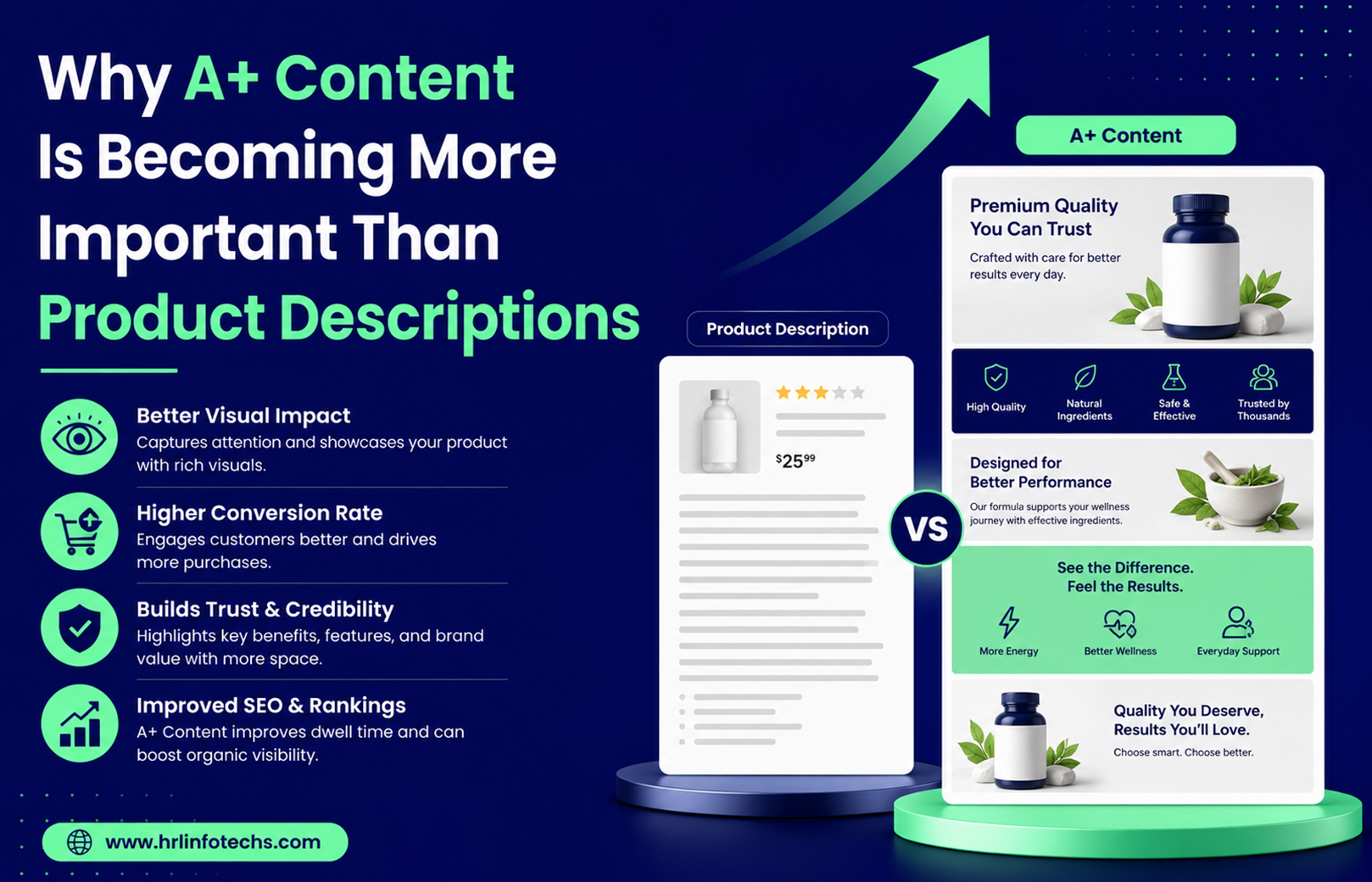
A+ Content can strengthen the information available on a product detail page, particularly when it explains product benefits, comparisons and use cases clearly. It should support the core listing rather than compensate for missing or weak product information.

For sellers investing in AI readiness Amazon listing work, A+ Content is useful for addressing questions that are difficult to explain in five short bullets. A comparison module, for example, can help shoppers understand the difference between two products in the same range.

HRL Infotechs provides Amazon A+ Content design services, including product content writing, lifestyle imagery, brand storytelling, keyword optimization and comparison charts. The important distinction is that A+ Content should reinforce the product’s actual value proposition rather than become a collection of decorative graphics.

You should also remember that AI shopping does not eliminate the basics. A weak product, poor reviews, inaccurate specifications or an uncompetitive offer cannot be fixed simply by adding more A+ modules.

How Does Amazon Answer Engine Optimization Differ From Traditional Amazon SEO?

Amazon answer engine optimization, or Amazon AEO, focuses on making product information easy for an AI system to interpret and use when responding to conversational shopping questions. Traditional Amazon SEO places greater emphasis on discoverability for relevant searches, while AEO adds context, clarity and question-based relevance.

The two approaches should work together. A customer may search “wireless earbuds” first and later ask an AI shopping assistant which option is best for long office calls. Your listing needs to be relevant to the broad search while also containing accurate information about microphone quality, battery life, comfort and intended use.

This is why Amazon answer engine optimization (AEO) should not become another excuse for keyword stuffing. Amazon’s own conversational advertising guidance emphasizes the importance of clear product messaging and organized brand content because these provide stronger signals for AI-powered experiences.

A practical example: we often see sellers add five or six generic benefit phrases to a listing while leaving basic specifications incomplete. That is the wrong priority. If the customer needs to know dimensions, compatibility or capacity to decide, that information should come first.

What Is Amazon Contextual Ad Placement Beta?

Amazon’s contextual ad placement development uses AI to place relevant advertising and product information around shopper intent rather than relying solely on a conventional search-results placement.

The important distinction is that advertisers do not manually write every prompt. Amazon generates and manages the prompt experience using its own systems and signals. Existing campaigns can be eligible without requiring a separate campaign structure.

This means Amazon contextual ad placement beta should not be approached like a new keyword campaign where you simply create hundreds of targets. The stronger opportunity is to make your existing campaign and product data more useful.

For Indian brands, there is another important limitation: Amazon’s current documentation identifies Sponsored Products Prompts and Sponsored Brands Prompts as available to U.S. Amazon advertisers. Therefore, don’t increase Amazon.in budgets simply because the feature is live elsewhere. Verify marketplace availability inside your account first.

How Can Indian Amazon Sellers Prepare Now?

Indian sellers should prepare by improving the underlying listing rather than trying to force access to a feature that may not yet be available on Amazon.in.

Start with your highest-revenue products. Review their titles, bullets, attributes, images, A+ Content, reviews and search-term performance. Then identify questions that a real shopper would ask before spending ₹1,000, ₹5,000 or ₹20,000 on the product.

Your amazon product listing and seo services for sellers strategy should connect those questions with measurable search and conversion data. HRL Infotechs already recommends aligning listing content with PPC search terms, conversion data and product performance rather than managing advertising separately from catalogue optimization.

For sellers running serious advertising budgets, Amazon Advertising Services can also be integrated with listing optimization. That matters because sending paid traffic to a page that fails to answer obvious buyer questions simply increases the cost of discovering the problem.

You can also review HRL Infotechs’ recent guide on Amazon’s Rufus and Alexa for Shopping merger to understand how conversational shopping is developing beyond the original Rufus experience.

What Should You Do Next?

Don’t rewrite 500 listings because Amazon introduced AI-powered prompts. Start small and measure carefully.

Audit your top 10 to 20 ASINs. Identify the questions shoppers ask repeatedly. Improve the missing information in your titles, bullets, attributes and supporting content. Then connect your listing changes with search-term, conversion and advertising data.

If you’re unsure whether your images are helping or hurting the buying journey, HRL Infotechs’ recent Amazon product image SEO guide provides a useful next step for auditing the visual side of the listing.

The goal isn’t to make your listing “AI-friendly” by adding artificial language. The goal is to make the product easier for both shoppers and Amazon’s systems to understand.

If your listings are generating traffic but failing to answer buyer questions, that’s the gap worth fixing first. HRL Infotechs can help you audit listing content, A+ Content and advertising together so your Amazon strategy is built around the actual shopping journey rather than one isolated feature.

FAQs

Q1. Are Amazon AI Prompts available to sellers in India?

Ans. Amazon’s current documentation lists Sponsored Products Prompts and Sponsored Brands Prompts as generally available in the U.S. It does not currently list India as an available marketplace on that announcement. Indian sellers should therefore verify availability directly inside their Amazon Ads account rather than assuming that a U.S. rollout automatically applies to Amazon.in.

Q2. Do I need a separate campaign for Amazon AI Prompts?

Ans. No. Amazon says eligible Sponsored Products and Sponsored Brands campaigns are automatically enrolled in the prompts experience. Sellers can review prompt performance through the Ads Console and reporting tools where the feature is available. You don’t need to create a completely separate campaign simply to participate.

Q3. How do I make my Amazon listing ready for AI shopping?

Ans. Make the listing factually complete and easy to interpret. Explain the primary use case, specifications, compatibility, size, materials, benefits and limitations. Keep the information consistent across the title, bullets, attributes, images and supporting content. Avoid writing unnatural sentences simply to include AI-related keywords.

Q4. Can Amazon Rufus AI increase my product sales?

Ans. AI shopping can influence product discovery and purchase decisions, but no seller should treat AI prompts as a guaranteed sales channel. Performance depends on relevance, product quality, offer competitiveness, conversion rate, reviews, inventory and other marketplace factors. Use available reporting to measure actual business results instead of assuming visibility will automatically produce sales.

Q5. Should I optimize my Amazon listing for Rufus or Alexa for Shopping?

Ans. Optimize for the underlying shopping behaviour rather than the product name. Amazon’s conversational shopping experience has evolved from Rufus toward Alexa for Shopping. The practical requirement remains similar: provide accurate product information that helps an AI system understand shopper intent, product suitability and meaningful differences between products.

Q6. Is Amazon AEO replacing Amazon SEO?

Ans. No. Amazon AEO and Amazon SEO should complement each other. SEO helps your product become discoverable for relevant searches, while AEO focuses more on whether your product information can clearly answer conversational questions. Strong listings need both discoverability and useful, structured product information.

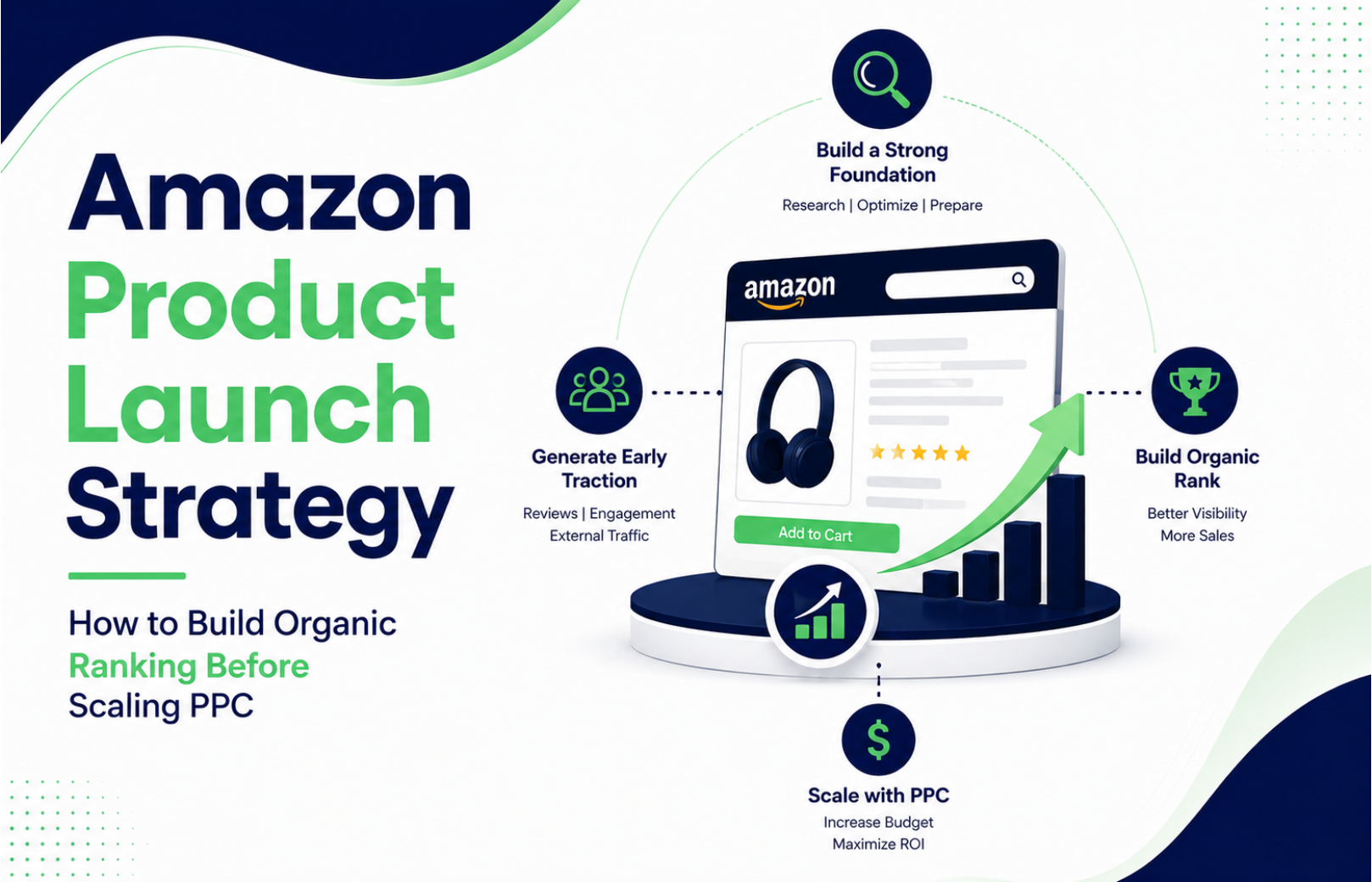
Amazon Product Launch Strategy: How to Build Organic Ranking Before Scaling PPC


A new Amazon product goes live. The listing looks polished, the inventory is ready, and the seller is eager to start advertising. Within a few days, the PPC dashboard shows clicks, but organic visibility is barely moving. The seller responds by increasing bids. That usually creates a more expensive problem, not a better launch.

A stronger Amazon product launch strategy starts before serious ad scaling. First, make the product detail page relevant to the searches you want to win, make the offer competitive enough to convert, and establish a clean keyword and measurement baseline. Then use PPC to accelerate discovery, collect useful search-term data, and build sales momentum. The goal isn’t to avoid Amazon PPC. It’s to make every paid click work harder while your organic ranking develops.

What Should You Do Before Launching Amazon PPC?

Before increasing Amazon PPC spend, make sure the product listing can convert the traffic you’re about to buy. Your title, images, bullet points, product description, pricing, inventory, relevant search terms, and overall offer should be ready before you attempt to scale advertising.

Amazon itself recommends auditing product detail pages before launching Sponsored Products and using relevant search terms that reflect how shoppers search for the product.

For a new product, your first priority should be relevance and conversion readiness, not ranking for every possible keyword.

Build the Amazon Listing Around Buyer Search Intent

Amazon product listing optimization means structuring the product detail page so shoppers can discover the product and understand why it fits their needs. Amazon describes the product detail page as the place where customers see product information such as the name, images, description, and offer details.

Start with three keyword groups:

  • Primary category keywords
  • High-intent long-tail keywords
  • Product-specific attributes and use cases

Don’t stuff every keyword into the title. A title that reads unnaturally can reduce shopper confidence even if it contains more search terms.

This is where a proper Amazon SEO launch differs from simply uploading a listing. Your keyword research should determine the search language, while the listing should turn that language into useful product information.

For brands that need this foundation built systematically, HRL Infotechs’ Amazon SEO and Listing Optimization Services cover keyword research, title optimization, bullet points, backend search terms, visual optimization, and ongoing performance analysis.

How Do You Build Organic Ranking Before Scaling PPC?

Build organic ranking by combining strong listing relevance with genuine sales and conversion activity, then use PPC selectively to accelerate visibility for the most commercially important searches. Organic ranking should be treated as an outcome of relevance, shopper response, and sustained performance rather than something that can be guaranteed through advertising alone.

This is one of the most important judgement calls in a new Amazon launch: don’t try to rank for your broadest keyword first.

If your new product is a premium stainless-steel lunch box, for example, competing immediately for an extremely broad term such as “lunch box” may consume substantial budget while attracting shoppers with very different requirements.

A more sensible launch sequence might start with specific searches such as:

  • stainless steel lunch box for office
  • leakproof lunch box for adults
  • insulated stainless steel lunch container
  • lunch box for working professionals

Once you identify which terms generate qualified clicks and conversions, you can gradually expand your targeting.

HRL Infotechs has previously covered this principle in its guide to Amazon keyword research and ranking strategy, which explains why keyword selection should be based on buyer intent rather than search volume alone.

When Should You Start Amazon PPC for a New Product?

You should start Amazon PPC once the product is buyable, the detail page is properly optimized, inventory is available, and the offer is capable of converting. The mistake is not starting PPC early. The mistake is scaling PPC aggressively before you know whether the listing can convert paid traffic.

Amazon Sponsored Products are CPC ads that promote individual product listings and can target keywords or products. Amazon states that advertisers control bids and budgets and can use campaign reporting to optimize performance.

That makes PPC useful during a launch, but your first campaigns should be treated as controlled discovery.

Start with:

  1. High-intent exact keywords
  2. Relevant phrase and discovery targeting
  3. Carefully selected product targets
  4. Brand terms where appropriate
  5. Controlled budgets
  6. Search-term analysis

Don’t interpret the first few days of impressions as proof that a campaign is working. Look for qualified traffic, clicks, conversions, search-term relevance, and movement in the product’s organic visibility.

How Should You Structure Amazon PPC During a Product Launch?

A new-product Amazon PPC launch should separate discovery from proven demand. Keep high-intent keywords, exploratory targeting, and product targeting sufficiently organized that you can identify what is actually producing useful traffic and sales.

Sponsored Products can use keyword or product targeting, and Amazon recommends monitoring campaign performance and adjusting budgets and keywords as campaigns develop.

A practical launch structure can include:

Exact campaign: Your strongest high-intent keywords.

Phrase campaign: Closely related variations and search discovery.

Auto campaign: Controlled discovery of search terms you may not have identified manually.

Product targeting: Relevant competitor or complementary product detail pages.

The important part isn’t creating the maximum number of campaigns. It’s maintaining enough separation to make decisions.

We’ve seen sellers create dozens of campaigns for a single new ASIN, then struggle to understand where the money is going. A smaller, cleaner structure often gives you better visibility into what deserves more budget.

Which Metrics Should You Track During the First 30 Days?

During the first 30 days, track impressions, clicks, CTR, conversion rate, advertising cost of sales, sales, search-term performance, and organic keyword movement. No single metric should determine whether you scale or reduce spend.

A useful launch review asks four questions:

  1. Are relevant shoppers seeing the product?
  2. Are they clicking?
  3. Are they converting after clicking?
  4. Are important keywords showing organic movement?

Amazon’s advertising system provides campaign reporting that lets advertisers evaluate performance and adjust targeting, bids, and budgets.

Don’t chase ACoS in isolation. A new product can have a higher initial ACoS while you’re gathering data and establishing demand. On the other hand, a campaign with excellent ACoS but almost no sales volume may not be contributing meaningfully to growth.

The better metric depends on your launch objective.

Should You Increase PPC Budget When Organic Ranking Improves?

Increase PPC when the data shows that additional spend can generate profitable or strategically valuable sales without overwhelming your margins. Improving organic ranking is a positive signal, but it isn’t automatically a reason to double the advertising budget.

This is where Amazon launch strategy becomes different from a simple PPC strategy.

Suppose your product begins ranking organically for several long-tail terms after four weeks. You may decide to maintain paid coverage on those valuable terms while redirecting incremental budget toward terms where organic visibility is still weak.

Amazon’s current new-product advertising guidance specifically recommends using advertising to promote new products and adjusting budgets and keywords as the product moves through its lifecycle.

The objective is to make paid and organic visibility reinforce each other, not to make PPC permanently responsible for every sale.

How Does Amazon Account Management Affect a New Product Launch?

Amazon account management keeps the operational side of a launch from undermining the marketing strategy. Inventory, account health, listing issues, pricing, catalog changes, advertising performance, and ongoing marketplace tasks all need attention while the product is gaining traction.

A ranking strategy cannot compensate for operational problems. If your product goes out of stock, the listing develops a compliance issue, or important catalog information is incorrect, your advertising plan can quickly become irrelevant.

This is why Amazon account management becomes particularly useful when you’re launching multiple ASINs or managing Amazon alongside other marketplaces. HRL Infotechs provides Amazon Account Management Services that cover ongoing marketplace operations and performance monitoring as part of its broader ecommerce management approach.

What Should You Do in the First 30 Days of an Amazon Product Launch?

Use the first 30 days to establish relevance, gather search data, identify conversion problems, and progressively shift budget toward proven opportunities. Don’t treat the launch as one fixed campaign that runs unchanged for a month.

A practical sequence is:

Days 1–7:
Check listing indexing, impressions, CTR, search-term relevance, price competitiveness, inventory, and initial conversion signals.

Days 8–14:
Review search-term data, identify irrelevant traffic, add negative targeting where appropriate, and refine bids.

Days 15–21:
Separate proven converting terms from discovery terms and evaluate organic keyword movement.

Days 22–30:
Increase investment in proven opportunities, reduce inefficient targeting, and identify the next set of keywords worth testing.

HRL Infotechs has also examined why Amazon PPC campaigns waste budget during the first 30 days, including problems such as weak campaign structures, broad targeting, and poorly controlled bids.

When Should You Scale Amazon Advertising?

Scale Amazon advertising after you have evidence that the listing, offer, targeting, and conversion process can support additional traffic. Scaling should follow validated performance, not simply the passage of time.

Amazon provides several advertising options beyond Sponsored Products, including Sponsored Brands and other formats. Its new-product advertising guidance recommends combining targeting approaches and using different campaign types according to launch objectives.

For most sellers, however, the first scaling decision shouldn’t be “Which new ad format should I launch?”

It should be:

Which search terms, products, audiences, and placements have already demonstrated commercial value?

Then increase investment there.

If managing bids, search terms, campaign structures, listing optimization, and performance reporting is taking more time than your team can realistically give it, Amazon Advertising Services from HRL Infotechs can fit naturally into the next stage of the workflow.

What Is the Right Amazon Product Launch Strategy?

The right Amazon product launch strategy is a staged process: optimize the listing, establish keyword relevance, make the offer conversion-ready, launch controlled PPC, analyze search-term and conversion data, improve the listing, and only then scale the campaigns that demonstrate value.

You don’t need to choose between Amazon SEO and Amazon PPC. You need to sequence them correctly.

PPC can create the initial traffic and provide valuable performance data. SEO and listing optimization create the foundation for sustainable organic discovery. Account management keeps operational issues from disrupting the process.

For a new product, that combination is usually more sensible than simply increasing the daily ad budget and hoping Amazon ranking follows.

If you’re preparing a new ASIN and aren’t sure whether your listing, keyword strategy, or PPC structure is ready for launch, HRL Infotechs can review the gaps and help you build the launch sequence before you commit more advertising budget.

Frequently Asked Questions

How long does it take for a new Amazon product to rank organically?

There is no fixed Amazon ranking timeline for a new product. Initial indexing and ranking movement can happen relatively quickly, but meaningful organic visibility depends on relevance, competition, conversion performance, sales activity, and other marketplace factors. Treat the first several weeks as a measurement period rather than expecting a guaranteed ranking date.

Should I run Amazon PPC immediately after launching a new product?

You can start PPC after the product is buyable and the listing is properly prepared. Starting advertising early can help generate visibility and collect useful search-term data. However, aggressive scaling before validating the listing’s conversion performance can waste budget. Start with controlled targeting, measure the results, and scale based on evidence.

Can Amazon PPC improve organic ranking?

PPC and organic ranking are separate mechanisms, so advertising should not be treated as a guaranteed way to buy an organic position. PPC can generate product detail page traffic and sales, while successful customer interactions may contribute to the broader performance picture. The practical goal is to use PPC to support product discovery while building sustainable organic demand.

What keywords should I target for a new Amazon product launch?

Start with relevant, high-intent keywords that closely describe the product, its features, use case, and buyer need. Include specific long-tail terms before aggressively targeting broad, highly competitive keywords. Search-term performance from early campaigns can then help you identify which queries deserve greater attention in your Amazon SEO launch.

How much should I spend on Amazon PPC for a new product?

There is no universal launch budget because CPCs, category competition, margins, conversion rates, and sales targets differ significantly. Set a test budget that your business can afford to learn from, then evaluate spend against clicks, conversions, sales, ACoS, and organic movement. Increase budget only when the underlying economics support it.

Should I optimize my Amazon listing before starting PPC?

Yes. Listing optimization should happen before serious PPC scaling because your ads send shoppers to the product detail page. If the title, images, bullets, pricing, product information, or overall offer are weak, additional traffic may simply expose those problems faster. Amazon also recommends auditing product detail pages before launching Sponsored Products.

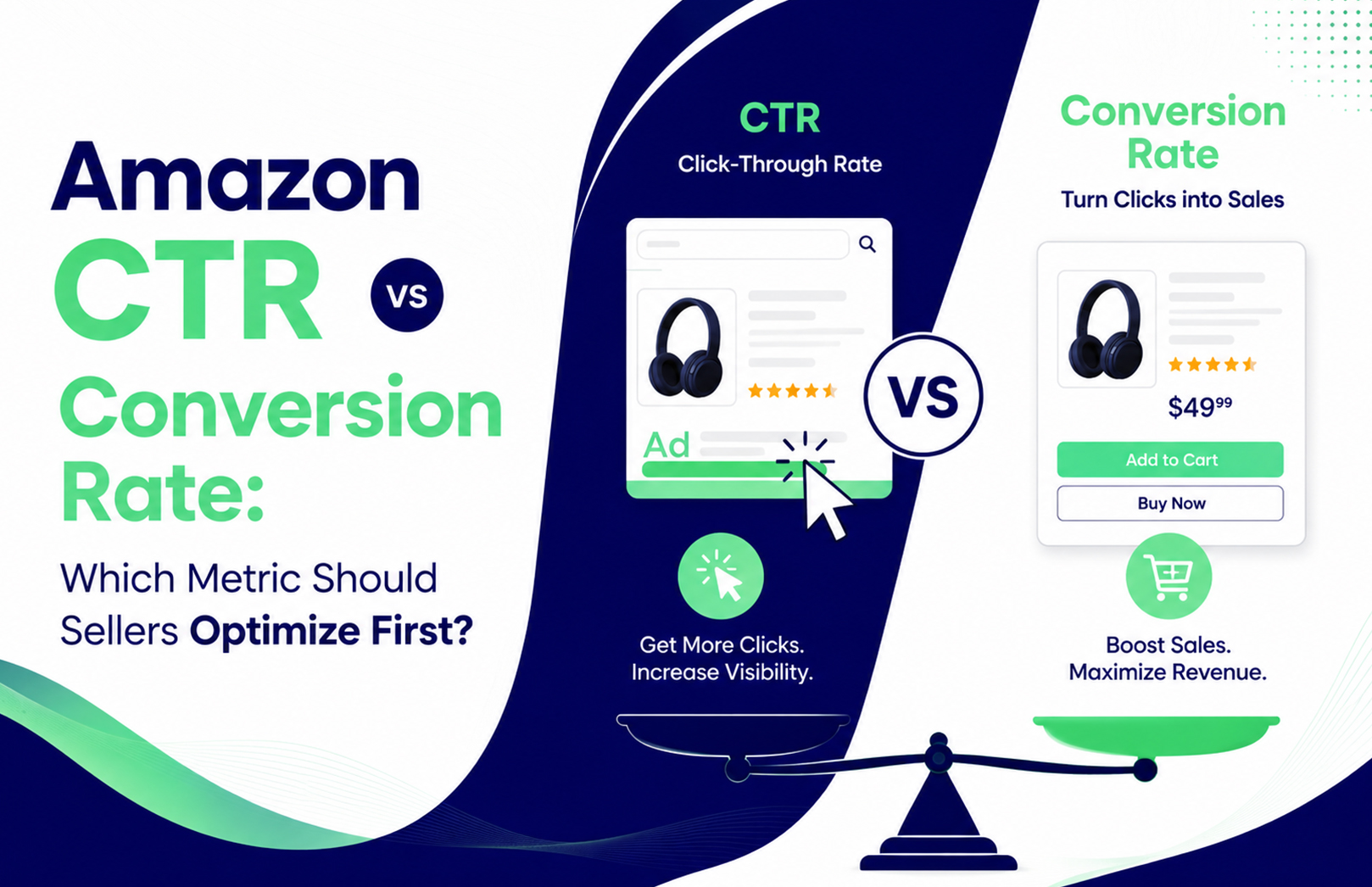
Amazon CTR vs Conversion Rate: Which Metric Should Sellers Optimize First?


Your Amazon listing is getting 50,000 impressions but only 250 clicks. Or perhaps your ads are generating hundreds of clicks every week, but orders remain disappointing. These are two very different problems, and treating them the same can waste your advertising budget.

So, should you optimize Amazon CTR or conversion rate first? Start with the metric showing the bigger funnel problem. If impressions are high but clicks are weak, prioritize Amazon CTR. If clicks are healthy but purchases are weak, prioritize conversion rate. Once both are performing reasonably well, move your attention to CPC, ACoS, ROAS, TACoS and profit. Amazon Ads itself positions CTR as a consideration-stage metric and conversion rate as a purchase-stage metric.

What Should Amazon Sellers Optimize First: CTR or Conversion Rate?

Optimize CTR first when your product is visible but shoppers aren’t clicking. Optimize conversion rate first when shoppers are clicking but not buying. This simple diagnostic prevents sellers from increasing ad spend before fixing the actual bottleneck.

Think about your Amazon funnel as:

Impressions → Clicks → Product Page → Purchase → Revenue → Profit

If the first transition is weak, improving the product page won’t immediately solve the traffic problem. If the second transition is weak, buying more traffic can simply increase wasted spend.

For example, consider an illustrative Amazon seller receiving 100,000 impressions, a 0.4% CTR and a 10% conversion rate. That produces approximately 400 clicks and 40 orders. If the seller improves CTR to 0.8% while maintaining the same conversion rate, the same impression volume could produce around 80 orders.

But there is a catch.

If the new clicks are less relevant and conversion falls from 10% to 4%, the seller would generate only about 32 orders. A higher CTR can therefore produce fewer sales if the additional traffic is poor quality.

That is one of the biggest mistakes sellers make when optimizing Amazon advertising metrics: treating an improving percentage as automatically meaning better business performance.

What Is Amazon Click-Through Rate and Why Does It Matter?

Amazon click-through rate, or CTR, is the percentage of ad impressions that result in clicks. Amazon Ads calculates CTR as clicks divided by impressions, multiplied by 100.

CTR tells you whether your ad is attracting attention from shoppers who see it. It does not tell you whether those shoppers will purchase.

For sellers, a weak Amazon listing CTR can point to several issues:

  • Your product is appearing for irrelevant searches.
  • Your main image isn’t competitive in the search results.
  • Your title doesn’t communicate the product clearly.
  • Your price looks uncompetitive.
  • A competitor has stronger ratings, reviews or offers.
  • Your ad placement is reaching shoppers with weaker intent.
  • Your keyword targeting is too broad.

This is why you shouldn’t immediately increase bids when CTR is poor.

If your product appears beside five stronger offers and shoppers repeatedly ignore yours, paying more to obtain that placement doesn’t necessarily solve the problem.

Amazon Ads recommends reviewing CTR alongside campaign goals and other KPIs rather than using it in isolation.

For sellers managing multiple campaigns, the more useful question is not simply “What is my Amazon CTR?” but:

“Which keywords, placements and products are generating impressions without earning enough qualified clicks?”

That distinction makes CTR actionable.

What Is Amazon Conversion Rate?

Amazon conversion rate measures how effectively shoppers who reach your product experience complete the desired action, such as making a purchase. Amazon Ads notes that conversion rate depends on how the conversion is defined and measured, so sellers should always understand which report and denominator they’re using.

For an Amazon seller, conversion performance is affected by much more than advertising.

Your product page has to answer the shopper’s questions quickly:

Is this the right product?
Is it worth the price?
Can I trust the seller?
Will it solve my problem?
Can I get it when I need it?

A seller can have excellent PPC targeting and still experience poor conversion because the product detail page doesn’t close the sale.

Common conversion blockers include:

  • Weak or unclear product images
  • Poor review rating or insufficient reviews
  • Uncompetitive pricing
  • Confusing variations
  • Weak bullet points
  • Missing product benefits
  • Poor A+ Content
  • Weak offer or delivery proposition
  • Traffic that doesn’t match the product’s actual use case

Amazon itself recommends relevant product content and product detail page optimisation as part of improving conversion performance.

This is where Amazon product listing and SEO optimization becomes part of the advertising strategy, rather than a separate SEO exercise. HRL Infotechs aligns listing content, keywords and conversion elements so paid traffic lands on a product page designed to continue the buying journey.

How Do Amazon CTR and Conversion Rate Work Together?

CTR measures how effectively you turn visibility into traffic. Conversion rate measures how effectively you turn that traffic into customers. You need both because improving only one part of the funnel can produce misleading results.

Consider three seller situations:

High impressions, low CTR

Your product is being seen but isn’t earning enough attention.

Priority: Investigate search relevance, main image, title, offer, placement and competitive positioning.

Do not assume that higher bids are the answer.

Healthy CTR, low conversion

Shoppers are interested enough to click, but something on the product page or offer is stopping them from buying.

Priority: Audit the listing, pricing, reviews, images, A+ Content, variations and traffic quality.

Increasing the campaign budget before fixing the listing can make the problem more expensive.

Healthy CTR, healthy conversion

Now you have a stronger foundation for scaling.

Priority: Evaluate CPC, ACoS, ROAS, TACoS, contribution margin, search-term performance and incremental sales.

This is where the seller’s goal changes from “Can I get more traffic?” to “Can I acquire more profitable customers?”

How Can Sellers Diagnose a Low Amazon CTR?

Start with the search results, not the advertising dashboard. Look at what a shopper actually sees when your product appears beside competing products.

Search your primary keywords manually and compare your listing against the products receiving the most attention.

Look at:

  • Main image
  • Product title
  • Price
  • Discount or coupon
  • Star rating
  • Review volume
  • Prime or delivery proposition
  • Product differentiation
  • Brand familiarity

One practical lesson from Amazon listing work is that sellers often try to solve a creative problem with a bidding solution.

If your product has a poor main image, increasing the bid may help you win more impressions, but it doesn’t necessarily make shoppers want to click.

HRL Infotechs’ analysis of Amazon product images and their impact on clicks and conversions makes this distinction particularly relevant. Your main image competes for attention before the shopper reads most of your listing copy.

You should also segment CTR instead of looking at one account-wide number.

Compare:

Brand vs non-brand → Exact vs phrase/broad → Search terms → Placements → Products → Time periods

A 2% CTR on branded searches doesn’t mean your generic keyword campaigns are equally strong.

How Can Sellers Fix a Low Amazon Conversion Rate?

Start by determining whether the problem is the product page or the traffic reaching it. A low conversion rate caused by irrelevant traffic requires campaign optimisation. A low conversion rate caused by a weak listing requires product-page optimisation.

This distinction matters because the wrong fix can make your account worse.

Suppose you’re selling a premium protein powder and your campaign receives clicks for searches related to cheap protein supplements. Your listing might be excellent, yet conversion remains poor because the shopper’s price expectation is wrong.

In that case, rewriting the listing may have limited impact.

But if shoppers are searching for your exact product type, clicking your ad and then choosing competitors, investigate:

  • Price positioning
  • Main image
  • Benefits
  • Product specifications
  • Reviews
  • A+ Content
  • Coupons
  • Delivery
  • Competitor offers
  • Product differentiation

A useful rule is:

Poor traffic quality = fix targeting.
Good traffic + poor purchase rate = fix the offer or listing.

Don’t automatically reduce price. That’s another trade-off experienced sellers learn quickly. A discount can increase conversion while reducing contribution margin. If your product can win through better positioning, stronger content or more relevant traffic, discounting may be the wrong first move.

Should Sellers Increase Amazon PPC Bids When CTR Is Low?

Not necessarily. Increasing a bid can help your ad compete for placements, but it does not directly fix weak shopper appeal or irrelevant targeting. First determine why CTR is low.

Amazon’s Sponsored Products guidance recommends monitoring impressions, clicks, sales and CPC and using search-term, targeting, advertised-product and placement reports to understand performance.

A better workflow is:

  1. Check whether the search term is relevant.
  2. Compare CTR with similar keywords in the account.
  3. Review the placement.
  4. Inspect the product’s search-result appearance.
  5. Check competitor pricing and offers.
  6. Improve the listing or targeting where necessary.
  7. Adjust the bid only after the underlying issue is understood.

This is the difference between bid management and genuine Amazon advertising optimisation.

If you need account-level support, Amazon PPC management and advertising services can connect search-term analysis, bid optimisation, campaign structure and conversion data rather than treating each metric separately. HRL Infotechs specifically positions PPC management around qualified traffic, search-term analysis, conversion data and advertising efficiency.

What Amazon PPC Metrics Should Sellers Check After CTR and Conversion?

CTR and conversion rate tell you where the funnel is leaking, but they don’t tell you whether the resulting sales are profitable. Once the funnel is functioning, sellers should connect these metrics to CPC, ACoS, ROAS, TACoS and ultimately contribution margin.

Amazon defines ACoS as ad spend divided by attributed sales and ROAS as ad sales divided by ad spend.

For example, an illustrative campaign might show:

CTR improving → clicks increasing → conversion stable → CPC rising → ACoS worsening

That isn’t necessarily a successful optimisation.

You may have improved the front of the funnel while making customer acquisition more expensive.

This is why HRL Infotechs’ recent Amazon ACoS vs TACoS analysis recommends looking beyond a single advertising metric and connecting advertising performance with overall sales.

For sellers, the final question should always be:

“Did this change create more profitable incremental sales?”

Not:

“Did this percentage go up?”

How Should Amazon Sellers Optimize CTR and Conversion Rate Together?

Use a staged optimisation process rather than changing everything simultaneously. This makes it easier to identify what actually improved performance and prevents sellers from wasting budget on symptoms instead of causes.

Step 1: Diagnose visibility

Check impressions and search-term relevance.

If impressions are low, investigate indexing, keyword coverage, bids, budget and eligibility before worrying about CTR.

Step 2: Diagnose the click

If impressions are healthy but CTR is weak, compare your search-result presentation against competitors.

Prioritise the main image, title clarity, relevance, price and offer.

Step 3: Diagnose the purchase

If clicks are healthy but orders aren’t following, audit the product detail page and traffic quality.

Don’t assume the advertising campaign is automatically responsible.

Step 4: Diagnose economics

Once traffic and conversion are reasonably healthy, review CPC, ACoS, ROAS, TACoS and contribution margin.

A campaign generating more orders isn’t automatically better if every incremental order reduces profitability.

Step 5: Scale only what has evidence

Amazon Ads recommends regularly reviewing campaign performance and using reporting to identify optimisation opportunities.

For sellers, that means scaling keywords, products and placements that have demonstrated commercially useful performance instead of increasing the entire campaign budget simply because sales are rising.

What Should Indian Amazon Sellers Do This Week?

Don’t start by changing every campaign. Start with the products and search terms where the performance problem is easiest to identify.

Use this sequence:

  1. Select your top 10 products by advertising spend.
  2. Pull impressions, clicks, CTR, CPC, orders, sales and ACoS.
  3. Identify products with high impressions and weak CTR.
  4. Identify products with strong CTR but weak conversion.
  5. Review their search terms and placements.
  6. Manually inspect the product detail pages.
  7. Compare price, reviews, images and offers against leading competitors.
  8. Make one meaningful change at a time.
  9. Give the account enough data to establish a pattern.
  10. Recheck sales and profitability, not just CTR or conversion rate.

This is particularly useful during Indian shopping peaks, when promotions, competitor discounts and demand changes can distort short-term performance.

Don’t compare a major sale event directly with a normal trading week and assume the difference is caused by your optimisation.

So, Which Metric Should Amazon Sellers Optimize First?

Optimize Amazon CTR first when your biggest problem is getting qualified shoppers to click. Optimize conversion rate first when qualified shoppers are already reaching your product page but aren’t purchasing. Neither metric should be treated as the final goal. The real objective is profitable Amazon sales.

The strongest Amazon sellers don’t ask, “Should I improve CTR or conversion rate?”

They ask:

“Where is my funnel losing the most commercially valuable shoppers?”

That question leads to better decisions about PPC, listing optimisation, bids, keywords, pricing and budget allocation.

If your Amazon account has strong impressions but weak CTR, or strong clicks but disappointing sales, the next step is not necessarily more advertising spend. It is identifying whether the problem sits in targeting, search-result presentation, product-page conversion or campaign economics.

HRL Infotechs brings Amazon advertising and listing optimisation together so sellers can diagnose those gaps across the funnel rather than optimise isolated dashboard metrics. If you’re unsure whether your current bottleneck is traffic, conversion or advertising efficiency, request an Amazon performance review and use the data to decide where the next optimisation should happen.

FAQs About Amazon CTR vs Conversion Rate

Q1. Is Amazon CTR or conversion rate more important for sellers?

Ans. Neither is universally more important. CTR matters most when your products receive impressions but insufficient clicks. Conversion rate matters more when shoppers click but don’t purchase. Sellers should identify the weakest stage first, then evaluate CPC, ACoS, ROAS, TACoS and profitability.

Q2. What causes a low Amazon listing CTR?

Ans. Low Amazon listing CTR can result from weak search relevance, an uncompetitive main image, unclear titles, pricing, poor ratings, weak offers or stronger competing products. Review CTR at the keyword and placement level rather than relying on an account-wide average.

Q3. Why is my Amazon CTR high but sales are low?

Ans. High CTR with low sales often indicates a traffic-quality or product-page problem. Check whether shoppers are searching for the exact product you sell, then review price, reviews, images, benefits, variations and delivery. More clicks won’t necessarily help if the additional traffic has weak purchase intent.

Q4. Should I increase my Amazon PPC bids to get more clicks?

Ans. Not automatically. Higher bids can help win more auctions and placements, but they don’t fix irrelevant targeting or weak product presentation. Before increasing bids, identify whether the problem is low visibility, poor CTR, expensive CPC or weak conversion. Then make the change that addresses the actual bottleneck.

Q5. What is a good Amazon CTR for Sponsored Products?

Ans. There isn’t one universal CTR target that applies to every seller. CTR varies by category, keyword intent, placement, competition and campaign type. Amazon has introduced benchmark resources that give advertisers more category-level context, making peer comparison more useful than relying on a generic CTR percentage.

Q6. How can I improve Amazon conversion rate without lowering my price?

Ans. Start with relevance and the product experience. Make sure your ads target shoppers who genuinely need the product, then improve images, product benefits, titles, bullet points, A+ Content, reviews and offer clarity. If qualified traffic is already strong, these improvements can be more sustainable than using discounts as the default conversion lever.

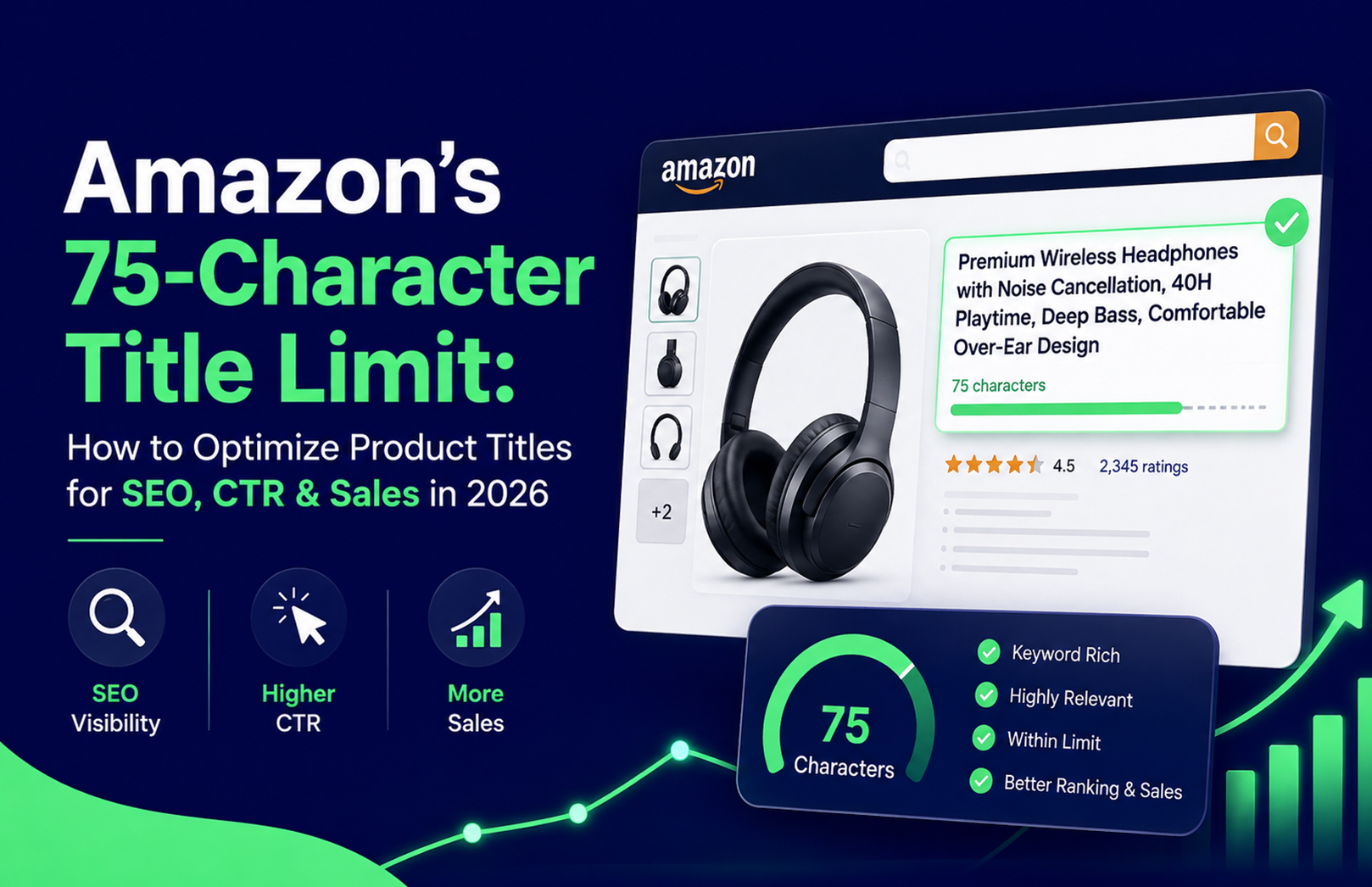
Amazon’s 75-Character Title Limit: How to Optimize Product Titles for SEO, CTR & Sales in 2026


Amazon sellers in India need to rethink how they create and optimize product titles in 2026. Amazon announced that, starting July 27, 2026, product titles in all categories except media must be 75 characters or fewer, including spaces. Amazon says the change is intended to make product titles display more clearly on mobile devices and create a more consistent shopping experience.

For sellers, this makes Amazon product title optimization more important than ever. Instead of trying to fit as many keywords as possible into a title, brands now need to prioritize the right keyword, essential product information and conversion-focused messaging within a much smaller character limit.

A well-optimized Amazon product title can help shoppers understand a product quickly, support relevance for Amazon search and encourage more clicks. In 2026, the goal is not simply to write a shorter title—it is to make every character work harder.

What Is Amazon’s 75-Character Title Limit?

Amazon’s new requirement states that titles for categories other than media must contain 75 characters or fewer, including spaces. Amazon also introduced Item Highlights, which provide an additional 125 characters for information such as materials and recommended use cases. This content is searchable and can appear with titles in search results and on product detail pages.

Amazon is also providing AI-powered tools to help sellers create titles and Item Highlights that comply with the new limits. Sellers can access recommendations through Manage All Inventory and review suggested changes before implementation.

This means the Amazon title character limit should not be viewed only as a compliance requirement. It should be treated as an opportunity to make product listings more concise, relevant and shopper-friendly.

Why Amazon Product Title Optimization Matters in 2026

The title is one of the first pieces of information shoppers encounter when browsing Amazon search results. It tells customers what the product is and can immediately communicate important attributes such as size, quantity, material, compatibility or use case.

At the same time, your title contributes to how Amazon understands your product and its relevance to customer searches. This makes Amazon SEO and title optimization closely connected.

However, keyword placement alone is not enough. A title can contain relevant keywords and still perform poorly if it is difficult to read or does not communicate a compelling reason to click.

The best approach combines search relevance + readability + conversion intent.

How to Optimize an Amazon Product Title Within 75 Characters

1. Start With the Most Important Keyword

The primary product keyword should generally appear early in the title so shoppers can understand the product immediately.

For example, instead of:

“Premium Quality Best Wireless Bluetooth Earbuds for Music Calls”

consider:

“Wireless Bluetooth Earbuds, Noise Cancellation, 40H Battery”

The second version removes unnecessary promotional wording and focuses on product identity and meaningful attributes.

When performing Amazon title optimization, identify the search terms most closely connected to the product and customer buying intent. Do not automatically choose a keyword simply because it has the highest search volume.

2. Remove Unnecessary Words

The new Amazon 75 character title limit means sellers have less room for filler.

Words such as “best,” “amazing,” “premium quality,” “high quality” and “perfect” can consume valuable space without helping shoppers understand the product.

Instead, use characters for information that helps customers make a purchasing decision.

Prioritize:

  • Product type
  • Primary keyword
  • Important feature
  • Size or quantity
  • Material
  • Compatibility
  • Key use case
  • Meaningful differentiator

Every word should either improve relevance or help the shopper understand the product.

3. Use High-Intent Keywords

Effective Amazon SEO begins with understanding what shoppers actually search for when they are ready to purchase.

For an Indian seller, keyword research can include:

  • Core product keywords
  • Long-tail search terms
  • Product attributes
  • Size and quantity terms
  • Material-related searches
  • Compatibility keywords
  • Usage-based searches
  • Category-specific terminology
  • Commercial search phrases

Rather than inserting every keyword into the title, select the strongest primary term and use the remaining relevant terms naturally across the listing.

This is particularly important because Amazon’s new title format forces sellers to make stronger keyword prioritization decisions.

4. Optimize for CTR, Not Just Rankings

A common mistake is to think that Amazon product title optimization is only about rankings.

Your title also has a direct role in the shopper’s decision to click.

Consider these examples:

Generic:
“Face Serum 30ml”

More informative:
“Vitamin C Face Serum 30ml, Brightening, Lightweight”

The second title quickly communicates the product, size and relevant benefit. It gives the shopper more context without becoming unnecessarily long.

A good title should answer the shopper’s basic question:

“Is this the product I am looking for?”

If the answer is immediately clear, the listing has a stronger opportunity to earn the click.

Use Item Highlights Instead of Overloading the Title

The 75-character requirement does not mean every product benefit needs to disappear.

Amazon’s new Item Highlights feature provides up to 125 additional characters for information such as materials and recommended use cases. Amazon states that this content is searchable and visible with titles in search results and on product detail pages.

This creates an opportunity to separate information strategically.

Product title:
Product identity + primary keyword + critical attribute

Item Highlights:
Material + recommended use + supporting product information

For example:

Title:
“Stainless Steel Water Bottle 1L, Leakproof, Insulated”

Item Highlight:
“Suitable for office, gym, school and travel; durable stainless steel construction.”

This approach keeps the title focused while giving customers additional information elsewhere in the listing.

Amazon Product Title Character Limit: Mistakes to Avoid

The biggest mistake sellers can make is treating the Amazon product title character limit as a keyword puzzle.

Avoid these common errors:

  • Repeating the same keyword multiple times
  • Adding unrelated high-volume keywords
  • Using unnecessary promotional claims
  • Writing the entire title in capital letters
  • Adding excessive punctuation
  • Including information that belongs elsewhere in the listing
  • Hiding the primary product keyword
  • Sacrificing readability to add another keyword
  • Ignoring category-specific Amazon requirements

Amazon’s guidance emphasizes concise titles and provides title requirements and best practices for sellers. Amazon also notes that titles exceeding applicable requirements can be subject to changes through its enforcement process.

The objective should always be relevance without keyword stuffing.

A Simple Formula for Amazon Title Optimization

A practical structure for creating a 75-character title is:

[Primary Product Keyword] + [Key Feature] + [Size/Quantity] + [Critical Differentiator]

For example:

“Cotton Bedsheet King Size, 300 TC, Floral Print”

Or:

“Yoga Mat 6mm, Non-Slip, Extra Wide for Home Workouts”

The exact structure will vary by category, but the principle remains the same: start with what the product is, then use the remaining space for the information most likely to influence search relevance and purchasing decisions.

Before publishing, check:

  1. Is the main product keyword clear?
  2. Is the product immediately understandable?
  3. Is the most important information near the beginning?
  4. Have filler words been removed?
  5. Is the title 75 characters or fewer?
  6. Does it follow category-specific requirements?
  7. Would a real shopper find the title useful?

How Better Titles Can Improve CTR and Sales

An optimized title cannot guarantee higher sales on its own. Amazon performance depends on several factors, including pricing, reviews, availability, advertising, images, conversion rate and overall listing quality.

However, a strong title can contribute to the customer journey in several ways.

Better relevance: A clearly structured title helps communicate what the product is and which searches it is relevant to.

Better readability: Customers can understand the offer faster, particularly when browsing on mobile.

Better click potential: A title that clearly matches customer intent can provide a stronger reason to open the product detail page.

This is why Amazon listing optimization should go beyond the title. Sellers should also optimize bullet points, product images, backend search terms, A+ Content and other listing elements.

If your catalogue contains multiple ASINs, maintaining all of these elements consistently can become difficult. Professional Amazon account management services can help brands manage catalogue optimization, listing performance, account health and other ongoing marketplace activities. HRL Infotechs provides account management covering catalogue optimization, performance analysis and broader Seller Central operations.

Combine Amazon SEO With Complete Listing Optimization

A product title works best when the rest of the listing supports it.

Imagine a customer searches for a product and clicks because the title matches their intent. If the product images are unclear, bullet points are weak or the description does not answer their questions, the click may not turn into a purchase.

That is why Amazon listing optimization should cover the entire product detail page.

A strong optimization strategy can include:

  • Keyword research
  • Amazon product title optimization
  • Bullet point optimization
  • Backend search term optimization
  • Product image optimization
  • A+ Content
  • Competitor analysis
  • Conversion-focused content
  • Search performance monitoring

For brands that need professional support, HRL Infotechs offers Amazon product listing and SEO services, helping businesses optimize product titles, keywords and other listing elements as part of a broader Amazon growth strategy.

Connect Title Optimization With Amazon Marketing

Optimizing a listing is only one part of growing on Amazon. Once your product page is properly structured, paid advertising can help bring qualified shoppers to it.

This is where Amazon marketing services become valuable.

Amazon PPC campaigns can be aligned with listing keywords so that the search terms being targeted through advertising are also reflected naturally within the product detail page. HRL Infotechs’ Amazon advertising approach combines keyword research, campaign management and listing optimization to help paid traffic reach product pages designed to convert.

For example, if your PPC campaign identifies a high-converting search term, your listing strategy can evaluate whether that term is appropriately represented in the title or another relevant listing field.

This creates a stronger connection between:

Keyword research → Amazon SEO → Listing optimization → PPC → Conversion → Sales

Should You Rewrite Existing Amazon Titles?

If you already have Amazon listings, do not blindly rewrite every title simply to make it shorter.

Start with your highest-priority ASINs.

Review:

  • Current title length
  • Organic ranking
  • Main search terms
  • Click performance
  • Conversion rate
  • Sales contribution
  • Competitor titles
  • Product relevance
  • Category requirements

Then prioritize titles that are over the new limit or contain unnecessary wording.

Amazon states that titles exceeding 75 characters after the July 27 change will be updated to AI recommendations gradually. Sellers can review, modify and approve AI-generated recommendations during the specified review period.

For brands with a large catalogue, this makes a systematic title audit more valuable than making random changes.

A 2026 Amazon Title Optimization Checklist

Before finalizing any Amazon product title, use this quick checklist:

  • Keep the title within the applicable character limit.
  • Place the primary product keyword naturally.
  • Describe the product clearly.
  • Add only important attributes.
  • Remove repetitive keywords.
  • Remove unnecessary promotional language.
  • Keep the title easy to read.
  • Optimize for mobile shoppers.
  • Follow category-specific requirements.
  • Use Item Highlights for additional information where applicable.
  • Review performance after optimization.

A title should not be written once and forgotten. Amazon search behavior, competition and customer preferences can change, so ongoing performance analysis is essential.

Final Thoughts

Amazon’s 75-character title limit is changing how sellers should approach product listing optimization in 2026. With less space available, brands cannot rely on long keyword-heavy titles to communicate every possible product detail.

Instead, successful Amazon product title optimization requires prioritization.

Start with the strongest relevant keyword. Clearly identify the product. Add the most important attribute or differentiator. Remove unnecessary words and use Item Highlights and other listing fields for additional information.

For Indian Amazon sellers, this is an opportunity to create cleaner, more focused listings that work better for mobile shoppers while supporting broader Amazon SEO and conversion strategies.

When title optimization is combined with complete Amazon listing optimization, professional account management and targeted Amazon marketing services, sellers can build a more consistent foundation for visibility, traffic and long-term marketplace growth.

If your Amazon catalogue needs to be reviewed for the new 75-character requirements, connect with HRL Infotechs for Amazon marketing and listing support.

FAQs

1. What is Amazon’s 75-character title limit?

Starting July 27, 2026, Amazon requires product titles in categories other than media to be 75 characters or fewer, including spaces.

2. Does the Amazon 75-character title limit apply to sellers in India?

Yes. Amazon’s Seller Central India announcement specifies that titles in all categories except media must be 75 characters or less, including spaces.

3. Can I still use keywords in my Amazon product title?

Yes. Keywords remain important for Amazon SEO, but sellers should focus on the most relevant, high-intent terms instead of repeating keywords or trying to include every search phrase.

4. What should I do if important product information does not fit within 75 characters?

Amazon introduced Item Highlights, which provide up to 125 additional characters for information such as materials and recommended use cases. This information is also searchable.

5. Can Amazon product title optimization increase sales?

An optimized title cannot guarantee sales, but it can improve product clarity, search relevance and click potential. Strong results usually require title optimization alongside images, bullet points, A+ Content, pricing, reviews, inventory and advertising.

6. Should I optimize all my Amazon product titles?

It is advisable to audit your catalogue, particularly high-traffic and high-revenue ASINs. Prioritize titles that exceed the new limit, contain unnecessary wording or are not clearly aligned with high-intent customer searches.

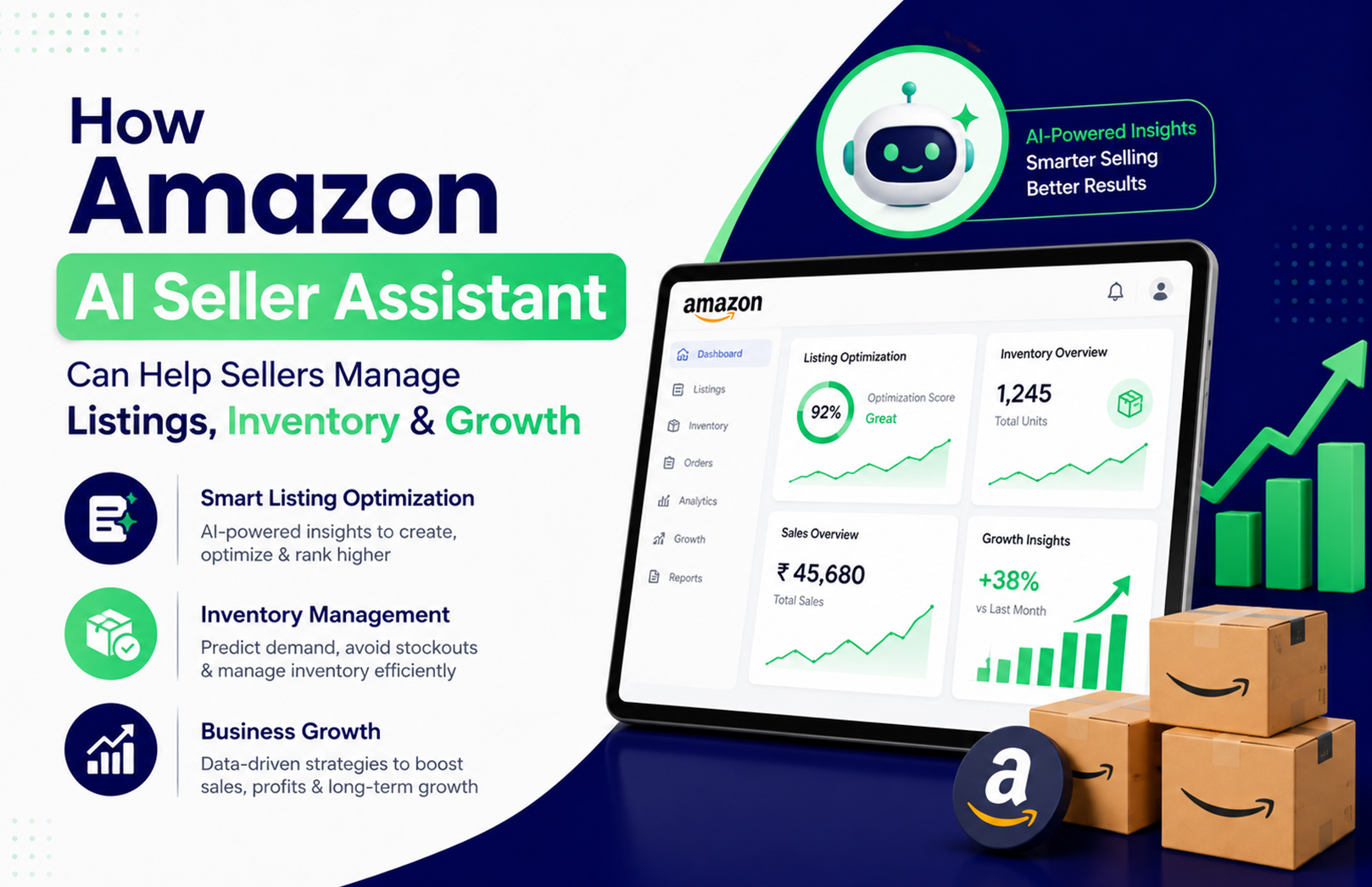
How Amazon AI Seller Assistant Can Help Sellers Manage Listings, Inventory & Growth


Amazon selling in India is becoming increasingly data-driven. Managing product listings, inventory, orders, pricing, advertising and account health manually can quickly become overwhelming, particularly as a seller’s catalogue grows.

Amazon is responding to this complexity with Seller Assistant, an AI-powered, conversational tool designed to help sellers launch, manage and grow their businesses. Amazon says the assistant can provide business insights across areas such as sales performance, inventory management, listings and catalogues, shipments and returns, orders and fees, while also helping sellers take certain actions with their approval.

For Indian sellers, this creates an important opportunity: AI can reduce the time spent analysing Seller Central data and help identify problems and opportunities faster. However, AI should complement not completely replace structured amazon seller account management and marketplace expertise.

What Is Amazon Seller Assistant?

Amazon Seller Assistant is an AI-powered assistant available within the Amazon selling ecosystem. Sellers can interact with it using natural-language questions instead of manually searching through multiple Seller Central reports and menus.

Amazon describes it as an always-on, generative AI and agentic system that can understand seller needs, surface relevant insights and, where supported, take actions with seller approval. Its capabilities cover areas including listings, inventory, sales performance, orders, fees, shipments and returns.

For Indian sellers, Amazon has also introduced Seller Assistant with support for English and Hinglish, making it more accessible to sellers who prefer conversational guidance over complicated dashboards. Amazon says the tool is available at no cost to sellers in India.

How AI Can Improve Amazon Listing Management

Product listings are one of the most important parts of an Amazon business. A seller can have a strong product and competitive price, but poor titles, bullet points, images or product information can still reduce visibility and conversions.

Seller Assistant can help sellers understand listing and catalogue-related issues and obtain guidance about their products. This makes AI particularly useful for sellers managing large catalogues where manually reviewing every ASIN is time-consuming.

However, AI recommendations should be reviewed against keyword strategy, customer intent, competitor positioning and Amazon’s listing requirements. This is where professional amazon listing management services can add significant value.

An experienced team can combine AI-assisted analysis with keyword research, backend keyword optimisation, content improvements and ongoing listing monitoring. HRL Infotechs’ Amazon SEO & Listing Optimization service, for example, focuses on improving listing visibility through listing optimisation, keyword research and backend keyword additions.

Using AI for Better Inventory Management

Inventory problems can quickly turn into lost sales.

Too little stock can create out-of-stock situations, while excessive inventory can tie up working capital and increase storage-related costs. Amazon’s Seller Assistant provides sellers with insights related to inventory management and can help identify actions associated with inventory and business performance.

Indian sellers can use these insights to ask practical questions such as:

  • Which products need immediate replenishment?
  • Which SKUs are selling slower than expected?
  • Where could inventory costs become a concern?
  • Which products require closer monitoring before major sales events?
  • How should inventory decisions align with expected demand?

AI can make the analysis faster, but sellers still need accurate sales history, lead times, supplier information and business context before making purchasing decisions.

Turning Seller Central Data Into Growth Insights

One of the biggest advantages of AI tools for Amazon sellers is the ability to turn large amounts of marketplace data into easier-to-understand insights.

Instead of checking multiple reports individually, sellers can use conversational questions to explore areas such as sales performance, orders, fees, inventory and catalogue performance. Amazon specifically highlights these business-insight capabilities within Seller Assistant.

For example, a seller could investigate why a product’s sales have declined, identify inventory-related concerns or understand which areas require attention.

But growth does not come from data alone. Sellers need to connect those insights with pricing, advertising, content, customer behaviour and profitability.

This is where amazon account management services become valuable. A professional account management team can continuously monitor performance, identify opportunities and coordinate different parts of the Amazon strategy instead of treating each metric separately.

Can AI Replace Amazon Seller Account Management?

Not completely.

AI can significantly reduce repetitive analysis and help sellers access information faster, but successful marketplace growth still requires strategic decision-making.

Professional amazon seller management services can cover areas such as account health monitoring, case management, FBA reimbursement, catalogue management and ongoing marketplace optimisation. HRL Infotechs’ Amazon Account Management service includes account health monitoring, case log management and FBA reimbursement support.

Think of AI as an additional layer of intelligence rather than a replacement for experienced Amazon professionals.

AI can identify a potential issue. A human expert can determine why it happened, assess its commercial impact and decide what should happen next.

Combining AI With Amazon Marketing Services

AI-assisted account management becomes even more powerful when combined with a structured advertising strategy.

A listing with strong organic visibility can still underperform if advertising campaigns are poorly structured. Similarly, increasing ad spend will not necessarily solve a conversion problem caused by weak product content.

Professional amazon marketing services can connect listing optimisation, keyword targeting, PPC management, competitor analysis and conversion improvements into one growth strategy.

An amazon marketing agency can also use Seller Central insights alongside advertising data to determine where budget should be increased, reduced or reallocated.

HRL Infotechs provides Amazon Advertising Services designed around campaign performance, conversions, traffic and ROI.

The Best Approach for Indian Amazon Sellers

For sellers in India, the strongest approach is not simply choosing between AI and human expertise. It is combining both.

A practical Amazon growth system can look like this:

AI insights → human analysis → strategic action → performance monitoring → continuous optimisation

Seller Assistant can help surface information and opportunities. A professional team can then validate those insights against business objectives, margins, competition and marketplace strategy.

This approach is particularly useful for established sellers managing multiple SKUs, advertising campaigns and fulfilment requirements.

Why Sellers Should Start Using AI Now

The Amazon marketplace is becoming increasingly dependent on automation, data and AI-driven experiences. Amazon is already expanding Seller Assistant’s capabilities beyond simple question answering into business insights and approved actions.

For Indian sellers, learning how to work alongside these tools can create an operational advantage.

The objective should not be to automate every decision. Instead, sellers should automate repetitive analysis while keeping important commercial decisions under expert control.

This can help teams spend less time navigating Seller Central and more time improving products, customer experience, profitability and growth.

Final Thoughts

Amazon AI Seller Assistant represents an important development for sellers who want faster access to marketplace insights. From listings and inventory to sales performance and account operations, AI can help simplify many parts of the selling process.

However, AI alone is not an Amazon growth strategy. Sellers still need strong listings, effective advertising, inventory planning, account health management and ongoing optimisation.

The most effective model is therefore a combination of AI tools for Amazon sellers and professional amazon seller account management. AI provides speed and insights, while experienced marketplace specialists provide strategy, context and execution.

If your Amazon business is growing and managing Seller Central is becoming difficult to handle internally, professional support can help you build a more structured and scalable marketplace operation.

Frequently Asked Questions

Q1. What is Amazon Seller Assistant?

Ans. Amazon Seller Assistant is an AI-powered conversational tool that helps Amazon sellers access information, receive business insights and manage aspects of their selling operations. Amazon says it covers areas including sales, inventory, listings, orders, fees, shipments and returns.

Q2. Is Amazon Seller Assistant available to Indian sellers?

Ans. Yes. Amazon India announced Seller Assistant for Indian sellers, with support for English and Hinglish. Amazon describes it as a free AI tool available to sellers in India.

Q3. Can Seller Assistant manage Amazon listings?

Ans. Seller Assistant can provide insights and guidance related to listings and catalogues. Sellers should still review AI-generated recommendations for accuracy, compliance, keyword relevance and brand positioning before implementing important changes.

Q4. Can AI replace Amazon account managers?

Ans. AI can automate and simplify many analytical and repetitive tasks, but it does not eliminate the need for strategic account management. Human expertise remains important for advertising, catalogue strategy, account health, profitability and complex marketplace decisions.

Q5. What are the best AI tools for Amazon sellers?

Ans. Amazon Seller Assistant is one of the key AI tools available within the Amazon seller ecosystem. Sellers can also use specialised AI and analytics solutions for keyword research, listing optimisation, advertising analysis and forecasting, depending on their requirements.

Q6. When should an Amazon seller consider professional account management?

Ans. Professional support becomes particularly valuable when a seller is managing a growing catalogue, increasing advertising spend, experiencing account-health issues, struggling with inventory or lacking the internal resources to monitor Seller Central consistently.

Why A+ Content Is Becoming More Important Than Product Descriptions


An e-commerce brand selling on Amazon India noticed something unusual in its conversion data in late 2024. Two products with nearly identical manufacturing costs, similar pricing, and comparable review counts were converting at dramatically different rates. One converted at 6.8%. The other sat at a mere 2.1%.

The difference was not the product. It was the listing. The higher-converting product had Amazon A+ Content Design lifestyle imagery showing the product in use, a comparison module explaining why the formula worked differently from alternatives, a brand story section establishing the founders’ credibility, and a clear benefit breakdown structured for scanning rather than reading.

The lower-converting product had a 200-word description listing ingredients and a standard five-bullet feature rundown.

Same product category. Same price point. Same platform. Three times the conversion rate. The gap between them was entirely in how the product was communicated to a buyer who had already decided to consider it.

The Changing Behaviour of Amazon Shoppers

Amazon customers in 2026 do not read listings. They evaluate them.

The average time spent on a product page before a purchase decision is made has dropped consistently year on year as mobile shopping has become the dominant format. A buyer arrives at a listing having already seen thumbnail images in search results. They have already formed a visual first impression. What the listing needs to do is confirm that impression and resolve any remaining hesitation in seconds, not paragraphs.

Amazon A+ Content exists precisely because text alone cannot do this job efficiently. A 200-word description requires a buyer to read and construct a mental model of the product. A well-designed A+ module communicates the same information visually in five seconds. For a buyer comparing three similar products simultaneously, that difference in cognitive load is the difference between staying on the page and clicking back.

Why Product Descriptions Alone Are No Longer Enough

Amazon product descriptions were built for a search environment where buyers arrived with a specific product in mind and needed detailed specification information to confirm their choice. That buying journey still exists, but it is no longer the dominant one.

Most Amazon purchases today begin with a category search, produce a results page with twenty similar options, and require a buyer to differentiate between products that appear nearly identical at thumbnail scale. The buyer who arrives on your listing is not certain they want your product. They are deciding whether your product deserves the thirty seconds of evaluation they are about to give it.

A text description that leads with dimensions and materials loses that decision. A+ Content that leads with the specific problem the product solves, visually, wins it.

Building Stronger Brand Experiences

Amazon brand content is not a design preference. It is a trust mechanism.

Indian buyers on Amazon have become significantly more sophisticated about evaluating brand credibility before purchasing. A listing that looks professionally designed signals a brand that takes its products seriously. A listing that relies on a plain text description against a white background signals the opposite, regardless of the actual product quality behind it.

The brand story, the founder’s credibility, the manufacturing process, and the quality commitment none of these things can be communicated effectively in a bullet point. A+ Content modules give brands the space to communicate who they are and why that matters to the buyer evaluating them, which is the conversion decision that price and specification comparisons alone never resolve.

Improving Amazon Customer Experience

Amazon customer experience on the listing page is determined by how quickly and confidently a buyer can answer three questions: does this product do what I need, is it better than the alternatives, and can I trust the brand selling it?

Standard listings answer the first question adequately through titles and bullets. They rarely answer the second or third effectively. A+ Content addresses all three simultaneously, benefiting communication through lifestyle imagery, competitive differentiation through comparison modules, and trust building through brand story and quality signals.

The e-commerce brand’s higher-converting listing answered all three questions before the buyer reached the reviews section. The lower-converting listing answered only the first and left the buyer to resolve the remaining uncertainty through competitor comparisons, which they often did.

How A+ Content Supports Conversion Rates

Amazon conversion optimisation through A+ Content works through a specific mechanism that is worth understanding clearly.

Conversion rate depends on visitors who buy versus those who leave due to hesitation, product uncertainty, or lack of trust. A+ Content directly addresses these friction points, using impactful visual communication to resolve consumer hesitation faster than text alone.

That extra detail on Amazon pages? It often leads to more buys – between 3% and 10%, based on what’s being sold and how well it’s shown. If a product gets a thousand views each month, just a 5% bump could turn into fifty new sales without spending another dollar on ads.

Enhanced Brand Content and Brand Building

Enhanced Brand Content, the term Amazon used before rebranding to A+ Content, was built around a simple insight: customers buy from brands they recognise and trust more readily than from brands they are encountering for the first time.

A+ modules sharing brand values, standards, or founder stories reduce the psychological distance to purchase, creating a compounding trust loop. Shoppers who connect with a strong A+ presence remember the brand, leading to repeat purchases and higher catalogue exploration. This is why pairing Amazon brand Storefront investment with A+ Content drives conversion improvements across your entire product ecosystem, not just individual listings.

The Role of Amazon Listing Optimisation

Amazon listing optimization is not a single lever. It is a system where each element supports the others.

Keyword-optimised titles and bullets drive traffic by improving search visibility. High-quality primary images drive click-through by winning the thumbnail evaluation. A+ Content drives conversion by resolving purchase hesitation once a buyer arrives. Amazon sales optimisation requires all three layers working together; traffic without conversion infrastructure wastes advertising spend, and conversion infrastructure without traffic visibility produces nothing.

One wrong move here kills visibility. Skip strong keywords, get lost in search. Rely only on fancy visuals, and watch clicks vanish without sales. Winning pages on Amazon India nail both. They guide shoppers step by step. Every phase gets what it needs.

Why A+ Content Works Harder When Your Entire Account Is Managed Strategically

Amazon Marketing Services amplifies A+ Content by converting ad traffic more efficiently. Driving a Sponsored Products campaign to an optimised listing yields measurably higher conversions than targeting a text-only page. Brands building this conversion infrastructure first make every rupee of paid spend highly productive, while those who advertise before optimising simply pay for traffic they cannot convert.

The fastest-growing brands on Amazon India don’t just optimise single listings; they treat every element as an interconnected system. Even elite A+ Content loses its conversion edge if stock runs out or ads target the wrong buyers. This is why Amazon Account Management makes the structural difference: it ensures your content, advertising campaigns, inventory logistics, and performance metrics work in perfect sync.

Why Indian Brands Should Prioritise A+ Content Now

Indian ecommerce is at an inflexion point. Category competition on Amazon India has intensified significantly since 2022 as both domestic brands and international sellers have professionalised their marketplace presence.

The listing quality gap that once existed between premium international brands and domestic Indian sellers has largely closed at the product and pricing level. What has not closed equally quickly is the A+ Content gap. A significant proportion of Indian sellers are still relying on text-first listings in categories where buyers are making visual-first decisions.

Amazon brand content investment now, before category competitors close the gap, builds a conversion rate advantage that is expensive to replicate quickly. A brand whose listing converts at 7% while competitors convert at 3% can sustain a lower advertising bid and still achieve the same sales velocity, which is the margin and growth advantage that compounds most powerfully over time.

Conclusion

The e-commerce brand that discovered the conversion gap between its two listings fixed it in six weeks. The lower-converting product received full Amazon A+ Content Design lifestyle modules, comparison charts, brand story section, and benefit-led visual hierarchy. Its conversion rate moved from 2.1% to 6.4% within thirty days of the update going live. No price change. No advertising increase. No review campaign.

At HRL Infotechs, we help Indian brands build the A+ Content, listing optimisation, and Amazon customer experience infrastructure that turns qualified traffic into consistent sales. The brands growing most efficiently on Amazon right now are not the ones spending the most on advertising. They are the ones converting most effectively once buyers arrive.

How to Fix Amazon Policy Violations Before Account Suspension: Complete Guide 2026


Policy violations on Amazon rarely appear out of nowhere. They usually build up quietly in your Account Health dashboard until one day you receive a warning, a restriction, or a dreaded suspension notice. The good news is that most sellers can fix Amazon policy violations before they reach that point, if they know exactly what to look for and how to respond.

This complete 2026 guide walks you through how to fix Amazon policy violations step by step, reduce your risk of account suspension, and build a safer, more compliant business on Amazon India. You will learn how Amazon account health violation metrics work, what triggers an Amazon seller policy violation, and how to prepare a strong plan of action that actually gets approved.

Understanding Amazon Policy Violations And Account Health

Before you can fix Amazon policy violations, you need to understand how Amazon defines them and how they affect your Account Health. Amazon tracks every seller against key metrics such as Order Defect Rate, Cancellation Rate, Late Shipment Rate, and policy compliance related to product authenticity, listing accuracy, and customer experience.

Each time you receive an Amazon seller policy violation, it appears in your Account Health dashboard under Product Policy Compliance, Shipping Performance, or Customer Service Performance. If these violations are not fixed quickly, your overall rating can move from Healthy to At Risk, and finally to Critical, which is when Amazon account suspended what to do India becomes a very real question.

Types Of Amazon Seller Policy Violations You Must Watch

Most sellers only think about suspensions, but the real danger starts earlier with smaller Amazon account health violation alerts. These may include listing policy violations, intellectual property complaints, restricted product issues, safety concerns, or customer complaints about product quality or authenticity.

Another common category is amazon listing violation fix issues, where titles, images, bullet points, or keywords break Amazon’s style or compliance rules. Ignoring these early warnings is risky, because repeated violations signal to Amazon that your business is not under control, which can trigger manual reviews and enforcement actions.

Why Fixing Violations Early Protects Your Business

When you fix Amazon policy violations quickly, you protect your revenue, your brand reputation, and your long-term ability to sell on Amazon. Every violation that remains unresolved increases the chance of automated restrictions or manual investigations by Amazon’s Seller Performance team.

In addition, resolving issues early gives you more time to gather documentation, improve internal processes, and prevent similar problems from happening again. This proactive approach is essential for sellers who want to scale, invest in Amazon marketing services, and grow their catalog without constantly worrying about sudden suspensions.

How To Fix Amazon Policy Violations Step By Step

To fix Amazon policy violations effectively, you need a clear, repeatable process. Treat every violation as a signal that something in your operations, listings, or supply chain needs attention, not just as a ticket to close. This mindset will help you build a stronger and more compliant Amazon business.

The following step by step workflow is designed for sellers in India who want to stay ahead of Amazon’s enforcement systems. It aligns with how Seller Performance teams review cases and increases your chances of getting quick approvals when you submit appeals or plans of action.

Step 1: Review Your Account Health Dashboard Daily

Start by logging into Seller Central and opening the Account Health dashboard at least once a day. This is where you will see every Amazon account health violation, including policy warnings, performance alerts, and deactivation risks. Do not wait for email notifications alone, as they can be delayed or missed.

Filter by the most recent violations and note the type, affected ASINs, and deadlines. When you fix Amazon policy violations early, you often avoid stricter penalties. Daily monitoring also helps you spot patterns, such as repeated complaints on the same product or category.

Step 2: Read The Violation Details And Root Cause Carefully

Many sellers rush to respond without fully understanding the violation type. Instead, open each case and read the exact policy that Amazon says you violated. For example, an amazon seller policy violation could relate to product condition, authenticity, listing accuracy, or customer communication.

Next, investigate the root cause internally. Check order messages, customer reviews, supplier invoices, packaging, and listing history. When you know what actually went wrong, you can fix Amazon policy violations with targeted actions instead of generic promises that Amazon will likely reject.

Step 3: Correct Listings, Operations, Or Supply Chain Issues

Once you identify the root cause, take concrete corrective actions. For an amazon listing violation fix, this might mean updating titles, removing prohibited keywords, changing images, or adjusting product descriptions to match the actual item you ship.

For performance or product quality violations, you may need to change packaging, improve quality checks, update handling times, or switch suppliers. Document every change you make, including screenshots, invoices, or SOP updates. This documentation will be critical when you explain how you fix Amazon policy violations in your appeal.

Step 4: Prepare A Strong Plan Of Action For Amazon

When Amazon requests an appeal, you must submit a clear Plan of Action. This is where many sellers struggle, especially when facing amazon account suspended what to do India situations. A strong Plan of Action usually includes three parts: what caused the issue, what you have done to fix it, and what you will do to prevent it in the future.

Use short, factual sentences and avoid emotional language. Focus on process improvements, such as new quality checks, staff training, better supplier vetting, or updated listing review procedures. The more specific you are, the easier it is for Amazon to trust that you can fix Amazon policy violations and avoid repeating them.

Preventing Future Amazon Account Health Violations

Fixing existing violations is only half the battle. To build a stable business, you must prevent new Amazon account health violation incidents from appearing. Prevention saves time, protects cash flow, and reduces the stress of dealing with urgent deactivation threats.

Think of prevention as building a compliance system around your Amazon store. This system should cover product sourcing, listing creation, customer service, and performance monitoring. When every part of your operation follows Amazon’s rules, you naturally reduce the number of amazon seller policy violation alerts.

Implement Internal Compliance Checklists

Create simple checklists for new product launches, listing updates, and supplier onboarding. These checklists should include checks for restricted categories, trademark or copyright risks, safety documentation, and accurate product descriptions. Use them every time, not just when problems appear.

Over time, these checklists help you fix Amazon policy violations before they even occur, because your team learns to think like Amazon’s policy reviewers. This structured approach is especially important if you manage multiple marketplaces or plan to scale with Amazon marketing services.

Train Your Team On Amazon Policies Regularly

Many violations happen because team members are not fully aware of Amazon’s latest rules. Schedule regular training sessions for staff who handle listings, customer communication, inventory, and advertising. Walk them through real examples of amazon listing violation fix cases and how they were resolved.

Encourage your team to flag potential issues early instead of hiding mistakes. A culture of transparency makes it easier to fix Amazon policy violations quickly and keeps your account in good standing, even as your order volume grows.

When Your Amazon Account Is Suspended: What To Do In India

If your account is already deactivated, you need to act methodically. The first step is to stay calm and read the suspension notice carefully. It will usually mention the main reason, such as product authenticity, safety complaints, or repeated policy breaches.

Next, gather all relevant data: invoices, supplier contacts, shipment records, customer messages, and internal SOPs. This information will help you understand what went wrong and how to fix Amazon policy violations that triggered the suspension. Avoid sending multiple rushed appeals, as this can reduce your chances of reinstatement.

Building A Reinstatement Strategy That Works

For amazon account suspended what to do India cases, your reinstatement strategy should follow a clear structure. Start with a short introduction acknowledging the issue, then explain the root cause, corrective actions, and long-term preventive measures in separate sections.

Keep your tone professional and factual. Attach supporting documents where allowed and make sure your Plan of Action directly answers the concerns raised in the suspension notice. When you show that you can fix Amazon policy violations with real operational changes, Amazon is more likely to restore your selling privileges.

Should You Work With An Amazon Account Management Agency In India

As Amazon policies become stricter each year, many sellers consider partnering with an Amazon accoumt managment agency in India to handle compliance, optimization, and growth. A good agency can help you interpret policy updates, monitor account health, and respond quickly to new violations.

In addition, experienced partners can support you with Amazon marketing services, listing optimization, catalog expansion, and performance analytics. This combination of growth and compliance support makes it easier to fix Amazon policy violations while still focusing on scaling your business across categories and marketplaces.

What To Look For In A Compliance-Focused Partner

When choosing a partner, look for a proven track record with Amazon seller policy violation cases, strong understanding of Amazon India marketplace rules, and transparent communication. Ask how they monitor account health, prepare Plans of Action, and coordinate with your internal team.

Also check whether they can support related areas such as amazon listing violation fix, catalog audits, and advertising optimization. A partner who understands both growth and compliance can help you fix Amazon policy violations faster and prevent new ones from appearing as your sales increase.

Conclusion: Take Control Of Your Amazon Policy Compliance

Fixing Amazon policy violations is not just about avoiding suspension; it is about building a resilient, trustworthy business that can grow year after year. By monitoring your Account Health daily, investigating root causes, implementing strong internal processes, and preparing clear Plans of Action, you can stay ahead of enforcement and protect your revenue.

If you need expert guidance to review your account, resolve complex violations, or build a long-term compliance and growth strategy tailored to India, the specialist team at HRL Infotechs can help you move from reactive firefighting to confident, scalable selling on Amazon.

Top Reasons Why Some Brands Grow Faster on Blinkit Than on Amazon


Many consumer brands notice a surprising pattern today: they scale faster on Blinkit than on Amazon. While Amazon remains the giant of traditional ecommerce, quick commerce platforms are rewriting the rules of marketplace growth. Understanding the dynamics of Blinkit vs Amazon for brands is now critical for every ambitious D2C and FMCG player.

This article breaks down why some brands gain traction, visibility, and revenue faster on Blinkit. We will compare quick commerce vs ecommerce, explore marketplace strategy for D2C brands, and show how to align your growth playbook with the strengths of each platform.

Understanding the Core Difference: Quick Commerce vs Traditional Ecommerce

The first reason some brands grow faster on Blinkit than on Amazon lies in the business model itself. Blinkit is built around instant delivery and hyperlocal inventory, while Amazon focuses on a broad catalog and nationwide reach. This difference shapes how consumers search, discover, and buy products on each platform.

On Blinkit, shoppers arrive with high purchase intent and a need for speed. They are often looking for immediate consumption categories like groceries, snacks, beverages, personal care, and household essentials. On Amazon, the journey is more research-driven, with users comparing prices, reading reviews, and exploring alternatives before they buy.

How Consumer Intent Shapes Blinkit vs Amazon for Brands

Consumer intent is the foundation of marketplace performance. On Blinkit, users usually know what they want and are ready to purchase within minutes. This favors brands that offer impulse-friendly, repeat-purchase products with strong packaging and clear value propositions.

On Amazon, intent is more diverse. Some users are browsing, some are researching, and some are buying in bulk. As a result, brands must invest heavily in Amazon Marketing Services, content optimization, and reviews to stand out in a crowded search environment.

Why Discovery Can Be Easier on Blinkit for Emerging Brands

One of the most important reasons brands grow faster on Blinkit is reduced competition in key categories. While Amazon lists millions of SKUs, Blinkit curates a tighter catalog, especially in fast-moving consumer categories. This improves visibility for new and challenger brands.

Because of this curated approach, the quick commerce strategy on Blinkit often revolves around being present in the right assortment rather than fighting thousands of similar listings. With fewer direct competitors per shelf, brands can gain share of voice and share of cart more quickly.

Assortment, Shelf Space, and Category Positioning

On Blinkit, digital shelf space is more controlled. Category managers focus on availability, margins, and consumer demand. If your product solves a clear need and maintains strong fill rates, you can secure premium placements faster than on Amazon.

On Amazon, assortment is almost limitless. While this is great for consumers, it makes organic discovery harder. Brands must rely on a mix of SEO, paid ads, and promotions to appear on the first page. This often slows down early-stage marketplace growth compared to Blinkit.

Speed, Convenience, and Basket Behavior on Blinkit

Quick commerce platforms are designed for speed and convenience, and this shapes how baskets are built. Shoppers often add multiple items in a single session, driven by immediate needs. This behavior can accelerate Blinkit marketplace growth for brands that understand cross-sell and upsell opportunities.

When comparing Blinkit vs Amazon for brands, it is important to note that Blinkit users are less likely to overanalyze every purchase. They value time savings and convenience. This can boost conversion rates for well-positioned SKUs with strong images and clear benefits.

Impulse Purchases and Repeat Buying Patterns

Impulse buying is a powerful growth driver on Blinkit. Products like snacks, beverages, desserts, and personal care add-ons often ride along with planned purchases. If your quick commerce strategy includes bundle offers and smart recommendations, you can grow average order value quickly.

Repeat buying is another advantage. Because Blinkit focuses on daily and weekly essentials, brands can build habit loops. Once a product becomes part of a user’s regular basket, retention and lifetime value increase significantly compared to occasional Amazon purchases.

Operational Levers: Availability, Fill Rates, and Localized Demand

Operational excellence plays a bigger role in quick commerce vs ecommerce comparison than many brands realize. Blinkit’s model depends on real-time inventory and dark store efficiency. If your product is consistently in stock and well distributed, your growth curve can be steep.

On Amazon, stockouts hurt rankings, but the impact is often slower and more spread across regions. On Blinkit, a stockout in a key micro-market can immediately reduce your visibility and sales. Therefore, supply chain agility becomes a core part of your Blinkit marketplace growth strategy.

Using Data to Align Supply with Hyperlocal Demand

Quick commerce platforms generate rich hyperlocal data. Brands can analyze which SKUs move fastest in specific neighborhoods, time slots, and seasons. This allows smarter assortment planning and targeted promotions that accelerate growth.

In contrast, Amazon data is broader and more category-level. While still powerful, it may not capture the same granularity of local behavior. For brands focused on everyday consumption, this hyperlocal insight from Blinkit can create a competitive edge.

Marketing Levers: Blinkit vs Amazon for Brands

Marketing mechanics differ significantly between the two platforms. Amazon Marketing Services offers a mature suite of ad formats, from sponsored products to display and video. However, competition and cost per click are high, especially in saturated categories.

Blinkit, on the other hand, is still evolving its ad stack, which can mean lower competition and more affordable visibility. Sponsored placements, in-app banners, and homepage features can deliver strong returns when paired with the right quick commerce strategy.

Designing a Marketplace Strategy for D2C Brands

D2C brands should not treat Blinkit and Amazon as interchangeable. Instead, they should design a marketplace strategy for D2C brands that assigns clear roles to each platform. Blinkit can focus on trial, frequency, and habit formation, while Amazon can focus on range, bulk packs, and research-driven purchases.

Key elements of a winning approach include: clear hero SKUs for quick commerce, optimized content and reviews for Amazon, differentiated pricing or pack sizes, and coordinated campaigns that move users between platforms based on their needs.

  • Use Blinkit to drive discovery in everyday use categories.
  • Use Amazon to build depth with larger packs and extended ranges.
  • Align promotions with platform strengths and consumer intent.
  • Leverage data from both to refine your overall marketplace playbook.

Choosing the Right Growth Mix Across Platforms

Ultimately, the question is not Blinkit vs Amazon for brands, but how to balance both for sustainable growth. Some brands will see faster early traction on Blinkit due to lower competition, impulse behavior, and hyperlocal demand. Others may still rely on Amazon for scale, reviews, and nationwide reach.

The most successful companies build an integrated quick commerce vs ecommerce comparison framework. They track metrics like acquisition cost, repeat rate, average order value, and contribution margin by platform. This allows them to invest where returns are highest while maintaining a strong presence across both ecosystems.

Conclusion: Turning Insights into Actionable Growth

Brands that understand why they grow faster on Blinkit can design smarter strategies across all marketplaces. By aligning product assortment, supply chain, and marketing with the unique strengths of quick commerce, they can capture demand that traditional ecommerce might miss or delay.

Instead of choosing one platform over the other, smart leaders use insights from Blinkit vs Amazon for brands to build a complementary, data-driven approach that maximizes revenue, loyalty, and long-term marketplace equity, often with expert guidance from partners like HRL Infotechs.

Amazon FBA Management Services in Vadodara: What’s Included & How Much It Costs


Running a profitable Amazon business today is far more complex than just listing products and waiting for sales. From inventory planning and PPC campaigns to account health and customer experience, every element needs expert attention. That is why many sellers now rely on professional Amazon FBA Management Services in Vadodara to scale faster, reduce risks, and protect margins in a highly competitive marketplace.

Vadodara has quickly become a hub for eCommerce talent in India, offering specialized Amazon seller account management and Amazon FBA consulting services tailored for both new and established brands. If you are wondering what exactly is included in these services and how much they cost, this guide breaks down everything you need to know before choosing an Amazon store management services agency in India.

Why Sellers in Vadodara Need Amazon FBA Management Services

Competition on Amazon India and global marketplaces has grown aggressively, and small mistakes can lead to account suspensions or wasted ad spend. Professional Amazon FBA Management Services in Vadodara help sellers navigate complex policies, optimize listings, and manage logistics so they can focus on sourcing and brand building. This support is especially valuable for manufacturers and wholesalers entering Amazon for the first time.

Local agencies in Vadodara understand both Indian supply chains and Amazon’s global standards, which creates a strong advantage. They combine Amazon seller account management expertise with knowledge of GST, packaging norms, and regional courier networks. As a result, sellers can launch faster, avoid compliance issues, and maintain healthy profit margins even in competitive categories.

Core Components of Amazon FBA Management Services in Vadodara

Most top agencies follow a structured approach to Amazon FBA Management Services covering the full lifecycle of your Amazon business. While each provider has its own process, the core building blocks remain similar across leading service partners. Understanding these components helps you compare proposals and avoid paying for incomplete solutions.

Comprehensive Amazon store management services in India usually include strategic planning, daily operational management, and performance optimization. This ensures that your Amazon presence is not just set up correctly but also continuously improved based on data, seasonality, and changing competition.

Account Setup and Amazon Seller Account Management

For new sellers, the first step is proper account setup and verification. Agencies guide you through documentation, brand registry, tax details, and marketplace selection. Effective amazon seller account management ensures your account is compliant from day one, reducing the risk of holds or suspensions later.

Ongoing management includes monitoring account health, handling performance notifications, responding to Amazon support, and maintaining policy compliance. In practice, this means fewer surprises, faster resolution of issues, and a more stable foundation for scaling your Amazon FBA operations.

Listing Creation, Optimization, and Catalog Management

High-converting product listings are at the heart of successful Amazon FBA Management Services in Vadodara. Agencies conduct keyword research, competitor analysis, and category mapping to craft optimized titles, bullet points, and descriptions. They also ensure images, A+ Content, and brand stories meet Amazon’s guidelines while appealing to your target audience.

Catalog management covers variation setup, parent-child relationships, pricing updates, and regular content refreshes. With structured catalog control, your products appear correctly in search, avoid duplication, and maintain consistent branding across marketplaces, including Amazon.in and international platforms.

Inventory Planning and FBA Operations

Stockouts and overstocking both hurt profitability, which is why inventory planning is a key part of amazon fba consulting services. Agencies forecast demand using sales history, seasonality, and promotional plans. They then recommend reorder points and shipment schedules to Amazon fulfillment centers to maintain healthy inventory levels.

On the operational side, experts manage FBA shipment creation, labeling requirements, packaging standards, and reconciliation of lost or damaged inventory. This level of operational control reduces penalties, storage fees, and customer dissatisfaction due to delayed or canceled orders.

Amazon Marketing Services and PPC Management

Even the best listings struggle without visibility, which is why Amazon Marketing Services and PPC campaigns are central to modern Amazon strategies. Agencies in Vadodara design advertising structures that balance aggressive growth with controlled ACoS, ensuring your ad spend converts into profitable sales. They also align campaigns with product launches, seasonal events, and deal periods.

Typical Amazon store management services in India include Sponsored Products, Sponsored Brands, and Sponsored Display campaigns. Experts handle keyword research, bid optimization, negative keyword management, and daily performance monitoring. Over time, this data-driven approach improves rankings organically while keeping your advertising budget under control.

Promotions, Deals, and Brand Visibility

Beyond PPC, Amazon FBA Management Services in Vadodara often include planning and execution of promotions and deals. This may involve Lightning Deals, coupons, price drops, and participation in major sale events. The goal is to boost sales velocity without eroding margins unnecessarily.

Agencies also work on enhancing brand visibility through Stores, Posts, and review generation strategies that comply with Amazon policies. When combined with strong advertising and optimized listings, these efforts create a powerful flywheel effect for long-term growth.

Analytics, Reporting, and Strategic Consulting

Data-driven decision-making is a hallmark of professional amazon fba consulting services. Agencies track key performance indicators such as conversion rate, click-through rate, organic ranking, and repeat purchase behavior. Regular reporting keeps you informed about what is working and where improvements are needed.

Strategic consulting goes beyond numbers to include product expansion planning, pricing strategy, and marketplace diversification. With this guidance, sellers can decide when to launch new SKUs, test bundles, or expand from Amazon India to global marketplaces while maintaining operational stability.

Customer Experience and Reputation Management

Customer satisfaction directly impacts your rankings and Buy Box share. As part of Amazon FBA Management Services in Vadodara, agencies monitor reviews, ratings, and customer messages. They help you respond quickly to issues, process returns smoothly, and identify recurring product problems that need attention.

Reputation management also involves proactive measures such as improving packaging, clarifying product descriptions, and refining post-purchase communication. Over time, this leads to higher ratings, stronger social proof, and more organic conversions from browsing customers.

How Much Do Amazon FBA Management Services in Vadodara Cost?

Pricing for Amazon FBA Management Services in Vadodara varies based on scope, catalog size, and sales volume. Most agencies follow one of three models: fixed monthly retainers, percentage of sales, or hybrid structures. Entry-level plans for small catalogs usually start at a modest monthly fee, while advanced, multi-marketplace management commands higher retainers.

When evaluating cost, it is important to look beyond the headline price and focus on return on investment. A capable Amazon store management services agency in India should help increase revenue, reduce wasted ad spend, and prevent costly account issues. In many cases, the incremental profit generated far exceeds the management fee.

  • Fixed monthly retainers for ongoing management and optimization
  • Performance-based fees linked to sales or ad spend
  • Project-based pricing for launches, audits, or account recovery

Before signing, request a clear breakdown of deliverables, reporting frequency, and communication channels. This transparency helps you compare providers fairly and ensures expectations are aligned from the start.

Choosing the Right Amazon Store Management Services Agency in India

Selecting the right partner for Amazon FBA Management Services in Vadodara requires more than just comparing prices. You should evaluate experience in your product category, understanding of Amazon policies, and the depth of their analytics capabilities. Ask for case studies, sample reports, and a walkthrough of their optimization process.

It is also wise to check how the team handles communication, escalation, and strategic planning. The best Amazon seller account management partners act as an extension of your internal team, not just a vendor. They proactively suggest improvements, test new tactics, and keep you updated on Amazon’s frequent policy and algorithm changes.

When to Invest in Professional Amazon FBA Consulting Services

If you are spending too much time on daily Amazon tasks or your growth has plateaued, it may be time to invest in expert support. Professional amazon fba consulting services are especially valuable when you are preparing for major sales events, launching new product lines, or expanding to new marketplaces.

By partnering with a specialized agency, you gain access to proven playbooks, advanced tools, and experienced strategists. This combination allows you to scale faster, protect your brand, and compete effectively with larger sellers and established brands.

Conclusion: Turn Amazon into a Scalable Growth Channel

Building a profitable, sustainable Amazon business requires more than basic listing setup or occasional ad campaigns. Comprehensive Amazon FBA Management Services in Vadodara bring together strategy, operations, marketing, and analytics to create a scalable growth engine. With the right partner, you can reduce operational stress, protect your account, and unlock new revenue opportunities across Amazon marketplaces.

If you are ready to treat Amazon as a serious growth channel rather than a side experiment, consider partnering with an experienced team like HRL Infotechs to manage, optimize, and scale your store with confidence.