

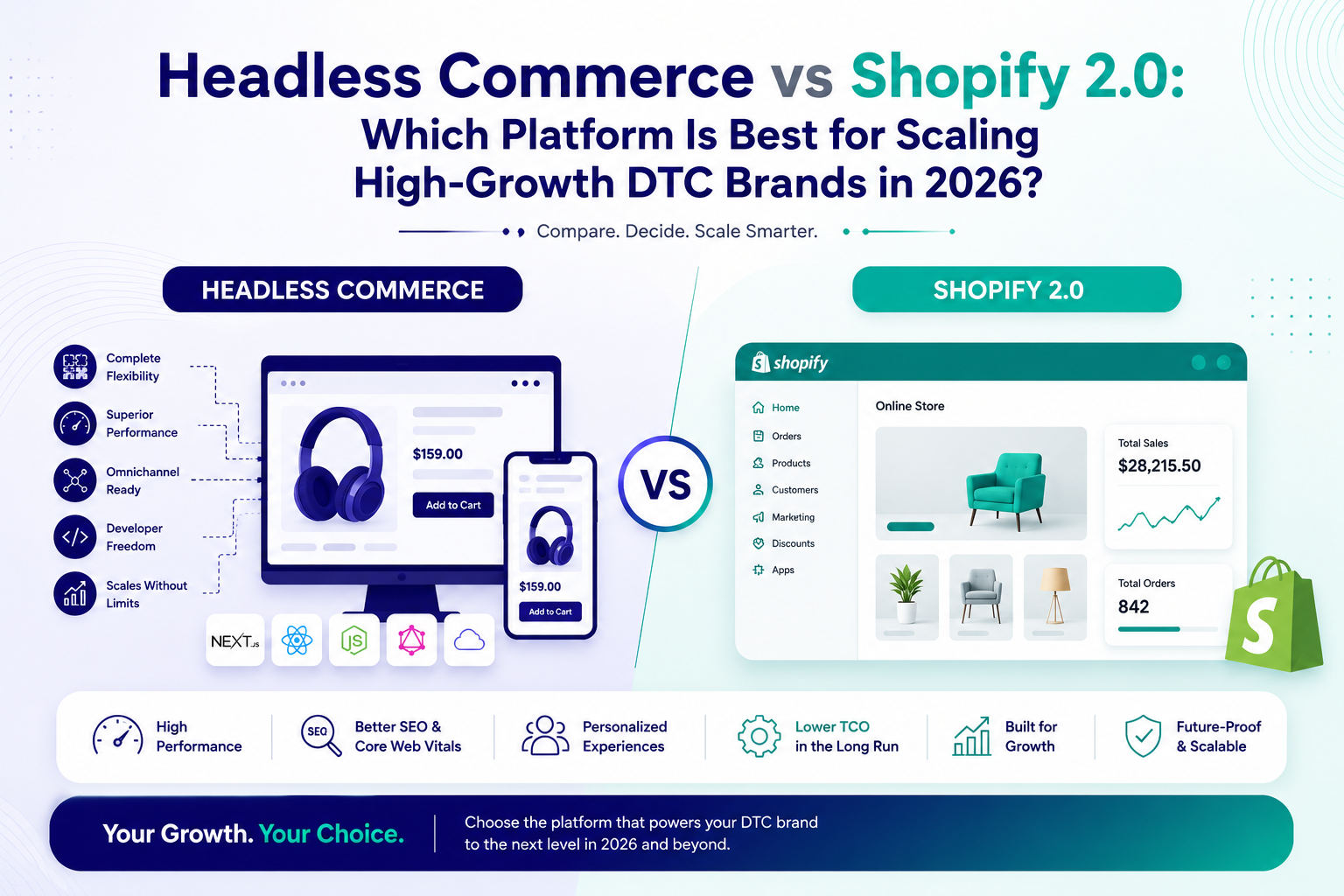
Scaling a high-growth DTC brand in 2026 is not just about great products. It is about choosing the right ecommerce architecture that can handle traffic spikes, deliver fast experiences, and support advanced marketing. For many founders and CMOs, the big question is whether Shopify 2.0 is enough or if it is time to move to headless commerce.
This guide breaks down Shopify 2.0 vs headless commerce in practical terms, using real-world scenarios for growing brands. You will understand what headless commerce is, when to switch, and whether your Shopify store should go headless or stay on a well-optimized Shopify 2.0 stack.
Understanding Shopify 2.0 For Scaling DTC Brands
Shopify 2.0 is the upgraded version of Shopify’s online store framework, designed to give brands more flexibility, better performance, and improved customization. For many DTC brands in India and globally, Shopify 2.0 is often the first serious ecommerce platform for scaling brands beyond the early stage.
With Shopify 2.0, merchants get improved theme architecture, faster storefront rendering, and more control over sections and blocks. When combined with expert Shopify website development agency support, it can deliver fast ecommerce websites for conversions without needing a complex headless setup.
Key Features That Make Shopify 2.0 Attractive
Shopify 2.0 brings a more modular theme system, better metafields, and improved app integrations. These changes make it easier for marketers to launch landing pages, run campaigns, and test offers without relying heavily on developers for every small change.
For growing DTC brands, this means faster experimentation and better alignment between ecommerce marketing services and the storefront. Shopify performance optimization is also easier with built-in tools, CDN delivery, and a mature ecosystem of performance-focused apps.
When Shopify 2.0 Is Enough For Growing Brands
Many founders ask if Shopify 2.0 is enough for growing brands that are scaling aggressively. In most cases, Shopify 2.0 can comfortably support brands up to mid-market level, especially when the store is well optimized and uses high-quality themes and apps.
If your current challenges are related to basic speed issues, checkout friction, or limited merchandising, improving Shopify performance optimization, cleaning up apps, and working with a specialist agency often solves the problem without needing to go headless.
What Is Headless Commerce In Simple Terms
To decide between Shopify 2.0 vs headless commerce, you need a clear view of what headless actually means. Headless commerce separates the frontend experience from the backend platform, so your storefront is built using modern frameworks while Shopify or another engine manages products, orders, and payments.
In this model, the frontend communicates with the backend via APIs. This gives brands more control over design, performance, and omnichannel experiences. Headless ecommerce for high traffic stores is popular because it can deliver extremely fast, custom experiences tailored to specific audiences and markets.
Headless Commerce Advantages And Disadvantages
Headless commerce advantages and disadvantages must be weighed carefully before making a decision. On the positive side, headless allows pixel-perfect design, lightning-fast page loads, and deep personalization. It is ideal for enterprise ecommerce brands that need unique experiences across web, mobile, apps, and other channels.
However, the disadvantages include higher development costs, more complex maintenance, and greater dependency on engineering teams. For many DTC brands, the question is not just is headless commerce worth it, but whether the team has the capacity to manage a more technical stack over the long term.
Headless Commerce For Enterprise Ecommerce And High Traffic
Headless commerce for enterprise ecommerce shines when brands operate across multiple regions, languages, or storefronts. It allows centralized logic with localized experiences, which is difficult to achieve with a single traditional theme-based store. This is especially relevant for brands planning global expansion.
Headless ecommerce for high traffic stores also helps when performance requirements are extreme, such as flash sales, influencer drops, or large-scale campaigns. In these situations, a decoupled frontend can be tuned for speed and resilience, while the backend handles order processing reliably.
Shopify 2.0 Vs Headless Commerce: How To Decide
Choosing between Shopify 2.0 vs headless commerce should start with your business goals, not just technology trends. The dominant search intent around this topic is informational with a commercial angle, which means leaders want clarity before committing budgets to a new architecture.
Instead of asking only should my Shopify store go headless, it is better to map your current pain points, growth targets, and team capabilities. Then you can match those needs to what Shopify 2.0 or a headless setup can realistically deliver in the next 12 to 24 months.
When To Switch To Headless Commerce
There are clear signals that indicate when to switch to headless commerce. If your brand has hit the limits of Shopify 2.0 themes, needs highly custom user journeys, or is planning a multi-country rollout with complex content, headless may be a strong option.
You should also consider headless if your marketing team needs advanced experimentation that standard Shopify templates cannot support. In these cases, a modern frontend with API-driven content and product data can unlock new growth opportunities and higher conversion rates.
When To Double Down On Shopify 2.0 Instead
On the other hand, if your main issues are slow load times, cluttered apps, or poor UX, Shopify 2.0 is often still the right foundation. A focused Shopify performance optimization project can dramatically improve speed and conversions without a full rebuild.
For many Indian DTC brands, investing in a strong Shopify website development agency, better CRO, and integrated ecommerce marketing services delivers a higher ROI than moving to headless too early. This approach keeps your stack simpler while still supporting aggressive growth.
Practical Evaluation Checklist For DTC Founders
To make a confident decision, it helps to use a structured checklist. This reduces bias and keeps the conversation grounded in numbers, not hype. You can review this list with your internal team and external partners to align on the right path forward.
Consider the following factors before choosing Shopify 2.0 or headless commerce for your next phase of growth. Revisiting this checklist every 6 to 12 months also helps you decide if your current architecture is still serving your goals.
Key Questions To Ask Before Going Headless
Use these questions to clarify whether headless commerce is worth it for your specific situation and stage of growth. Honest answers will prevent overbuilding or underinvesting in your ecommerce platform.
- Is my current Shopify 2.0 store truly maxed out, or can optimization still deliver gains
- Do I have or plan to build an in-house or retained engineering team to manage a headless stack
- Are my performance issues due to architecture or poor implementation and heavy apps
- Do I need unique experiences across multiple regions, brands, or channels
- Will a headless build directly support revenue, AOV, or LTV growth in the next 12 months
Which Path Is Best For Scaling In 2026
Looking ahead to 2026, the best ecommerce platform for scaling brands will be the one that balances flexibility, speed, and operational simplicity. For many DTC brands, a well-optimized Shopify 2.0 store, supported by strong partners, will remain a powerful and cost-effective choice.
Headless commerce will continue to grow among larger and more complex brands that need advanced personalization, global rollouts, or highly custom experiences. The key is to avoid rushing into headless just because it is a trend and instead align your technology roadmap with clear business outcomes.
Conclusion: Making A Confident Platform Decision
Deciding between Shopify 2.0 and headless commerce is ultimately a strategic choice, not just a technical one. If your brand is still unlocking growth through better UX, faster pages, and smarter campaigns, doubling down on Shopify 2.0 with expert support is often the smartest move.
When your brand reaches a stage where standard templates and apps limit innovation, exploring headless commerce for enterprise ecommerce can be the next logical step. Partnering with HRL Infotechs can help you evaluate both paths objectively, design a scalable architecture, and build a store that is ready for the demands of high-growth DTC in 2026.