

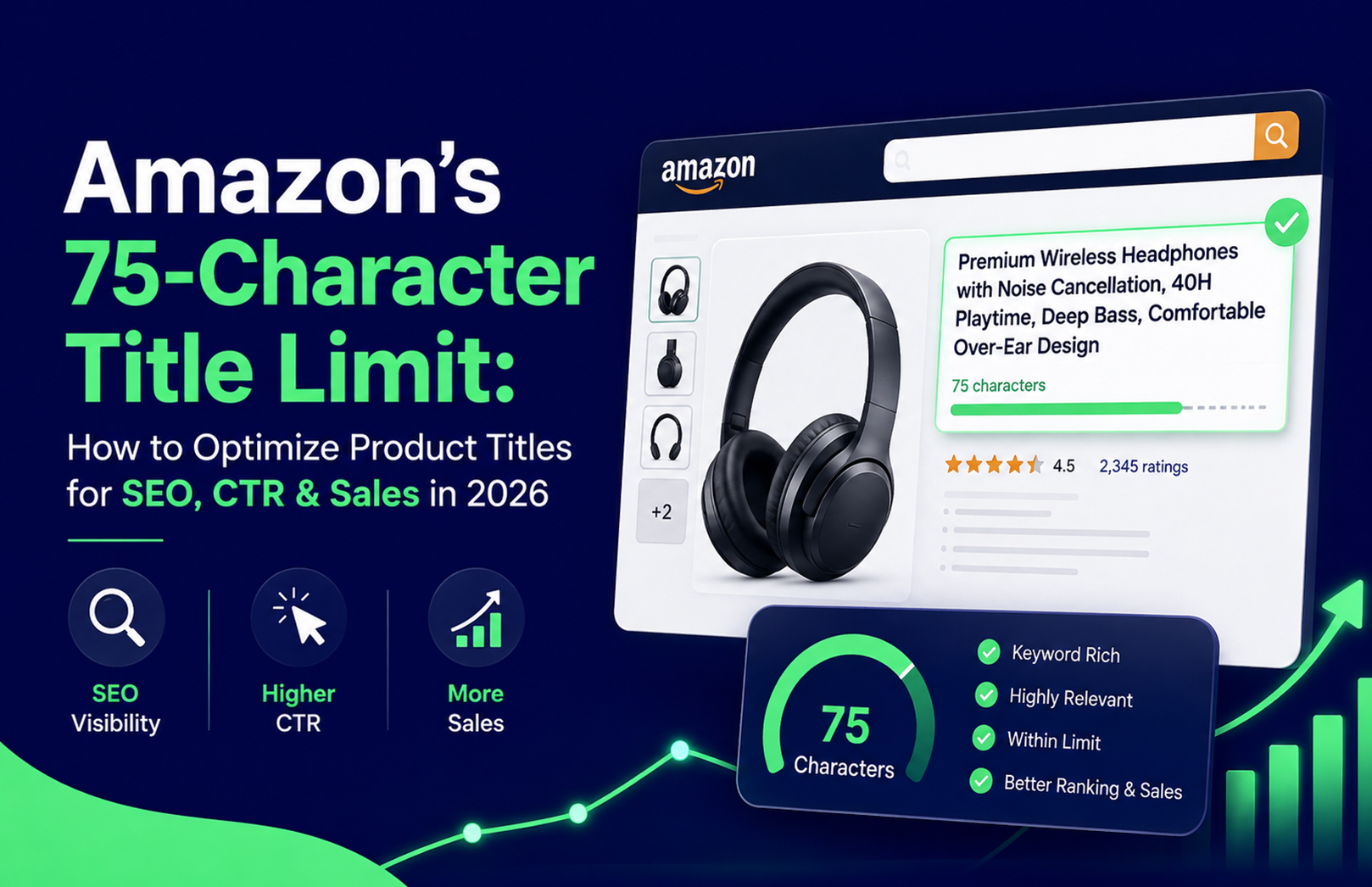
Amazon sellers in India need to rethink how they create and optimize product titles in 2026. Amazon announced that, starting July 27, 2026, product titles in all categories except media must be 75 characters or fewer, including spaces. Amazon says the change is intended to make product titles display more clearly on mobile devices and create a more consistent shopping experience.
For sellers, this makes Amazon product title optimization more important than ever. Instead of trying to fit as many keywords as possible into a title, brands now need to prioritize the right keyword, essential product information and conversion-focused messaging within a much smaller character limit.
A well-optimized Amazon product title can help shoppers understand a product quickly, support relevance for Amazon search and encourage more clicks. In 2026, the goal is not simply to write a shorter title—it is to make every character work harder.
What Is Amazon’s 75-Character Title Limit?
Amazon’s new requirement states that titles for categories other than media must contain 75 characters or fewer, including spaces. Amazon also introduced Item Highlights, which provide an additional 125 characters for information such as materials and recommended use cases. This content is searchable and can appear with titles in search results and on product detail pages.
Amazon is also providing AI-powered tools to help sellers create titles and Item Highlights that comply with the new limits. Sellers can access recommendations through Manage All Inventory and review suggested changes before implementation.
This means the Amazon title character limit should not be viewed only as a compliance requirement. It should be treated as an opportunity to make product listings more concise, relevant and shopper-friendly.
Why Amazon Product Title Optimization Matters in 2026
The title is one of the first pieces of information shoppers encounter when browsing Amazon search results. It tells customers what the product is and can immediately communicate important attributes such as size, quantity, material, compatibility or use case.
At the same time, your title contributes to how Amazon understands your product and its relevance to customer searches. This makes Amazon SEO and title optimization closely connected.
However, keyword placement alone is not enough. A title can contain relevant keywords and still perform poorly if it is difficult to read or does not communicate a compelling reason to click.
The best approach combines search relevance + readability + conversion intent.
How to Optimize an Amazon Product Title Within 75 Characters
1. Start With the Most Important Keyword
The primary product keyword should generally appear early in the title so shoppers can understand the product immediately.
For example, instead of:
“Premium Quality Best Wireless Bluetooth Earbuds for Music Calls”
consider:
“Wireless Bluetooth Earbuds, Noise Cancellation, 40H Battery”
The second version removes unnecessary promotional wording and focuses on product identity and meaningful attributes.
When performing Amazon title optimization, identify the search terms most closely connected to the product and customer buying intent. Do not automatically choose a keyword simply because it has the highest search volume.
2. Remove Unnecessary Words
The new Amazon 75 character title limit means sellers have less room for filler.
Words such as “best,” “amazing,” “premium quality,” “high quality” and “perfect” can consume valuable space without helping shoppers understand the product.
Instead, use characters for information that helps customers make a purchasing decision.
Prioritize:
- Product type
- Primary keyword
- Important feature
- Size or quantity
- Material
- Compatibility
- Key use case
- Meaningful differentiator
Every word should either improve relevance or help the shopper understand the product.
3. Use High-Intent Keywords
Effective Amazon SEO begins with understanding what shoppers actually search for when they are ready to purchase.
For an Indian seller, keyword research can include:
- Core product keywords
- Long-tail search terms
- Product attributes
- Size and quantity terms
- Material-related searches
- Compatibility keywords
- Usage-based searches
- Category-specific terminology
- Commercial search phrases
Rather than inserting every keyword into the title, select the strongest primary term and use the remaining relevant terms naturally across the listing.
This is particularly important because Amazon’s new title format forces sellers to make stronger keyword prioritization decisions.
4. Optimize for CTR, Not Just Rankings
A common mistake is to think that Amazon product title optimization is only about rankings.
Your title also has a direct role in the shopper’s decision to click.
Consider these examples:
Generic:
“Face Serum 30ml”
More informative:
“Vitamin C Face Serum 30ml, Brightening, Lightweight”
The second title quickly communicates the product, size and relevant benefit. It gives the shopper more context without becoming unnecessarily long.
A good title should answer the shopper’s basic question:
“Is this the product I am looking for?”
If the answer is immediately clear, the listing has a stronger opportunity to earn the click.
Use Item Highlights Instead of Overloading the Title
The 75-character requirement does not mean every product benefit needs to disappear.
Amazon’s new Item Highlights feature provides up to 125 additional characters for information such as materials and recommended use cases. Amazon states that this content is searchable and visible with titles in search results and on product detail pages.
This creates an opportunity to separate information strategically.
Product title:
Product identity + primary keyword + critical attribute
Item Highlights:
Material + recommended use + supporting product information
For example:
Title:
“Stainless Steel Water Bottle 1L, Leakproof, Insulated”
Item Highlight:
“Suitable for office, gym, school and travel; durable stainless steel construction.”
This approach keeps the title focused while giving customers additional information elsewhere in the listing.
Amazon Product Title Character Limit: Mistakes to Avoid
The biggest mistake sellers can make is treating the Amazon product title character limit as a keyword puzzle.
Avoid these common errors:
- Repeating the same keyword multiple times
- Adding unrelated high-volume keywords
- Using unnecessary promotional claims
- Writing the entire title in capital letters
- Adding excessive punctuation
- Including information that belongs elsewhere in the listing
- Hiding the primary product keyword
- Sacrificing readability to add another keyword
- Ignoring category-specific Amazon requirements
Amazon’s guidance emphasizes concise titles and provides title requirements and best practices for sellers. Amazon also notes that titles exceeding applicable requirements can be subject to changes through its enforcement process.
The objective should always be relevance without keyword stuffing.
A Simple Formula for Amazon Title Optimization
A practical structure for creating a 75-character title is:
[Primary Product Keyword] + [Key Feature] + [Size/Quantity] + [Critical Differentiator]
For example:
“Cotton Bedsheet King Size, 300 TC, Floral Print”
Or:
“Yoga Mat 6mm, Non-Slip, Extra Wide for Home Workouts”
The exact structure will vary by category, but the principle remains the same: start with what the product is, then use the remaining space for the information most likely to influence search relevance and purchasing decisions.
Before publishing, check:
- Is the main product keyword clear?
- Is the product immediately understandable?
- Is the most important information near the beginning?
- Have filler words been removed?
- Is the title 75 characters or fewer?
- Does it follow category-specific requirements?
- Would a real shopper find the title useful?
How Better Titles Can Improve CTR and Sales
An optimized title cannot guarantee higher sales on its own. Amazon performance depends on several factors, including pricing, reviews, availability, advertising, images, conversion rate and overall listing quality.
However, a strong title can contribute to the customer journey in several ways.
Better relevance: A clearly structured title helps communicate what the product is and which searches it is relevant to.
Better readability: Customers can understand the offer faster, particularly when browsing on mobile.
Better click potential: A title that clearly matches customer intent can provide a stronger reason to open the product detail page.
This is why Amazon listing optimization should go beyond the title. Sellers should also optimize bullet points, product images, backend search terms, A+ Content and other listing elements.
If your catalogue contains multiple ASINs, maintaining all of these elements consistently can become difficult. Professional Amazon account management services can help brands manage catalogue optimization, listing performance, account health and other ongoing marketplace activities. HRL Infotechs provides account management covering catalogue optimization, performance analysis and broader Seller Central operations.
Combine Amazon SEO With Complete Listing Optimization
A product title works best when the rest of the listing supports it.
Imagine a customer searches for a product and clicks because the title matches their intent. If the product images are unclear, bullet points are weak or the description does not answer their questions, the click may not turn into a purchase.
That is why Amazon listing optimization should cover the entire product detail page.
A strong optimization strategy can include:
- Keyword research
- Amazon product title optimization
- Bullet point optimization
- Backend search term optimization
- Product image optimization
- A+ Content
- Competitor analysis
- Conversion-focused content
- Search performance monitoring
For brands that need professional support, HRL Infotechs offers Amazon product listing and SEO services, helping businesses optimize product titles, keywords and other listing elements as part of a broader Amazon growth strategy.
Connect Title Optimization With Amazon Marketing
Optimizing a listing is only one part of growing on Amazon. Once your product page is properly structured, paid advertising can help bring qualified shoppers to it.
This is where Amazon marketing services become valuable.
Amazon PPC campaigns can be aligned with listing keywords so that the search terms being targeted through advertising are also reflected naturally within the product detail page. HRL Infotechs’ Amazon advertising approach combines keyword research, campaign management and listing optimization to help paid traffic reach product pages designed to convert.
For example, if your PPC campaign identifies a high-converting search term, your listing strategy can evaluate whether that term is appropriately represented in the title or another relevant listing field.
This creates a stronger connection between:
Keyword research → Amazon SEO → Listing optimization → PPC → Conversion → Sales
Should You Rewrite Existing Amazon Titles?
If you already have Amazon listings, do not blindly rewrite every title simply to make it shorter.
Start with your highest-priority ASINs.
Review:
- Current title length
- Organic ranking
- Main search terms
- Click performance
- Conversion rate
- Sales contribution
- Competitor titles
- Product relevance
- Category requirements
Then prioritize titles that are over the new limit or contain unnecessary wording.
Amazon states that titles exceeding 75 characters after the July 27 change will be updated to AI recommendations gradually. Sellers can review, modify and approve AI-generated recommendations during the specified review period.
For brands with a large catalogue, this makes a systematic title audit more valuable than making random changes.
A 2026 Amazon Title Optimization Checklist
Before finalizing any Amazon product title, use this quick checklist:
- Keep the title within the applicable character limit.
- Place the primary product keyword naturally.
- Describe the product clearly.
- Add only important attributes.
- Remove repetitive keywords.
- Remove unnecessary promotional language.
- Keep the title easy to read.
- Optimize for mobile shoppers.
- Follow category-specific requirements.
- Use Item Highlights for additional information where applicable.
- Review performance after optimization.
A title should not be written once and forgotten. Amazon search behavior, competition and customer preferences can change, so ongoing performance analysis is essential.
Final Thoughts
Amazon’s 75-character title limit is changing how sellers should approach product listing optimization in 2026. With less space available, brands cannot rely on long keyword-heavy titles to communicate every possible product detail.
Instead, successful Amazon product title optimization requires prioritization.
Start with the strongest relevant keyword. Clearly identify the product. Add the most important attribute or differentiator. Remove unnecessary words and use Item Highlights and other listing fields for additional information.
For Indian Amazon sellers, this is an opportunity to create cleaner, more focused listings that work better for mobile shoppers while supporting broader Amazon SEO and conversion strategies.
When title optimization is combined with complete Amazon listing optimization, professional account management and targeted Amazon marketing services, sellers can build a more consistent foundation for visibility, traffic and long-term marketplace growth.
If your Amazon catalogue needs to be reviewed for the new 75-character requirements, connect with HRL Infotechs for Amazon marketing and listing support.
FAQs
1. What is Amazon’s 75-character title limit?
Starting July 27, 2026, Amazon requires product titles in categories other than media to be 75 characters or fewer, including spaces.
2. Does the Amazon 75-character title limit apply to sellers in India?
Yes. Amazon’s Seller Central India announcement specifies that titles in all categories except media must be 75 characters or less, including spaces.
3. Can I still use keywords in my Amazon product title?
Yes. Keywords remain important for Amazon SEO, but sellers should focus on the most relevant, high-intent terms instead of repeating keywords or trying to include every search phrase.
4. What should I do if important product information does not fit within 75 characters?
Amazon introduced Item Highlights, which provide up to 125 additional characters for information such as materials and recommended use cases. This information is also searchable.
5. Can Amazon product title optimization increase sales?
An optimized title cannot guarantee sales, but it can improve product clarity, search relevance and click potential. Strong results usually require title optimization alongside images, bullet points, A+ Content, pricing, reviews, inventory and advertising.
6. Should I optimize all my Amazon product titles?
It is advisable to audit your catalogue, particularly high-traffic and high-revenue ASINs. Prioritize titles that exceed the new limit, contain unnecessary wording or are not clearly aligned with high-intent customer searches.