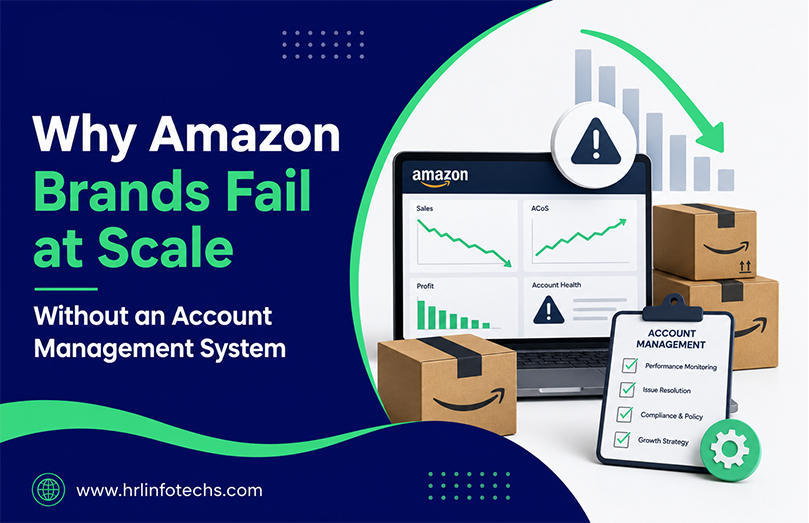
Why Amazon Brands Fail at Scale Without an Account Management System


Most Amazon brands have a good first year.

A product catches on, the ads start performing, and sales climb month over month. Everyone’s happy. Then, somewhere around month eight or nine, things that used to run smoothly start breaking quietly in the background.

Inventory runs out at the worst possible moment. Advertising costs creep up without anyone noticing why. A listing that was ranking well two months ago has slipped to page two. Customer complaints start showing up that nobody has time to chase down properly.

None of this happens because the product got worse. It happens because growth exposed gaps that were always there; they just weren’t visible when order volume was small enough to manage by memory. This is exactly the moment where real Amazon account management services stop being optional and start being the thing that decides whether a brand keeps growing or quietly stalls.

The brands that keep scaling and the ones that plateau usually aren’t separated by who has the better product. They’re separated by who built a system before they needed one.

Why Growth Creates Problems Nobody Saw Coming

In the early days, running a seller account is genuinely manageable solo. A handful of SKUs, a couple of ad campaigns, maybe an hour a day checking on things. That’s fine.

Here’s how it piles up. More ad campaigns mean more daily monitoring. Inventory guesses start carrying real financial weight. Listings demand constant tweaking instead of a one-time setup. Customer questions start overflowing whatever spare time used to exist. Account metrics deserve a much closer look than a glance. Performance data piles up faster than anyone can read it properly. Pricing decisions stop being something you can put off till next week.

Without a real Amazon seller growth strategy behind all of that, these things stop being manageable tasks and start becoming bottlenecks that quietly slow everything down.

The Costs Nobody Budgets For

A lot of sellers assume that more sales automatically mean things are going well. It’s not quite that simple.

Unmanaged growth tends to bring its own problems along with it: stock running out at the wrong time, ad spend climbing without a clear reason, account health numbers slipping, listings getting suppressed out of nowhere, conversion rates quietly dropping, and storage fees piling up on inventory that isn’t moving fast enough.

All of this works directly against sustainable Amazon business scaling, even while the top-line sales numbers might still look fine for a while. The brands without proper systems usually end up spending more time firefighting these issues than actually working on the next stage of growth.

Why Scaling Actually Requires a System

Growing a brand on Amazon isn’t just about selling more units. It’s about staying consistent while the operation gets bigger and messier.

Real growth depends on a few things working together: tight Amazon PPC management that doesn’t bleed budget, Amazon listing optimisation that treats every page as something living rather than set-and-forget, inventory planned instead of reacted to, and an honest read of the data instead of a gut-feel guess.

Without that, brands end up reactive. And here’s the part that catches people off guard: a small mistake that barely matters at ten orders a day becomes a serious problem once you’re doing a thousand. Scale doesn’t just multiply revenue. It multiplies the cost of every small thing you’ve been ignoring.

What an Account Management System Actually Does

A proper account management system puts structure around every part of the business that used to run on memory and good intentions.

Most times it involves watching how listings perform, staying aware of stock condition, tracking ad results closely, noticing price shifts before they cost money, reading what customers are actually saying, checking account numbers regularly, and keeping an eye on what competitors are doing, all gathered neatly in one place, updated consistently, rather than floating loose inside someone’s head.

With things finally clear, attention shifts naturally toward building the company, not just putting out morning emergencies.

The Marketplace Itself Keeps Getting Harder

Amazon today is a genuinely different environment than it was even two years ago.

New sellers show up in every category constantly. Advertising costs keep climbing. The search algorithm keeps shifting. Customers expect more than they used to, faster than they used to.

A sharp Amazon advertising strategy helps brands stay steady through all of that, not by avoiding the chaos, but by having enough operational consistency to absorb it without falling behind. Brands that don’t adapt tend to lose ground quietly to competitors who simply have better systems running underneath them.

Building Something That Actually Lasts

Short-term promotions and discount sprints can move the needle for a week. They don’t build a business.

Real Amazon sales optimisation is built around things that compound profitability, repeat customers, ad spend that’s actually efficient, inventory that’s planned instead of reactive, listings that keep improving, and a brand that’s actually building something recognisable over time.

The brands that focus on operational stability tend to outperform the ones chasing aggressive discounting or ad spend spikes, simply because stability is what survives past the first good quarter.

Why the Small Stuff Matters More Than It Seems

It’s rarely one big disaster that tanks an account. It’s usually a handful of small things compounding quietly.

A weak product title here. Incomplete backend keywords there. Inventory is running a little too low too often. Conversion rates are slowly drifting down. Ad costs are creeping up. A few unanswered negative reviews.

Catching these early is exactly what proper Amazon brand management is supposed to do, not after a quarterly review shows the damage already done, but continuously, before small issues turn into lost sales nobody noticed slipping away.

When It’s Time to Bring in Real Expertise

At some point, the operational demands of running an Amazon brand outgrow what an internal team can reasonably handle alone.

Most times, this is where real expertise across Amazon A+ Content Design, Amazon Storefront Design, advertising, inventory, and account standing actually starts mattering. The goal isn’t to swap out the people who built the brand. It’s to free them up to stay focused on products and customers, while someone else takes charge of the daily operational demands that have grown too heavy to juggle part-time.

A storefront that actually looks built, and A+ Content that actually explains the product properly, are the kind of things that get pushed aside when the team is stretched thin, and they’re exactly the things that quietly cost conversions when they’re missing.

Why This Never Really Stops

Amazon doesn’t sit still. Algorithms shift. Competitors adjust pricing overnight. What customers want changes. Ad costs go up and down without warning.

Real growth management isn’t a project you finish and walk away from. It’s ongoing, constant monitoring, constant small adjustments. The brands still growing two or three years from now will almost certainly be the ones that kept adapting the whole way through, not the ones that set something up once and assumed it would keep working forever.

Conclusion

Most Amazon brands that hit a wall didn’t fail because of a bad product or weak demand. They failed because growth introduced problems that a system would have caught, and they didn’t have one.

Real Amazon account management services give you the structure to handle inventory properly, keep listings sharp, run advertising efficiently, and protect account health before small issues turn into expensive ones.

At HRL Infotechs, this is genuinely what we help brands build: scalable systems backed by real account management, sharp PPC and listing strategy, strong A+ Content and Storefront work, and the kind of operational support that lets a brand grow without quietly falling apart in the background. As the marketplace keeps getting more competitive, the brands that invest properly in this now are the ones that’ll still be growing profitably a few years from today.


Want to Boost the Sales with Amazon Storefront Design?


In the rapidly evolving realm of e-commerce, comprehending the intricate interplay between advertising and inventory management emerges as a pivotal determinant for businesses aiming to flourish on prominent platforms like Amazon. As a colossal online marketplace, Amazon presents abundant opportunities for sellers and brands to tap into an expansive customer base, yet effectively capitalizing on this potential necessitates a well-coordinated approach that harmonizes advertising strategies with astute inventory management. This symbiotic relationship between advertising and inventory management not only augments visibility and sales but also ensures the judicious allocation of resources and a seamless customer experience.

Within this enlightening manual, we delve into the profound correlation between Amazon advertising and inventory management, delving into how these two fundamental elements function in tandem to propel growth and unleash the full potential of online selling. Whether you are an established seller or an aspiring entrepreneur, gaining valuable insights into this pivotal nexus can equip you with the confidence and efficiency to navigate the Amazon marketplace, paving the way towards sustainable success.

Amazon Advertising: An Overview

Amazon Advertising stands as a potent and dynamic marketing platform, revolutionizing the approach of businesses towards product promotion and customer engagement in the digital era. As an integral component of the Amazon ecosystem, this advertising platform empowers sellers and brands to directly reach millions of potential buyers on the world’s largest online marketplace. Diverse ad formats, including Sponsored Products, Sponsored Brands, and Display Ads, grant sellers the flexibility to tailor campaigns to specific customer segments, target pertinent keywords, and enhance product visibility.

The abundance of data generated by customer searches and behavior serves as a valuable resource for advertisers, enabling data-driven strategies that elevate the precision and efficacy of marketing endeavors. From optimizing product rankings to driving sales and fostering brand recognition, Amazon Advertising has emerged as a pivotal tool, facilitating the prosperity of businesses across all scales in the dynamic realm of e-commerce.

With the marketplaces is extending continuously and comprehending the potential that 

Amazon Advertising has become for both sellers and brands which are seeking to maintain the required competitiveness and to establish a long lasting existence on the given retail giant.

The Significance of Amazon’s Inventory Management

The world renowned Amazon’s success as the best foremost online retailer is deeply rooted in its impactful and efficient inventory management .With a very vast and diverse product range, a proficient inventory management plays an important role in meeting the demands of the customer and reducing the costs of fulfillment while optimizing the operational efficiency on the other hand. The company’s inventory management system enables to maintain an extensive collection of products and efficiently replenish the popular items and ensure perfect deliveries.

By employing the advanced algorithms and real time data analysis, the company can anticipate demand, prevent the products from being stocked out and avoid overstocking too, balancing availability and cost-effectiveness at the same time. The streamlined approach not only just improves customer satisfaction but it also empowers the sellers and the brands to capitalize the Amazon’s extensive logistics network and services being fulfilled, for an example FBA.

Consequently, businesses can concentrate on quality of products and how it is been marketed and the complexity of inventory management to Amazon. Moreover, the company extends the inventory management process to third-party sellers, providing a seamless and smooth shopping experience for the customers worldwide, thus, amazon’s faithful commitment to an efficient inventory management stands as a vital factor in maintaining a dominant position in the whole e-commerce landscape, establishing a mutual relationship which is beneficial for both sellers and customers.

The Relationship Between Inventory Management And Amazon Advertising

The strategic alliance between inventory management and Amazon advertising holds paramount importance for sellers aspiring to thrive on the Amazon marketplace. Coordinating these two essential elements can significantly impact a seller’s success. Efficient inventory management is vital to maintain adequate stock levels, avoiding stock outs and overstocking, which can result in missed sales opportunities or increased storage costs. By optimizing inventory levels, sellers can ensure prompt order fulfillment, enhancing their reputation for reliability and timely deliveries, consequently positively impacting customer satisfaction.

Conversely, Amazon advertising empowers sellers to augment product visibility, attract potential buyers, and boost sales. When integrated with inventory management data, advertising campaigns can be tailored to target specific products or capitalize on high-demand periods, thereby optimizing ad spend and driving conversion rates. For instance, sellers can strategically utilize Sponsored Products campaigns to promote items with ample stock and leverage Sponsored Brands to cultivate brand awareness during peak seasons when inventory is abundant. Furthermore, advertising efforts can be dynamically adjusted in response to inventory levels, enabling sellers to refrain from promoting products that may soon go out of stock.

The amalgamation of effective inventory management and targeted advertising establishes a virtuous cycle. Adequate inventory ensures the fulfillment of advertised products, while successful advertising campaigns increase product visibility and drive sales, consequently reducing inventory turnover time. This collegial approach optimizes a seller’s resource utilization, leading to improved profitability and an enhanced overall shopping experience for customers.

Tips For Integrating Inventory Management And Advertising Successfully

Strategies for Seamlessly Integrating Inventory Management and Advertising on Amazon

  • Insights from Data Analytics: Utilize data-driven analytics to gain in-depth knowledge of product performance, customer behavior, and demand trends. By combining inventory data with advertising insights, you can identify high-demand products and optimize advertising efforts accordingly.
  • Aligned Planning: Synchronize inventory management and advertising strategies with seasonal trends, sales promotions, and product launches. Coordinate advertising campaigns to complement available inventory, ensuring timely fulfillment and avoiding stock outs during peak periods.
  • Optimizing Budgets: Link advertising budgets with inventory availability to avoid advertising out-of-stock products. Allocate more resources to promote items with ample stock to maximize returns on advertising investment.
  • Continuous Monitoring: Monitor inventory levels and sales performance in real-time to adjust advertising efforts accordingly. Pause or modify advertising campaigns for products running low on stock to prevent customer disappointment.
  • Agile Response: Be prepared to swiftly pivot advertising efforts in response to sudden changes in inventory levels or customer demand. Be prepared to adapt, manage the inventory and advertising allows effective response to dynamic market conditions.  Utilizing Amazon’s Fulfillment by Amazon (FBA) service to rationalize inventory management, which then focuses on advertising and business growth. 
  • Implementing A/B Testing: to optimize campaigns and resource allocation based on different inventory levels and customer segments.  You could also ensure accurate, informative and appealing product listings to improve conversion rates and inventory turnover. Use demand forecasting to project inventory needs and plan replenishments in advance, minimizing stockouts and disruptions in advertising efforts. Effective communication and collaboration between inventory management and advertising teams lead to informed decision-making and better business outcomes.

Final Thoughts

The seamless integration of the inventory management and advertising on Amazon not only plays an important role in seller’s success in the competitive e-com industry but it also empowers businesses which optimize resources, provide a better customer experience and drive sales to new heights. What helps the sellers to stay ahead is the Amazon’s storefront design helps the sellers to stay ahead and seize opportunities and promote a  prospering business.Captivating storefront designs also complements advertising efforts and increases brand identity, thus making a long lasting impact on buyers.

All set to elevate your Amazon selling name? Shake hands with HRL services, a reputed amazon advertising agency specialized in stunning amazing Amazon storefront designs. Our professional team crafts data engaged ad strategies which aligns with your inventory management, driving sales and also increasing the brand visibility to unlock Amazon’s selling potential. Pick from our professionally designed storefront templates or let us customize one to perfectly match the brand identity. Embrace the power of effective advertising and engaging storefront designs with HRL services, and begin your journey to an e-commerce excellence today!