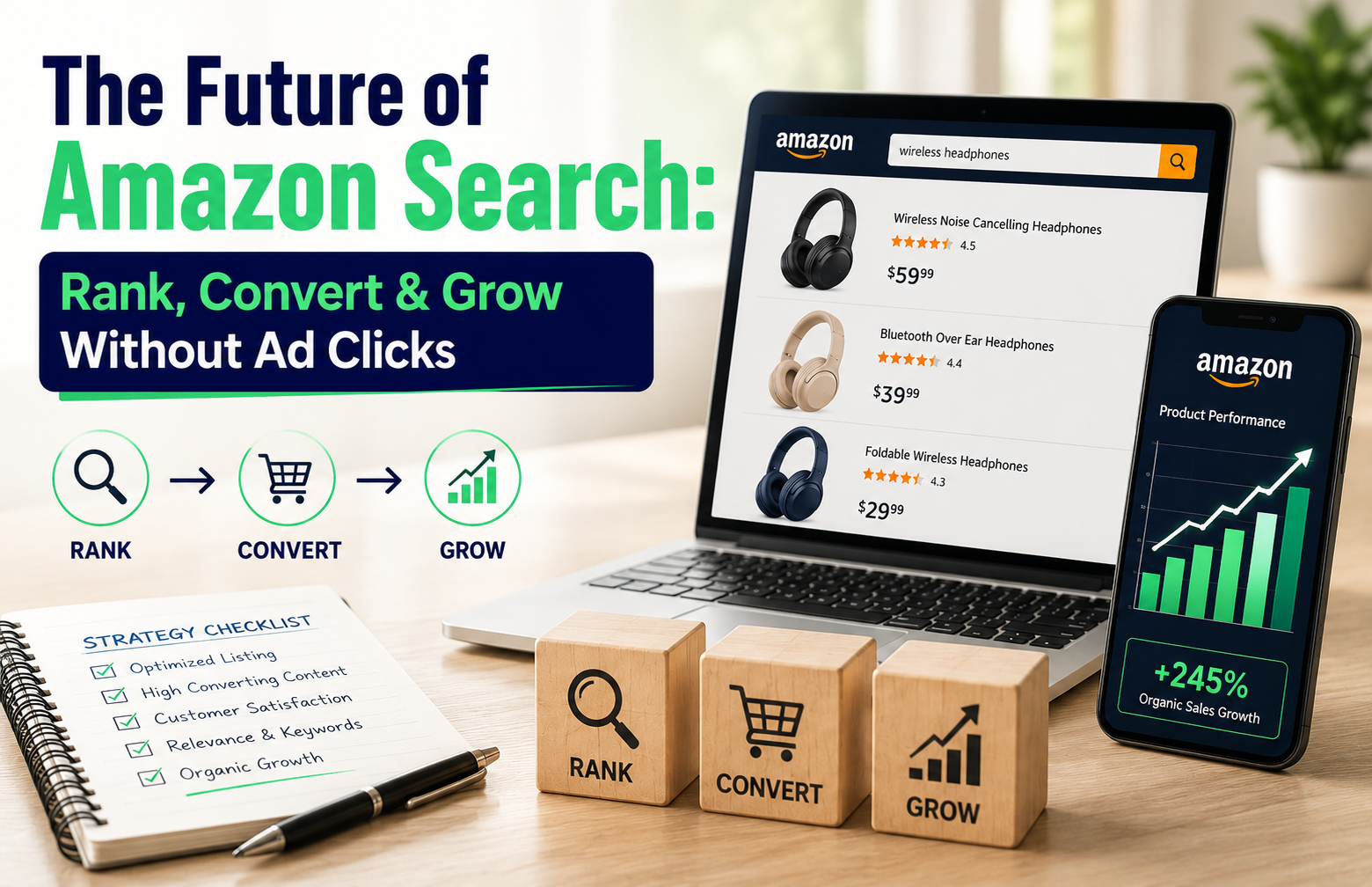
The Future of Amazon Search: How Sellers Can Rank, Convert & Grow Without Ad Clicks


Shoppers on Amazon are searching, comparing and deciding faster than ever. Many of them never click on ads or even scroll very far. They scan what appears first, read key details, check reviews and buy. This new behaviour is driving a powerful shift toward amazon zero click search, where winning the first glance matters more than ever.

For Indian sellers, this shift is both a challenge and a massive opportunity. If you understand how to rank on Amazon without ads, how to align with Amazon organic ranking factors and how to turn impressions into conversions, you can grow profitably even when ad costs rise. This guide breaks down exactly how to do that.

Understanding Amazon Zero Click Search And Why It Matters

Amazon zero click search refers to buying journeys where shoppers get everything they need from the first screen of results. They see a product’s image, title, price, rating and key benefits, then decide to purchase or shortlist without exploring many other listings or sponsored ads.

This behaviour is growing because customers trust Amazon’s organic ranking and rely on visual cues. For sellers, that means your product must be highly visible, instantly clear and strongly persuasive right from the search results page, not only on the product detail page.

Dominant Search Intent: High-Intent, Research-Driven Buyers

Most searches that trigger amazon zero click search are high-intent Amazon keywords. Shoppers already know what they want, such as a specific size, feature, material or use case. They are comparing options, not casually browsing, so relevance and clarity are critical.

To capture this intent, you need a focused amazon brand growth strategy. That includes mapping long tail queries, aligning your content with buyer language and ensuring your offer is clearly better than competing listings on the first page, especially in India’s price-sensitive but quality-conscious market.

Core Amazon Organic Ranking Factors In A Zero Click World

Amazon’s algorithm is designed to maximise revenue and customer satisfaction. In a zero click ecommerce search environment, the core amazon organic ranking factors become even more important, because the system must quickly identify which products deserve top visibility.

While the exact formula is secret, performance data from top sellers shows that the following elements have the strongest impact on how to rank on Amazon without ads and with lower ad dependency over time.

Relevance: Keywords, Category And Listing Structure

Relevance starts with how precisely your listing matches the search query. Amazon uses your title, bullet points, description, backend keywords and category to decide if your product deserves to appear for a term like amazon long tail keywords or a very specific product phrase.

To improve relevance, research high intent Amazon keywords that match your product’s real strengths. Integrate them naturally into titles and bullets, and use backend fields for variations and synonyms. This helps you show up for more zero click ecommerce search journeys without keyword stuffing.

Performance: Click-Through Rate, Conversion And Sales Velocity

Once you appear in search, Amazon tracks how shoppers respond. High click-through rate, strong conversion rate and consistent sales velocity signal that your product satisfies demand. These signals are central amazon organic ranking factors and directly influence your future visibility.

Improving images, pricing, reviews and social proof can significantly lift performance. Over time, better performance allows you to rely less on Amazon PPC vs organic ranking, because organic placements become strong enough to generate stable sales even when ad budgets are controlled.

Customer Experience: Reviews, Returns And Content Clarity

Amazon wants happy customers who keep buying. Positive reviews, low return rates and clear, accurate content all feed into that goal. Listings that overpromise or mislead may get clicks but will struggle to sustain organic rank in the long run.

Focus on honest benefit-driven copy, realistic images and transparent details. This approach not only supports amazon conversion rate optimization but also builds long-term trust, which is vital for brand growth in India’s competitive marketplaces.

Advanced Amazon Listing Optimization For Zero Click Wins

To truly benefit from amazon zero click search, you must treat your search result snippet as a mini landing page. The title, main image, price, rating and badges together must answer the buyer’s key questions and push them to click or buy.

Amazon listing optimization services and expert guidance can help you refine every element, but you can start with a structured approach that mirrors what top-ranking competitors are already doing in your category.

Titles And Images That Capture High-Intent Shoppers

Your title should combine clarity, benefits and amazon long tail keywords. Instead of stuffing every possible phrase, focus on the 2 or 3 most important attributes buyers care about, such as size, material, use case or compatibility, along with the core product keyword.

For images, invest in a clean, high-resolution main image that stands out on mobile. Support it with secondary images that show use cases, scale, key features and comparison shots. Strong visuals are often the deciding factor in amazon zero click search outcomes.

Bullet Points, A+ Content And Conversion Triggers

Bullet points should quickly communicate benefits, not just features. Use simple language, short phrases and scannable formatting. Address objections like durability, warranty, compatibility and after-sales support to reassure buyers before they even reach the detail page.

Enhanced Amazon A+ Content design can further support amazon conversion rate optimization by telling a clear brand story, comparing variants and highlighting proof points. While A+ does not always show in the search snippet, it improves the overall performance signals that feed organic ranking.

Balancing Amazon PPC Vs Organic Ranking For Sustainable Growth

Paid ads still matter, but the goal is to use them strategically to boost organic visibility, not to depend on them forever. The healthiest accounts use Amazon PPC to generate early sales and data, then gradually shift focus to organic performance as rankings improve.

In practice, this means targeting high intent Amazon keywords with sponsored campaigns, monitoring which terms convert best and then doubling down on those terms in your listing content. Over time, this approach supports how to rank on Amazon without ads dominating your budget.

Using PPC Data To Strengthen Zero Click Ecommerce Search

Your search term reports are a goldmine for discovering amazon long tail keywords that real customers use. Many of these phrases have lower competition but very strong buying intent, making them perfect for amazon zero click search optimisation.

Identify phrases with strong conversion and reasonable cost, then integrate them into titles, bullets and backend fields. This closes the loop between Amazon PPC vs organic ranking and helps your listing earn more free, high-quality traffic.

Why Indian Sellers Need Pro-Level Amazon Account Management Services

Managing catalog health, pricing, inventory, ads and content together is complex, especially when you are scaling across multiple categories or marketplaces. This is where specialised Amazon account management services can create a real competitive edge.

An experienced amazon seo agency or amazon marketing agency in India understands local buyer behaviour, category trends and compliance requirements. They can coordinate listing optimisation, review generation, pricing tests and advertising so that every action supports your amazon brand growth strategy.

Key Outcomes Of Strategic Amazon Product Discoverability

When all these elements work together, your products become easier to find, easier to understand and easier to trust. That is the foundation of strong Amazon product discoverability and sustainable growth in a zero click environment.

Over time, you should see higher organic rankings, better conversion rates, lower ad dependency and more predictable revenue. These are the exact outcomes that top-ranking sellers focus on, and they are achievable with a disciplined, data-driven approach.

Conclusion: Turning Zero Click Behaviour Into A Growth Engine

Zero click behaviour on Amazon is not a threat to sellers who understand how the platform thinks. By aligning with amazon organic ranking factors, optimising for high-intent Amazon keywords and treating every search result impression as a conversion opportunity, you can build a resilient, profitable presence.

If you want expert support in mastering amazon zero click search, from listing optimisation and conversion rate improvements to full-funnel strategy, partnering with HRL Infotechs can help you move from ad-dependent sales to sustainable organic growth in the Indian market.

What Is a Good Amazon ROAS in 2026? Latest Benchmarks, Trends & Winning PPC Strategies


Amazon advertising has become one of the most important growth levers for ecommerce brands, but many sellers still struggle to understand what a good Amazon ROAS actually looks like. As we move into 2026, competition, ad costs, and customer behavior are shifting, so your ROAS targets must evolve too. Knowing the latest benchmarks and how to interpret them is now critical for profitable scaling.

This guide breaks down what Amazon ROAS means in plain language, what is considered a good Amazon ROAS in 2026, how it compares to ACOS, and the key factors that impact your results. You will also learn proven strategies to improve Amazon PPC ROAS and how to use benchmarks by industry to set realistic goals for your brand.

What Is Amazon ROAS and Why It Matters in 2026

Amazon ROAS, or Return on Ad Spend, measures how much revenue you generate for every dollar spent on Amazon PPC. The formula is simple: Revenue from ads divided by ad spend. If you spend $1,000 and generate $4,000 in attributed sales, your Amazon ROAS is 4.0. This metric shows how efficiently your campaigns turn ad budget into sales.

In 2026, Amazon ROAS matters more than ever because ad auctions are more crowded and CPCs are rising in most categories. Sellers can no longer rely on guesswork or vanity metrics. A clear understanding of Amazon ROAS helps you decide which campaigns to scale, which to fix, and which to pause so that your advertising supports long-term profitability.

Amazon ACOS vs ROAS Explained

Many advertisers still confuse Amazon ACOS vs ROAS, even though they are closely related. ACOS, or Advertising Cost of Sales, is calculated as ad spend divided by revenue. ROAS is the inverse: revenue divided by ad spend. If your ACOS is 25 percent, your ROAS is 4.0. Both metrics tell a similar story but from different angles.

Understanding both Amazon ACOS benchmark ranges and ROAS targets gives you a more complete view of performance. ACOS is often easier to align with profit margins, while ROAS is useful when comparing performance across different platforms or campaigns. In 2026, top-performing brands track both, but they usually set goals and optimization rules around one primary metric for clarity.

What Is Considered a Good Amazon ROAS in 2026?

There is no single universal answer to what is considered a good Amazon ROAS in 2026, because it depends on your margins, category, and growth stage. However, based on current Amazon PPC benchmarks by industry, most healthy accounts fall within a few common ranges. Brands focused on aggressive growth may accept lower ROAS, while profit-focused brands push for higher returns.

For many ecommerce brands, a baseline Amazon ROAS of 3.0 to 5.0 is considered acceptable for always-on campaigns. High-margin products and mature brands often target 5.0 to 8.0 or higher. Launch campaigns, branded search, and defensive strategies might run at a lower ROAS if they support long-term sales velocity and organic ranking gains.

Amazon PPC Benchmarks by Industry in 2026

Average Amazon advertising metrics in 2026 vary widely by niche. Categories like beauty, supplements, and home decor often see higher CPCs but also higher conversion rates, which can still support a strong Amazon ROAS. On the other hand, low-margin categories such as consumer electronics may operate with tighter ROAS targets due to intense price competition.

When reviewing Amazon PPC benchmarks by industry, treat them as directional rather than absolute rules. Use them to sanity-check your own data, but always calculate your break-even ACOS and minimum viable ROAS based on your landed cost, fees, and target profit. This approach keeps your strategy grounded in your actual business economics.

How Average Amazon Advertising Metrics in 2026 Are Changing

Average Amazon advertising metrics in 2026 are being shaped by several trends: more brand advertisers, improved creative formats, and better targeting options. These shifts often increase competition on high-intent keywords, which can push ACOS up and ROAS down if you do not optimize proactively. Sellers who rely on outdated structures usually see performance erode over time.

At the same time, better tools and reporting make it easier to manage bids, placements, and search term harvesting. Brands that lean into data-driven optimization, audience segmentation, and creative testing often maintain a strong Amazon ROAS even as the marketplace evolves. The gap between optimized and unoptimized accounts is widening each year.

Key Factors That Impact Amazon ROAS

Several controllable and uncontrollable factors impact Amazon ROAS. Understanding these levers helps you decide where to focus your Amazon PPC optimization efforts. While you cannot change your category’s competitiveness, you can influence how effectively you convert traffic and how efficiently you buy clicks.

Some of the most important factors that impact Amazon ROAS include product economics, listing quality, targeting strategy, and customer experience. When these elements are aligned, your ads work harder for you, and your ROAS naturally improves. When one of them is weak, even the best bidding strategy will struggle to deliver sustainable results.

Product Margins, Pricing, and Fees

Your margin structure is the foundation of your Amazon ROAS targets. If your landed cost, FBA fees, and other expenses leave only a small profit per unit, you will need a very efficient ACOS and high ROAS to remain profitable. In contrast, high-margin products can tolerate lower ROAS during launch or seasonal pushes.

Regularly review your pricing, fee changes, and cost of goods to update your break-even points. This ensures your Amazon ACOS benchmark and ROAS goals stay realistic. Without this discipline, you may think a 3.0 ROAS is strong, only to discover that rising costs have eroded your actual profit per sale.

Listing Quality and Conversion Rate

Even the most sophisticated Amazon PPC strategy will underperform if your product detail pages do not convert. High-quality images, clear benefit-driven copy, strong social proof, and mobile-friendly layouts all contribute to a better conversion rate. A higher conversion rate usually leads directly to a better Amazon ROAS, since more clicks turn into sales.

Audit your top ASINs regularly and test improvements such as enhanced brand content, video, and clearer value propositions. Small conversion lifts can significantly improve your Amazon ROAS, especially on high-volume campaigns. This is often one of the fastest ways to move from average to above-average performance.

Proven Strategies to Improve Amazon PPC ROAS

Improving Amazon PPC ROAS in 2026 requires a mix of smart structure, disciplined optimization, and thoughtful creative. Rather than chasing hacks, focus on building a repeatable process that you can apply across campaigns and products. This approach supports both short-term wins and long-term marketplace growth.

Below are practical strategies that consistently help brands improve Amazon ROAS while maintaining or even increasing scale. You can implement many of these changes within a few weeks and start seeing measurable impact on your advertising efficiency.

Refine Targeting and Keyword Strategy

Start by tightening your targeting. Use search term reports to identify high-spend, low-conversion queries and add them as negatives. Shift budget toward exact and phrase match keywords with strong performance while using broad match more selectively. This helps concentrate spend on proven intent and improves Amazon ROAS over time.

Consider building separate campaigns for branded, competitor, and generic terms. Branded terms often deliver the highest Amazon ROAS, while generic terms can be more expensive but essential for discovery. By separating them, you can set different bids, budgets, and optimization rules that match the intent of each group.

Optimize Bids, Placements, and Dayparting

Bid management remains one of the most powerful levers for Amazon PPC optimization. Use performance data to lower bids on underperforming keywords and increase bids on high-ROAS winners. Test placement adjustments for top-of-search and product pages to see where your ads deliver the best return.

If your data volume allows, explore dayparting strategies, reducing bids during low-conversion hours and increasing them when shoppers are most active. Over time, these refinements can significantly improve Amazon ROAS without requiring major structural changes to your account.

Leverage Creative Testing and Sponsored Ad Types

Creative quality is becoming a bigger driver of Amazon ROAS as ad inventory expands. Test different main images, headlines, and value propositions in Sponsored Brands and Sponsored Display campaigns. Strong creative can lift click-through rates and conversion rates, both of which support better ROAS.

Use a mix of Sponsored Products, Sponsored Brands, and Sponsored Display to cover the full shopper journey. Sponsored Products often drive the bulk of sales, while the other formats help with awareness, cross-selling, and retargeting. When coordinated properly, this mix can raise your overall Amazon ROAS while growing total revenue.

When to Partner With an Amazon Account Management Agency

As your catalog and ad spend grow, managing Amazon PPC in-house can become overwhelming. This is often the point where brands consider working with an Amazon account management agency or a broader ecommerce marketing agency. The right partner brings specialized expertise, tools, and processes that are difficult to replicate internally.

Look for a team that understands Amazon PPC benchmarks by industry, can clearly explain Amazon ACOS vs ROAS, and is comfortable working toward specific profitability or growth targets. A strategic partner should help you align advertising with your overall ecommerce marketplace growth services, not just manage bids in isolation.

Conclusion: Turn Amazon ROAS Into a Scalable Growth Engine

In 2026, understanding Amazon ROAS is no longer optional for serious ecommerce brands. By knowing what a good Amazon ROAS looks like for your category, tracking the right Amazon PPC benchmarks, and applying disciplined optimization, you can turn advertising from a cost center into a predictable growth engine. The key is to connect ROAS targets with real margins, strong listings, and a clear marketplace marketing strategy.

If you are ready to push beyond average Amazon advertising metrics in 2026 and build a scalable ecommerce sales strategy across marketplaces, partnering with a full-service team like HRL Infotechs can help you move faster, avoid costly mistakes, and unlock higher, more sustainable ROAS from your Amazon PPC investment.

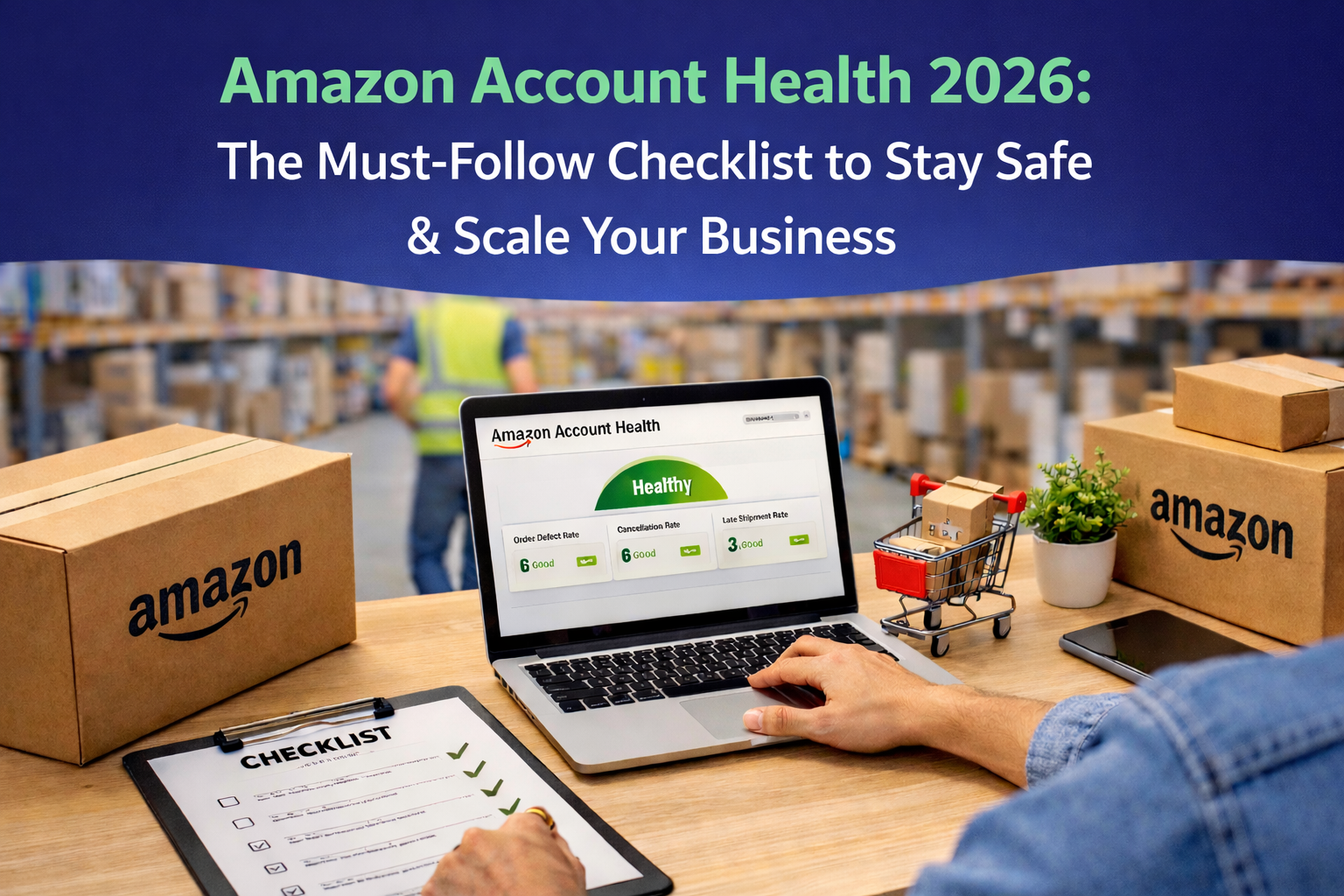
Amazon Account Health 2026: The Must-Follow Checklist to Stay Safe & Scale Your Business


Amazon Account Health is no longer something sellers can ignore and fix later. In 2026, with stricter policies, smarter bots, and more competition, your Amazon Account Health is the difference between a stable, scalable business and a sudden account shutdown. If you want to stay safe, avoid surprise suspensions, and grow profitably, you need a clear, actionable Amazon Account Health checklist 2026 and the discipline to follow it.

This guide breaks down exactly how to improve Amazon Account Health, what metrics matter most, and how to prevent Amazon account suspension 2026 before it happens. Use this as a practical checklist to protect your revenue, keep your listings live, and build a long-term, defensible Amazon business.

Understanding Amazon Account Health in 2026

Amazon Account Health is the overall scorecard Amazon uses to judge how trustworthy and compliant your seller account is. It combines policy compliance, customer experience, and shipping performance into one view that directly impacts your visibility and risk of suspension. In 2026, Amazon is tightening enforcement, using AI to detect patterns of abuse, and acting faster on violations.

For serious sellers, Amazon Account Health is now a core business KPI, not just a support tab you check when something goes wrong. The better your Amazon Account Health, the more confident you can be when scaling ad spend, launching new products, or expanding into new marketplaces. Poor health, on the other hand, means every new order could push you closer to a suspension or listing removal.

Core Metrics That Define Strong Amazon Account Health

To follow a reliable Amazon Account Health checklist 2026, you must first understand the metrics Amazon tracks. These metrics fall into three main buckets: customer service performance, policy compliance, and shipping performance. Each of these areas is monitored continuously and can trigger warnings or suspensions if they fall below standards.

While the dashboard may look simple, every metric is influenced by dozens of operational decisions. Your customer communication, product quality, packaging, shipping partners, and listing accuracy all affect how to improve Amazon Account Health. Treat each metric as a leading indicator of deeper operational issues that need attention.

Customer Service Performance Indicators

Customer service metrics are central to Amazon Account Health because they reflect how buyers experience your brand. Key indicators include Order Defect Rate (ODR), negative feedback rate, A-to-z Guarantee claims, and chargeback rates. When these climb, Amazon assumes your products or processes are not meeting expectations.

To keep these metrics healthy, focus on accurate listings, fast responses to buyer messages, and proactive problem resolution. Resolve issues before they become claims or negative reviews, and document your actions. Consistent customer care is one of the most reliable ways to prevent Amazon account suspension 2026.

Policy Compliance and Listing Integrity

Policy violations are a leading cause of Amazon listing suspension and full account shutdowns. Common issues include restricted products, intellectual property complaints, review manipulation, and misleading product information. Amazon’s automated systems now flag suspicious patterns faster than ever.

Maintain strict internal checks before publishing or editing listings. Ensure images, titles, bullets, and descriptions comply with category rules and Amazon’s style guides. Regularly audit your catalog to remove outdated claims, prohibited keywords, or non-compliant content that could damage Amazon Account Health.

Shipping, Delivery, and Operational Performance

Late shipments, high cancellation rates, and lost packages all harm Amazon Account Health. Even if your products are great, poor logistics can trigger warnings and penalties. Amazon expects consistent, predictable delivery performance aligned with the promises on your listings.

Use reliable carriers, accurate handling times, and realistic inventory buffers. If you use FBA, monitor inbound performance and stock levels to avoid stockouts that lead to cancellations. Strong operations not only protect your Amazon Account Health but also support better reviews and repeat purchases.

The Must-Follow Amazon Account Health Checklist 2026

A structured Amazon Account Health checklist 2026 helps you move from reactive firefighting to proactive risk management. Instead of waiting for performance notifications, you build routines that catch issues early. This is essential if you want to scale safely and maintain stable revenue.

Use the following checklist weekly and monthly to keep your Amazon Account Health in the green and your growth plans on track. Document each step so your team can follow the same process as you add more products, markets, and staff.

Weekly Account Health Review Routine

Set a recurring weekly slot to review the Amazon Account Health dashboard in detail. Look for new policy warnings, performance alerts, or unusual trends in returns and feedback. Address every notification, even if it seems minor, because small issues often signal bigger problems.

During this review, track your ODR, late shipment rate, and cancellation rate against Amazon’s thresholds. If any metric is trending upward, investigate root causes immediately. This disciplined routine is one of the simplest ways to understand how to improve Amazon Account Health consistently.

Listing Compliance and Content Audit

At least once a month, run a structured audit of your catalog to reduce the risk of Amazon listing suspension. Check that each listing follows category rules, uses approved claims, and avoids restricted keywords. Verify that product images, variations, and attributes match what buyers actually receive.

Use this audit to align Amazon product listing optimization with compliance. Update titles, bullets, and descriptions to be both conversion-focused and policy-safe. This balance ensures you attract more traffic while protecting Amazon Account Health from unnecessary violations.

Customer Feedback and Review Management

Customer feedback is both a risk and an opportunity for Amazon Account Health. Negative reviews and A-to-z claims can hurt metrics, but they also reveal where your processes are failing. Systematically monitor reviews, messages, and return reasons to spot patterns early.

Respond professionally to buyer concerns, offer fair resolutions, and use insights to improve packaging, instructions, or product quality. Over time, this approach reduces complaints and builds a stronger reputation. Healthy feedback trends directly support better Amazon Account Health and higher conversion rates.

How Amazon Product Listing Optimization Protects Account Health

Amazon product listing optimization is not just about keywords and rankings. In 2026, optimized listings also reduce confusion, returns, and complaints, which all impact Amazon Account Health. Clear, accurate content sets the right expectations and leads to happier customers.

When you optimize listings with both SEO and compliance in mind, you reduce the risk of Amazon listing suspension. You also improve click-through rates and conversion, which signal to Amazon that your offers are relevant and trustworthy. This combination strengthens both visibility and safety.

Key Elements of a High-Performing, Compliant Listing

Focus on precise titles, honest bullet points, and benefit-driven descriptions that match the actual product. Avoid exaggerated claims, prohibited phrases, or competitor references that could trigger policy issues. Use high-quality images that clearly show what buyers will receive.

Incorporate your target keywords naturally, including Amazon Account Health related terms where relevant to buyer questions. This helps you rank for important queries like how to improve Amazon Account Health while keeping content user-friendly. The goal is clarity first, optimization second.

Scaling Safely: From Stable Account Health to Business Growth

Once your Amazon Account Health is stable, you can confidently invest in growth. This includes expanding your catalog, increasing ad spend, and testing new marketplaces. However, every growth move must be supported by strong operations and compliance processes.

Consider structured Amazon account managment support as you scale. Whether in-house or external, you need clear ownership of performance metrics, policy monitoring, and listing quality. This ensures growth does not outpace your ability to maintain strong Amazon Account Health.

When to Bring in Expert Support

As your catalog and ad spend grow, managing Amazon Account Health becomes more complex. Multiple brands, marketplaces, and fulfillment models increase the risk of missed alerts or inconsistent processes. At this stage, expert guidance can protect your downside while you focus on strategy.

Many sellers partner with an experienced Amazon marketing agency to handle monitoring, optimization, and escalation. The right partner helps prevent Amazon account suspension 2026, respond quickly to issues, and build scalable systems. This combination of expertise and process is often the difference between fragile and durable growth.

Conclusion: Turn Amazon Account Health into Your Competitive Advantage

In 2026, Amazon Account Health is not just a compliance requirement; it is a strategic asset. Sellers who treat it as a core part of their Amazon account managment can scale faster, withstand policy shifts, and outlast competitors who operate on the edge. By following a disciplined Amazon Account Health checklist 2026, you reduce risk and unlock more confident growth.

If you want expert support to protect your account, optimize your catalog, and prevent Amazon listing suspension while you scale, HRL Infotechs can help you turn Amazon Account Health into a long-term competitive advantage.

How Mumbai Home & Kitchen Sellers Can Increase Flipkart CTR & Amazon Sales with Data-Driven Strategies


Mumbai home and kitchen sellers are in a unique position. Demand for appliances, cookware, and décor is booming, yet competition on Amazon and Flipkart is fiercer than ever. To stand out, you need more than good products you need smart, data-driven amazon and flipkart sales growth strategies that turn views into clicks and clicks into sales.

By analyzing how top sellers optimize their catalogs, ads, and pricing, you can uncover patterns that reliably boost CTR and conversions. This guide breaks down practical tactics for increasing Amazon CTR, improving Flipkart CTR optimization, and building a scalable growth engine for your marketplace business in India.

Understanding the Real Growth Levers on Amazon and Flipkart

Most Mumbai sellers focus only on discounts and deals, but sustainable growth comes from understanding platform signals. Both marketplaces reward listings that attract clicks, keep shoppers engaged, and convert at healthy rates. That is why effective amazon and flipkart sales growth strategies always start with data, not guesswork.

On Amazon, the algorithm looks closely at click-through rate, conversion rate, and customer satisfaction. Flipkart behaves similarly, with high-performing listings gaining better visibility in search and ads. When you track these metrics at SKU level, you can see which images, titles, and price points actually move the needle.

Optimizing Listings for Higher CTR and Conversions

Before investing heavily in ads, make sure your product pages are ready to convert. Strong listings are the foundation of all amazon and flipkart sales growth strategies. If your titles, images, and content are weak, even the best campaigns will underperform and waste budget.

For Mumbai home and kitchen categories cookware sets, storage containers, small appliances visual appeal and clarity matter most. Shoppers scan quickly, so your listing must communicate value in seconds. This is where professional amazon listing optimization services can make a measurable difference in both CTR and sales.

Title, Image, and Content Tactics That Increase Amazon CTR

To increase Amazon CTR, start with keyword-rich yet readable titles. Include brand, product type, key feature, material, and size. Avoid keyword stuffing, but ensure your main terms like “non-stick kadai” or “borosilicate glass storage” appear naturally.

Next, invest in high-resolution images that show real use in Mumbai homes compact kitchens, Indian cooking styles, and local serving habits. Add infographics for capacity, dimensions, and key benefits. Well-structured bullet points that highlight durability, warranty, and ease of cleaning can further boost engagement and conversions.

Flipkart CTR Optimization for Home & Kitchen Sellers

Flipkart shoppers often compare multiple products on one screen, so your thumbnail and price positioning are critical. Effective flipkart ctr optimization focuses on clean images, clear titles, and compelling price-value balance. Even small improvements in main image quality can significantly improve click-through.

Use the description space to answer common questions: compatibility with gas or induction, material safety, and capacity. Align your content with how Indian families actually use these products. When combined with structured flipkart seller account management, this approach helps you win more impressions and clicks in crowded categories.

Leveraging Data-Driven Advertising on Amazon and Flipkart

Once your listings are optimized, advertising becomes a powerful accelerator. The most successful amazon and flipkart sales growth strategies use ads not just to drive traffic, but also to gather data on keywords, audiences, and price sensitivity.

In India, home and kitchen is a high-intent category, which makes smart ad management essential. Poorly structured campaigns can burn through budgets quickly. That is why many sellers rely on specialized amazon ppc management services and flipkart advertising services to protect ROI while scaling.

Smart Amazon PPC Structures for Home & Kitchen

To increase Amazon CTR and conversions through ads, segment your campaigns by product type and match type. Use auto campaigns for discovery and manual campaigns for scaling proven keywords. Continuously mine search term reports to find new profitable queries.

Pause low-performing keywords and shift budget to terms with strong CTR and conversion rates. Over time, this disciplined approach becomes one of your most reliable amazon and flipkart sales growth strategies, especially when combined with seasonal pushes around festivals and sales events.

Flipkart Advertising Strategies That Actually Drive Sales

On Flipkart, start with sponsored listings for your bestsellers and hero SKUs. Focus on placements that give maximum visibility in search and category pages. Effective flipkart advertising services prioritize products with strong reviews and competitive pricing to maximize ad efficiency.

Track CTR, cost per click, and conversion rate at ad group level. Use this data to refine your bids and creatives. When paired with consistent flipkart seller account management, this creates a feedback loop that steadily improves performance and profitability.

Building a Marketplace Growth Engine for Mumbai Sellers

For long-term success, you need more than isolated tactics. You need a system. Leading marketplace growth services india focus on building repeatable processes across catalog, content, ads, and operations. This is especially important for fast-moving home and kitchen SKUs.

Data should guide every decision from which products to launch, to which bundles convert best in Mumbai, to which keywords drive profitable traffic. When your amazon and flipkart sales growth strategies are data-backed, scaling becomes predictable instead of risky.

Role of Professional Account Management Services

Many amazon sellers in mumbai struggle to balance daily operations with strategic growth. That is where amazon account management services india and marketplace specialists come in. They handle catalog hygiene, listing optimization, ad management, and reporting.

This support frees you to focus on product development and supply chain. Meanwhile, experts continuously refine your amazon and flipkart sales growth strategies based on platform updates, competition analysis, and seasonal demand patterns.

Turning Data into Actionable Growth for Home & Kitchen Brands

To truly understand how to increase Amazon sales and Flipkart performance, you must treat data as a daily tool, not a monthly report. Review key metrics like CTR, conversion rate, average order value, and return rate at least weekly.

Then, translate those insights into clear actions. Improve images for low-CTR SKUs, refine bullets for high-traffic but low-conversion listings, and adjust bids for underperforming keywords. Over time, this disciplined approach compounds, making your ecommerce marketing services india stack far more effective.

Key Metrics Mumbai Sellers Should Track

Focus on a simple yet powerful dashboard. For each ASIN or listing, track impressions, CTR, conversion rate, and revenue. Add ad spend and ACoS for campaigns. This view reveals which amazon and flipkart sales growth strategies are actually working.

Use these insights to prioritize your efforts. Double down on winning products and keywords, and either fix or phase out persistent underperformers. This is how serious amazon sellers in mumbai turn marketplaces into scalable, predictable revenue channels.

Conclusion: Turn Browsers into Buyers with Data-Driven Strategy

Mumbai home and kitchen sellers who embrace data-driven decision making consistently outperform those relying on guesswork. By combining optimized listings, smart advertising, and disciplined account management, you can improve Flipkart CTR, increase Amazon CTR, and unlock sustainable marketplace growth.

If you are ready to turn your marketplace presence into a true growth engine and want expert support across listing optimization, PPC, and marketplace strategy, partnering with a specialist like HRL Infotechs can help you implement these amazon and flipkart sales growth strategies faster and with greater impact.

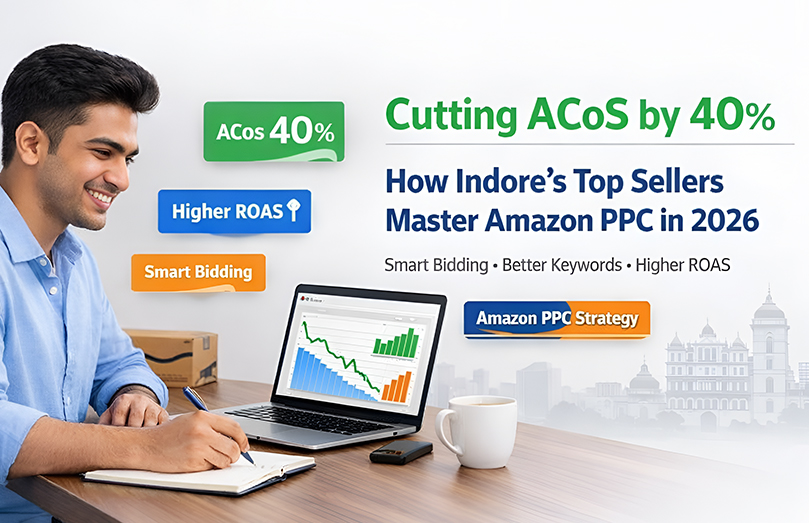
Cutting ACoS by 40%: How Indore’s Top Sellers Master Amazon PPC in 2026


Amazon PPC in 2026 is no longer about simply bidding higher and hoping for clicks. Indore’s top Amazon sellers are proving that with the right data-driven strategy, it is possible to cut ACoS by 40% while still scaling revenue. The brands winning today treat Amazon PPC like a performance engine, not a guessing game.

If you are selling on Amazon from Indore or anywhere in India, you are competing in a far more sophisticated marketplace than even a year ago. This guide breaks down how leading sellers are mastering Amazon PPC in 2026, reducing ACoS, and building sustainable growth with smarter campaigns, sharper keyword research, and disciplined optimization.

Why Amazon PPC in 2026 Demands a New Playbook

The way Amazon PPC works has evolved quickly. In 2026, the algorithm rewards relevance, conversion history, and shopper experience more than raw bids. That means the old tactics of broad targeting and aggressive spending often lead to rising ACoS and shrinking margins.

Indore’s top sellers understand that Amazon PPC in 2026 is a full-funnel system. They align campaigns with clear goals: visibility for new products, profitability for mature listings, and dominance for category leaders. This shift from random testing to structured strategy is the foundation for sustainable ACoS control.

Understanding ACoS and Its Role in Profitability

Advertising Cost of Sales (ACoS) is the percentage of ad spend compared to the revenue generated from those ads. When you reduce ACoS in Amazon PPC, you free up budget to reinvest in growth, inventory, and new product launches. For many Indore-based sellers, a 40% ACoS reduction has been the difference between break-even and strong profit.

However, cutting ACoS is not about slashing bids blindly. In Amazon PPC in 2026, you must balance ACoS with total sales, organic ranking, and long-term brand visibility. The goal is to reach a profitable ACoS that still allows your products to stay competitive in search results.

Core Amazon PPC Strategies Top Indore Sellers Use in 2026

Winning sellers in Indore follow a structured framework for Amazon PPC strategies instead of random experiments. They start by defining clear campaign goals, then map those goals to specific ad types and targeting methods. This disciplined approach keeps ACoS under control while still driving growth.

These Amazon PPC strategies are not theory; they are battle-tested in competitive Indian marketplaces. By adopting them, you can move from reactive campaign management to proactive performance marketing that steadily reduces ACoS and improves return on ad spend.

1. Smart Campaign Structuring for Control and Clarity

Top sellers separate campaigns by match type, product category, and intent. This structure gives them precise control over bids and budgets. For example, they run separate campaigns for branded, competitor, and generic keywords, each with its own ACoS target.

This level of segmentation is essential for Amazon PPC in 2026 because it reveals which search terms truly drive profit. With clear data, you can quickly decide where to scale spend and where to cut, making ACoS reduction a predictable process rather than guesswork.

2. Amazon Sponsored Products ACoS Optimization Tactics

Sponsored Products remain the backbone of most Amazon PPC accounts. To reduce ACoS in Amazon PPC, Indore’s leading sellers focus on three levers: bids, search terms, and product detail pages. They constantly refine these elements based on performance data.

Key optimization moves include lowering bids on high-spend, low-conversion terms, adding negative keywords to block waste, and improving listing content to boost conversion rate. In Amazon PPC in 2026, even small gains in conversion can significantly lower Sponsored Products ACoS.

3. Leveraging Sponsored Brands and Sponsored Display for Scale

While Sponsored Products drive direct sales, Sponsored Brands and Sponsored Display support brand visibility and remarketing. Indore’s advanced sellers use these formats to protect their brand terms, cross-sell related products, and re-engage shoppers who viewed but did not buy.

These upper and mid-funnel campaigns may show a higher ACoS on the surface. However, when aligned with Sponsored Products, they help lift total sales and organic ranking. This holistic view of Amazon PPC in 2026 is what separates casual advertisers from true performance marketers.

High-Intent Keyword Research for Amazon PPC in India

Effective Amazon PPC keyword research in India is now about understanding buyer intent, not just search volume. Top Indore sellers dig into search term reports to find phrases that signal strong purchase intent, such as size, color, pack quantity, or use case.

They combine Amazon’s own data with third-party tools to identify profitable long-tail keywords. This approach reduces competition, improves click-through rates, and lowers ACoS. In Amazon PPC in 2026, precision beats volume when it comes to keyword targeting.

How Sellers in Indore Build Profitable Keyword Sets

Leading sellers start with broad and phrase match campaigns to discover new search terms. Then they promote the best-performing terms into exact match campaigns with dedicated budgets and tighter ACoS targets. This step-by-step process turns raw data into reliable profit drivers.

They also localize their Amazon PPC keyword research in India by including regional phrases, common spelling variations, and use cases relevant to Indian shoppers. This localized approach improves relevance, which is critical for Amazon PPC in 2026 as the platform rewards ads that closely match shopper intent.

Practical Ways to Reduce ACoS in Amazon PPC

Cutting ACoS by 40% is realistic when you apply consistent, data-backed optimizations. Indore’s top sellers do not chase overnight miracles. Instead, they follow a weekly and monthly routine that steadily improves performance across all campaigns.

These routines focus on trimming waste, reallocating budget to winners, and improving the shopper journey. Over time, these small, disciplined actions compound into major ACoS reductions and stronger overall profitability from Amazon PPC in 2026.

Weekly Optimization Checklist for Sellers

High-performing sellers rely on simple but powerful checklists to keep campaigns healthy. A typical weekly optimization routine for Amazon PPC in 2026 includes several focused actions that directly impact ACoS and sales.

Key weekly tasks often include:

  • Reviewing search term reports and adding negative keywords
  • Lowering bids on high-ACoS keywords and raising bids on top performers
  • Pausing underperforming ads or ad groups
  • Testing new keyword variations and match types
  • Checking product pages for content or pricing issues

Improving Listings to Support Lower ACoS

No Amazon PPC strategy can succeed if product pages fail to convert. Indore’s leading sellers treat listing optimization as part of their Amazon PPC strategies, not a separate task. They refine titles, bullet points, images, and A+ content to align with target keywords and buyer expectations.

When listings convert better, every click becomes more valuable. This naturally reduces ACoS in Amazon PPC because more of your paid traffic turns into revenue. In 2026, the strongest Amazon PPC results come from the combination of optimized ads and high-converting product pages.

When to Partner with an Amazon Marketing Agency in Indore

As Amazon PPC in 2026 grows more complex, many sellers reach a point where in-house management is no longer efficient. They spend hours in spreadsheets but still struggle to reduce ACoS or scale profitably. This is often the moment to consider expert support.

An experienced Amazon marketing agency in Indore can bring advanced tools, proven playbooks, and dedicated specialists to your account. For many brands, this partnership turns Amazon PPC from a stressful cost center into a predictable growth channel.

What to Expect from Professional Amazon Marketing Services

Professional Amazon marketing services typically include full-funnel PPC management, listing optimization, and ongoing performance reporting. Agencies build structured campaigns, execute deep keyword research, and run continuous A/B tests to keep improving results.

They also align Amazon PPC strategies with your broader business goals, such as launching new products, entering new categories, or preparing for seasonal peaks. With expert guidance, cutting ACoS by 40% becomes a structured project with clear milestones instead of a vague wish.

Conclusion: Turn Amazon PPC in 2026 into a Profit Engine

Indore’s top Amazon sellers are proving that Amazon PPC in 2026 can be both scalable and profitable. By structuring campaigns intelligently, investing in precise keyword research, and following disciplined optimization routines, they are consistently reducing ACoS while growing total sales.

If you are ready to move beyond trial-and-error and turn your advertising into a true profit engine, partnering with a specialist team like HRL Infotechs can help you apply these strategies faster, with less risk and a clearer path to long-term marketplace dominance.

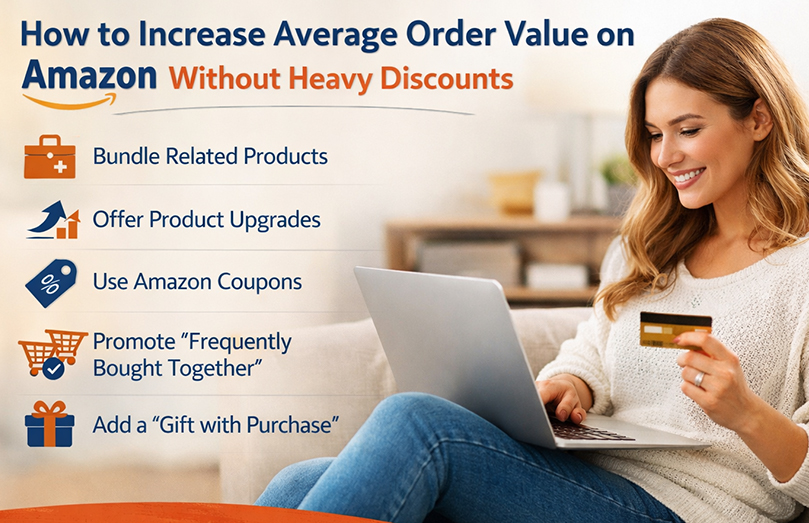
How to Increase Average Order Value on Amazon Without Heavy Discounts


Want to increase average order value on Amazon without slashing your margins with constant discounts? You are not alone. Many brands hit a revenue ceiling because customers buy only one item at a time or choose the lowest-priced option in the cart.

The good news is you can increase average order value on Amazon using smart merchandising, positioning, and experience tweaks instead of heavy couponing. By optimizing how products appear, how they are bundled, and how customers move through your listings, you can increase AOV on Amazon, boost basket size, and grow revenue per customer sustainably.

Understanding Average Order Value on Amazon and Why It Matters

Before you try to increase average order value on Amazon, you need to understand what it represents. Amazon average order value (AOV) is the total revenue divided by the number of orders over a period. It shows how much, on average, each customer spends per transaction with your brand.

When you increase AOV on Amazon, you improve profitability without needing more traffic. Instead of chasing new visitors with expensive ads, you extract more value from existing demand. This makes every click, impression, and page view more profitable and stabilizes your long-term growth.

Key Drivers That Influence Amazon Average Order Value

Several factors directly affect your ability to increase average order value on Amazon. Product pricing, catalog depth, and how well your items complement each other all play a role. The way you structure offers, bundles, and variations can either limit or expand what customers add to their carts.

Customer behavior is equally important. Shoppers respond to convenience, perceived value, and social proof. When your Amazon product listing and SEO are optimized, customers discover more relevant products, trust your brand more, and feel confident buying multiple items in a single order.

Why Increasing Basket Size Beats Discount-Driven Growth

Relying on deep discounts to grow sales can quickly erode margins and train customers to wait for deals. Instead, focusing on strategies that increase basket size on Amazon helps you grow profitably. You encourage customers to buy more of what they already value, not just chase the lowest price.

When you increase basket size Amazon shoppers often discover complementary products that improve their experience. This leads to better reviews, more repeat purchases, and a healthier account performance, all without a race to the bottom on pricing.

Optimize Product Listings to Naturally Increase AOV

One of the most effective ways to increase average order value on Amazon is to improve your listings. High-intent shoppers land on product pages expecting clarity, relevance, and trust signals. When these elements are strong, they are more open to buying additional or higher-value items.

Start by aligning your Amazon product listing and SEO with how customers search and compare products. This ensures your best offers appear for high-intent queries and that your catalog structure supports upselling and cross-selling opportunities.

Strengthen Titles, Bullets, and Images for Higher-Value Purchases

Compelling titles and bullets help increase AOV on Amazon by positioning premium features and multi-pack options as better value. Use clear benefit-driven language and highlight quantity, durability, or long-term savings to justify higher price points.

High-quality images and infographics can also increase basket size Amazon customers by visually promoting bundles, usage scenarios, and complementary products. When shoppers see how items work together, they are more likely to add more than one product to their cart.

Use Variations and Packs to Lift Amazon Revenue per Customer

Smart variation structures are a powerful lever to increase average order value on Amazon. Instead of listing single units only, consider multi-packs, value bundles, and size upgrades as variations on the same parent listing. This makes trading up feel natural, not forced.

When you present higher-quantity or premium options first, you subtly guide shoppers toward choices that increase Amazon revenue per customer. Customers still feel in control, but your catalog is designed to favor higher-value selections.

Amazon Upselling Strategies That Do Not Depend on Discounts

Upselling is one of the most direct ways to increase AOV on Amazon without cutting prices. The goal is to move customers from a base product to a more valuable version that better meets their needs. Done well, upselling feels helpful, not pushy.

Effective Amazon upselling strategies rely on positioning, social proof, and clear differentiation. You want customers to understand why the higher-priced option is the smarter long-term choice, whether due to durability, performance, or convenience.

Position Premium and Bundle Options as the Default Choice

When customers land on your listing, what they see first shapes their expectations. To increase average order value on Amazon, make sure premium or bundled options are clearly visible and well-explained. Use comparison charts to highlight the extra value they deliver.

Consider these tactics to support upselling without discounts:

  • Feature premium variations in the main images and A+ content.
  • Use bullets to contrast base and upgraded versions.
  • Highlight long-term savings from larger packs or better materials.

These simple adjustments can increase AOV on Amazon by nudging customers toward higher-value choices they already find appealing.

Leverage Social Proof to Justify Higher-Value Purchases

Reviews and ratings are critical when you want to increase average order value on Amazon. High review counts and strong ratings on premium options reduce perceived risk and make upgrades feel safer. Customers trust the experiences of others when deciding what to buy.

Encourage satisfied customers to mention pack sizes, longevity, and value in their reviews. When shoppers see proof that others are happy with larger or premium options, they are more likely to increase basket size Amazon orders and spend more per transaction.

Cross-Selling and Bundling to Increase Basket Size

Cross-selling is another powerful way to increase average order value on Amazon without relying on heavy coupons. The idea is to surface complementary products that enhance the main purchase, such as accessories, refills, or compatible items.

When done strategically, cross-selling can increase basket size Amazon shoppers by turning single-item orders into multi-product solutions. Customers feel they are getting a complete setup rather than a standalone product.

Design Complementary Product Ecosystems

To increase AOV on Amazon through cross-selling, think in terms of ecosystems, not isolated SKUs. Map out which products naturally go together and how customers use them over time. Then align your catalog and content to reflect those real-world use cases.

Examples of cross-selling opportunities include:

  • Main product plus protective or storage accessories.
  • Core item with refills, replacements, or consumables.
  • Starter kit with add-ons that unlock extra functionality.

These structures help increase Amazon revenue per customer while genuinely improving the customer experience.

Leverage Amazon Account Management Strategies and Data

To sustainably increase average order value on Amazon, you need ongoing optimization, not one-time changes. Strong Amazon account management strategies ensure you are tracking performance, testing new approaches, and responding to customer behavior.

Instead of focusing only on traffic or rankings, build dashboards that track AOV, units per order, and attach rates. This data shows whether your efforts to increase AOV on Amazon and boost basket size are working across your catalog.

Use Data to Refine Catalog, Pricing, and Content

Analyze which ASINs naturally drive higher Amazon average order value and why. Look at which bundles, variations, or cross-sells perform best. Then replicate those patterns across similar product lines to scale your success.

Combine these insights with ongoing Amazon advertising services, if you use them, to drive more qualified traffic to high-AOV listings. Even if you aim to boost Amazon sales without ads, understanding how paid and organic traffic behave will sharpen your overall strategy.

Conclusion: Build a Sustainable AOV Growth Engine

Increasing average order value on Amazon without heavy discounts is not about tricks; it is about strategy. By optimizing listings, designing smart variations, using thoughtful upselling and cross-selling, and leveraging data-driven Amazon account management strategies, you can lift AOV while protecting your margins.

When you treat your catalog as a connected ecosystem and focus on real customer value, you naturally increase AOV on Amazon, expand basket size, and grow revenue per customer. If you are ready to turn these principles into a tailored growth plan for your brand, HRL Infotechs can help you design and execute a scalable strategy.

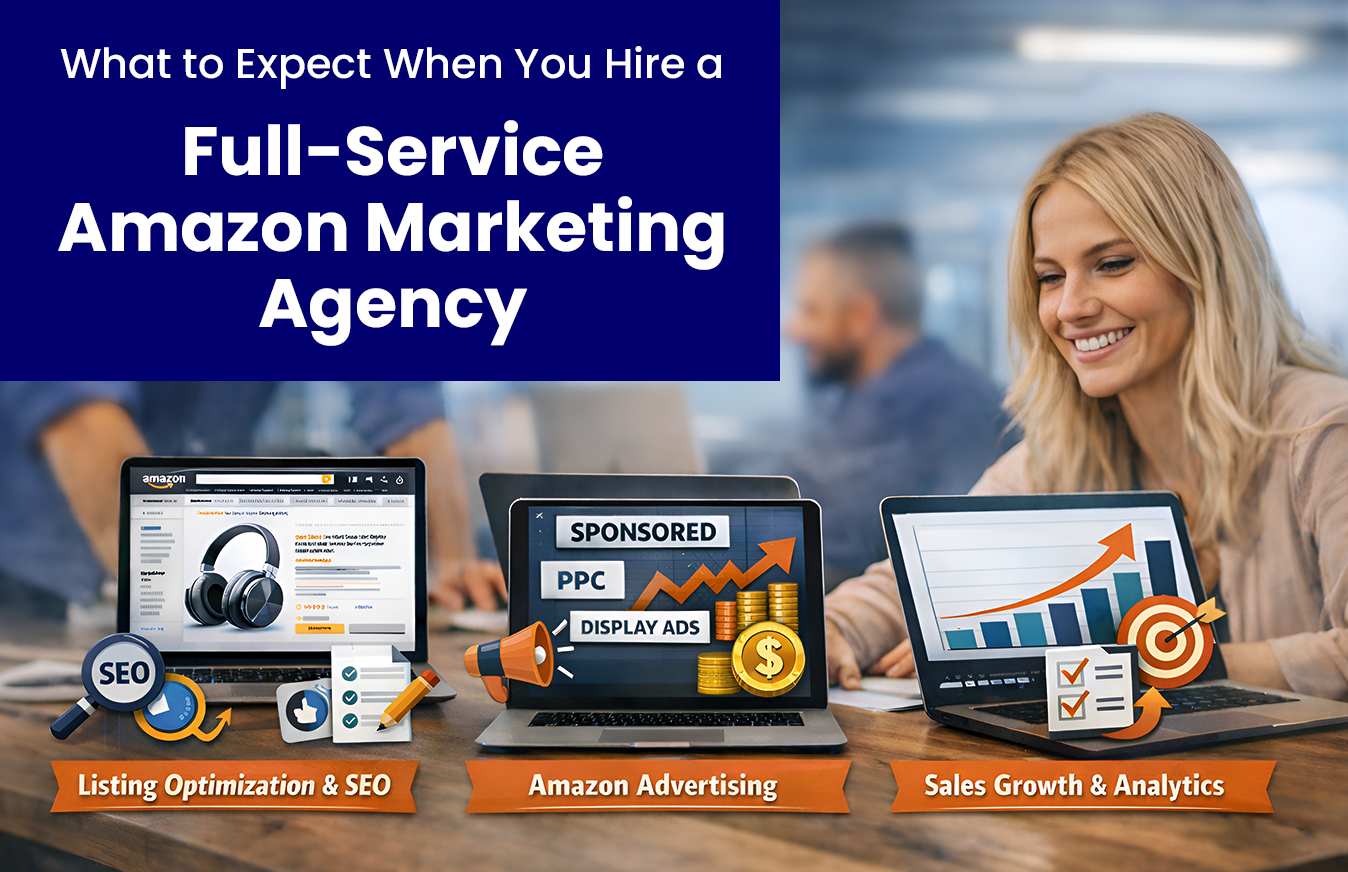
What to Expect When You Hire a Full-Service Amazon Marketing Agency


Selling on Amazon is one of the most rewarding opportunities, but it is also one of the most demanding ecommerce platforms. With intense competition, where everyone is trying to come out on top and grab customer attention, keeping up with Amazon’s constantly changing requirements and guidelines becomes difficult for an individual seller without professional help. Small mistakes can be the reason for big problems like stagnant growth, blocked accounts, or a lack of customer attraction. That is one of the reasons why many sellers are now choosing to work with a full-service Amazon marketing agency. 

If you are planing of working with a marketing agency in this blog, we are going to go into detail about what an Amazon marketplace marketing agency is, what you should expect and how it can take you towards your success faster. 

What is an Amazon Marketing Agency?

An Amazon advertising agency is a specialized business partner that manages everything from seller account registration to product sales. It helps brands expand their businesses on the Amazon marketplace and increase their sales by running targeted ad campaigns. These agencies have experts who understand how Amazon’s algorithm works, who keep track of changing policies and guidelines to make necessary changes and who also specialize in running ads that bring maximum traffic to your product. 

What an Amazon Marketing Agency Offers

A marketing agency focuses on improving your brand performance by improving how your products are found, clicked and purchased on Amazon. This process involves paying special attention to the core areas mentioned below. 

Amazon Account Management Services

These services include complete Amazon seller account monitoring and health review. Amazon is a constantly evolving ecommerce marketplace; its policies and guidelines keep changing. An Amazon growth agency consistently checks for these changes and makes required adjustments so that your seller account follows all rules and guidelines. They also monitor account performance to know what strategies are working and not.  

Amazon PPC Management Services

These services include running PPC campaigns on Amazon, sponsored brand ads, product ads and display ads to boost your brand visibility and bring brand awareness. The agency leverages its experts who identify the high traffic areas to run ads on Amazon that eventually help the seller gain sales. This also includes running seasonal or event-based campaigns according to the prevailing trends so that you can monetize the opportunity effectively.   

Amazon Product Listings & SEO Services

Amazon product listings and SEO services include performing deep keyword research and bringing out high-quality sales-drive techniques to boost your sales by delivering optimized product titles, bullet points and product descriptions. The experts also monitor the keyword ranking consistently to adjust strategies accordingly. Clear and optimized listings enable customers to find the right product easily and deliver satisfactory customer service. 

Amazon A+ Content Design Services

A+ content plays an important role when it comes to enhancing customer experience and attracting sales. High-quality images and videos influence customer decisions, build trust and, hence, are a crucial focus area. An Amazon marketplace marketing agency improves your A+ content by showing clear pictures of the product from different angles, mentioning all its features, its lifestyle use and how it solves customer problems.

Amazon FBA Reimbursement Services

If you are an FBA seller, chances are that Amazon owes you money. This service includes keeping track of all your inventory by collecting the data on lost and damaged items by Amazon employees, analyzing the collected data, filing the cases on your behalf, and taking up regular follow-ups to make sure everything is accounted for. It is important to claim all your pending reimbursements from Amazon to maintain fairness. 

Amazon Storefront Design Services

Amazon storefront design service is crucial to establishing your brand reputation and gaining customer loyalty. Amazon allows brands to create their own custom storefront designs to offer a branded shopping experience to customers. A marketing agency helps you create attractive, easy-to-navigate and well-organized storefront designs for your brand so that you can drive more traffic and high conversion rates and also retain customers.

Who Needs an Amazon Marketing Agency?

An Amazon marketing agency is a good idea for you and your business if:

  • You wish to grow faster on Amazon without learning about every rule and guideline.
  • You are spending a lot of money on ads without getting equivalent results.
  • Your product listings get views, but not enough sales and conversion rates.
  • You wish to expand your business and enter new markets and product categories.
  • Want to focus on your business without worrying about the online aspect of sales. 

Final Thoughts: Boost Sales and Success With Amazon Marketing Agency

Managing your business’s both online and offline aspects together, individually, can be overwhelming. An Amazon marketing agency significantly lessens the seller’s burden by handling their online presence so that the brand can focus on products and operations while experts manage the brand’s visibility and performance. Choosing the right agency, where every decision is made based on proper data, trends and audience, can make the unpredictable market of Amazon a bit easier to navigate. 

At HRL Infotech, we leverage our experts who help you elevate your business performance, increase conversion rates, and boost visibility.  

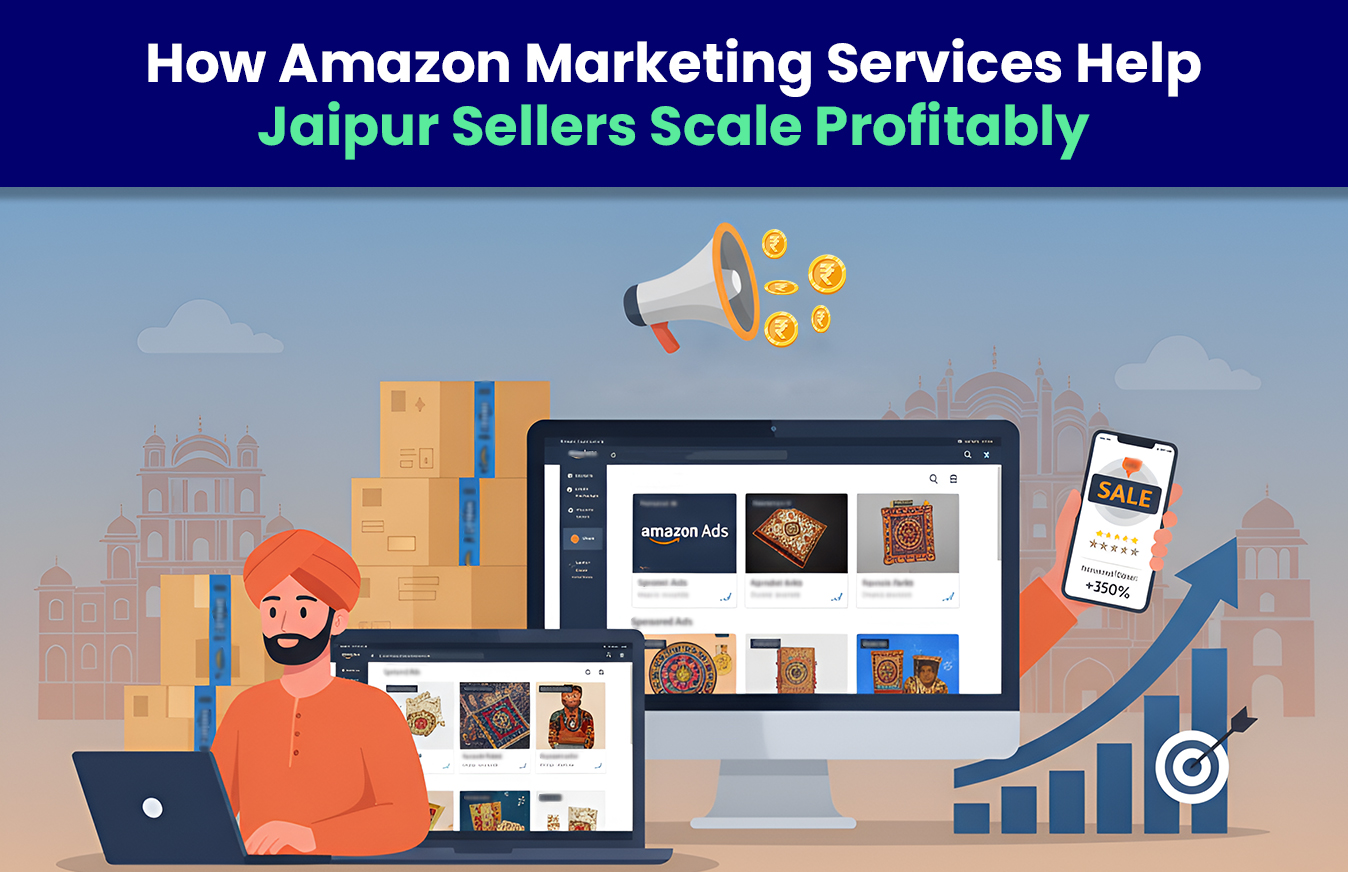
How Amazon Marketing Services Help Jaipur Sellers Scale Profitably in 2026


Most Jaipur sellers I’ve spoken to didn’t start selling on Amazon with a master plan. It usually began with one product. Sometimes two. A bit of curiosity. A bit of pressure to try something new. And honestly, a hope that Amazon would “figure things out” on its own once the product went live.

For a while, that hope works.

Orders trickle in. Reviews slowly appear. The dashboard shows numbers moving in the right direction. Then one day, ads cost more than expected. Rankings slip. A competitor pops up out of nowhere. And suddenly, selling on Amazon doesn’t feel simple anymore.

This is usually the moment sellers start hearing about Amazon Marketing Services, not as a buzzword, but as something they might actually need.

Jaipur Sellers Don’t Struggle With Effort, They Struggle With Clarity

One thing I’ve noticed about Jaipur-based sellers is this: effort is rarely the problem.

People here are hands-on. They pack, manage suppliers, talk to customers, and check dashboards late at night. The real struggle is clarity. What’s working? What’s not? And most importantly, why?

That’s where Amazon Marketing Services for sellers quietly help. Not by promising miracles, but by reducing confusion. When things are broken down properly, ads, listings, search terms, and pricing decisions stop feeling random.

And when decisions stop being random, profits tend to stabilize.

Growth on Amazon Feels Exciting… Until It Doesn’t

Early growth feels great. You might even think, “I’ve cracked this.”

But Amazon has a habit of humbling sellers. What worked last month suddenly doesn’t. Ad costs creep up. Sales stay flat. You start changing things too fast, hoping something sticks.

This is where structured Amazon Marketing Services matter. They slow sellers down in the right way. Instead of reacting daily, sellers start looking at patterns. Weeks instead of hours. Trends instead of spikes.

It’s less exciting, but far more profitable.

Amazon Marketing Services in Jaipur Need a Different Lens

Let’s be honest. Jaipur is not Bangalore or Mumbai.

Budgets are tighter. Teams are smaller. Sellers can’t afford to “experiment aggressively.” So Amazon Marketing Services in Jaipur need to be practical, not flashy.

No complicated jargon. No unnecessary dashboards. Just clear answers:
Is this ad profitable?
Is this listing converting?
Is this product worth scaling, or not?

Agencies like HRL Infotechs tend to work well in this environment because the approach is grounded. The focus is not on chasing vanity metrics, but on protecting margins while growing steadily.

Listings Are Where Most Sellers Lose Without Realizing It

This part hurts a little, but it’s true.

Many sellers pour money into ads while ignoring their listings. Weak titles. Confusing bullet points. Images that don’t explain anything.

Amazon Product Listing & SEO Services aren’t glamorous, but they’re foundational. When a listing is clear, ads suddenly perform better. When it’s not, ads feel expensive no matter what you do.

Most sellers only realize this after wasting money. The smarter ones fix listings first and save themselves a lot of frustration later.

Amazon Ads ROI for Sellers Isn’t About Spending More

There’s this idea floating around that scaling means increasing ad budgets. That’s only half true.

Real Amazon ads ROI for sellers comes from cutting things out. Cutting keywords that look promising but don’t convert. Cutting campaigns that burn money quietly. Cutting emotional decisions.

This kind of discipline is hard when you’re inside the account every day. That’s why Amazon Account Management services exist, not to run ads endlessly, but to know when to stop.

Sometimes, the best optimization is doing less.

Amazon Ads for Local Sellers Work Best When They’re Narrow

Jaipur sellers often try to compete broadly and get crushed.

The sellers who survive focus narrowly. One product. One use case. A handful of keywords. Amazon ads for local sellers work best when they’re precise, not ambitious.

You don’t need to dominate the entire category. You just need to own a small, profitable corner of it.

That mindset shift alone saves sellers thousands.

Storefronts Aren’t About Style, They’re About Trust

Most sellers underestimate Amazon Storefront Services because they don’t see instant results.

But storefronts help with something more subtle: trust. When buyers click your brand and see consistency, similar quality, and similar messaging, it reassures them. Especially repeat buyers.

It won’t change your business overnight. But over time, it makes your sales less fragile.

Amazon A+ Content Services Fix Doubts Before They Happen

People don’t like confusion. They don’t read long descriptions either.

Amazon A+ Content Services help bridge that gap. Simple visuals. Comparisons. Clear explanations. Not salesy, just informative.

When customers understand the product clearly, they hesitate less. They return less. And those small improvements quietly improve profitability.

What Sellers Actually Gain From Amazon Marketing Services

Here’s the honest answer: peace of mind.

Good Amazon Marketing Services don’t just increase sales. They reduce panic. Sellers stop waking up worried about sudden drops. They know what’s being tracked, what’s being fixed, and what’s being tested.

Predictability isn’t exciting, but it’s sustainable.

Why More Jaipur Sellers Are Letting Experts Handle Amazon

At some point, sellers hit a ceiling, not of growth, but of attention.

Managing everything yourself works… until it doesn’t. Delegating doesn’t mean losing control. It means getting your time back.

That’s why Amazon Account Management services are becoming common even among mid-sized Jaipur sellers. Not because they can’t manage Amazon, but because they don’t want Amazon managing them.

Final Thoughts

Amazon doesn’t reward hustle alone. It rewards structure.

For Jaipur sellers, Amazon Marketing Services provides that structure, slow, steady, sometimes boring, but effective.

And in the long run, boring profitability beats exciting chaos every single time.

Advanced Amazon Marketing Tactics for Indian Sellers in 2026


If you’re selling on Amazon in India in 2026, you’ve probably noticed one thing very clearly: Amazon marketing has changed, and how people buy on it has changed too. A few years ago, listing optimization and simple PPC seemed enough; these days, they are almost table stakes. As somebody who works in Amazon account management for a living (running an Amazon Advertising Services team at HRL Infotechs), I’d like to share what sophisticated sellers are doing now, not because it’s trendy, but because it actually works.

Thinking Strategically, Not Transactionally

Let me start with what I see most sellers misunderstand about Amazon marketing: Amazon isn’t just a sales channel anymore. For many successful brands, it’s a strategic customer acquisition engine. That means your Amazon store isn’t only about transactions, it’s about building trust, brand recall, and long-term customer value. If you still view it like a glorified flyer for Karachi-style discounts, you’ll struggle to compete with sellers who take their optimization seriously.

The equation has shifted: sales velocity + customer satisfaction + voice-of-customer signals = sustainable growth. And that’s where we lean in with our Amazon Seller Strategies for Indian brands.

Refined Keyword Strategy: From Mass Reach to Intent-to-Buy

A prevalent trap is chasing huge-volume keywords without understanding buyer intent. Yes, “cotton bedsheet” might give you thousands of impressions, but how many of those come from people who are actually ready to buy? Not enough. We increasingly focus on more deliberate, long-tail phrases like “long-staple organic cotton bedsheet queen size” or “wrinkle-resistant cotton sheet for family bed.” These phrases cost less per click and tend to convert better because these shoppers are further down the purchase funnel.

Our team uses Amazon SEO & Product Listing Optimization to dissect honest customer conversations: we examine reviews, search behavior, and competitor lists to find the sweet spots, the phrases where customers are precise, and competition is still manageable.

Smarter PPC Structures: Efficiency Over Vanity Metrics

If a seller calls me and says, “We spent ₹5 lakh last month on ads,” my first instinct is to check whether that was useful ad spend. Blowing money on PPC that “just runs” is not our style. What we build are multi-layered campaigns; we have separate pods for testing, scaling, and defending. It means we don’t just throw budget at random keywords; we test first, double down on what works, and hold back enough budget to protect top ASINs from competitive encroachment.

We also deeply integrate profit logic into our Amazon PPC Services. Every campaign is analyzed not just for sales, but for margin. If a keyword drives clicks but destroys profitability, it’s not worth scaling. That discipline helps us avoid the common trap of “sales at all costs.”

Learning from Competitors: Review-Driven Positioning

One of my favorite parts of strategy is competitive teardown through reviews. I tell my team, “Read what people hate about their current choice because that’s where we can win.” Suppose customers repeatedly complain about flimsy material, poor packaging, or mis-sized items. In that case, we make sure our product listing addresses those specific issues. Our bullet points, description, and even A+ content call out how we solved those problems.

I’ve seen this tactic drive trust instantly. Buyers feel smarter because they see you are not just selling: you listened.

A+ Content That Converts, Not Just Decorates

A lot of listings look pretty. But pretty doesn’t always convert. What works better is content that educates and persuades, showing how the product solves a particular pain point. Recently, we revamped a listing for a kitchen appliance brand. Instead of a typical lifestyle banner, we used a comparison chart, real user scenarios, and a quick troubleshooting guide. The result? The client told us they saw a perceptible bump in conversion rates almost overnight.

A well-designed A+ Content can set you apart from imports and cheaper alternatives. It’s not fluff. It’s a conversion lever.

External Traffic: More Important Than You Think

This isn’t old-school influencer talk or wishlist spam. In 2026, sending substantial external traffic to your Amazon listings helps you boost your Amazon authority. We create targeted micro-influencer partnerships, run Google Ads for specific ASINs, and sometimes even launch Instagram campaigns that direct users straight to Amazon.

When Amazon sees you bringing buyers from outside, it treats those conversions differently as validation that your product deserves visibility. It is part of what we deliver when we provide deep Amazon Advertising Services (even from Indore).

FBA Strategy: Winning with Speed and Inventory Intelligence

Delivery speed is no longer a “nice touch,” it’s a ranking and conversion lever. Customers in India now expect fast delivery, and Amazon rewards sellers who combine FBA smartly. With well-managed FBA, we help clients pick SKUs worth warehousing, optimize inventory, and reduce unnecessary FBA storage costs. The outcome is higher product availability, faster delivery, and stronger Buy-Box performance.

These logistics decisions matter more than you think. Putting the right SKUs in FBA at the right time pays off not just in customer satisfaction but also in visibility.

Encouraging Genuine Reviews Without Breaking the Rules

Amazon’s review policies are strict, and they should be: fake reviews destroy trust. That said, getting honest, objective feedback doesn’t have to be an uphill battle. We deploy subtle yet effective tactics: post-purchase email sequences that invite feedback, smart insert cards in packaging, and even friendly follow-ups via Amazon buyer-seller messaging. The goal is simple: a delight-first experience that encourages happy users to leave thoughtful reviews.

This steady review velocity helps with ranking and conversion, as new shoppers read and trust these genuine voices.

Pricing Psychology: Beyond Discounts

Deep discounts may get eyeballs, but they don’t always drive healthy margins. We’ve found that Indian buyers respond really strongly to perceived value. Bundle offers, gift packs, and limited-time “value set” deals often outperform straight discounts. For example, instead of selling a pair of pillowcases at ₹1,199, we might package them with a bedsheet for ₹1,499, making it feel like a smarter deal while preserving margin.

We also test subscription models for replenishable products. Customers who like your quality will sign up for repeat orders, and you get predictable recurring revenue.

Why Professional Account Management Makes All the Difference

Look, managing all this on your own is overwhelming. Between optimizing listings, juggling inventory, running ads, and monitoring reviews, it’s a full-time job. Many sellers try doing it themselves and eventually feel like they’re constantly chasing fires.

We at HRL Infotechs can help with that.  We design growth, not merely manage campaigns.  We assist companies in developing scalable, quantifiable, and closely aligned Amazon Seller Growth strategies with their long-term business objectives.

You receive more than simply “someone to run PPC” when you work with us.  You’re getting a team that plans, conducts thorough testing, and makes quick adjustments.

Final Thoughts: Be Bold. Be Smart. Be Patient.

It may seem like a lot if you’re searching for quick fixes. However, this is the blueprint for long-term Amazon success in 2026. In India, Amazon marketing has changed. Today’s victors are those who develop long-term strategies, optimise relentlessly, and confidently adopt cutting-edge approaches.

We would be delighted to assist you in creating a plan that delivers consistent growth, more substantial profit margins, and true longevity. Let’s discuss what you need. When you’re ready, our staff is too.

How Best Ecommerce Marketing Agency Increase Your Revenue


An organization that aids in developing e-commerce companies by utilizing advertising and data analysis to boost conversions and revenues is an e-commerce marketing agency. An e-commerce marketing agency or Walmart PPC management promotes e-commerce to help businesses expand. The agency accomplishes this by providing a range of goods and assistance that aid in identifying, implementing, and evaluating expansion possibilities for the business.

Identifying possibilities for expansion is the most significant and crucial task performed by an e-commerce marketing agency. Data analysis is required to determine which organizational components are performing well and what management might need to change to improve on these. For instance, a company may have chances to boost income by introducing additional products or services when it has excellent conversion rates and yet low income per customer.

An e-commerce marketing agency works with a company to take advantage of possibilities when they are recognized. Various tactics are used, like improving website design by introducing additional product pages, boosting customer engagement through social media, or boosting web traffic through SEO. A marketing agency for e-commerce will then evaluate the efficiency of that opportunity by looking at metrics like sales revenue.

Using an E-commerce Marketing Agency has Many Advantages.

To expand your e-commerce company, you might be debating whether hiring a reputable agency for e-commerce development is worthwhile. The following are the main advantages associated with the one that we have compiled:

  1. With digital marketing proficiency, e-commerce marketing agencies can point out opportunities for enhancement. They are capable of helping you maximize your spending plan because they are aware of what appears to work and what doesn’t.
  1. They are the best if you wish for another person to handle your duties so that you can concentrate on other things like promotion of sales and goods or resource allocation instead because they provide a broad spectrum of offerings like SEO optimization and PPC strategic planning!
  1. They’ll collaborate with you to create an action plan and offer continuous backing during the procedure. These experts can consider what makes your company unique when thinking of methods for improving your internet presence because they are aware that each company has its own characteristics.
  1. They have a history of effectively assisting businesses to increase sales, so you understand what and how to anticipate when working with them. Additionally, you can view their information to observe how they’ve undertaken customers in similar circumstances, just like yours. It will increase your trust in their capacity to produce outcomes for your business.
  1. An e-commerce marketing company offering all-inclusive services can research the company’s present and historical circumstances and offer a custom solution based on the data they learn. Instead of telling them what might have happened if they had been in charge, it gives you a solution you can implement quickly.

Top E-commerce Marketing Agency: How can I Locate One? 

It can be challenging to identify the appropriate companion for e-commerce marketing services for your company. You require assistance from a professional who can assist in boosting revenues, drawing more website visitors, and boosting client satisfaction.

Countless options! How do you figure out the finest choice for you? To help you make the most suitable choice, we have some essential queries you can inquire about before collaborating with a potential marketing partner. 

  • You can inquire about their experience in your field.
  • The number of customers they serve simultaneously. 
  • You can question if they provide the counseling free of cost.
  • Exactly how long has the business been in business?
  • The kind of outcome they can provide you. 
Click here and hire the best ecommerce marketing agency for your business growth

How to Find a Full-Service E-Commerce Firm?

Accomplish your task to ensure you’re collaborating with a professional who comprehends your necessities and, therefore, can produce outcomes that can prevent your company from greatly suffering from selecting the incorrect partner.

To select the optimal e-commerce agency companion for your company, try these methods:

  1. Be specific about your desired behavior from your partnership with an e-commerce marketing agency. You must clearly state the outcomes you expect from your collaboration and the strategies you intend to use to get there.
  1. Locate a firm that has worked with businesses in your sector or has objectives and problems comparable to yours.
  1. Examine their past work with several other customers and see if they can identify any particular alterations they created to those companies (like raised deals or consumer retention).
  1. Consider whether their team has the appropriate mixture of abilities for your initiatives, such as a person able to handle accounts on social media or a person proficient in writing compelling ad copy or Google AdWords.
  1. Assure the organization has the expertise to operate with businesses similar to yours and is knowledgeable about your sector.
  1. Get the opinions of friends or coworkers who’ve already dealt with organizations on whether they might suggest them. You should also check out online feedback to find out what additional people here think concerning them generally and about particular elements of their job (like how attentive they have been, for instance).

How E-commerce Marketing Agency Helps Increase Your Revenue?  

E-commerce marketing agencies use their expertise to comprehend and research the preferences, wants, and behavior patterns of your intended audience, to maximize the sales and revenue from your marketing campaigns for your company.  

  • Study: Before developing any marketing plan, a background study of present industry patterns is crucial.
  • Recognize: To begin an effective campaign, you must thoroughly understand your rivals and industry norms.
  • Analyze: If you’ve partnered with an e-commerce marketing agency, they must conduct this extensive study and evaluation of the economy.
  • Identify: The committed team carefully selects the rivals, content needed, and marketing strategies while considering recent developments and patterns.
  • Research: They also carry the burden of monitoring and adhering to the most current marketing strategies to generate quantitative findings.

Summing Up

Any business that wants to succeed needs to have a robust online presence, especially one that involves e-commerce. However, to boost sales and expand your business, you must also have a strong e-commerce marketing strategy besides your online store. And this is where a reputable e-commerce marketing agency like HRL Infotechs can help. Collaborating with our best ecommerce marketing agency will allow you to benefit from our knowledge of current marketing methods and developments. You can create a specific marketing plan with our assistance suited to your company and your target market.