Amazon AI Prompts Went Live: How to Optimize Listings for Amazon’s New Contextual Ad Feature


Amazon has moved advertising closer to the actual shopping conversation. Sponsored Products Prompts and Sponsored Brands Prompts use AI to surface relevant product information around shopper questions and decision points. Amazon says the feature became generally available in the U.S. on March 25, 2026, and prompts can appear in shopping results and product detail pages. For Indian sellers, the key takeaway is simple: start improving the information Amazon’s AI can understand, but don’t assume every U.S. advertising feature is already available on Amazon.in.

If you’ve been treating your Amazon listing as a collection of keywords, this update is a good reason to change that approach. A shopper may ask whether a water purifier suits a family of four, whether a laptop is suitable for students, or whether a skincare product works for oily skin. Your listing needs to answer those questions clearly through titles, bullets, attributes, product information, reviews and supporting content. Amazon says its prompts use signals from product detail pages, Brand Stores and campaign data.

What Are Amazon AI Prompts and Why Do They Matter?

Amazon AI Prompts are AI-powered advertising enhancements that can present relevant product information during shopping interactions. They are designed to help shoppers move from a question or comparison to a more informed purchase decision.

This is different from a traditional keyword-triggered ad. Amazon determines which prompts and products are relevant using its own signals, while existing Sponsored Products and Sponsored Brands campaigns can become eligible automatically. Amazon also provides prompt-level reporting in the Ads Console and through its reporting system.

For sellers, this makes listing quality more closely connected with advertising quality. Your campaign can generate visibility, but the product information still needs to explain why the item fits the shopper’s requirement.

This is where Amazon Rufus ads become relevant. Amazon’s conversational shopping experience has evolved into Alexa for Shopping, but the underlying shift remains the same: shoppers can use natural questions rather than relying only on short search terms. Amazon’s current guidance describes prompts as conversational advertising that can help customers discover relevant product information.

How Should You Optimize Listings for Amazon AI Shopping?

To optimize listings for Amazon AI shopping, make your product information specific, consistent and useful for real buyer questions. Start with the highest-value ASINs rather than changing your entire catalogue at once.

Think about the questions a customer would ask before buying. If you sell a mixer grinder, for example, your listing should clearly communicate capacity, wattage, jar sizes, intended usage and relevant limitations. If you sell office chairs, explain weight capacity, adjustability, material, seat dimensions and suitable use cases.

This is also where how to optimize listings for Rufus AI becomes a practical exercise rather than a keyword trick. Amazon has not published a guaranteed formula such as a specific keyword density or content length that makes a product appear in AI recommendations. The safer approach is to make the product data complete enough for Amazon’s systems to understand what the product is, who it suits and how it differs from alternatives.

HRL Infotechs’ Amazon SEO and listing optimization services follow a similar foundation, covering keyword research, title enhancement, backend search terms, visual optimization and performance-based content improvements. The objective is not to stuff a listing with phrases. It is to make the listing relevant and understandable.

Which Parts of Your Amazon Listing Should You Change First?

Start with the title, bullets, attributes and backend search terms because these areas provide structured information about the product. Then review your images and A+ Content to make sure the visual and written information tell the same story.

A useful sequence is:

  1. Identify your 10 to 20 highest-value ASINs.
  2. Collect common customer questions from reviews, Q&A and support interactions.
  3. Compare those questions against your existing product content.
  4. Add missing factual information where Amazon’s policies allow.
  5. Remove vague or contradictory claims.
  6. Review PPC search-term data after the content changes.
  7. Measure conversion, sales and advertising efficiency before making another major change.

One trade-off experienced sellers learn quickly is that more content isn’t automatically better. A listing packed with repetitive keywords can be harder for shoppers to understand. Clear information about compatibility, size, use case, materials and limitations is often more valuable than another repetition of the main keyword.

Your Rufus AI listing optimization strategy should therefore focus on information quality first. Keyword research still matters, but the keyword should support the buying question rather than replace the answer.

What Is the Amazon Rufus Prompts Report and How Can Sellers Use It?

The Amazon Rufus Prompts Report provides prompt-level performance information for eligible campaigns. Amazon says the report can include prompt text, associated ads, impressions, clicks, CTR, CPC, spend, sales, ACoS, ROAS and orders or units.

If the feature is available to your marketplace and account, don’t treat this report as another dashboard to download and forget. Read the actual prompt language. It can show you the kinds of questions Amazon is connecting with your products.

For example, if your prompts repeatedly revolve around “Does this product work for…” while your listing barely explains that use case, you’ve found a content gap. If shoppers interact with comparison-style prompts, review the bullets and A+ Content to make your product’s differentiators easier to understand.

This is one of the most useful applications of Amazon Rufus prompts report data. The report can become a feedback loop between advertising and listing optimization rather than simply another performance report.

Amazon’s documentation also says prompts can be viewed from the Ads Console through Campaign, Ad Group, Ads and the Prompts tab when applicable.

Does A+ Content Help With AI-Driven Shopping?

A+ Content can strengthen the information available on a product detail page, particularly when it explains product benefits, comparisons and use cases clearly. It should support the core listing rather than compensate for missing or weak product information.

For sellers investing in AI readiness Amazon listing work, A+ Content is useful for addressing questions that are difficult to explain in five short bullets. A comparison module, for example, can help shoppers understand the difference between two products in the same range.

HRL Infotechs provides Amazon A+ Content design services, including product content writing, lifestyle imagery, brand storytelling, keyword optimization and comparison charts. The important distinction is that A+ Content should reinforce the product’s actual value proposition rather than become a collection of decorative graphics.

You should also remember that AI shopping does not eliminate the basics. A weak product, poor reviews, inaccurate specifications or an uncompetitive offer cannot be fixed simply by adding more A+ modules.

How Does Amazon Answer Engine Optimization Differ From Traditional Amazon SEO?

Amazon answer engine optimization, or Amazon AEO, focuses on making product information easy for an AI system to interpret and use when responding to conversational shopping questions. Traditional Amazon SEO places greater emphasis on discoverability for relevant searches, while AEO adds context, clarity and question-based relevance.

The two approaches should work together. A customer may search “wireless earbuds” first and later ask an AI shopping assistant which option is best for long office calls. Your listing needs to be relevant to the broad search while also containing accurate information about microphone quality, battery life, comfort and intended use.

This is why Amazon answer engine optimization (AEO) should not become another excuse for keyword stuffing. Amazon’s own conversational advertising guidance emphasizes the importance of clear product messaging and organized brand content because these provide stronger signals for AI-powered experiences.

A practical example: we often see sellers add five or six generic benefit phrases to a listing while leaving basic specifications incomplete. That is the wrong priority. If the customer needs to know dimensions, compatibility or capacity to decide, that information should come first.

What Is Amazon Contextual Ad Placement Beta?

Amazon’s contextual ad placement development uses AI to place relevant advertising and product information around shopper intent rather than relying solely on a conventional search-results placement.

The important distinction is that advertisers do not manually write every prompt. Amazon generates and manages the prompt experience using its own systems and signals. Existing campaigns can be eligible without requiring a separate campaign structure.

This means Amazon contextual ad placement beta should not be approached like a new keyword campaign where you simply create hundreds of targets. The stronger opportunity is to make your existing campaign and product data more useful.

For Indian brands, there is another important limitation: Amazon’s current documentation identifies Sponsored Products Prompts and Sponsored Brands Prompts as available to U.S. Amazon advertisers. Therefore, don’t increase Amazon.in budgets simply because the feature is live elsewhere. Verify marketplace availability inside your account first.

How Can Indian Amazon Sellers Prepare Now?

Indian sellers should prepare by improving the underlying listing rather than trying to force access to a feature that may not yet be available on Amazon.in.

Start with your highest-revenue products. Review their titles, bullets, attributes, images, A+ Content, reviews and search-term performance. Then identify questions that a real shopper would ask before spending ₹1,000, ₹5,000 or ₹20,000 on the product.

Your amazon product listing and seo services for sellers strategy should connect those questions with measurable search and conversion data. HRL Infotechs already recommends aligning listing content with PPC search terms, conversion data and product performance rather than managing advertising separately from catalogue optimization.

For sellers running serious advertising budgets, Amazon Advertising Services can also be integrated with listing optimization. That matters because sending paid traffic to a page that fails to answer obvious buyer questions simply increases the cost of discovering the problem.

You can also review HRL Infotechs’ recent guide on Amazon’s Rufus and Alexa for Shopping merger to understand how conversational shopping is developing beyond the original Rufus experience.

What Should You Do Next?

Don’t rewrite 500 listings because Amazon introduced AI-powered prompts. Start small and measure carefully.

Audit your top 10 to 20 ASINs. Identify the questions shoppers ask repeatedly. Improve the missing information in your titles, bullets, attributes and supporting content. Then connect your listing changes with search-term, conversion and advertising data.

If you’re unsure whether your images are helping or hurting the buying journey, HRL Infotechs’ recent Amazon product image SEO guide provides a useful next step for auditing the visual side of the listing.

The goal isn’t to make your listing “AI-friendly” by adding artificial language. The goal is to make the product easier for both shoppers and Amazon’s systems to understand.

If your listings are generating traffic but failing to answer buyer questions, that’s the gap worth fixing first. HRL Infotechs can help you audit listing content, A+ Content and advertising together so your Amazon strategy is built around the actual shopping journey rather than one isolated feature.

FAQs

Q1. Are Amazon AI Prompts available to sellers in India?

Ans. Amazon’s current documentation lists Sponsored Products Prompts and Sponsored Brands Prompts as generally available in the U.S. It does not currently list India as an available marketplace on that announcement. Indian sellers should therefore verify availability directly inside their Amazon Ads account rather than assuming that a U.S. rollout automatically applies to Amazon.in.

Q2. Do I need a separate campaign for Amazon AI Prompts?

Ans. No. Amazon says eligible Sponsored Products and Sponsored Brands campaigns are automatically enrolled in the prompts experience. Sellers can review prompt performance through the Ads Console and reporting tools where the feature is available. You don’t need to create a completely separate campaign simply to participate.

Q3. How do I make my Amazon listing ready for AI shopping?

Ans. Make the listing factually complete and easy to interpret. Explain the primary use case, specifications, compatibility, size, materials, benefits and limitations. Keep the information consistent across the title, bullets, attributes, images and supporting content. Avoid writing unnatural sentences simply to include AI-related keywords.

Q4. Can Amazon Rufus AI increase my product sales?

Ans. AI shopping can influence product discovery and purchase decisions, but no seller should treat AI prompts as a guaranteed sales channel. Performance depends on relevance, product quality, offer competitiveness, conversion rate, reviews, inventory and other marketplace factors. Use available reporting to measure actual business results instead of assuming visibility will automatically produce sales.

Q5. Should I optimize my Amazon listing for Rufus or Alexa for Shopping?

Ans. Optimize for the underlying shopping behaviour rather than the product name. Amazon’s conversational shopping experience has evolved from Rufus toward Alexa for Shopping. The practical requirement remains similar: provide accurate product information that helps an AI system understand shopper intent, product suitability and meaningful differences between products.

Q6. Is Amazon AEO replacing Amazon SEO?

Ans. No. Amazon AEO and Amazon SEO should complement each other. SEO helps your product become discoverable for relevant searches, while AEO focuses more on whether your product information can clearly answer conversational questions. Strong listings need both discoverability and useful, structured product information.
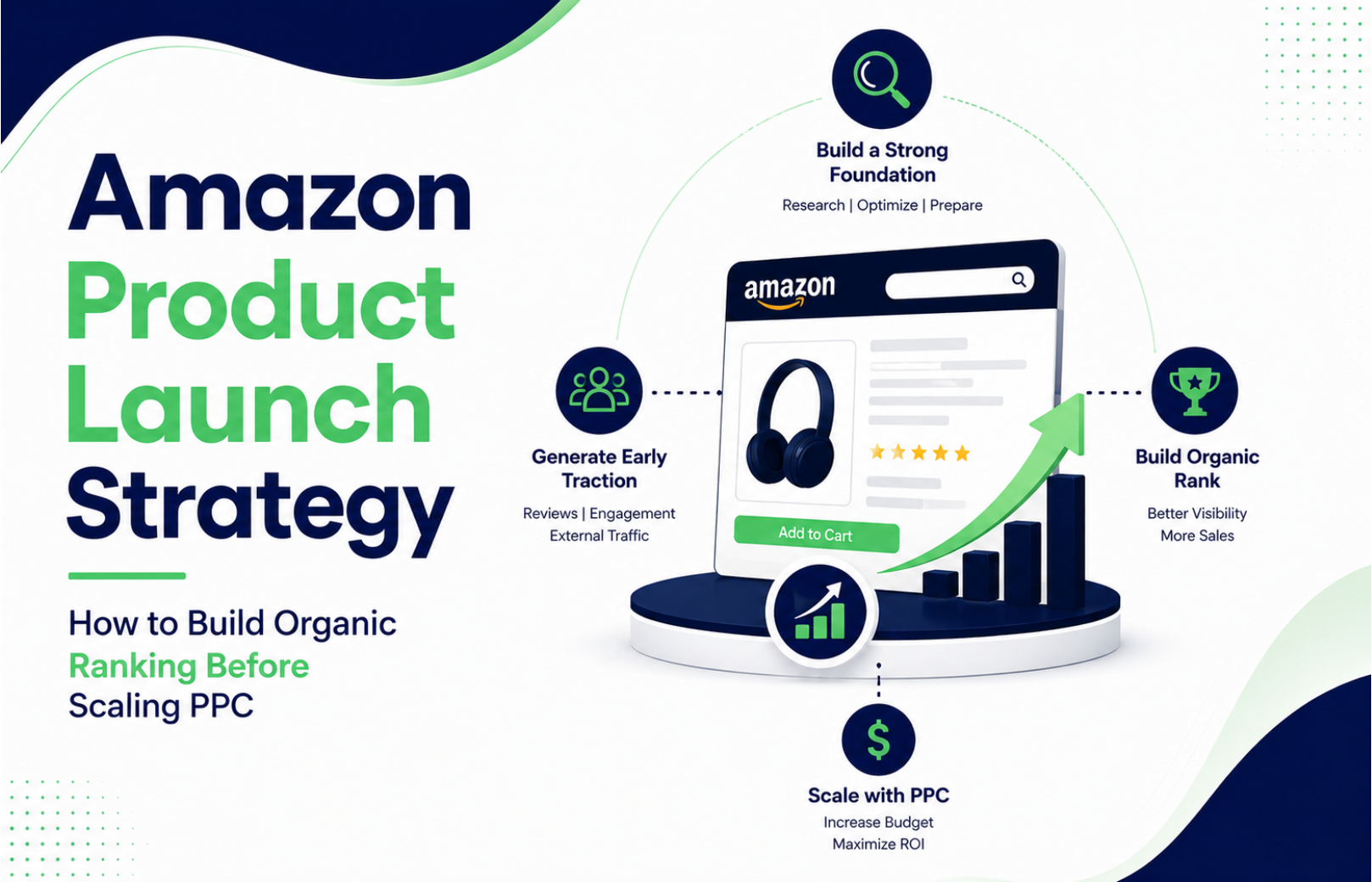
Amazon Product Launch Strategy: How to Build Organic Ranking Before Scaling PPC


A new Amazon product goes live. The listing looks polished, the inventory is ready, and the seller is eager to start advertising. Within a few days, the PPC dashboard shows clicks, but organic visibility is barely moving. The seller responds by increasing bids. That usually creates a more expensive problem, not a better launch.

A stronger Amazon product launch strategy starts before serious ad scaling. First, make the product detail page relevant to the searches you want to win, make the offer competitive enough to convert, and establish a clean keyword and measurement baseline. Then use PPC to accelerate discovery, collect useful search-term data, and build sales momentum. The goal isn’t to avoid Amazon PPC. It’s to make every paid click work harder while your organic ranking develops.

What Should You Do Before Launching Amazon PPC?

Before increasing Amazon PPC spend, make sure the product listing can convert the traffic you’re about to buy. Your title, images, bullet points, product description, pricing, inventory, relevant search terms, and overall offer should be ready before you attempt to scale advertising.

Amazon itself recommends auditing product detail pages before launching Sponsored Products and using relevant search terms that reflect how shoppers search for the product.

For a new product, your first priority should be relevance and conversion readiness, not ranking for every possible keyword.

Build the Amazon Listing Around Buyer Search Intent

Amazon product listing optimization means structuring the product detail page so shoppers can discover the product and understand why it fits their needs. Amazon describes the product detail page as the place where customers see product information such as the name, images, description, and offer details.

Start with three keyword groups:

  • Primary category keywords
  • High-intent long-tail keywords
  • Product-specific attributes and use cases

Don’t stuff every keyword into the title. A title that reads unnaturally can reduce shopper confidence even if it contains more search terms.

This is where a proper Amazon SEO launch differs from simply uploading a listing. Your keyword research should determine the search language, while the listing should turn that language into useful product information.

For brands that need this foundation built systematically, HRL Infotechs’ Amazon SEO and Listing Optimization Services cover keyword research, title optimization, bullet points, backend search terms, visual optimization, and ongoing performance analysis.

How Do You Build Organic Ranking Before Scaling PPC?

Build organic ranking by combining strong listing relevance with genuine sales and conversion activity, then use PPC selectively to accelerate visibility for the most commercially important searches. Organic ranking should be treated as an outcome of relevance, shopper response, and sustained performance rather than something that can be guaranteed through advertising alone.

This is one of the most important judgement calls in a new Amazon launch: don’t try to rank for your broadest keyword first.

If your new product is a premium stainless-steel lunch box, for example, competing immediately for an extremely broad term such as “lunch box” may consume substantial budget while attracting shoppers with very different requirements.

A more sensible launch sequence might start with specific searches such as:

  • stainless steel lunch box for office
  • leakproof lunch box for adults
  • insulated stainless steel lunch container
  • lunch box for working professionals

Once you identify which terms generate qualified clicks and conversions, you can gradually expand your targeting.

HRL Infotechs has previously covered this principle in its guide to Amazon keyword research and ranking strategy, which explains why keyword selection should be based on buyer intent rather than search volume alone.

When Should You Start Amazon PPC for a New Product?

You should start Amazon PPC once the product is buyable, the detail page is properly optimized, inventory is available, and the offer is capable of converting. The mistake is not starting PPC early. The mistake is scaling PPC aggressively before you know whether the listing can convert paid traffic.

Amazon Sponsored Products are CPC ads that promote individual product listings and can target keywords or products. Amazon states that advertisers control bids and budgets and can use campaign reporting to optimize performance.

That makes PPC useful during a launch, but your first campaigns should be treated as controlled discovery.

Start with:

  1. High-intent exact keywords
  2. Relevant phrase and discovery targeting
  3. Carefully selected product targets
  4. Brand terms where appropriate
  5. Controlled budgets
  6. Search-term analysis

Don’t interpret the first few days of impressions as proof that a campaign is working. Look for qualified traffic, clicks, conversions, search-term relevance, and movement in the product’s organic visibility.

How Should You Structure Amazon PPC During a Product Launch?

A new-product Amazon PPC launch should separate discovery from proven demand. Keep high-intent keywords, exploratory targeting, and product targeting sufficiently organized that you can identify what is actually producing useful traffic and sales.

Sponsored Products can use keyword or product targeting, and Amazon recommends monitoring campaign performance and adjusting budgets and keywords as campaigns develop.

A practical launch structure can include:

Exact campaign: Your strongest high-intent keywords.

Phrase campaign: Closely related variations and search discovery.

Auto campaign: Controlled discovery of search terms you may not have identified manually.

Product targeting: Relevant competitor or complementary product detail pages.

The important part isn’t creating the maximum number of campaigns. It’s maintaining enough separation to make decisions.

We’ve seen sellers create dozens of campaigns for a single new ASIN, then struggle to understand where the money is going. A smaller, cleaner structure often gives you better visibility into what deserves more budget.

Which Metrics Should You Track During the First 30 Days?

During the first 30 days, track impressions, clicks, CTR, conversion rate, advertising cost of sales, sales, search-term performance, and organic keyword movement. No single metric should determine whether you scale or reduce spend.

A useful launch review asks four questions:

  1. Are relevant shoppers seeing the product?
  2. Are they clicking?
  3. Are they converting after clicking?
  4. Are important keywords showing organic movement?

Amazon’s advertising system provides campaign reporting that lets advertisers evaluate performance and adjust targeting, bids, and budgets.

Don’t chase ACoS in isolation. A new product can have a higher initial ACoS while you’re gathering data and establishing demand. On the other hand, a campaign with excellent ACoS but almost no sales volume may not be contributing meaningfully to growth.

The better metric depends on your launch objective.

Should You Increase PPC Budget When Organic Ranking Improves?

Increase PPC when the data shows that additional spend can generate profitable or strategically valuable sales without overwhelming your margins. Improving organic ranking is a positive signal, but it isn’t automatically a reason to double the advertising budget.

This is where Amazon launch strategy becomes different from a simple PPC strategy.

Suppose your product begins ranking organically for several long-tail terms after four weeks. You may decide to maintain paid coverage on those valuable terms while redirecting incremental budget toward terms where organic visibility is still weak.

Amazon’s current new-product advertising guidance specifically recommends using advertising to promote new products and adjusting budgets and keywords as the product moves through its lifecycle.

The objective is to make paid and organic visibility reinforce each other, not to make PPC permanently responsible for every sale.

How Does Amazon Account Management Affect a New Product Launch?

Amazon account management keeps the operational side of a launch from undermining the marketing strategy. Inventory, account health, listing issues, pricing, catalog changes, advertising performance, and ongoing marketplace tasks all need attention while the product is gaining traction.

A ranking strategy cannot compensate for operational problems. If your product goes out of stock, the listing develops a compliance issue, or important catalog information is incorrect, your advertising plan can quickly become irrelevant.

This is why Amazon account management becomes particularly useful when you’re launching multiple ASINs or managing Amazon alongside other marketplaces. HRL Infotechs provides Amazon Account Management Services that cover ongoing marketplace operations and performance monitoring as part of its broader ecommerce management approach.

What Should You Do in the First 30 Days of an Amazon Product Launch?

Use the first 30 days to establish relevance, gather search data, identify conversion problems, and progressively shift budget toward proven opportunities. Don’t treat the launch as one fixed campaign that runs unchanged for a month.

A practical sequence is:

Days 1–7:
Check listing indexing, impressions, CTR, search-term relevance, price competitiveness, inventory, and initial conversion signals.

Days 8–14:
Review search-term data, identify irrelevant traffic, add negative targeting where appropriate, and refine bids.

Days 15–21:
Separate proven converting terms from discovery terms and evaluate organic keyword movement.

Days 22–30:
Increase investment in proven opportunities, reduce inefficient targeting, and identify the next set of keywords worth testing.

HRL Infotechs has also examined why Amazon PPC campaigns waste budget during the first 30 days, including problems such as weak campaign structures, broad targeting, and poorly controlled bids.

When Should You Scale Amazon Advertising?

Scale Amazon advertising after you have evidence that the listing, offer, targeting, and conversion process can support additional traffic. Scaling should follow validated performance, not simply the passage of time.

Amazon provides several advertising options beyond Sponsored Products, including Sponsored Brands and other formats. Its new-product advertising guidance recommends combining targeting approaches and using different campaign types according to launch objectives.

For most sellers, however, the first scaling decision shouldn’t be “Which new ad format should I launch?”

It should be:

Which search terms, products, audiences, and placements have already demonstrated commercial value?

Then increase investment there.

If managing bids, search terms, campaign structures, listing optimization, and performance reporting is taking more time than your team can realistically give it, Amazon Advertising Services from HRL Infotechs can fit naturally into the next stage of the workflow.

What Is the Right Amazon Product Launch Strategy?

The right Amazon product launch strategy is a staged process: optimize the listing, establish keyword relevance, make the offer conversion-ready, launch controlled PPC, analyze search-term and conversion data, improve the listing, and only then scale the campaigns that demonstrate value.

You don’t need to choose between Amazon SEO and Amazon PPC. You need to sequence them correctly.

PPC can create the initial traffic and provide valuable performance data. SEO and listing optimization create the foundation for sustainable organic discovery. Account management keeps operational issues from disrupting the process.

For a new product, that combination is usually more sensible than simply increasing the daily ad budget and hoping Amazon ranking follows.

If you’re preparing a new ASIN and aren’t sure whether your listing, keyword strategy, or PPC structure is ready for launch, HRL Infotechs can review the gaps and help you build the launch sequence before you commit more advertising budget.

Frequently Asked Questions

How long does it take for a new Amazon product to rank organically?

There is no fixed Amazon ranking timeline for a new product. Initial indexing and ranking movement can happen relatively quickly, but meaningful organic visibility depends on relevance, competition, conversion performance, sales activity, and other marketplace factors. Treat the first several weeks as a measurement period rather than expecting a guaranteed ranking date.

Should I run Amazon PPC immediately after launching a new product?

You can start PPC after the product is buyable and the listing is properly prepared. Starting advertising early can help generate visibility and collect useful search-term data. However, aggressive scaling before validating the listing’s conversion performance can waste budget. Start with controlled targeting, measure the results, and scale based on evidence.

Can Amazon PPC improve organic ranking?

PPC and organic ranking are separate mechanisms, so advertising should not be treated as a guaranteed way to buy an organic position. PPC can generate product detail page traffic and sales, while successful customer interactions may contribute to the broader performance picture. The practical goal is to use PPC to support product discovery while building sustainable organic demand.

What keywords should I target for a new Amazon product launch?

Start with relevant, high-intent keywords that closely describe the product, its features, use case, and buyer need. Include specific long-tail terms before aggressively targeting broad, highly competitive keywords. Search-term performance from early campaigns can then help you identify which queries deserve greater attention in your Amazon SEO launch.

How much should I spend on Amazon PPC for a new product?

There is no universal launch budget because CPCs, category competition, margins, conversion rates, and sales targets differ significantly. Set a test budget that your business can afford to learn from, then evaluate spend against clicks, conversions, sales, ACoS, and organic movement. Increase budget only when the underlying economics support it.

Should I optimize my Amazon listing before starting PPC?

Yes. Listing optimization should happen before serious PPC scaling because your ads send shoppers to the product detail page. If the title, images, bullets, pricing, product information, or overall offer are weak, additional traffic may simply expose those problems faster. Amazon also recommends auditing product detail pages before launching Sponsored Products.

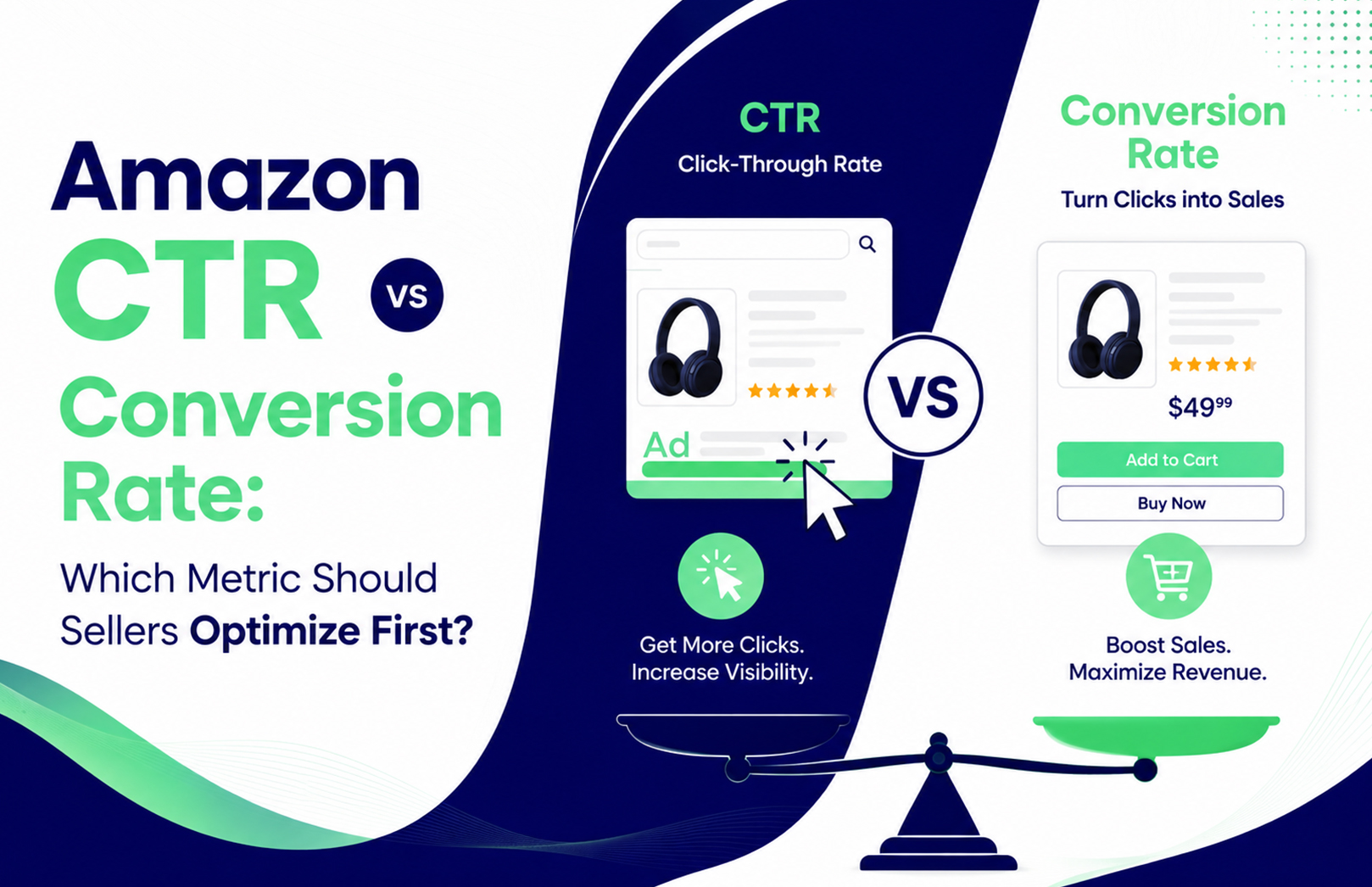
Amazon CTR vs Conversion Rate: Which Metric Should Sellers Optimize First?


Your Amazon listing is getting 50,000 impressions but only 250 clicks. Or perhaps your ads are generating hundreds of clicks every week, but orders remain disappointing. These are two very different problems, and treating them the same can waste your advertising budget.

So, should you optimize Amazon CTR or conversion rate first? Start with the metric showing the bigger funnel problem. If impressions are high but clicks are weak, prioritize Amazon CTR. If clicks are healthy but purchases are weak, prioritize conversion rate. Once both are performing reasonably well, move your attention to CPC, ACoS, ROAS, TACoS and profit. Amazon Ads itself positions CTR as a consideration-stage metric and conversion rate as a purchase-stage metric.

What Should Amazon Sellers Optimize First: CTR or Conversion Rate?

Optimize CTR first when your product is visible but shoppers aren’t clicking. Optimize conversion rate first when shoppers are clicking but not buying. This simple diagnostic prevents sellers from increasing ad spend before fixing the actual bottleneck.

Think about your Amazon funnel as:

Impressions → Clicks → Product Page → Purchase → Revenue → Profit

If the first transition is weak, improving the product page won’t immediately solve the traffic problem. If the second transition is weak, buying more traffic can simply increase wasted spend.

For example, consider an illustrative Amazon seller receiving 100,000 impressions, a 0.4% CTR and a 10% conversion rate. That produces approximately 400 clicks and 40 orders. If the seller improves CTR to 0.8% while maintaining the same conversion rate, the same impression volume could produce around 80 orders.

But there is a catch.

If the new clicks are less relevant and conversion falls from 10% to 4%, the seller would generate only about 32 orders. A higher CTR can therefore produce fewer sales if the additional traffic is poor quality.

That is one of the biggest mistakes sellers make when optimizing Amazon advertising metrics: treating an improving percentage as automatically meaning better business performance.

What Is Amazon Click-Through Rate and Why Does It Matter?

Amazon click-through rate, or CTR, is the percentage of ad impressions that result in clicks. Amazon Ads calculates CTR as clicks divided by impressions, multiplied by 100.

CTR tells you whether your ad is attracting attention from shoppers who see it. It does not tell you whether those shoppers will purchase.

For sellers, a weak Amazon listing CTR can point to several issues:

  • Your product is appearing for irrelevant searches.
  • Your main image isn’t competitive in the search results.
  • Your title doesn’t communicate the product clearly.
  • Your price looks uncompetitive.
  • A competitor has stronger ratings, reviews or offers.
  • Your ad placement is reaching shoppers with weaker intent.
  • Your keyword targeting is too broad.

This is why you shouldn’t immediately increase bids when CTR is poor.

If your product appears beside five stronger offers and shoppers repeatedly ignore yours, paying more to obtain that placement doesn’t necessarily solve the problem.

Amazon Ads recommends reviewing CTR alongside campaign goals and other KPIs rather than using it in isolation.

For sellers managing multiple campaigns, the more useful question is not simply “What is my Amazon CTR?” but:

“Which keywords, placements and products are generating impressions without earning enough qualified clicks?”

That distinction makes CTR actionable.

What Is Amazon Conversion Rate?

Amazon conversion rate measures how effectively shoppers who reach your product experience complete the desired action, such as making a purchase. Amazon Ads notes that conversion rate depends on how the conversion is defined and measured, so sellers should always understand which report and denominator they’re using.

For an Amazon seller, conversion performance is affected by much more than advertising.

Your product page has to answer the shopper’s questions quickly:

Is this the right product?
Is it worth the price?
Can I trust the seller?
Will it solve my problem?
Can I get it when I need it?

A seller can have excellent PPC targeting and still experience poor conversion because the product detail page doesn’t close the sale.

Common conversion blockers include:

  • Weak or unclear product images
  • Poor review rating or insufficient reviews
  • Uncompetitive pricing
  • Confusing variations
  • Weak bullet points
  • Missing product benefits
  • Poor A+ Content
  • Weak offer or delivery proposition
  • Traffic that doesn’t match the product’s actual use case

Amazon itself recommends relevant product content and product detail page optimisation as part of improving conversion performance.

This is where Amazon product listing and SEO optimization becomes part of the advertising strategy, rather than a separate SEO exercise. HRL Infotechs aligns listing content, keywords and conversion elements so paid traffic lands on a product page designed to continue the buying journey.

How Do Amazon CTR and Conversion Rate Work Together?

CTR measures how effectively you turn visibility into traffic. Conversion rate measures how effectively you turn that traffic into customers. You need both because improving only one part of the funnel can produce misleading results.

Consider three seller situations:

High impressions, low CTR

Your product is being seen but isn’t earning enough attention.

Priority: Investigate search relevance, main image, title, offer, placement and competitive positioning.

Do not assume that higher bids are the answer.

Healthy CTR, low conversion

Shoppers are interested enough to click, but something on the product page or offer is stopping them from buying.

Priority: Audit the listing, pricing, reviews, images, A+ Content, variations and traffic quality.

Increasing the campaign budget before fixing the listing can make the problem more expensive.

Healthy CTR, healthy conversion

Now you have a stronger foundation for scaling.

Priority: Evaluate CPC, ACoS, ROAS, TACoS, contribution margin, search-term performance and incremental sales.

This is where the seller’s goal changes from “Can I get more traffic?” to “Can I acquire more profitable customers?”

How Can Sellers Diagnose a Low Amazon CTR?

Start with the search results, not the advertising dashboard. Look at what a shopper actually sees when your product appears beside competing products.

Search your primary keywords manually and compare your listing against the products receiving the most attention.

Look at:

  • Main image
  • Product title
  • Price
  • Discount or coupon
  • Star rating
  • Review volume
  • Prime or delivery proposition
  • Product differentiation
  • Brand familiarity

One practical lesson from Amazon listing work is that sellers often try to solve a creative problem with a bidding solution.

If your product has a poor main image, increasing the bid may help you win more impressions, but it doesn’t necessarily make shoppers want to click.

HRL Infotechs’ analysis of Amazon product images and their impact on clicks and conversions makes this distinction particularly relevant. Your main image competes for attention before the shopper reads most of your listing copy.

You should also segment CTR instead of looking at one account-wide number.

Compare:

Brand vs non-brand → Exact vs phrase/broad → Search terms → Placements → Products → Time periods

A 2% CTR on branded searches doesn’t mean your generic keyword campaigns are equally strong.

How Can Sellers Fix a Low Amazon Conversion Rate?

Start by determining whether the problem is the product page or the traffic reaching it. A low conversion rate caused by irrelevant traffic requires campaign optimisation. A low conversion rate caused by a weak listing requires product-page optimisation.

This distinction matters because the wrong fix can make your account worse.

Suppose you’re selling a premium protein powder and your campaign receives clicks for searches related to cheap protein supplements. Your listing might be excellent, yet conversion remains poor because the shopper’s price expectation is wrong.

In that case, rewriting the listing may have limited impact.

But if shoppers are searching for your exact product type, clicking your ad and then choosing competitors, investigate:

  • Price positioning
  • Main image
  • Benefits
  • Product specifications
  • Reviews
  • A+ Content
  • Coupons
  • Delivery
  • Competitor offers
  • Product differentiation

A useful rule is:

Poor traffic quality = fix targeting.
Good traffic + poor purchase rate = fix the offer or listing.

Don’t automatically reduce price. That’s another trade-off experienced sellers learn quickly. A discount can increase conversion while reducing contribution margin. If your product can win through better positioning, stronger content or more relevant traffic, discounting may be the wrong first move.

Should Sellers Increase Amazon PPC Bids When CTR Is Low?

Not necessarily. Increasing a bid can help your ad compete for placements, but it does not directly fix weak shopper appeal or irrelevant targeting. First determine why CTR is low.

Amazon’s Sponsored Products guidance recommends monitoring impressions, clicks, sales and CPC and using search-term, targeting, advertised-product and placement reports to understand performance.

A better workflow is:

  1. Check whether the search term is relevant.
  2. Compare CTR with similar keywords in the account.
  3. Review the placement.
  4. Inspect the product’s search-result appearance.
  5. Check competitor pricing and offers.
  6. Improve the listing or targeting where necessary.
  7. Adjust the bid only after the underlying issue is understood.

This is the difference between bid management and genuine Amazon advertising optimisation.

If you need account-level support, Amazon PPC management and advertising services can connect search-term analysis, bid optimisation, campaign structure and conversion data rather than treating each metric separately. HRL Infotechs specifically positions PPC management around qualified traffic, search-term analysis, conversion data and advertising efficiency.

What Amazon PPC Metrics Should Sellers Check After CTR and Conversion?

CTR and conversion rate tell you where the funnel is leaking, but they don’t tell you whether the resulting sales are profitable. Once the funnel is functioning, sellers should connect these metrics to CPC, ACoS, ROAS, TACoS and ultimately contribution margin.

Amazon defines ACoS as ad spend divided by attributed sales and ROAS as ad sales divided by ad spend.

For example, an illustrative campaign might show:

CTR improving → clicks increasing → conversion stable → CPC rising → ACoS worsening

That isn’t necessarily a successful optimisation.

You may have improved the front of the funnel while making customer acquisition more expensive.

This is why HRL Infotechs’ recent Amazon ACoS vs TACoS analysis recommends looking beyond a single advertising metric and connecting advertising performance with overall sales.

For sellers, the final question should always be:

“Did this change create more profitable incremental sales?”

Not:

“Did this percentage go up?”

How Should Amazon Sellers Optimize CTR and Conversion Rate Together?

Use a staged optimisation process rather than changing everything simultaneously. This makes it easier to identify what actually improved performance and prevents sellers from wasting budget on symptoms instead of causes.

Step 1: Diagnose visibility

Check impressions and search-term relevance.

If impressions are low, investigate indexing, keyword coverage, bids, budget and eligibility before worrying about CTR.

Step 2: Diagnose the click

If impressions are healthy but CTR is weak, compare your search-result presentation against competitors.

Prioritise the main image, title clarity, relevance, price and offer.

Step 3: Diagnose the purchase

If clicks are healthy but orders aren’t following, audit the product detail page and traffic quality.

Don’t assume the advertising campaign is automatically responsible.

Step 4: Diagnose economics

Once traffic and conversion are reasonably healthy, review CPC, ACoS, ROAS, TACoS and contribution margin.

A campaign generating more orders isn’t automatically better if every incremental order reduces profitability.

Step 5: Scale only what has evidence

Amazon Ads recommends regularly reviewing campaign performance and using reporting to identify optimisation opportunities.

For sellers, that means scaling keywords, products and placements that have demonstrated commercially useful performance instead of increasing the entire campaign budget simply because sales are rising.

What Should Indian Amazon Sellers Do This Week?

Don’t start by changing every campaign. Start with the products and search terms where the performance problem is easiest to identify.

Use this sequence:

  1. Select your top 10 products by advertising spend.
  2. Pull impressions, clicks, CTR, CPC, orders, sales and ACoS.
  3. Identify products with high impressions and weak CTR.
  4. Identify products with strong CTR but weak conversion.
  5. Review their search terms and placements.
  6. Manually inspect the product detail pages.
  7. Compare price, reviews, images and offers against leading competitors.
  8. Make one meaningful change at a time.
  9. Give the account enough data to establish a pattern.
  10. Recheck sales and profitability, not just CTR or conversion rate.

This is particularly useful during Indian shopping peaks, when promotions, competitor discounts and demand changes can distort short-term performance.

Don’t compare a major sale event directly with a normal trading week and assume the difference is caused by your optimisation.

So, Which Metric Should Amazon Sellers Optimize First?

Optimize Amazon CTR first when your biggest problem is getting qualified shoppers to click. Optimize conversion rate first when qualified shoppers are already reaching your product page but aren’t purchasing. Neither metric should be treated as the final goal. The real objective is profitable Amazon sales.

The strongest Amazon sellers don’t ask, “Should I improve CTR or conversion rate?”

They ask:

“Where is my funnel losing the most commercially valuable shoppers?”

That question leads to better decisions about PPC, listing optimisation, bids, keywords, pricing and budget allocation.

If your Amazon account has strong impressions but weak CTR, or strong clicks but disappointing sales, the next step is not necessarily more advertising spend. It is identifying whether the problem sits in targeting, search-result presentation, product-page conversion or campaign economics.

HRL Infotechs brings Amazon advertising and listing optimisation together so sellers can diagnose those gaps across the funnel rather than optimise isolated dashboard metrics. If you’re unsure whether your current bottleneck is traffic, conversion or advertising efficiency, request an Amazon performance review and use the data to decide where the next optimisation should happen.

FAQs About Amazon CTR vs Conversion Rate

Q1. Is Amazon CTR or conversion rate more important for sellers?

Ans. Neither is universally more important. CTR matters most when your products receive impressions but insufficient clicks. Conversion rate matters more when shoppers click but don’t purchase. Sellers should identify the weakest stage first, then evaluate CPC, ACoS, ROAS, TACoS and profitability.

Q2. What causes a low Amazon listing CTR?

Ans. Low Amazon listing CTR can result from weak search relevance, an uncompetitive main image, unclear titles, pricing, poor ratings, weak offers or stronger competing products. Review CTR at the keyword and placement level rather than relying on an account-wide average.

Q3. Why is my Amazon CTR high but sales are low?

Ans. High CTR with low sales often indicates a traffic-quality or product-page problem. Check whether shoppers are searching for the exact product you sell, then review price, reviews, images, benefits, variations and delivery. More clicks won’t necessarily help if the additional traffic has weak purchase intent.

Q4. Should I increase my Amazon PPC bids to get more clicks?

Ans. Not automatically. Higher bids can help win more auctions and placements, but they don’t fix irrelevant targeting or weak product presentation. Before increasing bids, identify whether the problem is low visibility, poor CTR, expensive CPC or weak conversion. Then make the change that addresses the actual bottleneck.

Q5. What is a good Amazon CTR for Sponsored Products?

Ans. There isn’t one universal CTR target that applies to every seller. CTR varies by category, keyword intent, placement, competition and campaign type. Amazon has introduced benchmark resources that give advertisers more category-level context, making peer comparison more useful than relying on a generic CTR percentage.

Q6. How can I improve Amazon conversion rate without lowering my price?

Ans. Start with relevance and the product experience. Make sure your ads target shoppers who genuinely need the product, then improve images, product benefits, titles, bullet points, A+ Content, reviews and offer clarity. If qualified traffic is already strong, these improvements can be more sustainable than using discounts as the default conversion lever.

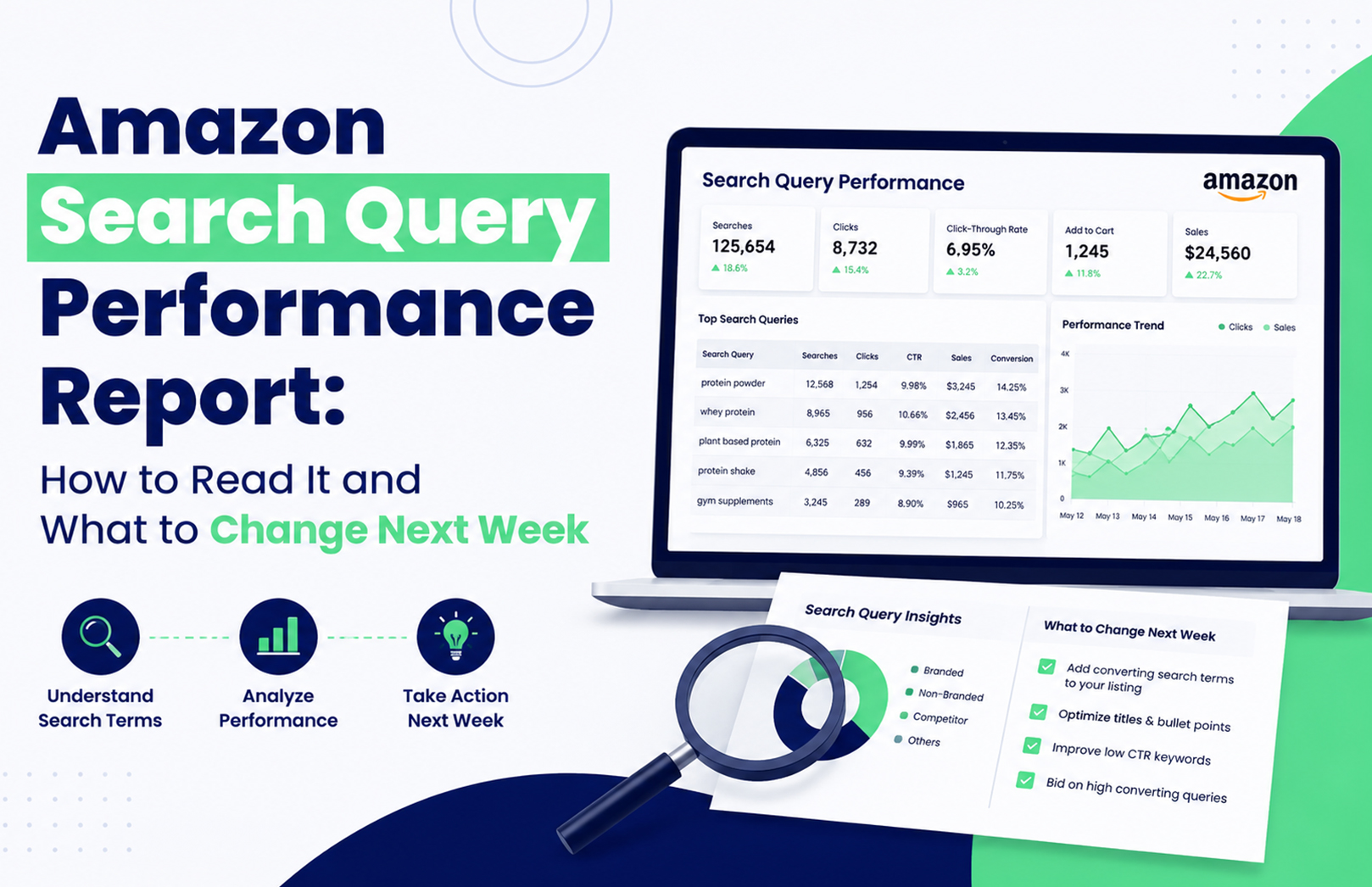
Amazon Search Query Performance Report: How to Read It and What to Change Next Week


Your Amazon product is getting 40,000 impressions for a search query, but only 800 clicks. Another query gets fewer impressions yet produces significantly more cart adds and purchases. Which one deserves your attention next week? The Amazon Search Query Performance report helps answer that question by showing how shoppers move from search impressions to clicks, cart adds, and purchases for queries associated with your brand.

The mistake is treating SQP as another keyword report. It isn’t. Used properly, it tells you where your brand is losing potential customers and whether the next action should be listing optimisation, advertising, pricing, or broader account management.

What Is the Amazon Search Query Performance Report?

The Amazon Search Query Performance report is a Brand Analytics report that shows how your brand performs for customer search queries. It provides query-level visibility into stages such as impressions, clicks, cart adds, and purchases, helping you compare your brand’s performance with the wider query opportunity.

For eligible brands, Search Query Performance sits within Amazon Brand Analytics in Seller Central. Amazon’s Brand Analytics tools are designed to give registered brands access to customer and search behaviour insights, but availability depends on account and Brand Registry eligibility.

The practical value is simple: instead of asking “Which keyword should I add?”, you can ask “At which stage are shoppers dropping away?”

How Do You Read Amazon SQP Data?

Read the report as a search-to-purchase funnel, not as a list of keywords. Start with relevant queries, then compare your performance across impressions, clicks, cart adds, and purchases before deciding what to change.

SQP SignalWhat It Usually IndicatesFirst Thing to Check
High impressions, low clicksVisibility without enough shopper interestMain image, title, price
High clicks, low cart addsProduct page isn’t convincing enoughListing content, reviews, offer
High cart adds, low purchasesPurchase frictionPrice, delivery, availability
Low impressionsWeak visibility or query coverageRelevance, SEO, PPC
Strong purchases, low brand shareOpportunity to capture more demandListing + advertising

1. Start With Commercially Relevant Queries

Don’t automatically select the query with the highest search volume.

Suppose you sell a ₹799 vitamin supplement in India. A broad query such as “vitamins” may generate huge search activity, but a more specific query such as “multivitamin for daily energy” could have stronger purchase intent for your particular product.

This is one of the judgement calls that matters in real Amazon optimisation: the biggest query isn’t necessarily the best query to win.

If the query is relevant but your listing isn’t sufficiently aligned with the customer’s language, review your Amazon SEO and listing optimisation strategy before simply increasing advertising spend. HRL Infotechs’ Amazon SEO service specifically combines keyword research with product-page optimisation.

2. Compare Impressions With Clicks

High impressions mean your products are appearing, but they don’t tell you whether shoppers care enough to click.

If your brand receives substantial impressions for a query but very few clicks, compare your product with the competing results visible for the same search. Look at the main image, price, rating, review count, title presentation, and product type.

A common mistake is changing keywords first. If Amazon is already showing the product for a relevant query, the bigger problem may be search-result competitiveness rather than keyword coverage.

What Should You Do When Amazon Impressions Are High but Clicks Are Low?

When impressions are healthy but clicks are weak, improve the elements shoppers see before entering your product detail page. The main image, visible title, price, rating, reviews, and relevance should be checked before you touch the campaign structure.

This is particularly important on mobile, where shoppers scroll quickly through competing products. HRL Infotechs’ analysis of how Amazon product images affect rankings, clicks and conversions highlights why product imagery should be treated as a performance element rather than decoration.

Don’t change five listing elements simultaneously if you want to understand what worked. Test the most obvious weakness first, document the change, and compare the next meaningful reporting period.

What Does Low Cart-Add Performance Mean?

High clicks but weak cart adds usually mean the search result did its job, but the product page didn’t complete the next step. The shopper was interested enough to visit but didn’t find sufficient reason to move closer to purchase.

Check your bullets, images, A+ Content, reviews, price, variations, product information and offer. Also ask whether the search query actually matches what your product delivers.

This is where Amazon listing optimisation and SQP analysis work together. The report identifies the leak; the listing work addresses the leak.

What If Cart Adds Are Strong but Purchases Are Low?

Strong cart activity with weak purchases can indicate purchase friction rather than poor keyword targeting. Price, delivery expectations, stock availability, promotions, competition and customer confidence can all influence the final decision.

Don’t automatically respond by increasing PPC bids. More traffic won’t necessarily fix a purchase-stage problem.

This is another practical trade-off: if the listing already generates clicks and cart adds, sending more paid traffic before fixing the purchase barrier can increase spend without solving conversion.

Amazon Search Query Performance vs Search Term Report: What’s the Difference?

The Amazon Search Query Performance report and the Search Term Report serve different purposes. SQP focuses on customer search-query performance around your brand, while the Search Term Report helps advertisers analyse the customer search terms associated with their advertising activity.

That distinction matters because an important customer query might represent a broader organic opportunity even when your current PPC activity isn’t capturing it effectively.

If the SQP data identifies a valuable query, compare it against your advertising data before deciding whether to increase keyword coverage, adjust bids, add negative targeting, or leave the query primarily to organic optimisation.

For broader advertising execution, Amazon advertising services can connect search-term analysis with Sponsored Products, Sponsored Brands, Sponsored Display and other advertising activities.

How Can Amazon Brand Analytics Search Terms Improve Your Keyword Strategy?

Amazon Brand Analytics search data can help you understand the language customers use and identify queries worth investigating for your catalogue. But don’t copy every high-volume search term into your listing.

A query should pass three tests before becoming a priority:

  1. Relevance: Does the query accurately describe your product?
  2. Commercial value: Do shoppers using it show meaningful buying behaviour?
  3. Competitive opportunity: Can your product realistically improve its position?

This approach prevents a common problem: building a keyword-heavy listing around searches that generate traffic but don’t generate the right customers.

How Do You Use Amazon Impression Share by Keyword?

Amazon impression share should be interpreted alongside the rest of the funnel. A low share can indicate an opportunity, but it doesn’t automatically mean you should spend more.

If your brand has low impression share but strong clicks and purchases whenever it appears, increasing visibility may be worth testing. If impression share is low and conversion is also poor, fixing the listing or offer may come first.

The same principle applies to advertising. Your goal isn’t simply to maximise impressions. You want qualified visibility that has a realistic path to conversion.

What Should You Change Next Week?

Once you’ve identified the biggest SQP gap, turn it into one clearly defined action rather than making broad account changes.

Monday: Segment the Queries

Separate relevant queries into four groups:

  • High impressions
  • High clicks
  • High cart adds
  • High purchases

Then identify where your brand is disproportionately weak.

Tuesday: Diagnose the Listing

For high-impression/low-click queries, compare your main image, title, rating, reviews and price against competing products.

For high-click/low-cart queries, inspect your detail page and product positioning.

If several products need this work, a structured Amazon product listing and SEO strategy can help connect query analysis with catalogue-level optimisation.

Wednesday: Review Advertising

Match priority queries against your advertising search terms.

Ask:

  • Are valuable queries being targeted?
  • Are bids competitive enough?
  • Are irrelevant searches consuming spend?
  • Are converting search terms isolated appropriately?
  • Is your listing strong enough to justify additional paid traffic?

Thursday: Check Price and Availability

Don’t ignore operational factors. A search-query problem can sometimes be caused by price, stock availability, delivery expectations or the competitive offer.

Friday: Make the Smallest Meaningful Change

Change one major variable at a time where practical.

For example, if the main image is clearly weaker than competitors, test the image before rewriting the entire listing and changing PPC bids on the same day.

Following Week: Compare Before and After

SQP data shouldn’t be judged from a single movement. Search volume changes, seasonality, promotions and reporting delays can affect short periods.

Keep a simple record of the query, original performance, change made and subsequent performance. That turns SQP from a reporting exercise into a repeatable optimisation process.

How Should SQP Data Influence Amazon PPC?

SQP should tell you where to investigate the opportunity. Advertising data should help determine how to capture it.

For example, imagine a query with strong customer demand and healthy purchase behaviour but weak brand visibility. That is a reasonable candidate for deeper PPC investigation.

But if the query generates plenty of clicks while your product rarely converts, increasing bids may simply buy more expensive traffic.

This is why advertising shouldn’t be evaluated through ACoS alone. HRL Infotechs’ recent Amazon ACoS vs TACoS analysis explains why sellers need to distinguish campaign-level advertising efficiency from broader business performance.

When Should You Use Amazon Account Management Services?

SQP becomes significantly more useful when someone actually turns the findings into weekly execution. That can involve listing changes, advertising adjustments, catalogue maintenance, inventory checks, reporting and account-health monitoring.

For brands managing multiple ASINs, these tasks can quickly become difficult to coordinate. Amazon account management services can bring those activities into one operational workflow, including catalogue management, account-health monitoring, performance tracking and other marketplace tasks.

The goal isn’t to generate another dashboard. The goal is to make sure the insight from that dashboard produces an action.

What Are the Biggest Amazon SQP Mistakes?

The biggest mistake is assuming that every low metric requires an immediate optimisation.

SQP data needs context. Query relevance, competition, product availability, pricing, promotions and the reporting period can all affect what you see.

The second mistake is making too many changes simultaneously. If you change your listing, increase PPC bids, reduce price and launch a promotion in the same week, you may improve sales without knowing which action created the improvement.

Experienced Amazon teams usually work with a clearer sequence: identify the bottleneck → choose the most relevant intervention → document it → measure the result → iterate.

Final Takeaway: Use SQP to Decide What Changes Next

The Amazon Search Query Performance report is most valuable when you use it to answer a practical question: where are customers dropping out of my search journey?

Start with commercially relevant queries. Compare impressions, clicks, cart adds and purchases. Then connect the gap to the appropriate action—listing optimisation, advertising, pricing, availability or account-level execution.

If your SQP report repeatedly shows the same gaps across important queries, that’s a sign that you need a consistent optimisation process rather than another one-off report. HRL Infotechs provides Amazon account management and marketplace optimisation support for brands that need the analysis and execution to work together.

Frequently Asked Questions

Q1. How often should I check the Amazon Search Query Performance report?

A weekly review is useful for active Amazon brands because it helps identify emerging visibility and conversion gaps. However, don’t make major decisions from a single short period. Compare relevant periods and account for seasonality, promotions, inventory changes and reporting delays before judging whether an optimisation worked.

Q2. What does a high Amazon SQP impression share mean?

High impression share means your brand is capturing a meaningful portion of the available visibility associated with a query. It doesn’t automatically mean the query is profitable or that your listing is converting well. Always evaluate impression share alongside clicks, cart adds, purchases and commercial relevance.

Q3. Can Amazon SQP data help with Amazon SEO?

Yes. SQP can provide useful evidence about customer search behaviour and your brand’s performance for relevant queries. Use it alongside keyword research, listing relevance, conversion data and competitive analysis. SQP should inform your Amazon SEO decisions rather than replace broader keyword and listing research.

Q3. Is Amazon SQP the same as the Amazon Search Term Report?

No. Search Query Performance is a Brand Analytics tool focused on customer search-query performance around your brand. The Search Term Report is primarily an advertising analysis tool. They can be used together: SQP can identify valuable search opportunities, while advertising reports can show how your paid campaigns capture those searches.

Q4. Should I increase PPC bids if my SQP impressions are low?

Not necessarily. Low impressions can result from weak relevance, limited advertising coverage, competition, inventory problems or other factors. First determine whether the query is commercially valuable and whether your product is capable of converting. Increase PPC coverage only when advertising is genuinely the missing part of the funnel.

Q5. Can an Amazon agency manage SQP analysis every week?

Yes. SQP analysis can be incorporated into a broader Amazon management process that combines search-query analysis, listing optimisation, PPC management, catalogue operations and performance reporting. The benefit is that the report becomes an input for specific weekly actions rather than remaining a passive performance document.

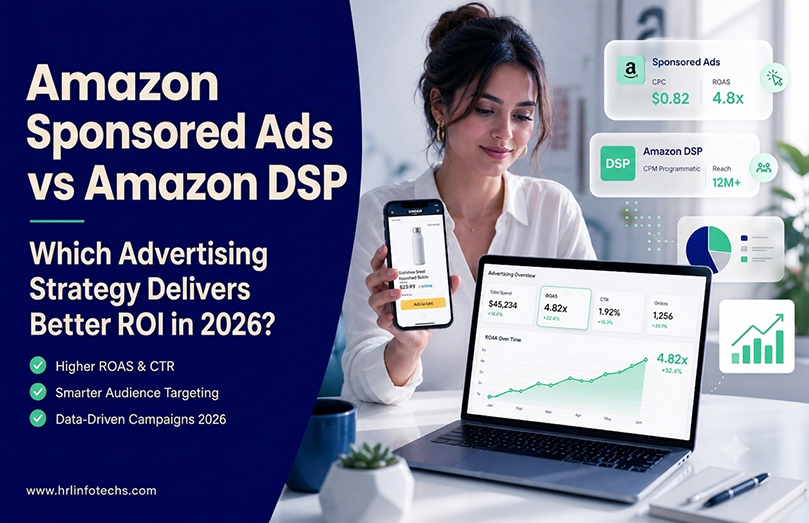
Amazon Sponsored Ads vs Amazon DSP: Which Advertising Strategy Delivers Better ROI in 2026?


An ecommerce brand selling on Amazon India spent eighteen months running only Sponsored Ads. Sales were steady. ACoS sat around 22%, comfortably profitable. Then a private label competitor entered the category with a near-identical product at a similar price, and the brand’s growth flattened within two quarters, not because their campaigns got worse, but because Sponsored Ads alone had no answer for a competitor building awareness before shoppers ever typed a search term.

The brand added a modest DSP retargeting campaign six months later. Within one quarter, repeat purchase rate increased, and their branded search volume, people typing the brand name directly rather than a generic category term, grew 31%. Sponsored Ads had never been the wrong choice. It had simply never been the complete answer.

This is the real question behind Amazon Sponsored Ads vs Amazon DSP in 2026, not which one wins, but which one is solving the specific growth problem a brand actually has right now.

Understanding Amazon Sponsored Ads

Amazon-sponsored ads represent keyword-targeted placement opportunities on search result pages and product pages, targeting active customers searching for similar goods, with purchase intent, and at the highest stage of the purchasing funnel.

A successful Amazon Sponsored Ads strategy should focus on selecting the right keywords, optimising listings, increasing conversion rates, and adjusting bids based on performance. Moreover, because such advertising initially targets those already interested in the product, it helps generate sales more quickly.

Sponsored ads are most useful for such purposes as introducing new products, creating sales, increasing a website’s traffic due to their velocity, and taking advantage of narrow promotional opportunities where timing is more important than building brand awareness. For most small and mid-sized Amazon India sellers, Sponsored Ads remain the correct starting foundation on which the e-commerce brand built eighteen months of profitable growth on this alone before hitting its ceiling.

What Is Amazon DSP?

Amazon DSP advertising operates differently at a fundamental level. Rather than waiting for a keyword search, DSP uses audience data, shopping behaviour, demographics, and browsing history to place targeted display and video ads on Amazon-owned properties, third-party websites, mobile apps, and streaming platforms.

Amazon DSP for brands is valuable for building brand awareness before product searches, retargeting those who viewed a listing but didn’t purchase, remarketing to those who abandoned a cart, reaching out to new customers with your product, and for premium brand-building creative. This is exactly the opportunity that the E-commerce brand found that DSP does not wait for a customer to begin searching. It takes place before shoppers even start their search.

Comparing Advertising Objectives

Both platforms generate sales, but they solve different problems. Sponsored Ads capture demand that already exists in a shopper actively comparing products right now. DSP creates demand by introducing a brand before that search behaviour begins, supporting the upper-funnel influence that shapes decisions over a longer window.

Businesses needing immediate conversions typically prioritise Sponsored Ads. Brands focused on long-term acquisition and defending market position against new competitors, exactly the situation the appliance brand faced, which increasingly needed DSP as part of the mix, not as a replacement.

Which Platform Delivers Better ROI?

There is no universal winner when evaluating Amazon advertising ROI. Sponsored Ads typically produce stronger short-term returns because they target high-intent shoppers, with lower acquisition costs and faster, easier-to-measure sales.

DSP campaigns usually require larger investment and longer optimisation cycles, but contribute to brand recognition, retention, and repeat purchases that individual campaign metrics understate. The appliance brand’s 31% branded search increase never showed up as a direct DSP conversion; it showed up weeks later as improved Sponsored Ads efficiency, because more shoppers were now searching by brand name rather than generic category terms.

Evaluating ROI in isolation, campaign by campaign, misses this compounding effect. Evaluating it at the level of overall business growth reveals what each platform is actually contributing.

The Importance of Campaign Optimisation

Running ads without optimisation can drain profits on any platform. It means regular Amazon campaign optimisation to examine the search terms, audiences, bids, placements, creatives, and conversions.

This includes eliminating low-performing keywords, raising the cost for effective campaigns, and testing new audiences. In addition, teams should refresh their creative assets ahead of performance fatigue, evaluate their customer acquisition costs weekly (vs. monthly), and reallocate budgets depending on demand fluctuations throughout the year. Consistent optimisation is what separates advertising spend that compounds from spend that simply maintains a plateau, the exact plateau the appliance brand experienced before adding DSP.

Why Professional Campaign Management Matters

As Amazon advertising grows more sophisticated across both Sponsored Ads and DSP simultaneously, most internal teams struggle to manage both channels with the depth either requires. Professional Amazon PPC management brings dedicated expertise in campaign structure, keyword research, bidding strategy, and continuous reporting across both platforms.

Experienced specialists identify exactly the kind of growth ceiling the appliance brand hit, recognising when Sponsored Ads alone have plateaued and a DSP layer is the actual fix, rather than assuming the answer is simply higher Sponsored Ads bids on a strategy that has already reached its natural limit.

Building a Complete Ecommerce Advertising Strategy

Nowadays, the most successful advertisers already use a combination of channels to drive their sales instead of relying on one particular platform. To maximise revenues, they develop an integrated e-commerce advertising strategy that employs Sponsored Ads, DSP advertising, Brand Store optimisation, product content, SEO, and reviews management. All these tools are used to reach different audiences throughout the sales funnel.

Choosing the Right Solution for Your Business

Choose Sponsored Ads if you want short-term sales gains, faster keyword rankings, quicker product launches with instant ROI, and easier performance tracking. Choose DSP if your priority is building brand awareness, accessing non-Amazon channels, boosting customer retention, and preparing for competitive inroads. Note that most companies, like the appliance manufacturer mentioned, will likely need both types of advertising, though not necessarily simultaneously or in equal measure, as their business grows.

Conclusion

The debate around Amazon Sponsored Ads vs Amazon DSP is less about picking a winner and more about recognising which stage of growth your brand is actually in. Sponsored Ads capture active buyers and generate immediate conversions. DSP builds the brand recognition and retention that keeps a category competitor from quietly eating your growth the way it nearly did to the appliance brand before they adjusted their strategy.

At HRL Infotechs, we help businesses develop data-driven Amazon advertising services that combine strategic planning, performance analysis, and continuous optimisation across both Sponsored Ads and DSP. Whether your goal is immediate sales, long-term brand defence, or both together, our tailored approach is built to identify exactly which growth ceiling you are approaching before it becomes a plateau.

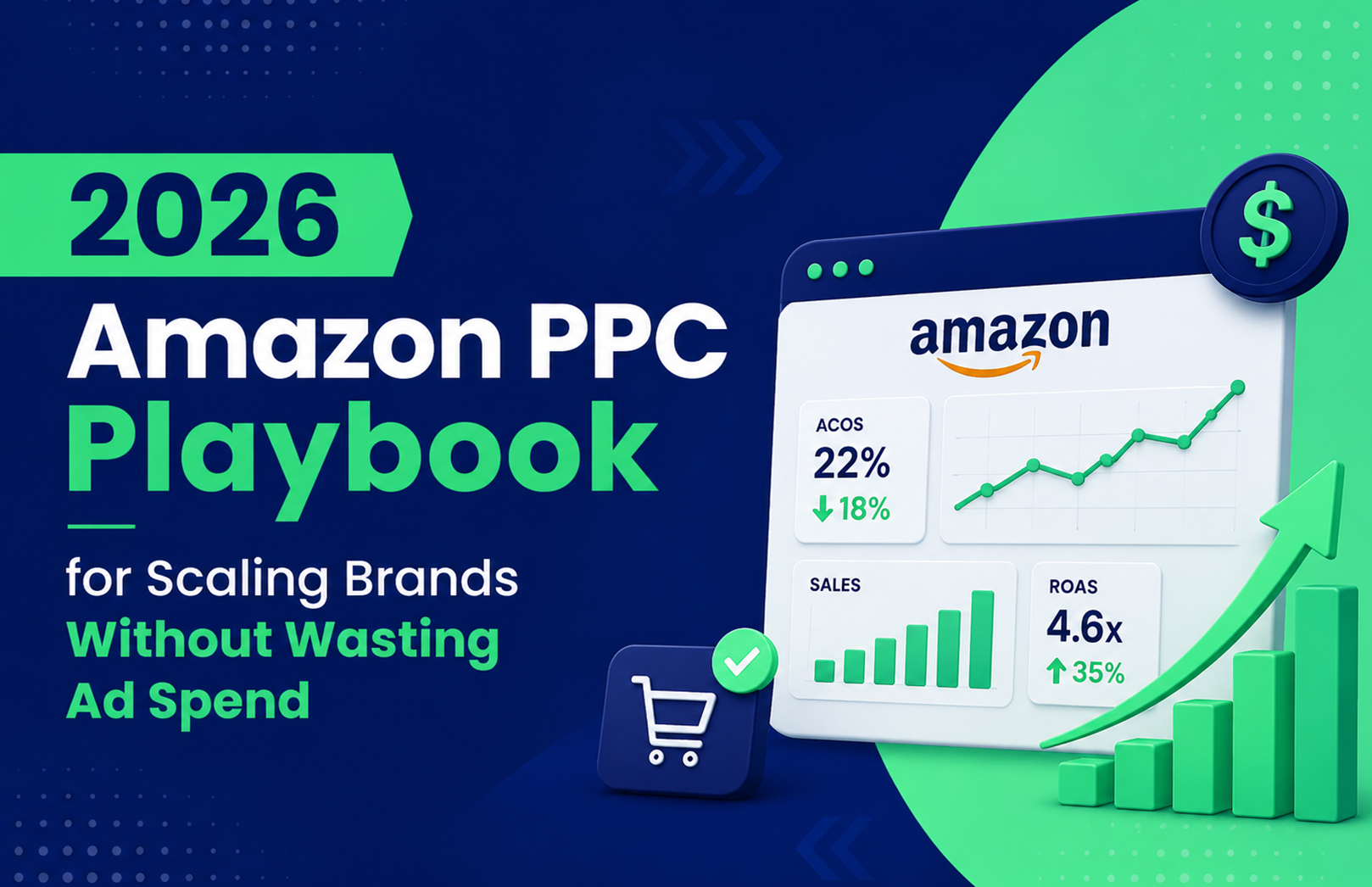
The 2026 Amazon PPC Playbook for Scaling Brands Without Wasting Ad Spend


A kitchenware brand selling on Amazon doubled its monthly ad spend between January and March 2025. Their revenue did not double. It grew 11%. Their ACoS climbed from 18% to 31%. By April, they were generating more gross sales than ever before and taking home less profit than the previous year.

This is the trap most Amazon sellers walk into when competition increases. The instinct is to spend more. The data almost always says spend smarter.

In 2026, the brands outperforming their categories are not the ones with the largest advertising budgets. They are the ones operating with a clear Amazon advertising strategy built around profitability, campaign structure, and continuous optimisation rather than budget increases alone.

Why Traditional Amazon Advertising No Longer Works

Back then, firing up large-scale automated ad runs worked just fine if you bumped budgets toward items showing sales. Less noise in the space meant cheaper clicks. Speed to rank leaned heavily on how much money moved, more than now. Spending power opened doors faster.

That environment no longer exists. Amazon PPC management in 2026 requires structure, intent alignment, and weekly optimisation discipline, as the cost of running unstructured campaigns has compounded alongside rising competition. Brands still running 2022-era campaign architecture in a 2026 competitive environment consistently experience the same outcomes: rising CPCs, declining ROAS, and budgets that generate activity without generating profit.

The playbook has changed. Most sellers have not changed with it.

Build Campaigns Around Business Goals First

The most common structural mistake is building campaigns before defining what success actually means for each product.

A product in the launch phase needs velocity and ranking data, not profitability optimisation. A mature hero product needs margin protection, not aggressive keyword expansion. A seasonal product needs structured planning, not year-round bid stability. Effective Amazon product listing and SEO management starts by defining the objective. Before opening any tools, figure out the goal. A single keyword can shift direction entirely – bidding too high when awareness isn’t needed pulls resources off track. Match type choices behave differently if growth or conversion is the target. Budget spread matters most when aligned with intent. Outcomes hinge not on setup alone but on whether strategy matches actual product stage.

Structure Amazon Sponsored Ads for Control and Measurement

Major difficulties start when every keyword gets dumped into one pile. Budgets get eaten by winners too fast, leaving little for newer ones trying to grow. Losing terms slip through because numbers look okay on paper – until money vanishes. Fixing it late costs more than planning early.

High-performing brands segment Amazon sponsored ads into four distinct layers. Automatic campaigns run continuously to capture new search term data without manual keyword input. Manual exact match campaigns isolate top-performing terms with dedicated budgets and precise bid control. Product targeting campaigns use competitor ASINs and complementary listings to intercept buyers mid-comparison. Brand defence campaigns protect branded search terms from competitor conquest.

One level handles one kind of goal. When needed, it can run faster, slower, or stop altogether. Put together, the pieces form a structure that tracks clearly, responds when nudged, and uses resources far better than lumped-together methods ever could.

Prioritise Amazon ACoS Optimisation Over Raw Spend Reduction

Amazon ACoS optimisation is widely misunderstood. Lower ACoS is not always the goal; it depends entirely on what the product needs at its current stage.

A launch into fresh categories might carry a 45% ACoS for two months – just long enough to gather reviews, lift visibility. Stop ads too soon, though, and the slow climb in natural search fades fast. Chasing the smallest number on performance reports misses the point entirely. What matters sits upstream: decide the correct cost per sale based on where the item stands now, well ahead of any ad run, rather than adjusting later under pressure.

Weekly search term report reviews, negative keyword additions, and bid adjustments based on conversion data rather than impression volume are what move ACoS in the right direction sustainably.

Listing Quality Determines How Far Your Budget Goes

No Amazon sales growth strategy survives a weak product listing. A perfectly structured campaign sending qualified traffic to a listing with poor images, a generic title, and missing social proof is simply an expensive way to generate impressions that do not convert.

Conversion rate is the multiplier on every advertising dollar. A listing converting at 12% generates three times the sales from the same traffic as one converting at 4% at identical ad spend. Start by making sure the product earns more spend first. An effective title packed with clear intent matters most. The main photo must show its worth even when tiny on screen. Bullet points work better when they ease concerns instead of just stating what’s included. Rich visuals and explanations build trust before checkout. Good ratings lower resistance to click buy now.  These are the conversion foundations that make Amazon PPC optimisation produce returns worth measuring.

Make Decisions From Data, Not Assumptions

The gap between brands that scale profitably and those that plateau at unprofitable scale is almost always data discipline, not budget size.

Weekly analysis of placement performance, top of search versus product pages versus the rest of search, reveals where conversion is strongest and where spend should concentrate. Click-through rate analysis identifies titles and primary images, creating search result friction before the listing even gets a chance to convert. Keyword profitability analysis at the individual term level surfaces the 20% of search terms generating 80% of profitable conversions, and the terms consuming budget without contributing revenue.

Small, consistent adjustments made weekly compound into significantly better performance than quarterly campaign overhauls made reactively when results have already deteriorated.

Why Professional Amazon Advertising Services Matter

As campaigns grow in complexity, the management overhead grows proportionally. Brands managing ten SKUs across four campaign types with weekly optimisation requirements across multiple marketplaces are running a specialist operation, not a side function of the marketing manager’s role.

Professional Amazon advertising services bring the structural expertise, platform access, and optimisation discipline that produce consistent performance improvement without requiring internal headcount to develop those capabilities from scratch. Combined with Amazon account management services that keep inventory, listing health, and account compliance supporting rather than undermining campaign performance, professional management typically pays for itself within the first ninety days of engagement.

The 2026 Amazon PPC Playbook

  1. Define the product-level objective before building any campaign
  2. Separate campaigns by intent: auto, manual exact, product targeting, brand defence
  3. Fix the listing conversion rate before scaling the budget
  4. Set ACoS targets based on product stage, not category averages
  5. Review search term reports and adjust bids weekly without exception
  6. Concentrate spending on the 20% of keywords driving 80% of profitable conversions
  7. Measure profitability at the product level, not blended account averages

Conclusion

The kitchenware brand, from the opening, restructured its campaign architecture in May 2025. Same products. Same marketplace. Reduced total ad spend by 22%. Revenue held within 8% of the previous peak. Profit margin returned to target within sixty days.

At HRL Infotechs, we help Amazon brands build exactly this kind of structured, profitable advertising operation combining strategic Amazon campaign management, continuous Amazon ACoS optimisation, and complete marketplace oversight into a growth system that scales revenue without proportionally scaling waste. The brands winning in 2026 are not outspending competitors. They are outthinking them.

How to Choose the Right Amazon Seller Account Management Agency for Your Business


Amazon is no longer just a sales platform; it has become the cornerstone of many online businesses. With countless sellers vying for the same customers, success on Amazon requires more than simply adding products to your listings. It encompasses maintaining your store efficiently, optimising product listings to be seen, advertising efficiently, and making it all come together seamlessly to provide the consumer with a great buying experience. Amazon account management services come to the rescue here.

Selecting the right agency to fulfill these responsibilities can be the difference between stagnant sales and explosive revenue growth. But if everyone makes delivery promises, which one do you choose? This manual will walk you through everything you need to know to select the optimum Amazon seller account management agency for your business.

Why Amazon Account Management Services are Important

Before talking about choosing an agency, let’s take a minute to discuss why Amazon account management services are needed. Operating an Amazon store has many moving parts: product research, keyword optimisation, campaigns, stock monitoring, pricing methodology, and customer service. Managing it all on top of the leading business can get overwhelming quickly.

Partnering with a seasoned agency specializing in Amazon account management is key to scaling your business. They bring expertise, market knowledge, and proven strategies to boost visibility and conversions. With data-driven approaches tailored to your products and goals, you’ll no longer be left guessing what works.

Signs You Need Professional Amazon Account Management

Most vendors fear engaging experts, believing they could do it alone. As much as that might be true at the onset, telltale indicators emerge when one has to consider outsourcing:

  • Time Constraints: You Spend More Time on Amazon Business than Developing Your Brand.
  • Stalled Growth: Your sales have plateaued despite consistent effort.
  • Very High Competition: You have competing sellers outranking you.
  • Ad Spend Problems: You have ads that do not have a high return on investment.
  • Low Conversion Rates: You have listings with visits that don’t lead to conversions.

If these ring a bell, it might be time to collaborate with a company that offers complete Amazon account management solutions.

Essential Services an Agency Must Offer

When reviewing agencies, ensure they cover all the primary sales aspects on Amazon. These include:

1. Amazon Listing Optimisation Services

Amazon listings optimised to perfection are the key to Amazon’s success. This encompasses titles with keywords, attractive bullet points, descriptive text, and high-resolution images. Amazon listing optimization service agencies ensure the products rank high and become attractive to buyers.

2. Amazon PPC Advertising Services

Advertising is one of Amazon’s leading sales promoters. A good agency should be able to provide professional Amazon PPC management services to create and manage each ad campaign you run and provide longer-term planning. Data-driven targeting can reduce wasted ad spend and maximise sales.

3. Amazon SEO Services for Sellers

Paid advertising and organic rankings go hand-in-hand. Do your research and find an agency offering Amazon SEO services for sellers that will rank your products at the top of Amazon’s search rankings. This includes things like keyword research, backend optimisation, and competitor research.

4. Reporting & Analytics

You need to be able to see the data and keep things transparent. A reputable agency will provide weekly or bi-weekly recap reports that detail your sales, how your ad spend is working for you, and what optimisation work has been completed. This is a way to measure your return on investment and keep both parties accountable.

How to Choose the Best Amazon Seller Account Management Agency

Knowing the services that will follow next, it is time to outline the stages of choosing the right agency for business:

1. Establish Your Goals

Before looking for agencies, be specific about your goals. Do you need to scale sales quickly? Get more product visibility? Lower the cost of ads? Choosing an agency whose strengths align with your goals is more manageable.

2. Verification of Their Amazon Sell Experience

Not all digital marketing agencies are Amazon-competent. Many may be competent with Google or Facebook advertising but lack extensive expertise in the Amazon ecosystem. Only choose an agency with Amazon account management services as the core of its business, and that can show Amazon selling expertise on its resume.

3. Look for Industry-Specific Knowledge

In competitive categories such as health, fashion, and consumer electronics, having an agency that knows your category is necessary. Vendors have various optimization strategies that apply to different sectors, and expertise counts.

4. Evaluate their team and tools

Prospective agencies have professional team members and professional-grade tools. This includes keyword research tools and analytical tools that use artificial intelligence to automate issues and increase your chances of success. Ask how they detail their methods for Amazon listing optimization services or producing or managing ad campaigns.

5. Transparency & Communication

The best agencies are transparent about their operations. You should understand what they are doing, why they are doing it, and how it will benefit your business. Proper communication means regular status checks, well-documented reports, and open, free-flowing communication.

6. Ask for Testimonials and Case Studies

A reputable agency will not tell you about results; they will show you. Ask agencies for case studies or testimonials showing how their Amazon account management service improved visibility, lowered costs, and produced more revenue for another seller.

7. Think About Value and Price

Cost matters, but don’t base the choice of an agency on cost alone. An inexpensive agency that will deliver mediocre work will prove more expensive down the road. Consider the value that they offer better rankings, higher ROI for ads, faster growth—whatever that might be.

Advantages of Recruiting the Top Agency

Collaborate with the right agency that offers Amazon account management services and enjoy these benefits:

  • Time Savings: You can attend to product development and brand-building as professionals care for the store.
  • More Sales: Properly optimised listings and properly managed ads increase conversions.
  • Better ROI: Effective advertising investment translates into receiving the highest possible returns.
  • Scalability: Scalability is more effortless when seasoned individuals are on the team.
  • Competitive Edge: You will be ahead of competitors who remain speculating on what works.

Mistakes to be Avoided

When selecting an agency, be careful of the following errors:

  • Retaining a general advertising agency that has minimal Amazon expertise.
  • Selecting based on mere prices, ignoring outcomes.
  • Not requesting status reports or progress meetings.
  • Not establishing specific objectives before hiring.
  • To have overnight success, Amazon’s development needs continuous effort.

Conclusion

Amazon is the storehouse of unlimited opportunities, but it didn’t become successful overnight by chance. It demands meticulous planning, regular optimisation, and highly advanced management. That’s why picking the appropriate agency that provides Amazon account management service is one of the critical choices you must make as a seller.

By establishing your objectives, verifying expertise, and maintaining transparency, it is possible to have a partner who will manage the account and contribute to your company’s flourishing amidst the competitive Amazon world. Amazon product listing optimisation service, Amazon PPC service management, or Amazon SEO service for Amazon sellers, the appropriate agency will offer the boost that you require to scale constantly and sustainably. When bringing your Amazon store to the next level, it is time to think about Amazon account management services on a professional level. Because today’s marketplace is very competitive, expert guidance is not just an option but necessary.

A Guide to Choosing Suitable Amazon Advertising Campaigns & Maximizing Amazon Advertising Services


In today’s competitive e-commerce generation, Amazon advertising campaigns play a really important role in driving visibility, increasing sales, and reaching your target audience effectively. However, with the plethora of options available in the market, choosing the right advertising campaign can be a tough task. In this article, we will be discussing the valuable insights on how to select the most suitable Amazon advertising campaigns for your business. 

By understanding your goals, target audience, and available campaign types, you can optimize your advertising efforts and achieve greater success on the online platform.

Set Specific Advertising Goals

When embarking on an Amazon advertising campaign, it is very important  to clearly define your objectives. By considering what you want to achieve through your ads. Are you looking to increase brand awareness, drive product sales, or promote a specific offer? 

Defining your goals will help you  summarize your options and select the most suitable campaign type for your business.

Recognize Your Target Market

Understanding your target audience is the most important part for running effective Amazon advertising campaigns. Take the time to analyze your customers’ demographics, interests, and purchasing behavior. This activity will enable you to tailor your campaigns to resonate with your audience, resulting in higher engagement and conversion rates. 

Consider factors such as age, gender, location, and buying patterns to determine which campaign types are likely to reach your desired customers effectively.

Investigate The Various Types Of Amazon Advertising Campaigns

Amazon offers various campaign types, each with its own benefits and targeting options. Familiarize yourself with these options to make an informed decision:

  • Sponsored Products: This campaign type promotes individual products within search results and on product detail pages. It is an effective way to increase product visibility and drive sales.
  • Sponsored Brands: With Sponsored Brands, you can showcase your brand logo, a custom headline, and multiple products in a single ad. This type of campaign is great for boosting brand awareness and driving consideration.
  • Sponsored Display: Sponsored Display campaigns allow you to target your ads to shoppers both on and off Amazon. These ads can be displayed on product detail pages, customer review pages, and other placements across the web, expanding your reach and increasing visibility.
  • Video Ads: If you want to engage your audience with captivating video content, Amazon’s Video Ads provide an excellent opportunity. These ads can be displayed within search results and on product detail pages, capturing attention and driving engagement.

Watch Over and Improve Your Campaigns

Once you’ve chosen the most suitable campaign type, it’s important to monitor your campaigns regularly. Keep an eye on key performance metrics such as impressions, clicks, conversions, and return on ad spend (ROAS). Adjust your bids, targeting, and ad creative based on the data you gather to optimize your campaigns continuously. 

By making data-driven decisions and iterating on your strategies, you can refine your campaigns for optimal performance and maximize your advertising ROI.

Financial Factors

When selecting Amazon advertising campaigns, it’s important to consider your budget. Different campaign types have varying cost structures, such as cost-per-click (CPC) or cost-per-thousand-impressions (CPM). Assess your budget and determine how much you are willing to spend on advertising. This will help you choose the campaign type that aligns with your financial resources and maximizes your return on investment (ROI).

Exploration and A/B Testing

To optimize your Amazon advertising campaigns, it’s crucial to conduct A/B testing and experimentation. Test different ad variations, targeting options, and keywords to identify the most effective strategies. Split your audience into segments and run parallel campaigns to compare their performance. 

By gathering data and analyzing the results, you can refine your campaigns and improve their overall effectiveness over time.

Summing Up

Choosing the suitable Amazon advertising campaigns requires careful consideration of your objectives, target audience, and available campaign types. By defining your goals, understanding your audience, and exploring the various campaign options, you can make informed decisions that align with your business objectives. 

Regular monitoring and optimization are also essential for achieving the best results. With these insights in mind, you can embark on your Amazon advertising journey and drive success for your brand on the platform. And if you are looking for amazon advertising solutions or a platform, considering your market performance on top, we HRL, the amazon advertising agency, can make your dreams come true, will thrive on your expectations and make your brand bloom!

Visit Our Website Now!

The Ultimate Guide to Understanding and Optimizing Amazon Advertising Cost of Sales (ACoS)


As you know that advertising is crucial to generating sales and rapidly expanding your company as an Amazon seller. It might be challenging to manage your advertising expenses and maximize your investment’s return which is ROI. The best resource for managing Amazon advertising cost of sales is here (ACoS). 

A complete knowledge of Amazon’s advertising platform, such as its different ad formats, targeting alternatives, bidding techniques, and budget features, is necessary for manaining your ACoS Amazon. It calls for continual campaign monitoring and modification depending on performance information to get the best outcomes. Amazon account management agency can help you with all these numerous things effectively so that you can work with other affairs of your business. 

This comprehensive book will cover all you require to learn about ACoS, such as its significance, its determination, how to minimize it, and best practices for handling your Amazon advertising campaigns. This article will offer you helpful knowledge to assist you in increasing your advertisement ROI and expanding your Amazon business, regardless of whether you’re an experienced seller or just getting started.

What is Amazon ACoS? 

A measurement used to assess the success of advertising campaigns on Amazon is called Amazon ACoS, or Amazon Advertising Cost of Sales. It displays the proportion of revenue from sales that are allocated to marketing.

The ACoS is computed by dividing the advertising expenditure by the total revenue produced during the identical time frame. Your ACoS is 10%, for instance, assuming you invested $100 on Amazon advertisements and made $1,000 in sales within the same time frame.

Since it significantly affects how profitable a seller’s operation is, ACoS is a crucial indicator for Amazon sellers. A higher ACoS indicates that a higher income goes into advertising, which might lower profitability. A low ACoS, on the other hand, shows that marketing initiatives are producing solid returns and stimulating lucrative sales.

Amazon sellers must frequently review and tweak their advertising tactics to maximize ACoS. It involves picking the appropriate ad formats, focusing on the correct audience, establishing the best bids, and producing compelling copy that appeals to prospective customers. Marketers can raise ACoS and get a better return on their advertising spend by frequently testing and adjusting their advertising strategy.

At What Levels Can You Calculate ACoS? 

One can evaluate ACoS anywhere at the stage of an advertising campaign. Generally, Amazon analyzes ACoS dynamically at four levels, i.e., Account, keyword, campaign, and ad group. 

  • AD Group 

This level determines the mean ACoS for an ad group inside a program over a specified time frame.

  • Campaign  

Over time, the campaign’s general keywords and ad groups’ average ACoS are determined at this level.

  • Keyword Level 

The entire ACoS with a specific keyword during a certain period is determined.

  • Account-Level

It determines the average ACoS across all initiatives during a given period.

How to Calculate Amazon ACoS?

ACoS is calculated as follows: Total Advertising Costs / Total Sales Income from Ads*100

What Makes a Good ACOS?

A decent Amazon ACOS doesn’t have a specific numerical value. It depends on your business, business size, and regularity of campaigns, among many other things. Alternatively, by comprehending the key sections, you can gauge a good Amazon ACOS.

Recognizing Profit Margins

Companies want to sell enough goods or advertise to break even or profit. The distinction between these two is the net profit, which is the portion made after deducting the manufacturing expenses and any additional costs your label may incur.

Break-Even ACoS

The relationship between your profitability and break-even ACOS is straightforward. Your profitability must be higher than the Amazon ACOS to keep making a profit. Therefore, your advertising expenses will exceed your income.

How to Decrease ACoS? 

You can attempt to lower your Amazon ACOS or raise overall profits to avoid investing more in advertising efforts compared to what you’re making. Analyzing the results of your advertising efforts can assist you with deciding how you should spend your budget and the chances to save costs and maximize profits. Moreover, ensure you’re taking the correct phrases into account. Your advertisements may be able to expand their reach thanks to these measures. We advise using at least 20 – 25 terms when marketing using Sponsored Brands. These keywords may also comprise phrases, general terms, and titles of goods or brands. To find your ideal customers, combine a range of different keyword variations.

Examining the Appropriate Metrics.

Amazon ACOS is a terrific starting point, and it’s helpful to consider several different metrics to ascertain which features collaborate well and what adjustments can gain additional profits. For businesses, Amazon ACOS is merely one crucial performance metric. Other advertising indicators include the number of clicks, conversions, and exposures.

Choose the Target ACOS.

The desired ACOS will vary depending on the brand. Therefore, the initial stage should be obtaining break-even ACOS and contrasting that to your profitability. One can then decide which objective is more crucial for your brands and initiatives: Does it lead to more sales? Does it increase brand recognition? Once you’ve chosen, you may assess the importance of Amazon ACOS in any business plan.

What Factors Influence AcoS?

Undoubtedly, several elements impact a novel product’s ACoS. The overall age of the item is among the more crucial elements. Considering how long an item is available on the marketplace is essential.

Amazon PPC will place greater emphasis on Age-based listing. It’ll additionally make it possible for a similar listing to prevail in the bidding instead of helping the opposition. These situations also assist Amazon sellers in lowering the ACoS of its pertinent unique brands. The ACoS will start rising if the listing and the vendor are both newer, though it might take much longer to achieve the bid competition.

Here are the number of factors that influence ACoS:

  • Rate of Clicks

The CTC (Click Through Rate) reveals if the advertisement is appropriate. The ratio is determined by dividing clicks by views.

  • Cost Per Click

The ACoS may rise due to a more excellent CPC, which raises the price of generating clicks. The ACoS can be decreased by reducing the CPC or by improving the ad campaign’s rate of conversion.

  • Advertising Revenue

One can determine the income from advertisements by multiplying the orders by the typical sales price. Ad revenue refers to the entire amount of sales generated by the advert.

  • Clicks 

The volume of the click of a button may affect ACoS. More clicks can result in higher sales and revenue, but if those clicks don’t result in purchases, the ACoS may rise.

  • Impressions 

Impressions indicate how many times an advertisement is displayed. More impressions can increase the likelihood of clicks, resulting in more excellent sales and income. The cost of the impressions, though, may cause the ACoS to rise if the clicks do not result in orders.

Conclusion

It is evident from reading this ebook that any merchant using the platform must maintain Amazon’s Advertising Cost of Sales (ACoS). Marketers can boost their return on investment (ROI) and generate more sales revenue by handling ACoS properly.

The best ecommerce marketing agency HRL Infotechs specializes in assisting Amazon merchants to improve their ACoS and boost their revenues. Their staff of specialists is well-versed in the platform’s advertising ecosystem and can offer solutions that are specifically matched to each seller’s requirements.

We can assist you whether you’re attempting to improve your ACoS or sales on Amazon. We are the go-to option for any seller attempting to obtain the most out of their Amazon advertising budget due to their established track record of success and dedication to providing results.

Amazon Sponsored Display Ads Strategies to Increase Sales On Amazon


Seller on Amazon and searching for the powerful tool that can help you retarget visitors to your product listing? Well, Amazon Sponsored Display Ads is that powerful tool you have been searching for. It helps grow your business by engaging relevant audiences on and off Amazon. Amazon Sponsored Display Ads mainly support two targeting strategies: product targeting and audience targeting. These strategies work great and can complement one another depending on the business goal.

Let’s dig deeper into how Amazon Sponsored Display Ads services can help you hit your sales goals.

KPI-focused Strategies For Amazon Sponsored Display

Here are some KPI-focused strategies that you can use for sponsored display ads to target both product and audience.

1. Reaching Shoppers Outside Search

Many high intended customers prefer external search engines or browse on amazon by applying a filter rather than using a search page or search bar to find their purchase. In such a scenario, relying solely on search keywords can prove to be a setback. Here it is better to combine both product and keyword targeting to reach a specific shopper segment.

Amazon ads

If we go by data, it is seen that this tactic has shown a 47% increase in the impression and better engagement with high intended customers on amazon compared to just leveraging keyword targeting alone.

 2. Building a Detailed Page Strategy

Sponsored display product targeting gives you the advantage of reaching shoppers on:

  • Competitor’s detailed page
  • Your own detailed page
  • Detailed page in your category and also
  • Detailed pages outside your product category

Reaching audiences outside the product category is very helpful as it helps extend the reach on amazon and opens new opportunities to connect with a new set of audiences. Moreover, it helps in bringing these audiences to your category.

Three components of a detailed page strategy:

1) When it comes to Sponsored display, it is advised to target a detailed home page as it can surge CTR (Click Through Rate) by 41% compared to targeting other pages. It also helps to introduce potential customers to more products that a brand offers.

2) The next significant advantage of Amazon Sponsored Display Ads is they allow challenging brands to promote on famous detailed pages. These brands can also target complementary product detail pages or categories. This category targeting can help refine based on star rating, brand name, price etc.

3) As a brand, do you wish to reach new customers? If yes, then Amazon Sponsored Display Ads can prove to be a great way to get out of your aisle. With sponsored display, our Amazon marketing agency has enabled numerous brands to reach new customers that too, with good relevancy scores. Our entire model is based on detecting the relationships so that brands feel more empowered, offer a great shopping experience to customers, get out of their aisle and experience a surge in new-to-brand sales.

The Bottom Line

Ready to drive product awareness, expand your brand’s presence and boost sales? You can hire amazon sponsored ads expert who can handle everything on your part. HRL Infotech amazon advertising services can help you sail successfully and capitalize on the omnichannel functionality of the largest eCommerce platforms.