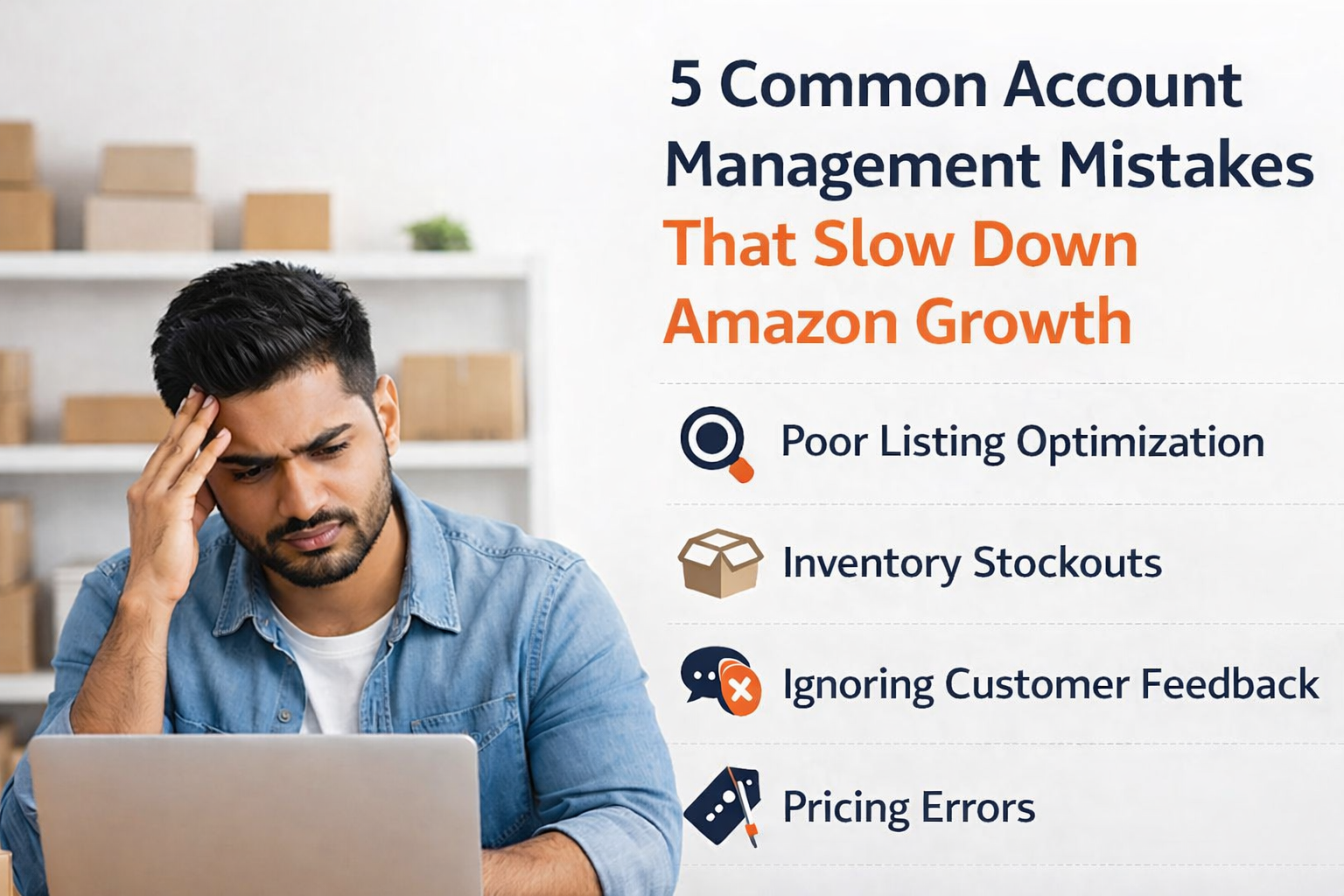
Managing an Amazon seller account looks simple from the outside, but small mistakes can quietly limit your growth. Many sellers focus on ads and promotions while ignoring core Amazon Account Managment fundamentals that actually drive long-term performance. When these basics are overlooked, it becomes harder to scale, protect margins, and stay competitive in crowded categories.
If your sales have plateaued or your ad costs keep rising, chances are there are hidden Amazon account management mistakes holding you back. By understanding the most common Amazon seller mistakes and fixing them early, you can unlock faster growth, stronger visibility, and more predictable revenue from your Amazon store.
Why Strong Amazon Account Managment Is Critical for Growth
Amazon is now a mature, highly competitive marketplace where basic listing setup is no longer enough. Effective Amazon Account Managment means treating your account like a performance engine that needs constant optimization, monitoring, and strategic decision-making. Sellers who ignore this reality often struggle with low visibility, poor conversion rates, and unstable sales.
At its core, Amazon account management is about aligning your catalog, content, pricing, and operations with how Amazon’s algorithm and shoppers behave. When your Amazon growth strategy is built on data, structured processes, and consistent optimization, you reduce risk and create a scalable foundation for long-term success.
Ignoring Data and Relying on Guesswork
One of the biggest Amazon account management mistakes is making decisions based on assumptions instead of data. Many sellers adjust prices, bids, or inventory based on gut feeling, which often leads to wasted ad spend and missed opportunities. Amazon provides rich data through reports and dashboards, but it is frequently underused.
To grow an Amazon seller account effectively, you must track key metrics like conversion rate, click-through rate, organic ranking, and ad performance. When you review this data regularly, you can identify trends, diagnose problems early, and refine your Amazon growth strategy with confidence.
Not Setting Clear KPIs for Your Account
Without clear performance goals, it is impossible to know whether your Amazon Account Managment efforts are working. Many sellers only look at total sales, ignoring profitability, inventory health, and advertising efficiency. This narrow view can hide serious issues that slow growth.
Define KPIs such as target ACoS, TACoS, minimum margin, and ideal inventory coverage. Then build your Amazon account optimization plan around those targets. This approach helps you prioritize the right actions and avoid reactive decision-making.
Overlooking Search Term and Advertising Reports
Search term reports reveal how shoppers actually find your products, yet many sellers never download or analyze them. This is a critical Amazon seller management tip: use these reports to discover converting keywords, irrelevant terms, and wasted spend.
By mining search term data, you can refine your keyword strategy, improve Amazon listing optimization, and build more efficient campaigns. This reduces ad waste while boosting visibility for high-intent search queries that drive profitable growth.
Poor Amazon Listing Optimization and Content Gaps
Another common Amazon store management mistake is treating listings as a one-time task. In reality, Amazon listing optimization is an ongoing process that should evolve with competition, seasonality, and shopper behavior. Weak titles, thin bullet points, and low-quality images can destroy your conversion rate.
Well-optimized listings help Amazon understand your product and match it to relevant searches. At the same time, strong content builds trust with shoppers and answers their most important questions. When your Amazon Account Managment includes regular content audits, you protect rankings and improve sales velocity.
Missing or Misused Keywords in Listings
Many sellers either stuff keywords unnaturally or ignore them altogether. Both are harmful. Effective Amazon account optimization means placing primary and family keywords strategically in titles, bullets, descriptions, and backend fields. This should be done in a natural, reader-friendly way.
Focus on phrases like Amazon account management mistakes, Amazon seller mistakes, and Amazon growth strategy where they fit contextually. This helps your listings rank for relevant searches without triggering keyword stuffing penalties or hurting readability.
Weak Visuals and Incomplete Product Story
Even with strong keywords, poor images and weak Amazon A+ content design can limit your growth. Shoppers rely heavily on visuals to judge quality and value. Low-resolution images, missing lifestyle photos, or unclear infographics reduce trust and suppress conversions.
To grow an Amazon seller account, invest in professional images, comparison charts, and benefit-driven visuals. Use A+ content to answer objections, highlight differentiators, and reinforce your brand story. This is one of the most overlooked Amazon seller management tips, yet it has a direct impact on revenue.
Inventory Mismanagement and Stock-Outs
Inventory issues are among the most damaging Amazon account management mistakes because they affect both sales and ranking. Frequent stock-outs signal unreliability to Amazon’s algorithm, which can push your listings down in search results. Over time, this makes it harder to recover lost momentum.
On the other hand, overstocking ties up cash and increases storage fees, especially during peak seasons. Effective Amazon Account Managment requires a balanced approach that aligns demand forecasting, lead times, and replenishment cycles with your growth goals.
Not Using Historical Data for Forecasting
Many sellers reorder inventory based on rough estimates instead of historical performance. This often leads to last-minute air shipments, emergency price hikes, or forced stock-outs. All of these hurt your Amazon growth strategy and profitability.
Use past sales data, seasonality trends, and promotional plans to build a realistic forecast. Then coordinate with suppliers and logistics partners to maintain healthy stock levels. This proactive approach supports stable rankings and consistent revenue.
Disorganized Pricing and Promotion Strategy
Pricing is a powerful growth lever, yet it is often managed haphazardly. Random discounts, constant price changes, or ignoring competitor moves are classic Amazon store management mistakes. These behaviors confuse shoppers and can trigger buy box instability.
A structured pricing strategy is a core part of Amazon Account Managment. It should consider your costs, competitor landscape, and perceived value. When pricing is aligned with your Amazon growth strategy, you can protect margins while still winning the buy box and attracting high-intent buyers.
Over-Reliance on Deep Discounts
Some sellers rely heavily on coupons and lightning deals to drive short-term spikes in sales. While promotions have their place, constant discounting can erode brand value and train customers to wait for deals. It can also compress margins to unsustainable levels.
Instead, use promotions strategically to launch new products, clear aging stock, or support key seasons. Combine this with strong Amazon account optimization and advertising to build sustainable, full-price demand over time.
Neglecting Reviews, Compliance, and Customer Experience
Amazon rewards sellers who deliver excellent customer experiences and follow platform rules closely. Ignoring reviews, messages, or policy updates is one of the most dangerous Amazon account management mistakes. It can lead to listing suppressions, account health issues, or even suspensions.
Proactive Amazon Account Managment means monitoring feedback, responding to customer concerns, and maintaining strict compliance. This not only protects your account but also strengthens trust signals that influence conversion and ranking.
Slow Response to Negative Reviews and Messages
Unaddressed negative reviews can scare away potential buyers and damage your product’s reputation. Similarly, slow responses to buyer messages can hurt your seller metrics. Both issues weaken your Amazon growth strategy over time.
Set up processes to review feedback daily, identify recurring issues, and improve products or listings accordingly. When shoppers see that you respond and care, they are more likely to trust your brand and convert.
Turning Amazon Account Managment into a Growth Engine
When you avoid these common Amazon account management mistakes, your account becomes a predictable growth engine instead of a constant firefight. Strong Amazon Account Managment combines data-driven decisions, optimized content, disciplined inventory control, and customer-first operations.
If you lack the time or in-house expertise, partnering with specialists can accelerate results and reduce risk. With the right support, you can transform your Amazon account optimization efforts into a scalable, profitable channel that consistently outperforms competitors and supports broader business goals for HRL Infotechs.