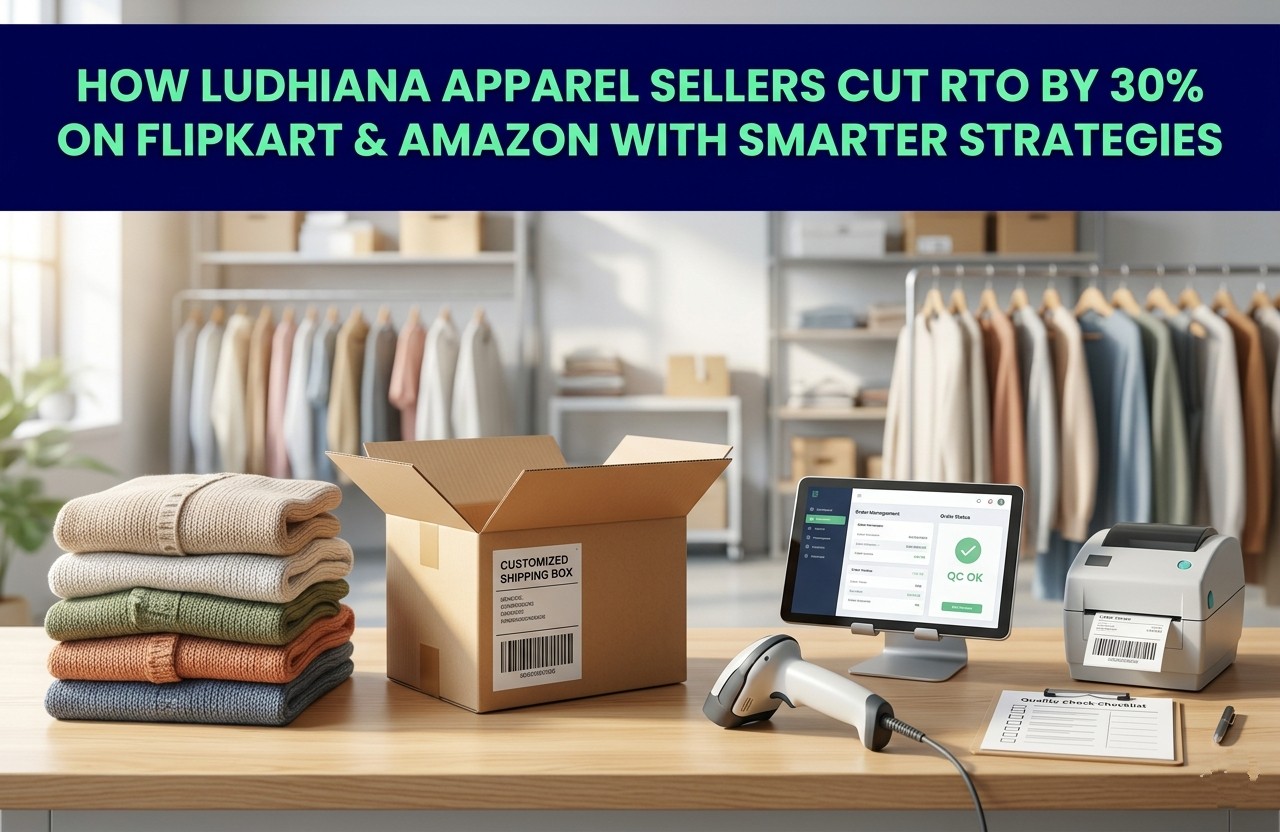
How Ludhiana Apparel Sellers Cut RTO by 30% on Flipkart & Amazon with Smarter Strategies


Ludhiana’s apparel sellers live in one of the most competitive ecommerce environments in India. Margins are tight, customer expectations are high, and one metric quietly eats profits every single day: Return to Origin (RTO). When RTO spikes on Flipkart and Amazon, it does not just hurt revenue, it also damages seller ratings and visibility.

The good news is that RTO is not random. With the right data-backed approach, it can be controlled and significantly reduced. By using smarter catalog, logistics, and marketplace strategies, many Ludhiana apparel sellers have been able to reduce RTO in ecommerce by 25–30% and protect their cash flow while scaling.

Why High RTO Happens In Ecommerce For Apparel Sellers

Before you can reduce RTO in ecommerce, you need to understand why it happens so frequently, especially in fashion and apparel. Most Ludhiana sellers see high RTO on COD orders, size-sensitive products, and listings where expectations do not match reality. These patterns are consistent across Flipkart and Amazon India.

Common reasons for high RTO in ecommerce India include wrong or incomplete addresses, customers not answering calls, size or fit issues, poor product photos, misleading titles, and delayed deliveries. Each of these can be fixed with structured ecommerce return rate reduction strategies that are tailored to marketplace rules.

Key RTO Triggers Specific To Flipkart And Amazon India

On Flipkart, RTO often spikes when listings are not aligned with platform guidelines or when sellers ignore Flipkart account management services recommendations. Incorrect category mapping, weak product attributes, and non-optimized titles can attract the wrong audience, which leads to cancellations and returns.

On Amazon India, RTO is heavily influenced by search visibility and expectation management. If Amazon SEO & Product Listing Optimization is weak, products may show up for irrelevant queries. Customers order based on partial information, and when the product arrives, they cancel or return, driving up RTO and hurting listing health.

Impact Of High RTO On Profitability And Growth

High RTO does not just mean a lost order. Sellers pay for packaging, shipping, manpower, and sometimes return logistics, all without earning a rupee. For Ludhiana apparel brands, even a 5–10% increase in RTO can wipe out monthly profits, especially on low-margin SKUs.

Additionally, Flipkart and Amazon algorithms track cancellations, returns, and delivery attempts. High RTO can reduce Buy Box chances, limit visibility in search, and even trigger penalties. That is why serious sellers treat reduce RTO in ecommerce as a core business strategy, not just an operational issue.

How To Reduce RTO On Flipkart With Smarter Listing & Operations

Flipkart buyers are highly price-sensitive, but they also respond well to clear, accurate information. To reduce RTO in ecommerce on Flipkart, Ludhiana apparel sellers need to optimize listings, strengthen order confirmation processes, and refine logistics choices. This is where structured flipkart account management services can make a measurable difference.

Start by auditing your top 50 SKUs with the highest RTO. Check titles, images, bullet points, size charts, and reviews. Often, a few targeted changes in flipkart product listing & SEO Optimization can reduce confusion, set correct expectations, and cut returns without heavy discounts.

Flipkart Product Listing & SEO Optimization Best Practices

Effective flipkart product listing & SEO Optimization focuses on clarity, relevance, and search intent. Use precise product titles with fabric type, fit, gender, and use case. For example, instead of a generic “Men’s Shirt”, use a detailed title that matches how buyers search and reduces ambiguity.

Include high-quality images from multiple angles, close-ups of fabric, and real model shots where possible. Add accurate size charts and highlight key benefits in bullet points. These steps reduce RTO in ecommerce by ensuring buyers know exactly what they are ordering, which is critical in apparel categories.

Operational Tactics To Reduce COD Returns On Flipkart

COD orders are a major driver of RTO. To address how to reduce COD returns in India on Flipkart, many successful sellers use a simple but effective confirmation workflow. They verify high-value or risky COD orders via automated calls or WhatsApp before dispatching.

Additional tactics include limiting COD for pin codes with historically high RTO, using reliable courier partners for those regions, and offering small prepaid discounts. Over time, these operational tweaks help reduce RTO in ecommerce India and stabilize cash flow for apparel sellers.

How To Reduce Returns On Amazon India With Data-Led Optimization

Amazon India is heavily algorithm-driven, so the way you structure your catalog and content directly affects both sales and RTO. To reduce RTO in ecommerce on Amazon, you must align your listings with buyer intent and continuously monitor return reasons from the Voice of Customer dashboard.

When sellers invest in Amazon marketing Services and strong Amazon SEO & Product Listing Optimization, they attract more qualified traffic. That means fewer impulse purchases from the wrong audience and fewer returns due to mismatch between expectations and the delivered product.

Using Amazon SEO & Product Listing Optimization To Cut RTO

Start with keyword research focused on apparel-specific queries in India. Integrate primary and secondary keywords naturally into titles, bullet points, and descriptions. This helps reduce RTO in ecommerce by ensuring your products appear for the right searches, not just high-volume generic terms.

Next, refine your A+ content and images to answer common pre-purchase questions: fabric feel, stretch, transparency, fit, and wash care. When customers understand these details before buying, they are less likely to return items. This is one of the most reliable ecommerce return rate reduction strategies for fashion.

Leveraging Amazon Marketing Services Without Increasing RTO

Many sellers worry that scaling ads through Amazon marketing Services will increase RTO. That only happens when campaigns are poorly targeted. Instead, focus on high-intent keywords, remarketing to past buyers, and promoting bestsellers with historically low RTO and strong reviews.

Monitor search term reports and return reasons together. If a campaign drives traffic that converts but returns spike, refine your targeting or improve listing clarity. This integrated view helps reduce RTO in ecommerce while still growing overall order volume.

Practical Ecommerce Return Rate Reduction Strategies For Apparel

Beyond marketplace-specific tactics, there are universal strategies that help reduce RTO in ecommerce India across both Flipkart and Amazon. Apparel sellers in Ludhiana who apply these consistently see a compounding effect over a few months, with RTO dropping and repeat purchase rates rising.

These strategies focus on pre-purchase clarity, post-purchase communication, and smart policy design. When combined, they directly address why high RTO happens in ecommerce and create a smoother experience for both buyers and operations teams.

Improve Size Accuracy And Product Expectations

Size and fit are the top reasons for returns in apparel. To reduce RTO in ecommerce, use detailed size charts with actual garment measurements, not just generic S, M, L labels. Add guidance like “If you are between sizes, choose one size up” based on real customer feedback.

Also, be transparent about fabric thickness, stretch, and fit type. If a shirt is slim fit or a kurti is slightly sheer, mention it clearly. This honesty may slightly reduce conversion in the short term but will significantly lower returns and build long-term trust.

Strengthen Communication And Delivery Experience

Another powerful way to reduce RTO in ecommerce India is to improve communication from order to delivery. Use automated SMS or WhatsApp updates to confirm orders, share tracking links, and remind customers about delivery attempts, especially for COD orders.

Additionally, work closely with courier partners to optimize delivery slots and reduce fake “customer not available” tags. When customers feel informed and prepared, they are more likely to accept deliveries and less likely to cancel at the doorstep.

How Ludhiana Apparel Sellers Achieved 30% RTO Reduction

Ludhiana apparel sellers who successfully reduced RTO in ecommerce by around 30% did not rely on a single trick. They implemented a structured roadmap that combined listing optimization, COD risk control, and marketplace-specific strategies for Flipkart and Amazon India.

Typically, the journey started with a detailed RTO audit: identifying high-risk SKUs, pin codes, courier partners, and order types. Then, they rolled out targeted changes in flipkart product listing & SEO Optimization, Amazon SEO & Product Listing Optimization, and operational workflows, measuring impact every 15–30 days.

Key Steps In Their RTO Reduction Playbook

Most winning playbooks included a few common steps that any serious apparel seller can replicate. These steps are practical, measurable, and aligned with how to reduce RTO on Flipkart and how to reduce returns on Amazon India without hurting growth.

  • Audit top RTO SKUs and pin codes across both marketplaces
  • Fix titles, images, and size charts for clarity and accuracy
  • Introduce COD confirmation flows for risky orders
  • Limit COD in historically high-RTO regions
  • Align ad campaigns with low-RTO, high-review products
  • Track RTO weekly and refine strategies continuously

Conclusion: Turn RTO Control Into A Competitive Advantage

For Ludhiana apparel sellers, learning how to reduce RTO on Flipkart and how to reduce returns on Amazon India is not optional anymore. It is a core part of building a profitable, scalable ecommerce business. When you reduce RTO in ecommerce, every rupee spent on ads, packaging, and logistics starts working harder for you.

If you want expert support in implementing these marketplace-focused strategies, from flipkart account management services to Amazon marketing Services and advanced listing optimization, partnering with a specialized ecommerce growth team like HRL Infotechs can help you move from reactive firefighting to predictable, data-driven growth.
Amazon, Flipkart or D2C? Where Mumbai Fashion Brands Profit Most in 2026


Mumbai’s fashion brands are entering a decisive phase. With 2026 around the corner, founders are asking a hard question: should they double down on Amazon, scale Flipkart, or build a powerful D2C engine? The answer is no longer obvious, especially as competition, ad costs, and customer expectations rise across every channel.

To stay profitable, brands now need sharper ecommerce marketing services, smarter channel selection, and a clear roadmap. This guide breaks down how Amazon, Flipkart, and D2C compare for Mumbai fashion labels, and how to design a fashion ecommerce strategy India 2026 that actually protects margins while scaling.

Understanding the 2026 Landscape for Fashion Ecommerce in India

By 2026, ecommerce trends India 2026 point to deeper penetration beyond metros, faster delivery expectations, and more price-sensitive shoppers. Fashion brands in Mumbai must plan for a world where customers compare prices in seconds and expect seamless experiences across every touchpoint.

At the same time, ecommerce marketing services are becoming more specialized. Brands that win will combine marketplace visibility with strong D2C presence, data-driven campaigns, and tight control over unit economics. The real question is not Amazon vs Flipkart which is better for sellers, but which mix of channels gives the best lifetime value.

Amazon vs Flipkart: Which Marketplace Works Better for Mumbai Fashion Sellers?

When founders discuss amazon vs flipkart which is better for sellers, they usually focus on fees and traffic. But in 2026, the more important lens is profitability, competition intensity, and how well ecommerce marketing services can be layered on top of each marketplace.

Amazon offers massive reach, strong search intent, and mature ad tools. Flipkart, meanwhile, remains powerful in value-driven segments and Tier-2 and Tier-3 audiences. For Mumbai fashion brands, the right choice often depends on price point, category, and how aggressively they can invest in marketplace optimization.

Key Profit Drivers on Amazon for Fashion Brands

On Amazon, fashion brands benefit from high-intent search, but they also face intense competition and ad inflation. To stay profitable, sellers need expert ecommerce marketing services that optimize listings, control ad spend, and improve conversion rates.

Many brands now work with an amazon consultant agency in Mumbai to manage catalog hygiene, A+ content, reviews, and Amazon Ads. The brands that win on Amazon in 2026 will treat it as a performance engine, not just a listing platform, and will track every rupee spent against net contribution margin.

Flipkart Seller Services in Mumbai: Where It Wins

Flipkart seller services in Mumbai are particularly attractive for mass and mid-market fashion brands. The platform’s audience is highly value-conscious, and discount-led campaigns often perform well when backed by strong ecommerce marketing services.

For Mumbai-based labels, Flipkart can be a powerful volume driver, especially in festive seasons and sale events. However, brands must watch return rates, logistics costs, and discount pressure. The most successful sellers will use data to decide which SKUs stay on Flipkart and which move to other channels.

D2C vs Marketplace Ecommerce India: Who Really Owns the Customer?

The debate around d2c vs marketplace ecommerce India is really a debate about control. Marketplaces bring traffic but own the customer relationship. D2C demands more investment but gives brands full access to data, margins, and brand storytelling.

By 2026, fashion ecommerce strategy India 2026 will likely be hybrid. Marketplaces will drive discovery and volume, while D2C will drive loyalty, higher average order value, and better profitability. Ecommerce marketing services will be the glue that connects performance campaigns, CRM, and retention across these channels.

Comparing the Amazon vs D2C Business Model for Fashion

In an amazon vs d2c business model comparison, Amazon wins on instant traffic and trust, but D2C wins on long-term economics. On Amazon, you rent attention; on your own site, you build an asset. However, D2C requires serious investment in ecommerce marketing services, tech stack, and operations.

For Mumbai fashion brands, the sweet spot often looks like this: launch and scale on marketplaces for validation, then invest in D2C once product-market fit is proven. Over time, shift repeat buyers from Amazon to your own site through packaging inserts, loyalty programs, and targeted campaigns.

Designing a Profitable Fashion Ecommerce Strategy for India 2026

To design a winning fashion ecommerce strategy India 2026, founders must think channel-first and margin-first. Instead of chasing every platform, they should map where each product line performs best and how ecommerce marketing services can amplify that performance.

A practical approach is to build a channel matrix that compares Amazon, Flipkart, and D2C on metrics like contribution margin, return rates, repeat purchase, and brand equity. This allows Mumbai fashion brands to decide where to push inventory, where to test new collections, and where to build long-term communities.

How Ecommerce Marketing Services Power Each Channel

Across Amazon, Flipkart, and D2C, the common success factor is sophisticated ecommerce marketing services. These services combine performance marketing, marketplace optimization, analytics, and creative strategy to drive profitable growth instead of vanity metrics.

In practice, this includes services like sponsored ads management, listing optimization, SEO for D2C sites, conversion rate optimization, and retention campaigns. For Mumbai brands, partnering with an ecommerce marketing agency Mumbai based can also help align campaigns with local trends, festivals, and regional fashion preferences.

Choosing the Right Ecommerce Marketing Agency in Mumbai

As competition intensifies, many founders realize they cannot manage every channel in-house. This is where a specialized ecommerce marketing agency in Mumbai brands trust becomes critical. The right partner understands both marketplaces and D2C, and can design a roadmap that fits your stage and budget.

When evaluating partners, look beyond generic digital marketing. You need teams that understand amazon vs d2c business model trade-offs, know how Flipkart seller services in Mumbai work, and can interpret ecommerce trends India 2026 into actionable campaigns. The goal is not just more traffic, but better profit per order.

What to Look for in a Strategic Ecommerce Partner

Founders should assess agencies on their ability to connect strategy, execution, and analytics. Strong ecommerce marketing services will include clear forecasting, transparent reporting, and a focus on contribution margin rather than just top-line GMV.

Ask for case studies in fashion, clarity on how they manage Amazon and Flipkart ads, and how they build D2C funnels. A good partner will help you decide where Mumbai fashion brands profit most in 2026, not just how to spend more on ads.

Conclusion: Building a Channel Mix That Protects Profit in 2026

By 2026, the most successful Mumbai fashion brands will not be the ones tied to a single platform. Instead, they will use Amazon for scale, Flipkart for value-driven segments, and D2C for brand and margin control, all powered by sharp ecommerce marketing services and disciplined execution.

The real advantage will come from data-driven decisions, agile experimentation, and the right strategic partner. Brands that invest early in structured ecommerce marketing, marketplace optimization, and D2C growth will be best placed to thrive, and this is where a specialist like HRL Infotechs can become a long-term growth ally.

How Ecommerce Account Management Services Help Jaipur-Based Brands Scale Faster


Jaipur is home to many traditional handicraft businesses that have been passed through many generations, such as clothes, footwear, jewellery, etc., which have made this place popular throughout the country and the world. Tourists coming to travel to India, make sure to visit Jaipur for its rich culture and handicrafts. With the rapid growth of ecommerce platforms over the years, Jaipur-based businesses are now able to showcase their skills and culture and reach international markets too, competing on a global level. After working traditionally for so long, being able to scale on ecommerce platforms like Amazon, Flipkart, Myntra, etc. can be difficult without proper knowledge and guidance. This is where an Ecommerce marketing agency comes to the rescue. 

Today, we are going to preview in detail how ecommerce account management services help Jaipur-based brands to scale faster. 

What are Ecommerce Account Management Services?

To scale your online business, end-to-end management of the seller central account on various ecommerce platforms is essential. Now this includes everything from account registration to product listing. It can be challenging to handle all this at once, but an ecommerce account management service can do this for you efficiently. Outsourcing these services would help you to focus on brand building and product quality.

Listed below are the services that come under ecommerce account management to assist you in your business journey:

Seller Onboarding

Seller onboarding is the process of bringing new sellers onto online platforms. It involves various methods such as seller registration, verification, product and brand approval, with proper documentation, GST and compliance setup. Completing the process under appropriate guidelines and restrictions avoids the situation of account suspension.

Product Listing & SEO Optimization

Properly researching the highest ranking keywords for product listing is essential to bring your product to the top of search results organically. A good account management company optimises the title, bullet points and descriptions efficiently without ignoring the backend keywords to generate traffic and increase sales.

Inventory & Order Management

Forecasting the product’s demand and leveraging proper tools for keeping a check on inventory accordingly, to avoid situations of overstocking of slow-moving products or understocking popular items, and focusing on maximising customer satisfaction through timely delivery and reducing shipping charges to get repeat sales.

PPC Campaigns and Advertising  

Running properly targeted campaigns to drive sales on your page through sponsored product ads, sponsored brand ads and sponsored display ads based on data and customer behaviour is essential for increasing sales and brand awareness. Ecommerce advertising services offer professional and experienced experts to run ads.

Account Health Monitoring

Ecommerce platforms offer performance reports, which are analysed by our account management experts to figure out what strategies are working best and which ones need to be updated. Constant monitoring also helps in being up to date with the constantly changing policies of the platforms and making necessary changes.

Why is Jaipur a Strategic Location?

There are plenty of advantages you can experience from starting your ecommerce business in Jaipur. Its strategic location makes it an ideal place for new and old sellers to expand their business. Given below are some detailed reasons supporting why Jaipur is a good choice:

Strong Manufacturing Ecosystem

Known worldwide for its unique and beautiful handicrafts, textiles, jewellery, etc, Jaipur is filled with manufacturers at every turn. This strong local manufacturing advantage allows the sellers to directly source products from here while maintaining excellent quality.

Comparatively Lower Operational Cost

Cheaper operational cost adds to the list of advantages of Jaipur, as starting a business here is more cost-effective as compared to other tier 1 and 2 cities, like Mumbai, Delhi or Bangalore. Jaipur offers warehousing and labour at lower rates.

Excellent Connectivity to Other Cities

Jaipur offers excellent connectivity via road, rail and air with many local and international cities, which allows for easy access to markets for delivery or purchases and helps in expanding the business. It also enables the company to reduce its shipping costs.

Rising Demand for Jaipur Origin Products

The hype for handmade, traditional, rich in culture and good quality products has increased rapidly over the years, and Jaipur brands check all the above-mentioned qualities and fit perfectly with the demand, which gives sellers a big market to target and expand into.

Strong Support from Ecommerce Platforms 

Major ecommerce marketplaces like Amazon, Flipkart, Myntra and many more actively onboard sellers from Jaipur as there is a high demand for Jaipur-origin products online, nationally and internationally because of their unique craftsmanship. 

Conclusion: Proper Account Management Can Change the Game

Ecommerce platforms have presented an excellent opportunity for Jaipur-based brands to take their craftsmanship, culture and talent forward to showcase the world our country’s unique handicrafts and traditions and get the well-deserved recognition. Jaipur is a perfect blend of cost-effectiveness, talent, and strong manufacturing, which makes it an ideal location and gives you a strategic advantage. Ecommerce account management services are there to make the process a bit simpler and attainable.

Hand over the reins of registering the account, advertisement and marketing, inventory management and other responsibilities to us so that you can focus on what you do best: producing quality products and establishing brand reputation and we