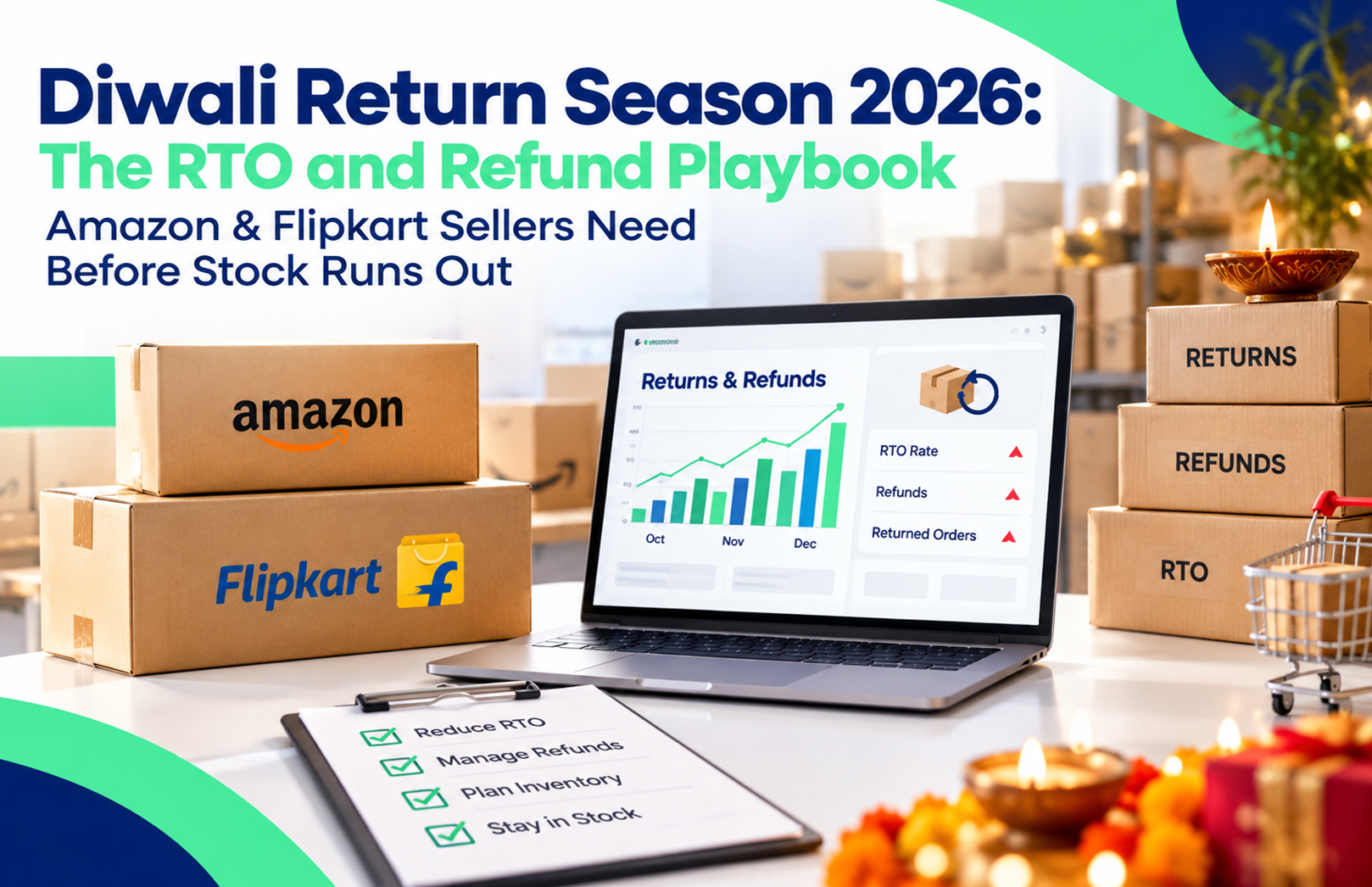
Diwali Return Season 2026: The RTO and Refund Playbook Amazon & Flipkart Sellers Need Before Stock Runs Out


Flipkart’s Big Billion Days and Amazon’s Great Indian Festival pushed record order volumes through most seller dashboards this October. Experienced sellers already know what comes next. The real test of Diwali 2026 is not the sale week itself, it is the four to six weeks after, when Return to Origin requests and refund tickets start climbing faster than new orders ever did. Sellers who get caught off guard here do not just lose a few parcels, they lose margin, cash flow, and in some cases weeks of stock that should already be back on the shelf for the rest of the festive season.

This is the playbook for that exact window. You will find why RTO spikes on Amazon and Flipkart after a major sale, how to separate real returns from delivery failures in your own reporting so you are fixing the right problem, what Amazon’s and Flipkart’s refund processes actually require from you in 2026, and a sequenced set of actions to work through before stock, cash, or patience runs out. If you manage even one high-volume account on either platform, and especially if Amazon account management or Flipkart account management is spread across a small team right now, the next few sections are worth reading in full before your next return request queue backs up.

What Happens to Returns After Diwali 2026 Ends?

Once the festive rush tapers off, both Amazon and Flipkart see a sharp, predictable jump in Return to Origin and customer-initiated returns, typically peaking seven to fifteen days after the sale ends. Flipkart marks a failed Cash on Delivery shipment as RTO once the delivery attempt cycle runs out, Amazon routes similar failures through its own courier return process, and both count directly against your seller performance metrics. In our experience managing festive-season accounts, RTO in categories like apparel and accessories can run two to three times higher in this window than the rest of the year, a pattern that holds across most couriers even though exact numbers vary by category, which is exactly why planning for post-Diwali order returns pays off more than reacting to them.

The reasons are mechanical, not mysterious. Buyers who ordered multiple sizes or colours during the sale send back whatever they do not keep. COD orders placed on impulse during flash pricing get refused at the door once the discount excitement wears off. Logistics partners, stretched thin during the sale itself, catch up on failed delivery attempts in the two weeks that follow, which shows up as a delayed RTO wave rather than an immediate one. Diwali sale returns on Amazon and Flipkart follow a fairly predictable curve once you track it properly, but only if you are watching the right week and the right metric instead of one blended return percentage, and this is usually the first gap a proper Amazon and Flipkart account management setup closes.

Why Does RTO Spike After Big Billion Days and the Great Indian Festival?

Both platforms see the spike for similar underlying reasons, but the mechanics differ enough that fixing one does not automatically fix the other. Amazon and Flipkart return to origin patterns look similar on the surface but come from different triggers underneath, Amazon’s shows up mostly through extended return windows, and Flipkart’s shows up through Non-Delivery Reports and COD refusals. Treating them as one combined number is the most common mistake we see sellers make every festive season.

Amazon RTO and Return Patterns

Amazon RTO after a festive sale is driven mainly by its extended holiday return window rather than failed deliveries alone, so returns keep arriving for weeks after the event itself ends.

On Amazon, a chunk of post-festive returns come through the standard customer return window rather than a failed delivery, since Amazon extends its holiday return period for many categories bought in the run-up to Diwali. That means products sold in early October can come back as returns well into December, long after the sale banners are gone. If you are not tracking returns against the original order date rather than the return date, your numbers will look better than reality for weeks. Sellers who do not want to rebuild this tracking from scratch every year usually bring in dedicated Amazon account management services to reduce RTO on Amazon India through structured account health monitoring and case log management, rather than checking it manually once a week.

Flipkart RTO and Return Patterns

Flipkart RTO after a festive sale is driven mainly by Cash on Delivery refusals and courier delivery failures, concentrated heavily in fashion, footwear, and accessories categories.

Flipkart’s spike is more COD-driven. During Big Billion Days, a large share of orders in fashion and accessories come in as Cash on Delivery, and a portion of those get refused the moment the buyer is actually asked to pay. The platform marks these as RTO once delivery fails after the standard attempt cycle, and the parcel starts its reverse journey back to your fulfilment centre or your own warehouse if you are not on Flipkart’s own fulfilment network. If you went into Big Billion Days without addressing COD limits, pin code level RTO history, or dispatch SLAs, the returns wave now is simply the second half of a problem that started before the sale. We covered the groundwork for this in our checklist on what Flipkart sellers should fix before Big Billion Days, and most of those same fixes apply directly to controlling the RTO that follows, which is also where dedicated Flipkart account management earns its keep during festive months.

How Do You Read Your RTO and Refund Numbers Before They Pile Up?

Before you can fix anything, you need to separate RTO from refunds in your own reporting, because they have different causes and different fixes. RTO means the order never reached the buyer. A refund means it did, and the buyer sent it back or the platform refunded it after a claim. Mixing the two into one return percentage hides which problem you actually have, and building this habit into an actual ecommerce refund management system, rather than a manual weekly glance, is what keeps the backlog from growing faster than you can clear it.

A quick way to triage your numbers each week during festive season:

  1. Pull RTO and return counts separately by platform, not combined.
  2. Segment by SKU and pin code, since RTO concentrates heavily in specific categories and delivery zones.
  3. Check the reason codes Amazon and Flipkart attach to each return, not just the raw count.
  4. Compare this week’s rate against your pre-festive baseline, not last month’s average, since Diwali skews both.
  5. Flag any SKU where returns cross 20 percent, since that usually points to a listing, sizing, or packaging issue rather than random buyer behaviour.

What Is Amazon’s Refund Policy for Sellers Heading Into 2026?

Amazon’s refund policy for most categories gives buyers a standard return window, which Amazon typically extends for items bought during the festive sale period, and sellers are expected to process eligible refunds within Amazon’s set timelines once the item is received back at the fulfilment centre or the seller’s return address. For FBA inventory, Amazon handles the refund directly, and any related reimbursement flows through Amazon’s own claims process rather than the seller initiating it manually. Knowing how to handle customer returns on Amazon correctly during this window, rather than reactively, is what keeps your account health score intact.

What catches sellers off guard every year is not the policy itself, it is the paperwork trail behind it. Every refund you process needs a matching credit note in your GST filings, so a backlog of unprocessed refunds in Seller Central does not just look bad on your dashboard, it shows up as a mismatch in your books before a single customer complains. For FBA sellers specifically, items marked returned but never actually received back at the fulfilment centre are often eligible for reimbursement, and this is one of the more commonly missed recoveries because sellers assume Amazon tracks it automatically. It does not always, and understanding Amazon’s seller refund policy in India down to this level of detail is what separates sellers who recover lost margin from those who write it off as a cost of doing business. This is exactly the gap our Amazon FBA reimbursement service is built to catch, since sellers managing refunds manually tend to recover only a fraction of what they are actually owed.

How Does the Flipkart Return Request Process Work During Diwali Week?

When a buyer raises a return on Flipkart, the seller gets a return request inside Seller Hub, usually within a seven to ten day window after delivery depending on category, and has to approve or reject it within the timeframe Flipkart sets before it auto-resolves in the buyer’s favour. During the Diwali sale window, the volume of these requests arrives in a short burst rather than spread evenly, which is where most sellers fall behind on the Flipkart return request process, and where a dedicated Flipkart account management partner usually earns back more than its cost in recovered refund timelines alone.

The sequence sellers forget under volume is simple but easy to skip when you are also managing dispatch SLAs and ad spend at the same time. You get the return request, you have a fixed window to accept or reject it, courier pickup gets scheduled once you approve it, and the refund only releases once the item is received and quality checked on Flipkart’s side. Reject without solid justification and you risk account level penalties stacking on top of the original return. We detailed how these penalties interact with returns and dispatch timing in our breakdown of Amazon cancellation fees and Flipkart dispatch penalties for 2026, which is worth reading alongside this one since the two problems usually show up together during festive season.

Common RTO and Refund Mistakes Sellers Make During Festive Season

Most of the damage from post-Diwali returns comes from a handful of repeated mistakes, not from one big failure.

Blocking COD entirely to kill RTO. It works, and we have seen sellers cut RTO sharply this way, but COD still drives a meaningful share of festive orders in tier 2 and tier 3 markets, so blocking it outright usually costs more in lost orders than it saves in returns. The better trade-off is tightening COD only on the pin codes and order values with a proven RTO history, not switching it off platform-wide.

Rejecting every return request to protect margin. This looks like it saves money short term, but a pattern of rejections without evidence pulls down your seller rating on both platforms, and a damaged rating costs more in lost buy box or search visibility than the returns themselves would have. The judgment call here is knowing which rejections are worth defending with photo evidence and which are cheaper to simply approve and move on from.

Treating RTO and refunds as one number in weekly reporting, which hides whether the real problem is delivery failure or product dissatisfaction, two issues that need completely different fixes. Good festive season returns management in ecommerce is not about eliminating RTO completely, it is about keeping it close to your category’s normal range and catching the outliers early. That kind of pattern recognition comes from running these accounts week after week rather than reacting once a quarter, which is the approach HRL Infotechs takes with every Amazon and Flipkart account we manage.

The RTO and Refund Playbook: Your Sequenced Action Plan Before Stock Runs Out

With the festive order spike behind you, the next four weeks decide how much of that revenue you actually keep. Work through these in order rather than all at once, since each step depends on the data the previous one gives you.

  1. Pull separate RTO and refund reports from Amazon Seller Central and Flipkart Seller Hub, by SKU and pin code, for the last 30 days.
  2. Flag any SKU with returns above 20 percent and check whether the reason codes point to sizing, description mismatch, or damaged-in-transit packaging.
  3. Tighten COD eligibility on the specific pin codes and order values showing the highest RTO, not across your entire catalogue.
  4. Clear your return request queue on Flipkart Seller Hub within the approval window every day through the end of November, since delays here auto-resolve in the buyer’s favour.
  5. Reconcile FBA returns against actual stock received, and file reimbursement claims for anything marked returned that never physically came back.
  6. Match every processed refund to its GST credit note before the filing period closes, so your books and your seller dashboard tell the same story.
  7. Rebuild your post-sale checklist now, while the data is fresh, so next year’s Diwali window starts with pin codes and SKUs already flagged instead of discovering them in week two.

If your team cannot clear this list before the next sale cycle, bringing in dedicated RTO-focused account management for Flipkart sellers alongside Amazon-side account health work usually costs less than the margin quietly disappearing into unresolved returns right now. If your dashboards are already showing the early signs of this spike and you want a second set of eyes on where the RTO is actually coming from, our team can start with a free account audit across both marketplaces before the backlog grows past what is easy to fix.

FAQs

Q1: What is the difference between RTO and a regular return on Amazon and Flipkart?

A1: RTO means a shipment never reached the buyer and came back due to a failed delivery attempt, refused COD, or wrong address. A regular return happens after successful delivery, when the buyer receives the item and sends it back through the platform’s return window. Both affect your seller metrics, but they need different fixes since one is a delivery problem and the other is a product or expectation problem.

Q2: How long does the post-Diwali RTO spike usually last?

A2: Most sellers see elevated RTO and return volume for roughly four to six weeks after a major sale event ends, with the sharpest spike in the first two weeks. Categories with extended return windows, especially on Amazon, can see return volume trickle in even longer, so it is worth tracking returns against the original order date rather than assuming the spike ends when the sale banners come down.

Q3: Can I reduce RTO by blocking Cash on Delivery entirely?

A3: You can, and it does cut RTO sharply, but COD still drives a large share of orders in tier 2 and tier 3 markets during festive sales, so blocking it completely usually costs more in lost orders than it saves in returns. Restricting COD only on specific pin codes and order values with a proven RTO history is typically the better trade-off.

Q4: What happens if I do not respond to a Flipkart return request in time?

A4: If you miss the approval window on a Flipkart return request, it typically auto-resolves in the buyer’s favour, meaning the refund goes through regardless of your position. Repeated missed windows during high-volume periods like Diwali week also tend to affect your seller performance metrics, so clearing the return queue daily matters more during festive season than any other time of year.

Q5: Does Amazon reimburse sellers for FBA items that were never actually returned?

A5: Yes. When a customer return is marked complete but the item never physically arrives back at the fulfilment centre, that is typically eligible for an FBA reimbursement claim. Many sellers do not file these claims because Amazon does not always flag them automatically, which means a portion of legitimate reimbursements go unclaimed every festive season unless someone is checking for them deliberately.

Q6: How do refunds affect my GST filings as an ecommerce seller?

A6: Every refund you process needs a corresponding credit note in your GST returns, since the original sale was already reported. A backlog of unprocessed refunds creates a mismatch between your platform dashboard and your filed returns, so clearing refund queues promptly during and after Diwali is as much a compliance matter as a customer service one.
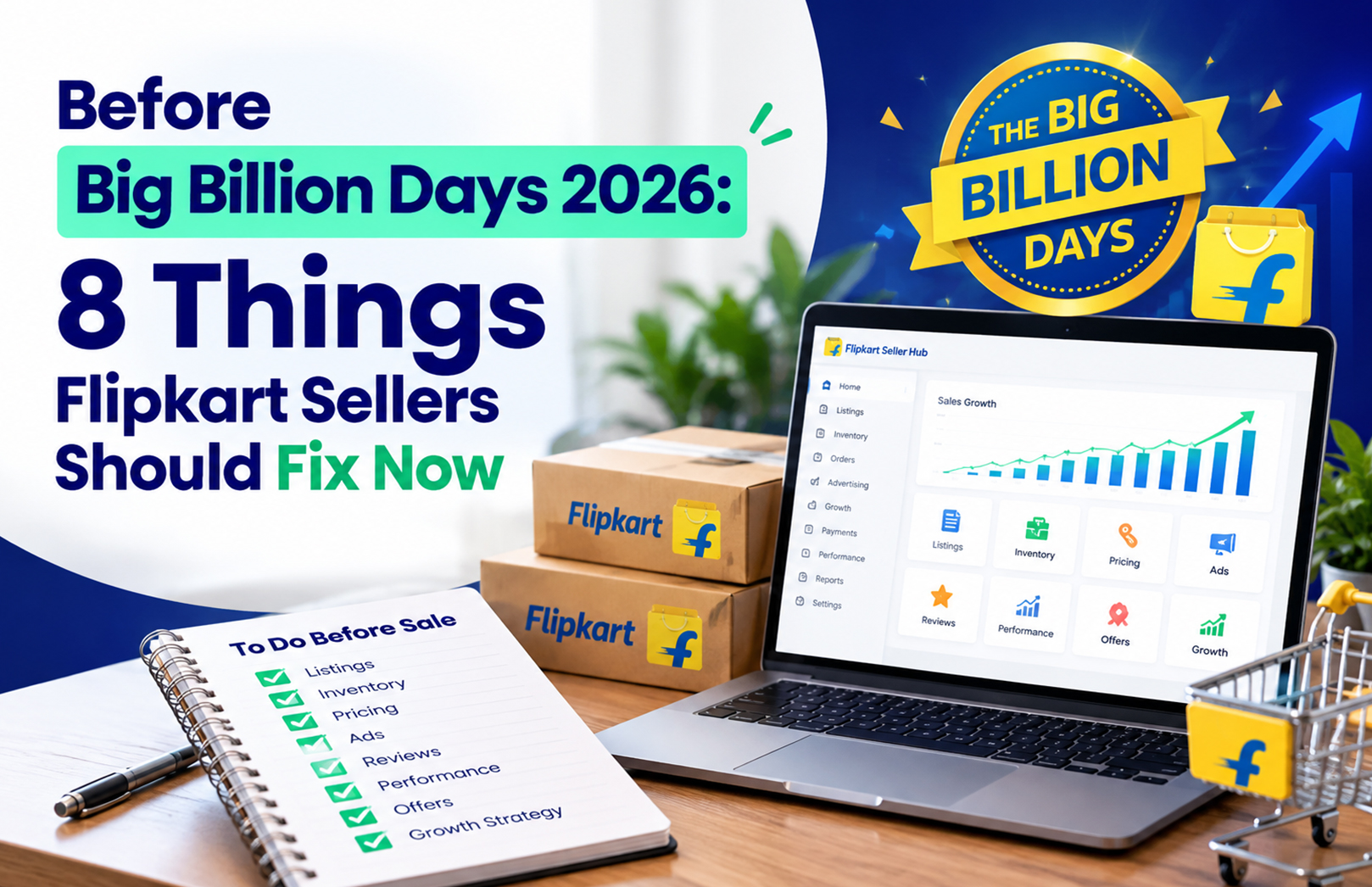
Before Big Billion Days 2026: 8 Things Flipkart Sellers Should Fix Now  


The biggest mistake you can make before Big Billion Days 2026 is waiting for the sale to begin before fixing your Flipkart store. A Flipkart seller should audit product listings, inventory, pricing, seller performance, advertising campaigns, images, and fulfilment readiness before increasing promotional activity. Flipkart has announced early access for Big Billion Days 2026 from October 8, with the main sale beginning October 9, giving sellers a limited window to prepare.

A sale event can bring a sudden increase in shopper attention, but traffic alone doesn’t guarantee orders. If your listing has weak images, unclear information, insufficient stock, poor pricing, or inefficient ads, more traffic can simply mean more wasted clicks. After working with marketplace sellers, one pattern becomes clear: the brands that prepare early usually spend the sale period optimizing performance rather than fixing basic catalogue problems.

What Should a Flipkart Seller Fix Before Big Billion Days 2026?

A Flipkart seller should first identify the products most likely to benefit from increased festive demand, then fix the factors that can prevent those products from converting. Prioritize your catalogue, inventory, pricing, advertising, seller metrics, and fulfilment before scaling promotional activity.

You don’t need to rebuild your entire catalogue. Start with the SKUs that already have search demand, reasonable conversion history, competitive pricing, and enough stock to support additional orders.

PriorityWhat to checkWhy it matters
1Product listingsImproves relevance and buyer understanding
2InventoryPrevents avoidable stockouts
3PricingKeeps offers competitive
4ImagesSupports clicks and product understanding
5Seller performanceProtects customer experience
6AdvertisingHelps capture relevant demand
7FulfilmentReduces operational bottlenecks
8AnalyticsHelps identify what needs adjustment

1. Are Your Flipkart Product Listings Actually Sale-Ready?

Your product listing is the first place to start. Check titles, descriptions, specifications, images, categories, attributes, and search terms before putting additional advertising budget behind the SKU.

A common mistake is optimizing only the title. Your main image, product information, pricing, ratings, availability, and category placement all influence what happens after a shopper finds the product.

HRL Infotechs’ Flipkart SEO and listing optimization services focus on catalogue structure, keyword research, titles, descriptions, images, and product discoverability. That makes listing optimization one of the most logical pre-Big Billion Days checks for sellers whose products already have demand.

Which Products Should You Optimize First?

Start with products that already receive impressions, clicks, or orders. These SKUs have existing marketplace data that can tell you where the biggest opportunity may be.

For example, if a product receives plenty of impressions but very few clicks, review its main image, title, pricing, and offer presentation before immediately increasing bids. If clicks are healthy but orders are weak, investigate the product page and offer instead.

That distinction matters. More impressions won’t fix a conversion problem.

2. Do You Have Enough Inventory for Big Billion Days?

Inventory should be planned before the sale, not after orders begin arriving. Estimate expected demand using recent sales velocity, historical seasonal patterns, current stock, supplier lead time, and the additional demand you expect from advertising.

HRL Infotechs’ inventory forecasting guide for marketplace sellers explains practical methods such as calculating daily sales velocity, accounting for lead time, maintaining safety stock, and setting reorder points.

Suppose a SKU currently sells 20 units a day and your replenishment lead time is 30 days. Your minimum planning requirement isn’t simply 600 units. You also need to consider safety stock and whether BBD advertising could materially increase demand.

Here’s the trade-off many new sellers miss: overstocking can lock up cash, but understocking can leave you unable to capitalize on demand. Your forecast should therefore be SKU-specific rather than based on one blanket percentage increase.

3. Is Your Pricing Competitive Without Destroying Your Margin?

Big Billion Days attracts price-sensitive shoppers, but the lowest price isn’t automatically the right strategy. Calculate your contribution margin before deciding how aggressively you can discount.

Review your selling price, marketplace fees, shipping or fulfilment costs, promotional discounts, advertising spend, returns, and applicable taxes. Then decide which SKUs can support deeper offers and which need a smaller discount.

Don’t copy a competitor’s price blindly. Their cost structure, inventory position, brand strength, and advertising economics may be completely different from yours.

A better approach is to create a price floor for each priority SKU before the event. This gives your team a clear boundary for promotional decisions instead of encouraging last-minute discounting.

4. Are Your Product Images Strong Enough to Compete?

Your product images have to answer buyer questions quickly. Review the primary image first, then check whether secondary images clearly communicate dimensions, features, use cases, inclusions, and important specifications.

For a festive sale, shoppers may compare several similar products within minutes. If your listing requires them to read a long description to understand what they are buying, you are creating unnecessary friction.

Look at your highest-traffic SKUs and ask three questions:

  1. Can the product be understood from the primary image?
  2. Do the secondary images explain important features?
  3. Does the listing answer the questions buyers commonly ask?

If the answer to any of these is no, fix the creative before the traffic spike.

5. Is Your Flipkart Seller Account Ready for Higher Order Volume?

Your seller operations need to be ready for more than just sales. Check order processing, inventory updates, dispatch capacity, returns handling, customer communication, and fulfilment workflows before the event.

This is especially important if you are scaling advertising at the same time. More clicks can create more orders, and more orders can expose operational weaknesses very quickly.

HRL Infotechs provides Flipkart account management services covering marketplace operations and ongoing account support. For sellers managing a large catalogue, structured account management can help keep operational tasks from becoming a bottleneck during peak periods.

The practical lesson is simple: don’t scale demand faster than your operation can handle it.

6. Are You Increasing Flipkart Ads Too Early?

Advertising should amplify products that are already reasonably prepared. It shouldn’t be used to hide weak listings, uncompetitive pricing, or poor conversion.

Review your existing campaigns before adding more budget. Identify products and search terms generating useful traffic, then separate them from campaigns producing clicks without meaningful outcomes.

HRL Infotechs’ Flipkart advertising services are built around campaign management and performance-focused advertising. The company’s existing Flipkart advertising guide also recommends looking at impressions, clicks, conversions, orders, pricing gaps, listing weaknesses, and competition rather than making decisions from assumptions alone.

One useful rule from practical campaign management is this: fix the product page before forcing more traffic into it. If the conversion experience isn’t ready, increasing ad spend can simply increase your cost per sale.

7. Have You Checked Your Seller Performance and Customer Experience?

A sale event puts pressure on the entire customer journey. Review cancellation rates, dispatch performance, returns, customer complaints, product information accuracy, and other seller-performance indicators that matter to your account.

Don’t wait until order volume increases to discover that your team can’t handle the workload.

Also review product-level customer feedback. If buyers repeatedly mention the same missing specification, packaging problem, sizing confusion, or product mismatch, address the root cause before the sale.

These aren’t glamorous optimizations, but they often matter more than another round of keyword edits.

8. Are You Tracking the Right Numbers During Big Billion Days?

Your final preparation step is measurement. Decide in advance which metrics you’ll monitor so you can distinguish a real improvement from a temporary traffic spike.

At minimum, track:

  • Impressions
  • Clicks
  • Click-through rate
  • Orders
  • Conversion rate
  • Advertising spend
  • ROAS or relevant advertising efficiency metric
  • Average selling price
  • Stock levels
  • Returns and cancellations

Don’t judge every SKU using the same benchmark. A high-margin product may justify a different advertising efficiency target than a low-margin volume product.

The useful comparison is not simply “Did sales increase?” Ask “Did sales increase efficiently, and can we fulfil the demand profitably?”

What Should a Flipkart Seller Do in the Final Week?

The final week should be about verification, not major experimentation. Confirm your priority SKUs, stock availability, pricing, listing accuracy, advertising settings, fulfilment capacity, and reporting before the event begins.

Use this sequence:

Step 1: Select your priority SKUs.
Step 2: Audit titles, images, descriptions, attributes, and categories.
Step 3: Confirm stock and supplier lead times.
Step 4: Set acceptable pricing and margin floors.
Step 5: Review existing advertising performance.
Step 6: Fix operational and seller-performance issues.
Step 7: Set daily monitoring responsibilities.
Step 8: Increase activity gradually and evaluate performance using actual data.

Avoid making several major changes simultaneously just before the sale. If you change pricing, listing content, advertising structure, and product selection on the same day, it becomes harder to identify what actually affected performance.

How Can HRL Infotechs Help Flipkart Sellers Before Big Billion Days?

HRL Infotechs works across Flipkart SEO and listing optimization, advertising, account management, and A+ content, which are directly relevant to the preparation process described above.

If your store has traffic but weak conversion, start with the catalogue. If the catalogue is strong but visibility is limited, investigate advertising and search optimization. If sales are growing but operations are becoming difficult to manage, account management and inventory planning deserve attention.

You don’t need every service at once. The useful approach is to identify the bottleneck first, then apply the service that addresses it.

For sellers preparing for Big Billion Days 2026, the goal shouldn’t be to make your store look busy before the sale. It should be to make sure your products, inventory, advertising, pricing, and operations can handle the demand you are trying to create.

FAQs About Big Billion Days 2026 for Flipkart Sellers

When is Big Billion Days 2026 starting?

Flipkart has announced that Big Billion Days 2026 will offer early access from October 8, 2026, with the main sale beginning October 9, 2026. Sellers should therefore complete major listing, inventory, pricing, advertising, and operational checks before the early-access period.

How can a Flipkart seller prepare for Big Billion Days 2026?

Start by identifying priority SKUs and auditing their listings, pricing, inventory, images, seller performance, and advertising. Then confirm fulfilment capacity and establish the metrics you’ll monitor during the event. Preparation should focus on removing conversion and operational bottlenecks before increasing traffic.

Should Flipkart sellers increase ad spend before Big Billion Days?

Increasing ad spend can make sense for products that already have strong listings, competitive offers, sufficient inventory, and acceptable conversion performance. Increasing spend on an underperforming product before fixing the underlying problem can lead to inefficient traffic and higher acquisition costs.

What should a Flipkart seller check in a product listing?

Check the title, product description, specifications, attributes, category, primary image, secondary images, pricing, availability, and relevant search terms. The goal is to make the product easy to discover and easy to understand. Start with high-priority SKUs rather than trying to rebuild the entire catalogue immediately.

How much inventory should sellers keep for Big Billion Days?

There is no universal inventory number because demand varies by product, category, sales velocity, advertising, lead time, and historical seasonality. Calculate expected daily demand, account for replenishment lead time, and maintain appropriate safety stock rather than applying the same increase to every SKU.

Is Flipkart seller registration required to participate as a seller?

Yes. Businesses that want to sell through Flipkart need to complete the platform’s seller onboarding and registration requirements. New sellers should complete registration and catalogue setup well before a major sale event rather than trying to establish their account immediately before peak demand.

Final Takeaway

Big Billion Days 2026 gives Flipkart sellers an opportunity to capture increased festive shopping demand, but the sale itself won’t fix an unprepared store. Your best preparation is practical: fix priority listings, secure inventory, establish profitable pricing, improve product images, review seller performance, prepare fulfilment, and only then scale advertising.

Flipkart’s official announcement confirms that early access begins October 8, so the preparation window is already defined.

If your team isn’t sure which part of the store is holding back growth, an audit is a sensible first step. HRL Infotechs can assess your Flipkart catalogue, advertising, and marketplace performance and help you prioritize the fixes that matter before the sale.

Don’t wait for Big Billion Days traffic to reveal problems you could have fixed beforehand.

How Mumbai Home & Kitchen Sellers Can Increase Flipkart CTR & Amazon Sales with Data-Driven Strategies


Mumbai home and kitchen sellers are in a unique position. Demand for appliances, cookware, and décor is booming, yet competition on Amazon and Flipkart is fiercer than ever. To stand out, you need more than good products you need smart, data-driven amazon and flipkart sales growth strategies that turn views into clicks and clicks into sales.

By analyzing how top sellers optimize their catalogs, ads, and pricing, you can uncover patterns that reliably boost CTR and conversions. This guide breaks down practical tactics for increasing Amazon CTR, improving Flipkart CTR optimization, and building a scalable growth engine for your marketplace business in India.

Understanding the Real Growth Levers on Amazon and Flipkart

Most Mumbai sellers focus only on discounts and deals, but sustainable growth comes from understanding platform signals. Both marketplaces reward listings that attract clicks, keep shoppers engaged, and convert at healthy rates. That is why effective amazon and flipkart sales growth strategies always start with data, not guesswork.

On Amazon, the algorithm looks closely at click-through rate, conversion rate, and customer satisfaction. Flipkart behaves similarly, with high-performing listings gaining better visibility in search and ads. When you track these metrics at SKU level, you can see which images, titles, and price points actually move the needle.

Optimizing Listings for Higher CTR and Conversions

Before investing heavily in ads, make sure your product pages are ready to convert. Strong listings are the foundation of all amazon and flipkart sales growth strategies. If your titles, images, and content are weak, even the best campaigns will underperform and waste budget.

For Mumbai home and kitchen categories cookware sets, storage containers, small appliances visual appeal and clarity matter most. Shoppers scan quickly, so your listing must communicate value in seconds. This is where professional amazon listing optimization services can make a measurable difference in both CTR and sales.

Title, Image, and Content Tactics That Increase Amazon CTR

To increase Amazon CTR, start with keyword-rich yet readable titles. Include brand, product type, key feature, material, and size. Avoid keyword stuffing, but ensure your main terms like “non-stick kadai” or “borosilicate glass storage” appear naturally.

Next, invest in high-resolution images that show real use in Mumbai homes compact kitchens, Indian cooking styles, and local serving habits. Add infographics for capacity, dimensions, and key benefits. Well-structured bullet points that highlight durability, warranty, and ease of cleaning can further boost engagement and conversions.

Flipkart CTR Optimization for Home & Kitchen Sellers

Flipkart shoppers often compare multiple products on one screen, so your thumbnail and price positioning are critical. Effective flipkart ctr optimization focuses on clean images, clear titles, and compelling price-value balance. Even small improvements in main image quality can significantly improve click-through.

Use the description space to answer common questions: compatibility with gas or induction, material safety, and capacity. Align your content with how Indian families actually use these products. When combined with structured flipkart seller account management, this approach helps you win more impressions and clicks in crowded categories.

Leveraging Data-Driven Advertising on Amazon and Flipkart

Once your listings are optimized, advertising becomes a powerful accelerator. The most successful amazon and flipkart sales growth strategies use ads not just to drive traffic, but also to gather data on keywords, audiences, and price sensitivity.

In India, home and kitchen is a high-intent category, which makes smart ad management essential. Poorly structured campaigns can burn through budgets quickly. That is why many sellers rely on specialized amazon ppc management services and flipkart advertising services to protect ROI while scaling.

Smart Amazon PPC Structures for Home & Kitchen

To increase Amazon CTR and conversions through ads, segment your campaigns by product type and match type. Use auto campaigns for discovery and manual campaigns for scaling proven keywords. Continuously mine search term reports to find new profitable queries.

Pause low-performing keywords and shift budget to terms with strong CTR and conversion rates. Over time, this disciplined approach becomes one of your most reliable amazon and flipkart sales growth strategies, especially when combined with seasonal pushes around festivals and sales events.

Flipkart Advertising Strategies That Actually Drive Sales

On Flipkart, start with sponsored listings for your bestsellers and hero SKUs. Focus on placements that give maximum visibility in search and category pages. Effective flipkart advertising services prioritize products with strong reviews and competitive pricing to maximize ad efficiency.

Track CTR, cost per click, and conversion rate at ad group level. Use this data to refine your bids and creatives. When paired with consistent flipkart seller account management, this creates a feedback loop that steadily improves performance and profitability.

Building a Marketplace Growth Engine for Mumbai Sellers

For long-term success, you need more than isolated tactics. You need a system. Leading marketplace growth services india focus on building repeatable processes across catalog, content, ads, and operations. This is especially important for fast-moving home and kitchen SKUs.

Data should guide every decision from which products to launch, to which bundles convert best in Mumbai, to which keywords drive profitable traffic. When your amazon and flipkart sales growth strategies are data-backed, scaling becomes predictable instead of risky.

Role of Professional Account Management Services

Many amazon sellers in mumbai struggle to balance daily operations with strategic growth. That is where amazon account management services india and marketplace specialists come in. They handle catalog hygiene, listing optimization, ad management, and reporting.

This support frees you to focus on product development and supply chain. Meanwhile, experts continuously refine your amazon and flipkart sales growth strategies based on platform updates, competition analysis, and seasonal demand patterns.

Turning Data into Actionable Growth for Home & Kitchen Brands

To truly understand how to increase Amazon sales and Flipkart performance, you must treat data as a daily tool, not a monthly report. Review key metrics like CTR, conversion rate, average order value, and return rate at least weekly.

Then, translate those insights into clear actions. Improve images for low-CTR SKUs, refine bullets for high-traffic but low-conversion listings, and adjust bids for underperforming keywords. Over time, this disciplined approach compounds, making your ecommerce marketing services india stack far more effective.

Key Metrics Mumbai Sellers Should Track

Focus on a simple yet powerful dashboard. For each ASIN or listing, track impressions, CTR, conversion rate, and revenue. Add ad spend and ACoS for campaigns. This view reveals which amazon and flipkart sales growth strategies are actually working.

Use these insights to prioritize your efforts. Double down on winning products and keywords, and either fix or phase out persistent underperformers. This is how serious amazon sellers in mumbai turn marketplaces into scalable, predictable revenue channels.

Conclusion: Turn Browsers into Buyers with Data-Driven Strategy

Mumbai home and kitchen sellers who embrace data-driven decision making consistently outperform those relying on guesswork. By combining optimized listings, smart advertising, and disciplined account management, you can improve Flipkart CTR, increase Amazon CTR, and unlock sustainable marketplace growth.

If you are ready to turn your marketplace presence into a true growth engine and want expert support across listing optimization, PPC, and marketplace strategy, partnering with a specialist like HRL Infotechs can help you implement these amazon and flipkart sales growth strategies faster and with greater impact.

How to Improve Conversion Rate on Flipkart Without Changing the Product


Improving your Flipkart conversion rate does not always require changing your product. In many cases, the real problem lies in how your product is presented, discovered, and trusted on the platform. By optimizing your listings, store page, and account management, you can significantly increase sales without touching the core product itself.

This guide explains how to improve flipkart conversion rate using proven marketplace strategies. You will learn how to increase conversion rate on Flipkart through listing optimization, store page optimization, and smart account management, so more visitors turn into paying customers.

Understanding Flipkart Conversion Rate and Buyer Intent

Before you can improve flipkart conversion rate, you must understand what it actually measures. Conversion rate is the percentage of visitors who land on your product page and complete a purchase. A low conversion rate means many shoppers visit but do not buy, even if your product is good.

On Flipkart, buyer intent is usually high because users are already in shopping mode. If your flipkart conversion rate is low, the issue often lies in trust, relevance, or presentation. Fixing these areas is the fastest way to increase conversion rate on Flipkart without changing the product itself.

Common Reasons Your Flipkart Product Is Not Selling

Many sellers ask, “why my flipkart product is not selling” even though they have competitive pricing. Often, the problem is not demand but how the listing appears in search and on the product page. Weak titles, poor images, and missing details push buyers away.

Other times, low flipkart conversion rate comes from negative reviews, slow response times, or unclear shipping and return policies. Understanding these friction points helps you prioritize the right optimization steps to increase Flipkart sales.

Flipkart Listing Optimization: Fix the Product Page First

Flipkart listing optimization is the most powerful lever to improve flipkart conversion rate. Your product page is where buyers decide to purchase or leave, so every element must build trust and reduce doubt. Small improvements here can create a big impact on sales.

Focus on optimizing the title, images, description, and key attributes. When these elements match buyer expectations and search behavior, you naturally increase conversion rate on Flipkart and improve your organic visibility in marketplace search.

Optimize Titles and Keywords for Higher Relevance

Your title is one of the strongest signals for both search ranking and click-through rate. To improve flipkart conversion rate, your title should be clear, keyword-rich, and benefit-driven without being spammy. Include brand, main feature, size or variant, and primary use case.

Research how top competitors phrase their titles for similar products. Then, structure your own title to cover the main search terms buyers use when looking for your product. This approach supports flipkart listing optimization and helps answer why your Flipkart product is not selling.

Upgrade Images and Visual Storytelling

High-quality images are critical for a strong flipkart conversion rate. Shoppers cannot touch the product, so visuals must do the convincing. Use clear, high-resolution images with a clean background and multiple angles to show details.

Where allowed, add lifestyle images that show the product in real use. Include close-ups of important features and size references. Better visuals reduce uncertainty, increase conversion rate on Flipkart, and often justify a slightly higher price.

Strengthen Descriptions, Bullet Points, and Attributes

Your description should answer every question a buyer might have before purchase. To improve flipkart conversion rate, write clear, benefit-focused copy that explains what the product does, who it is for, and why it is better. Avoid generic text and focus on real outcomes.

Use bullet points for key features and specifications so buyers can scan quickly. Ensure all attributes, such as size, color, material, and compatibility, are complete and accurate. This level of flipkart listing optimization reduces returns and builds long-term trust.

  • Highlight 3–5 core benefits in bullets.
  • Clarify usage instructions or care guidelines.
  • Address common objections directly.

Flipkart Store Page Optimization for Brand Trust

Even if a single listing is strong, a weak store page can still hurt your flipkart conversion rate. Buyers often click through to your store to check credibility, especially for higher-value products. A professional, consistent presence increases confidence.

Flipkart Store page optimization involves aligning visuals, messaging, and product assortment. When your store looks trustworthy and well-managed, shoppers feel safer buying from you, which helps increase conversion rate on Flipkart across all your listings.

Create a Consistent Brand Experience

Use consistent colors, imagery style, and tone of voice across your store banner, logo, and product images. This consistency signals professionalism and reliability, both of which support a stronger flipkart conversion rate. Avoid cluttered designs or mismatched visuals.

Organize products into logical categories and highlight bestsellers or top-rated items. This structure makes navigation easier and guides buyers to proven products, which can quickly increase Flipkart sales without changing your existing catalog.

Flipkart Account Management Optimization for Performance

Flipkart account management optimization goes beyond listings and store design. The platform also rewards operational excellence, such as fast shipping, low cancellation rates, and responsive customer service. These factors influence your visibility and flipkart conversion rate.

When your operational metrics are strong, Flipkart is more likely to favor your products in search and promotions. This improved exposure, combined with optimized listings, can dramatically increase conversion rate on Flipkart and drive sustainable growth.

Improve Service Metrics and Seller Performance

Monitor key performance indicators like on-time dispatch, return rate, and customer response time. Poor metrics can quietly drag down your flipkart conversion rate, even if your product pages look good. Set internal standards that exceed Flipkart’s minimum requirements.

Respond to customer queries quickly and professionally. Resolve issues before they turn into negative reviews. Over time, better ratings and fewer complaints will increase Flipkart sales and strengthen your overall marketplace reputation.

Leverage Promotions and Pricing Smartly

You do not need to change your product to adjust your pricing and offers. Strategic discounts, coupons, and limited-time deals can boost flipkart conversion rate by creating urgency. However, avoid constant deep discounts that hurt margins and brand perception.

Test different price points and promotional structures to see what best increases conversion rate on Flipkart for your category. Combine these offers with strong listing optimization to convert the extra traffic generated during campaigns.

Using Data and Reviews to Continuously Improve

Improving flipkart conversion rate is not a one-time task. You should regularly analyze performance data, customer reviews, and search trends. This ongoing review helps you spot new opportunities to refine your listings and store page.

Pay attention to which keywords drive the most sales and which products have the highest conversion. Use this insight to guide future flipkart listing optimization and store layout decisions, focusing on what actually works rather than guesswork.

Turn Customer Feedback into Optimization Ideas

Reviews and Q&A sections are a goldmine for understanding why your flipkart product is not selling as expected. Look for repeated complaints or confusion about features, sizing, or usage. Then, update your description, images, and bullets to address those issues.

Highlight positive reviews and ratings where possible to reinforce trust. This social proof can significantly improve flipkart conversion rate, especially for new visitors who are comparing multiple sellers and products.

Conclusion: Turn Traffic into Revenue Without Changing Your Product

When your product is good but sales are slow, the answer often lies in how you present, position, and manage it on the platform. By focusing on flipkart listing optimization, Flipkart Store page optimization, and strong account management, you can improve flipkart conversion rate and unlock more revenue from existing traffic. If you want expert help implementing these strategies at scale, HRL Infotechs can provide structured marketplace optimization support tailored to your business.

Consistent improvements in titles, images, descriptions, service metrics, and data-driven decisions will steadily increase conversion rate on Flipkart. Over time, these changes compound, helping you overcome the question of why your Flipkart product is not selling and turning your Flipkart presence into a reliable, high-performing sales channel.

How to Prepare Your Brand for High-Traffic Sale Events on Flipkart


High-traffic sale events on Flipkart can transform your brand visibility and revenue in just a few days. But without the right Flipkart Marketing Services strategy, you risk stockouts, poor visibility, and wasted ad spend while competitors capture demand. Strategic preparation is what separates top-performing brands from everyone else during Flipkart sale events.

To win during Big Billion Days, festive sales, and category-specific events, you need a clear roadmap. From catalog readiness and pricing to Flipkart Ad Services and performance tracking, every element must work together. This guide walks you through how to prepare for Flipkart sale events with a structured, data-backed approach.

Understanding the Opportunity of Flipkart Sale Events

Flipkart sale events concentrate massive buyer intent into a short window. Shoppers come ready to purchase, search volumes spike, and competition for visibility intensifies. Brands that leverage Flipkart Marketing Services effectively can see exponential gains in impressions, clicks, and conversions during these periods.

The dominant search intent around Flipkart sale events preparation is commercial and informational. Sellers want to know how to prepare for Flipkart sale, which levers to prioritize, and how to build a sustainable Flipkart sale strategy for sellers. Aligning your planning with this intent helps you focus on actions that actually move revenue.

Audit Your Flipkart Presence Before Any Major Sale

Before you plan discounts or campaigns, start with a thorough account and catalog audit. Strong foundations ensure your Flipkart Marketing Services efforts convert traffic into sales. This is where Flipkart Account Management Services and structured internal processes become critical.

Begin by reviewing your current performance across key metrics: impressions, click-through rate, conversion rate, return rate, and seller rating. This baseline helps you decide how aggressive your Flipkart sale strategy for sellers should be and where to invest in optimization before traffic surges.

Key Elements of a Pre-Sale Account Audit

A structured audit should cover operational, catalog, and performance aspects. Operationally, verify that your warehouse, shipping partners, and customer support can handle peak volumes. Any bottleneck here can erode the gains from even the best Flipkart Marketing Services plan.

On the catalog side, identify top sellers, high-margin products, and underperforming SKUs. Tag products that are ideal for Flipkart festive sale preparation, such as seasonal or giftable items. Use this data to decide which SKUs deserve prime visibility and promotional focus during Flipkart sale events.

Optimize Product Listings and On-Page SEO

High-intent traffic is useless if your product pages do not convert. Flipkart Product Listing & SEO Services should be a core pillar of your Flipkart sale events preparation. Optimized listings help you rank better in search and improve ad performance by increasing relevance and quality scores.

Focus on keyword-rich titles, clear bullet points, and persuasive descriptions. Integrate terms buyers actually use, such as “Flipkart sale events preparation” or “how to prepare for Flipkart sale,” in a natural way. This supports both organic discovery and better alignment with Flipkart Ad Services campaigns.

Listing Optimization Checklist for Sellers

To prepare for Flipkart big billion days preparation and other mega events, use a consistent optimization checklist. Start with titles: keep them concise, keyword-focused, and benefit-led. Include brand, key feature, size or variant, and primary use case to match search behavior.

Next, refine images and content. Use high-resolution images with multiple angles, lifestyle shots, and zoom capability. In descriptions, highlight benefits, not just features, and address common objections. This approach, combined with Flipkart Product Listing & SEO Services, can significantly lift conversion rates during peak sale traffic.

Build a Data-Driven Pricing and Discount Strategy

Pricing is one of the most sensitive levers in any Flipkart sale strategy for sellers. During high-traffic events, buyers compare aggressively across brands and listings. A structured pricing plan aligned with Flipkart Marketing Services can help you balance volume, margin, and visibility.

Start by segmenting products into hero SKUs, profit drivers, and clearance items. Hero SKUs can carry deeper discounts to attract traffic, while profit drivers maintain healthier margins. Clearance items can be used to unlock additional visibility slots during Flipkart festive sale preparation.

Aligning Offers with Buyer Psychology

Beyond raw discount percentage, think about how offers appear to shoppers. Bundles, bank offers, and limited-time deals can often outperform flat discounts. Integrating these into your Flipkart sale events preparation makes your offers more compelling without always sacrificing margin.

Monitor competitor pricing in the days leading up to the event. Adjust your strategy where necessary, but avoid reactive discounting that erodes profitability. Instead, use insights from Flipkart Account Management Services and historical data to set clear pricing guardrails.

Leverage Flipkart Ad Services for Maximum Visibility

Even the best listings need visibility to perform. Flipkart Ad Services are essential for capturing high-intent traffic during Big Billion Days and other events. A well-structured ad strategy, integrated with broader Flipkart Marketing Services, can multiply your reach.

Plan campaigns in advance rather than switching them on at the last minute. Use historical data to identify best-performing keywords, categories, and placements. This is especially important for Flipkart big billion days preparation, where competition for ad inventory is intense.

Structuring Campaigns for Sale Events

Segment campaigns by objective: visibility, conversions, and remarketing. Visibility campaigns focus on hero SKUs and flagship categories. Conversion campaigns target proven performers with strong ratings and reviews. Remarketing campaigns re-engage users who viewed or added to cart but did not purchase.

During the event, monitor performance closely and reallocate budgets toward winning campaigns and keywords. Pause underperforming ad groups quickly. This agile approach ensures your Flipkart Ad Services investment stays efficient while demand peaks.

Strengthen Operations, Inventory, and Customer Experience

No Flipkart sale events preparation is complete without operational readiness. Stockouts, delayed dispatch, and poor packaging can damage ratings and long-term visibility. Align your inventory planning with your Flipkart Marketing Services and demand forecasts.

Forecast demand using past event data, current trends, and planned ad spends. Ensure adequate stock for hero SKUs and fast-moving variants. Coordinate with logistics partners to handle increased order volumes and returns, especially during Flipkart festive sale preparation.

Protecting Ratings and Building Long-Term Trust

High-traffic events are an opportunity to acquire new customers and reviews at scale. Maintain strict quality checks, accurate descriptions, and reliable shipping. Positive experiences during Flipkart sale events can lift your organic rankings long after the sale ends.

Encourage genuine reviews and respond to queries quickly. Use insights from these interactions to refine your Flipkart sale strategy for sellers for future events. Over time, this cycle of optimization strengthens your brand equity within the marketplace.

Conclusion: Turn Every Flipkart Sale Event into a Growth Engine

Preparing for Flipkart sale events is not just about discounts; it is about building a repeatable, data-driven system. When Flipkart Marketing Services, Flipkart Product Listing & SEO Services, Flipkart Ad Services, and strong operations work together, every high-traffic event becomes a growth engine rather than a one-off spike.

If you want expert support across strategy, execution, and optimization for upcoming Flipkart events, HRL Infotechs can help you design and manage a complete performance-focused roadmap tailored to your category and growth goals.