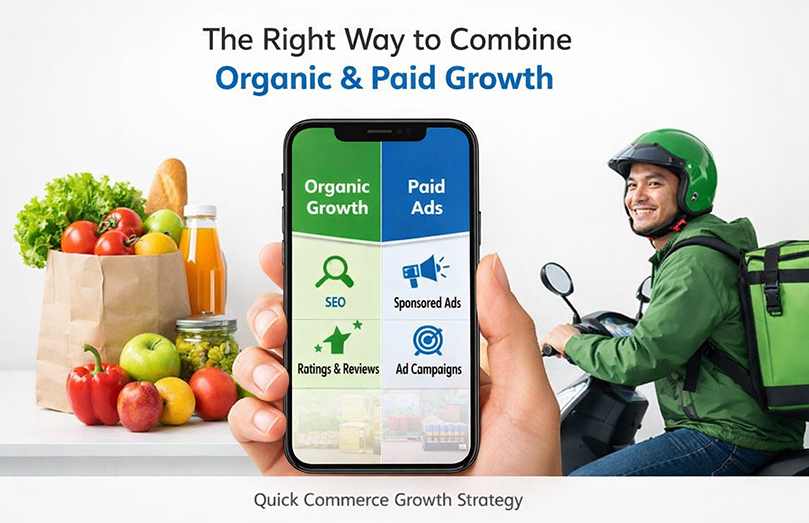
Quick commerce has changed how consumers shop, and how brands grow. But many brands still treat organic and paid growth as separate tracks, missing out on the real power of an integrated quick commerce growth strategy. When organic and paid work together, brands can scale faster, lower acquisition costs, and build long-term loyalty on platforms like Blinkit, Zepto, Instamart, and JioMart.
This guide breaks down the right way to combine organic and paid growth on quick commerce platforms. You will learn how to design a quick commerce marketing strategy that aligns content, performance ads, and marketplace optimization into one unified quick commerce growth engine.
Understanding Quick Commerce Growth and Today’s Search Intent
Quick commerce growth is no longer just about being visible on a few platforms. It is about owning high-intent moments when customers search, browse, and reorder. Most decision-makers now search for proven quick commerce growth strategy frameworks, not just generic tips or platform overviews.
The dominant search intent around quick commerce growth is commercial and informational. Leaders want to know what works, how to structure budgets, and how to blend organic and paid growth strategy into a single, measurable roadmap that drives revenue, not vanity metrics.
Why You Must Combine Organic and Paid Growth on Quick Commerce
Relying only on paid ads can drive short-term spikes but weak long-term profitability. On the other hand, depending only on organic visibility can slow down scale, especially in competitive categories. The most successful quick commerce growth strategies blend both in a coordinated way.
When organic and paid are aligned, your quick commerce marketing strategy can achieve three key outcomes: higher share of search, better conversion rates, and more efficient quick commerce customer acquisition. This is especially critical on platforms where rankings, visibility, and ad auctions are tightly connected.
The Compounding Effect of Organic Visibility
Strong organic presence on quick commerce platforms improves your baseline performance. Better content, reviews, and merchandising increase click-through and conversion rates. This, in turn, makes your paid campaigns more efficient because ads drive traffic to high-converting product pages.
Over time, this compounding effect reduces your cost per acquisition. Your quick commerce growth strategy should treat organic optimization as the foundation, not an afterthought. Paid media then becomes an accelerator layered on top of a strong organic base.
Paid Media as a Strategic Accelerator
Paid campaigns on quick commerce platforms help you win critical moments: launches, seasonal peaks, and competitive pushes. With the right organic and paid growth strategy, you can use ads to defend branded searches and capture generic category demand at scale.
Instead of running isolated campaigns, align your paid efforts with organic signals. Use paid to test new keywords, validate demand pockets, and then build organic content and merchandising around what performs best. This is how quick commerce growth becomes data-driven and sustainable.
Designing a Full-Funnel Quick Commerce Marketing Strategy
A high-performing quick commerce marketing strategy must cover the full funnel: awareness, consideration, conversion, and retention. Each stage should use a mix of organic and paid tactics tailored to how customers behave on specific platforms.
Think beyond single campaigns. Build a repeatable quick commerce growth framework that you can apply across Blinkit, Zepto, Instamart, and JioMart. While each marketplace has unique tools, the underlying growth principles remain consistent.
Top-of-Funnel: Discoverability and Awareness
At the top of the funnel, your goal is to make your brand and products discoverable. Focus on category-level keywords and generic search behavior that signals early interest. This is where your quick commerce growth strategy starts building reach.
Key tactics include optimizing titles, images, and descriptions for high-volume keywords, and running sponsored placements on category and search result pages. Combine these with off-platform awareness campaigns that drive branded searches directly into quick commerce listings.
Mid-Funnel: Consideration and Differentiation
In the consideration stage, shoppers compare options. Your quick commerce marketing strategy should highlight differentiation through content, packaging, and social proof. This is where strong organic presence and smart paid targeting intersect.
Use A/B testing on creatives, benefit messaging, and pricing bundles. Retarget engaged users with tailored offers and emphasize ratings, reviews, and trust signals. The goal is to move shoppers from browsing to adding your products to cart.
Bottom-Funnel: Conversion and Repeat Purchases
At the bottom of the funnel, your quick commerce growth strategy must remove friction. Ensure inventory reliability, competitive pricing, and clear delivery promises. Paid campaigns should focus on high-intent keywords and cart recovery.
Post-purchase, use platform tools such as subscription prompts, reorder nudges, and personalized recommendations. This is where quick commerce customer acquisition turns into long-term customer value, driving profitable growth over time.
Platform-Specific Tactics: Blinkit, JioMart, Zepto, and Instamart
While the core principles of quick commerce growth apply everywhere, each platform offers unique levers. Tailoring your approach to each ecosystem can unlock incremental gains and protect your share against aggressive competitors.
Instead of copying one playbook across platforms, design a modular quick commerce growth strategy. Keep your brand positioning consistent but adapt creatives, offers, and bidding strategies to each marketplace’s algorithms and user behavior.
Optimizing Blinkit Marketing Strategy
An effective Blinkit marketing strategy starts with strong catalog hygiene. Ensure accurate categorization, sharp product imagery, and benefit-led titles that match how users search on the app. This improves both organic rankings and ad performance.
Layer in targeted promotions during peak hours and local events. Use performance data to identify top-performing SKUs and then push them harder with sponsored listings. Over time, this integrated approach compounds your quick commerce brand growth on Blinkit.
Scaling JioMart Marketing Strategy
A winning JioMart marketing strategy leans on breadth and depth. Optimize for regional preferences, pack sizes, and price points that resonate with value-conscious shoppers. Strong organic visibility in key categories can significantly lift your baseline sales.
Combine this with smart bidding on high-intent keywords and cross-selling opportunities. Use insights from JioMart campaigns to refine your overall quick commerce growth strategy, especially for markets where omnichannel behavior is strong.
Building a Zepto Seller Growth Strategy
A robust Zepto seller growth strategy focuses on speed, availability, and assortment. Ensure your top SKUs are always in stock and well-positioned in relevant categories. Organic optimization here supports both discovery and repeat orders.
Use paid placements to launch new SKUs, test bundles, and defend your bestsellers. Over time, integrate these learnings into your broader organic and paid growth strategy so that Zepto becomes a reliable growth pillar, not just an experimental channel.
Refining Instamart Advertising Strategy
An effective Instamart advertising strategy blends precision targeting with strong creative. Focus on high-intent search terms and contextual placements near complementary categories. This helps you capture shoppers who are ready to buy.
Pair this with optimized product pages, clear benefits, and compelling pack sizes. As your campaigns mature, feed performance insights back into your quick commerce growth strategy to improve both organic ranking and paid efficiency across all platforms.
Measuring and Optimizing Your Quick Commerce Growth Engine
To sustain quick commerce growth, you must measure beyond impressions and clicks. Track contribution to revenue, share of search, repeat purchase rates, and blended customer acquisition cost across platforms and campaigns.
Set up a unified reporting framework that compares performance across Blinkit, Zepto, Instamart, and JioMart. Use these insights to reallocate budgets, refine creatives, and continuously improve your quick commerce marketing strategy.
Conclusion: Turning Quick Commerce Growth into a Competitive Advantage
Quick commerce growth is no longer optional for consumer brands; it is a core competitive battlefield. The brands that win are those that treat organic and paid not as separate teams, but as a single, integrated growth engine tuned for each platform and each stage of the funnel.
By aligning your quick commerce marketing strategy, platform-specific tactics, and measurement framework, you can turn quick commerce customer acquisition into sustained profitability and market leadership, especially when partnered with a specialist like HRL Infotechs.