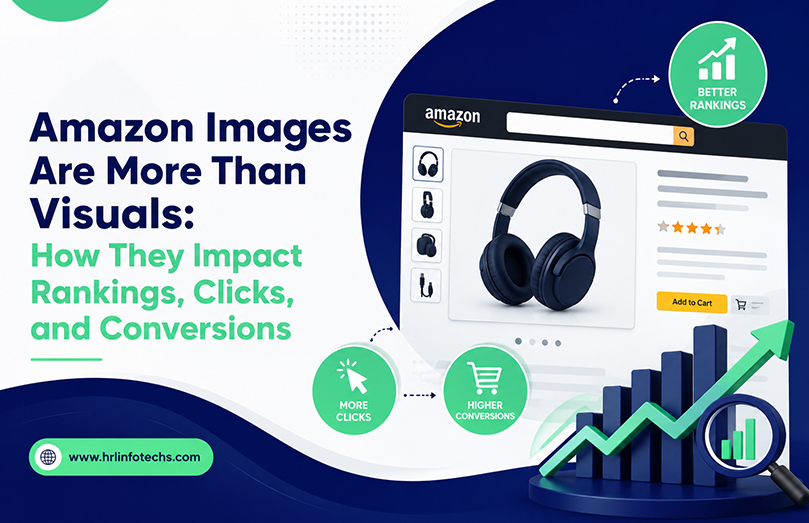
Amazon Images Are More Than Visuals: How They Impact Rankings, Clicks, and Conversions


Scroll through Amazon on your phone for 30 seconds and count how many product titles you have read in full. Realistically, not a single one of them probably caught your eye. What determined whether you continued scrolling or stopped to read more? The image beside the title, which most sellers continue to overlook, despite being their most important tool.

That’s the gap worth talking about, because it touches nearly every part of how a listing actually performs, not just how it looks.

Why Images Are Doing More Work Than Sellers Realise

Most sellers think of Amazon listing optimisation as a title-and-bullet-points exercise, with images treated as decoration added at the end once the copy is finalised.

That’s backwards. On a results page full of dozens of similar products, the image is the first and sometimes only information the shopper takes in before clicking through to your product detail page. Get it wrong, and no one will see your great title at all.

The Click Decision Happens Before Anyone Reads Anything

Real Amazon product image optimisation starts with understanding a simple, slightly uncomfortable truth: shoppers judge a product visually before they judge it rationally.

A messy main image, poorly lit product, or oddly framed shot in an otherwise perfect ad could cause a visitor to pause for half a second – just long enough to go back and pick a competitor instead. Your main image is all it takes to sell someone on your service before they’ve read a single word of your ad.

Why This Connects Directly to Search Visibility

Here’s the part most sellers genuinely don’t expect: images influence Amazon SEO services work more than people assume, because click-through rate is a ranking signal Amazon’s algorithm actively tracks.

A snippet that is clicked on more often than not will steadily improve its position in results, as it’s rewarded by higher levels of traffic. In other words, a well-performing snippet will continue doing well for months to come as a result of being clicked on more often than not.

Getting the Technical Side Right

Good Amazon image optimisation isn’t just about creative quality; it’s also about meeting Amazon’s actual technical requirements properly, something a surprising number of listings still get wrong.

That means using the full 85% of the frame Amazon recommends, keeping the background genuinely pure white on the main image, uploading at a resolution high enough to support zoom, and using every available image slot instead of stopping at three or four of the seven or nine available slots. Each unused slot is a missed opportunity to answer a question a shopper hasn’t asked yet.

Why Images Are the Real Conversion Lever

Traffic getting a shopper to your page is only half the job. The other half genuinely the harder half is convincing them to actually buy once they’ve arrived, and this is where Amazon conversion optimisation lives or dies.

Infographic-style images explaining size, material, or use case answer objections before a shopper has to type a question into the Q&A section. Lifestyle images showing the product genuinely in use build a kind of confidence that specification text alone simply can’t replicate. A shopper who can picture themselves actually using the product converts at a meaningfully higher rate than one left to imagine it purely from a bullet list.

Why This Needs Ongoing Attention, Not a One-Time Fix

A lot of sellers treat product imagery as something you do once at launch and never revisit, which is exactly where professional Amazon listing management services genuinely earn their value.

Seasonal changes, experimenting with alternate lifestyles, refreshing your image, studying the results to determine which image drives traffic and which one is a dud- they all add up to work that most solo sellers can not afford to do regularly.

The Bigger Picture Beyond a Single Listing

Zoom out, and this is really part of a much broader conversation about Amazon marketplace optimisation because images don’t function in isolation from everything else happening on your account.

A brand that leverages strong imagery across its catalogue – not just for the bestseller, but for everything else – can build an image appeal that its buyers will recognise across their purchases. This creates a powerful competitive advantage in a crowded product category, where multiple offerings have similar descriptions and target the same search queries.

Why Account Health Quietly Affects This Too

Here’s a connection most sellers don’t immediately see: solid Amazon seller account management directly supports how well your imagery actually gets to perform in the first place.

Hidden listings, policy issues, or faulty catalogue entries may bury even the most compelling images deep within the search maze, rendering them invisible to potential buyers despite your best efforts. After all, if there is no healthy and compliant account to showcase them on in the first place, all that creative energy goes to waste.

Why This Extends Beyond Amazon Specifically

This isn’t purely an Amazon-specific conversation either. The same visual principles apply directly to broader ecommerce marketplace optimisation across Flipkart, Myntra, and other platforms where Indian sellers increasingly operate simultaneously.

A brand that’s built a genuinely strong visual system for one marketplace can adapt that same underlying strategy across every other platform it sells on rather than starting the entire creative process over from scratch for each channel.

Conclusion

Product images on Amazon were never just visuals sitting next to a title. They’re doing real, measurable work across click-through rate, search ranking, conversion rate, and long-term brand perception, often more work than the copy surrounding them.

Sellers still treating imagery as a final, cosmetic step are consistently leaving performance on the table that better-optimised competitors are already capturing.

At HRL Infotechs, we help Indian sellers treat product imagery as the genuine strategic asset it actually is, building visuals that don’t just look good, but measurably move rankings, clicks, and conversions together, across every marketplace where a brand actually sells.
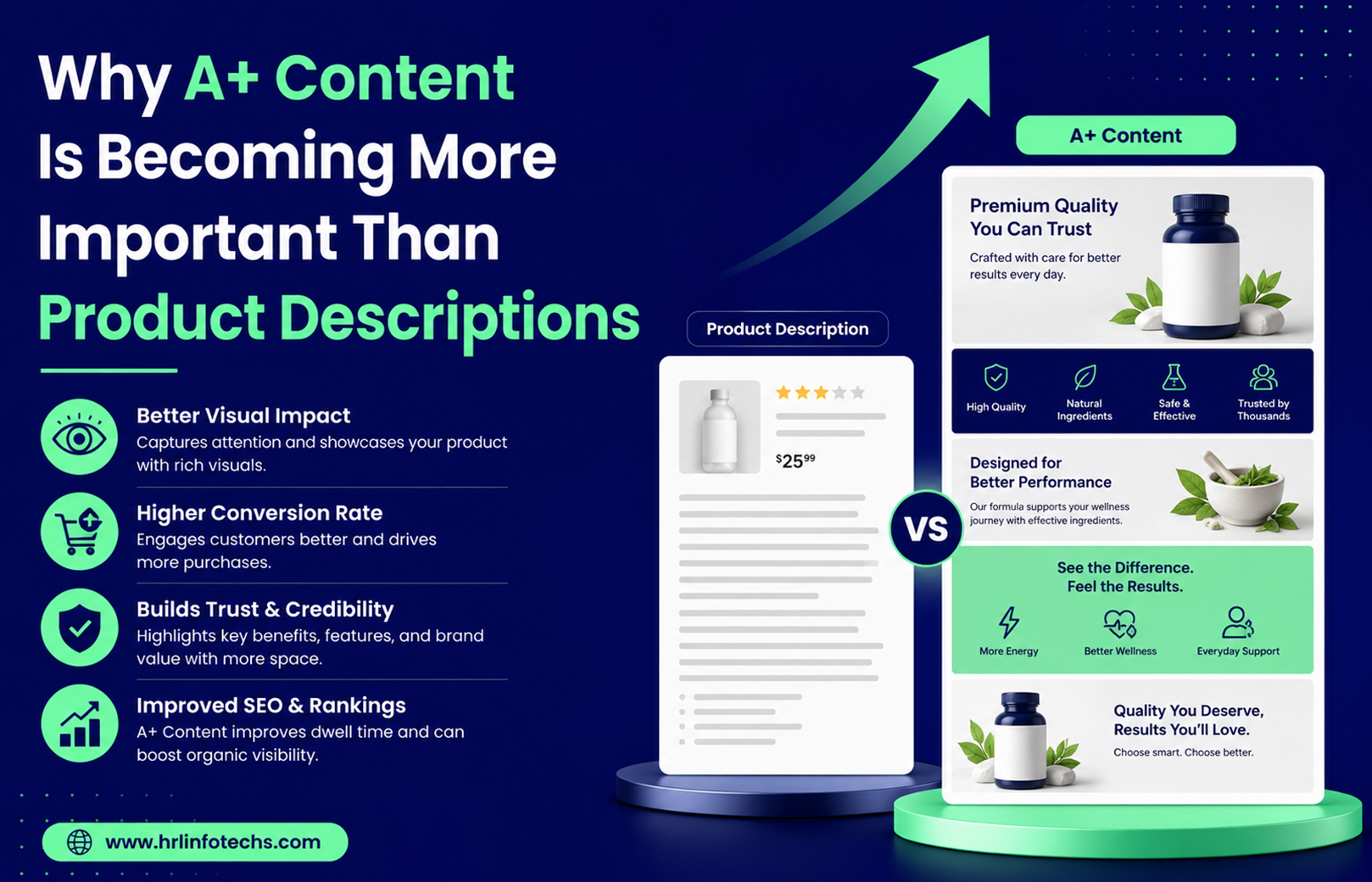

Why A+ Content Is Becoming More Important Than Product Descriptions


An e-commerce brand selling on Amazon India noticed something unusual in its conversion data in late 2024. Two products with nearly identical manufacturing costs, similar pricing, and comparable review counts were converting at dramatically different rates. One converted at 6.8%. The other sat at a mere 2.1%.

The difference was not the product. It was the listing. The higher-converting product had Amazon A+ Content Design lifestyle imagery showing the product in use, a comparison module explaining why the formula worked differently from alternatives, a brand story section establishing the founders’ credibility, and a clear benefit breakdown structured for scanning rather than reading.

The lower-converting product had a 200-word description listing ingredients and a standard five-bullet feature rundown.

Same product category. Same price point. Same platform. Three times the conversion rate. The gap between them was entirely in how the product was communicated to a buyer who had already decided to consider it.

The Changing Behaviour of Amazon Shoppers

Amazon customers in 2026 do not read listings. They evaluate them.

The average time spent on a product page before a purchase decision is made has dropped consistently year on year as mobile shopping has become the dominant format. A buyer arrives at a listing having already seen thumbnail images in search results. They have already formed a visual first impression. What the listing needs to do is confirm that impression and resolve any remaining hesitation in seconds, not paragraphs.

Amazon A+ Content exists precisely because text alone cannot do this job efficiently. A 200-word description requires a buyer to read and construct a mental model of the product. A well-designed A+ module communicates the same information visually in five seconds. For a buyer comparing three similar products simultaneously, that difference in cognitive load is the difference between staying on the page and clicking back.

Why Product Descriptions Alone Are No Longer Enough

Amazon product descriptions were built for a search environment where buyers arrived with a specific product in mind and needed detailed specification information to confirm their choice. That buying journey still exists, but it is no longer the dominant one.

Most Amazon purchases today begin with a category search, produce a results page with twenty similar options, and require a buyer to differentiate between products that appear nearly identical at thumbnail scale. The buyer who arrives on your listing is not certain they want your product. They are deciding whether your product deserves the thirty seconds of evaluation they are about to give it.

A text description that leads with dimensions and materials loses that decision. A+ Content that leads with the specific problem the product solves, visually, wins it.

Building Stronger Brand Experiences

Amazon brand content is not a design preference. It is a trust mechanism.

Indian buyers on Amazon have become significantly more sophisticated about evaluating brand credibility before purchasing. A listing that looks professionally designed signals a brand that takes its products seriously. A listing that relies on a plain text description against a white background signals the opposite, regardless of the actual product quality behind it.

The brand story, the founder’s credibility, the manufacturing process, and the quality commitment none of these things can be communicated effectively in a bullet point. A+ Content modules give brands the space to communicate who they are and why that matters to the buyer evaluating them, which is the conversion decision that price and specification comparisons alone never resolve.

Improving Amazon Customer Experience

Amazon customer experience on the listing page is determined by how quickly and confidently a buyer can answer three questions: does this product do what I need, is it better than the alternatives, and can I trust the brand selling it?

Standard listings answer the first question adequately through titles and bullets. They rarely answer the second or third effectively. A+ Content addresses all three simultaneously, benefiting communication through lifestyle imagery, competitive differentiation through comparison modules, and trust building through brand story and quality signals.

The e-commerce brand’s higher-converting listing answered all three questions before the buyer reached the reviews section. The lower-converting listing answered only the first and left the buyer to resolve the remaining uncertainty through competitor comparisons, which they often did.

How A+ Content Supports Conversion Rates

Amazon conversion optimisation through A+ Content works through a specific mechanism that is worth understanding clearly.

Conversion rate depends on visitors who buy versus those who leave due to hesitation, product uncertainty, or lack of trust. A+ Content directly addresses these friction points, using impactful visual communication to resolve consumer hesitation faster than text alone.

That extra detail on Amazon pages? It often leads to more buys – between 3% and 10%, based on what’s being sold and how well it’s shown. If a product gets a thousand views each month, just a 5% bump could turn into fifty new sales without spending another dollar on ads.

Enhanced Brand Content and Brand Building

Enhanced Brand Content, the term Amazon used before rebranding to A+ Content, was built around a simple insight: customers buy from brands they recognise and trust more readily than from brands they are encountering for the first time.

A+ modules sharing brand values, standards, or founder stories reduce the psychological distance to purchase, creating a compounding trust loop. Shoppers who connect with a strong A+ presence remember the brand, leading to repeat purchases and higher catalogue exploration. This is why pairing Amazon brand Storefront investment with A+ Content drives conversion improvements across your entire product ecosystem, not just individual listings.

The Role of Amazon Listing Optimisation

Amazon listing optimization is not a single lever. It is a system where each element supports the others.

Keyword-optimised titles and bullets drive traffic by improving search visibility. High-quality primary images drive click-through by winning the thumbnail evaluation. A+ Content drives conversion by resolving purchase hesitation once a buyer arrives. Amazon sales optimisation requires all three layers working together; traffic without conversion infrastructure wastes advertising spend, and conversion infrastructure without traffic visibility produces nothing.

One wrong move here kills visibility. Skip strong keywords, get lost in search. Rely only on fancy visuals, and watch clicks vanish without sales. Winning pages on Amazon India nail both. They guide shoppers step by step. Every phase gets what it needs.

Why A+ Content Works Harder When Your Entire Account Is Managed Strategically

Amazon Marketing Services amplifies A+ Content by converting ad traffic more efficiently. Driving a Sponsored Products campaign to an optimised listing yields measurably higher conversions than targeting a text-only page. Brands building this conversion infrastructure first make every rupee of paid spend highly productive, while those who advertise before optimising simply pay for traffic they cannot convert.

The fastest-growing brands on Amazon India don’t just optimise single listings; they treat every element as an interconnected system. Even elite A+ Content loses its conversion edge if stock runs out or ads target the wrong buyers. This is why Amazon Account Management makes the structural difference: it ensures your content, advertising campaigns, inventory logistics, and performance metrics work in perfect sync.

Why Indian Brands Should Prioritise A+ Content Now

Indian ecommerce is at an inflexion point. Category competition on Amazon India has intensified significantly since 2022 as both domestic brands and international sellers have professionalised their marketplace presence.

The listing quality gap that once existed between premium international brands and domestic Indian sellers has largely closed at the product and pricing level. What has not closed equally quickly is the A+ Content gap. A significant proportion of Indian sellers are still relying on text-first listings in categories where buyers are making visual-first decisions.

Amazon brand content investment now, before category competitors close the gap, builds a conversion rate advantage that is expensive to replicate quickly. A brand whose listing converts at 7% while competitors convert at 3% can sustain a lower advertising bid and still achieve the same sales velocity, which is the margin and growth advantage that compounds most powerfully over time.

Conclusion

The e-commerce brand that discovered the conversion gap between its two listings fixed it in six weeks. The lower-converting product received full Amazon A+ Content Design lifestyle modules, comparison charts, brand story section, and benefit-led visual hierarchy. Its conversion rate moved from 2.1% to 6.4% within thirty days of the update going live. No price change. No advertising increase. No review campaign.

At HRL Infotechs, we help Indian brands build the A+ Content, listing optimisation, and Amazon customer experience infrastructure that turns qualified traffic into consistent sales. The brands growing most efficiently on Amazon right now are not the ones spending the most on advertising. They are the ones converting most effectively once buyers arrive.