A new Amazon product goes live. The listing looks polished, the inventory is ready, and the seller is eager to start advertising. Within a few days, the PPC dashboard shows clicks, but organic visibility is barely moving. The seller responds by increasing bids. That usually creates a more expensive problem, not a better launch.
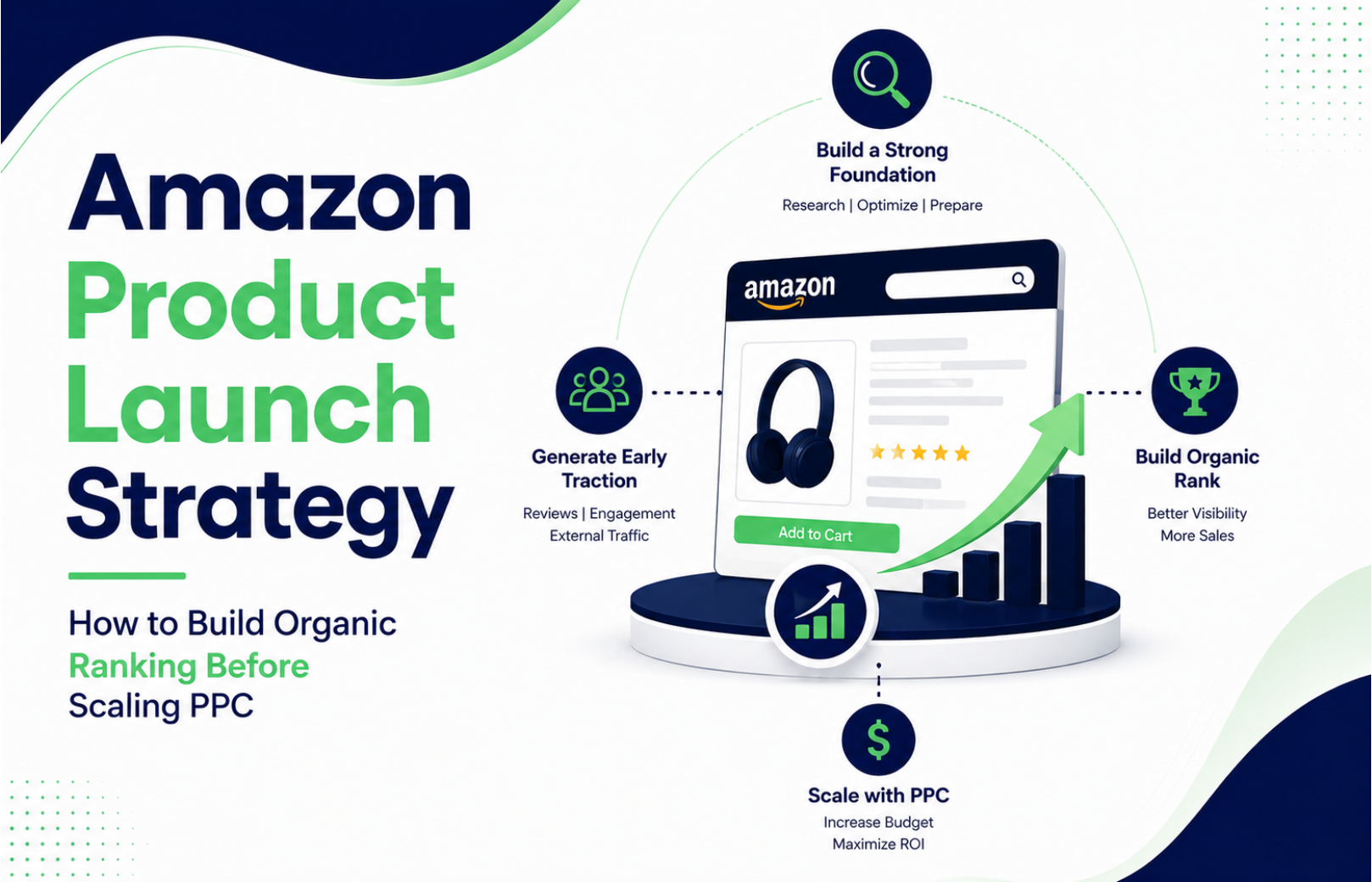
A stronger Amazon product launch strategy starts before serious ad scaling. First, make the product detail page relevant to the searches you want to win, make the offer competitive enough to convert, and establish a clean keyword and measurement baseline. Then use PPC to accelerate discovery, collect useful search-term data, and build sales momentum. The goal isn’t to avoid Amazon PPC. It’s to make every paid click work harder while your organic ranking develops.
What Should You Do Before Launching Amazon PPC?
Before increasing Amazon PPC spend, make sure the product listing can convert the traffic you’re about to buy. Your title, images, bullet points, product description, pricing, inventory, relevant search terms, and overall offer should be ready before you attempt to scale advertising.
Amazon itself recommends auditing product detail pages before launching Sponsored Products and using relevant search terms that reflect how shoppers search for the product.
For a new product, your first priority should be relevance and conversion readiness, not ranking for every possible keyword.
Build the Amazon Listing Around Buyer Search Intent
Amazon product listing optimization means structuring the product detail page so shoppers can discover the product and understand why it fits their needs. Amazon describes the product detail page as the place where customers see product information such as the name, images, description, and offer details.
Start with three keyword groups:
- Primary category keywords
- High-intent long-tail keywords
- Product-specific attributes and use cases
Don’t stuff every keyword into the title. A title that reads unnaturally can reduce shopper confidence even if it contains more search terms.
This is where a proper Amazon SEO launch differs from simply uploading a listing. Your keyword research should determine the search language, while the listing should turn that language into useful product information.
For brands that need this foundation built systematically, HRL Infotechs’ Amazon SEO and Listing Optimization Services cover keyword research, title optimization, bullet points, backend search terms, visual optimization, and ongoing performance analysis.
How Do You Build Organic Ranking Before Scaling PPC?
Build organic ranking by combining strong listing relevance with genuine sales and conversion activity, then use PPC selectively to accelerate visibility for the most commercially important searches. Organic ranking should be treated as an outcome of relevance, shopper response, and sustained performance rather than something that can be guaranteed through advertising alone.
This is one of the most important judgement calls in a new Amazon launch: don’t try to rank for your broadest keyword first.
If your new product is a premium stainless-steel lunch box, for example, competing immediately for an extremely broad term such as “lunch box” may consume substantial budget while attracting shoppers with very different requirements.
A more sensible launch sequence might start with specific searches such as:
- stainless steel lunch box for office
- leakproof lunch box for adults
- insulated stainless steel lunch container
- lunch box for working professionals
Once you identify which terms generate qualified clicks and conversions, you can gradually expand your targeting.
HRL Infotechs has previously covered this principle in its guide to Amazon keyword research and ranking strategy, which explains why keyword selection should be based on buyer intent rather than search volume alone.
When Should You Start Amazon PPC for a New Product?
You should start Amazon PPC once the product is buyable, the detail page is properly optimized, inventory is available, and the offer is capable of converting. The mistake is not starting PPC early. The mistake is scaling PPC aggressively before you know whether the listing can convert paid traffic.
Amazon Sponsored Products are CPC ads that promote individual product listings and can target keywords or products. Amazon states that advertisers control bids and budgets and can use campaign reporting to optimize performance.
That makes PPC useful during a launch, but your first campaigns should be treated as controlled discovery.
Start with:
- High-intent exact keywords
- Relevant phrase and discovery targeting
- Carefully selected product targets
- Brand terms where appropriate
- Controlled budgets
- Search-term analysis
Don’t interpret the first few days of impressions as proof that a campaign is working. Look for qualified traffic, clicks, conversions, search-term relevance, and movement in the product’s organic visibility.
How Should You Structure Amazon PPC During a Product Launch?
A new-product Amazon PPC launch should separate discovery from proven demand. Keep high-intent keywords, exploratory targeting, and product targeting sufficiently organized that you can identify what is actually producing useful traffic and sales.
Sponsored Products can use keyword or product targeting, and Amazon recommends monitoring campaign performance and adjusting budgets and keywords as campaigns develop.
A practical launch structure can include:
Exact campaign: Your strongest high-intent keywords.
Phrase campaign: Closely related variations and search discovery.
Auto campaign: Controlled discovery of search terms you may not have identified manually.
Product targeting: Relevant competitor or complementary product detail pages.
The important part isn’t creating the maximum number of campaigns. It’s maintaining enough separation to make decisions.
We’ve seen sellers create dozens of campaigns for a single new ASIN, then struggle to understand where the money is going. A smaller, cleaner structure often gives you better visibility into what deserves more budget.
Which Metrics Should You Track During the First 30 Days?
During the first 30 days, track impressions, clicks, CTR, conversion rate, advertising cost of sales, sales, search-term performance, and organic keyword movement. No single metric should determine whether you scale or reduce spend.
A useful launch review asks four questions:
- Are relevant shoppers seeing the product?
- Are they clicking?
- Are they converting after clicking?
- Are important keywords showing organic movement?
Amazon’s advertising system provides campaign reporting that lets advertisers evaluate performance and adjust targeting, bids, and budgets.
Don’t chase ACoS in isolation. A new product can have a higher initial ACoS while you’re gathering data and establishing demand. On the other hand, a campaign with excellent ACoS but almost no sales volume may not be contributing meaningfully to growth.
The better metric depends on your launch objective.
Should You Increase PPC Budget When Organic Ranking Improves?
Increase PPC when the data shows that additional spend can generate profitable or strategically valuable sales without overwhelming your margins. Improving organic ranking is a positive signal, but it isn’t automatically a reason to double the advertising budget.
This is where Amazon launch strategy becomes different from a simple PPC strategy.
Suppose your product begins ranking organically for several long-tail terms after four weeks. You may decide to maintain paid coverage on those valuable terms while redirecting incremental budget toward terms where organic visibility is still weak.
Amazon’s current new-product advertising guidance specifically recommends using advertising to promote new products and adjusting budgets and keywords as the product moves through its lifecycle.
The objective is to make paid and organic visibility reinforce each other, not to make PPC permanently responsible for every sale.
How Does Amazon Account Management Affect a New Product Launch?
Amazon account management keeps the operational side of a launch from undermining the marketing strategy. Inventory, account health, listing issues, pricing, catalog changes, advertising performance, and ongoing marketplace tasks all need attention while the product is gaining traction.
A ranking strategy cannot compensate for operational problems. If your product goes out of stock, the listing develops a compliance issue, or important catalog information is incorrect, your advertising plan can quickly become irrelevant.
This is why Amazon account management becomes particularly useful when you’re launching multiple ASINs or managing Amazon alongside other marketplaces. HRL Infotechs provides Amazon Account Management Services that cover ongoing marketplace operations and performance monitoring as part of its broader ecommerce management approach.
What Should You Do in the First 30 Days of an Amazon Product Launch?
Use the first 30 days to establish relevance, gather search data, identify conversion problems, and progressively shift budget toward proven opportunities. Don’t treat the launch as one fixed campaign that runs unchanged for a month.
A practical sequence is:
Days 1–7:
Check listing indexing, impressions, CTR, search-term relevance, price competitiveness, inventory, and initial conversion signals.
Days 8–14:
Review search-term data, identify irrelevant traffic, add negative targeting where appropriate, and refine bids.
Days 15–21:
Separate proven converting terms from discovery terms and evaluate organic keyword movement.
Days 22–30:
Increase investment in proven opportunities, reduce inefficient targeting, and identify the next set of keywords worth testing.
HRL Infotechs has also examined why Amazon PPC campaigns waste budget during the first 30 days, including problems such as weak campaign structures, broad targeting, and poorly controlled bids.
When Should You Scale Amazon Advertising?
Scale Amazon advertising after you have evidence that the listing, offer, targeting, and conversion process can support additional traffic. Scaling should follow validated performance, not simply the passage of time.
Amazon provides several advertising options beyond Sponsored Products, including Sponsored Brands and other formats. Its new-product advertising guidance recommends combining targeting approaches and using different campaign types according to launch objectives.
For most sellers, however, the first scaling decision shouldn’t be “Which new ad format should I launch?”
It should be:
Which search terms, products, audiences, and placements have already demonstrated commercial value?
Then increase investment there.
If managing bids, search terms, campaign structures, listing optimization, and performance reporting is taking more time than your team can realistically give it, Amazon Advertising Services from HRL Infotechs can fit naturally into the next stage of the workflow.
What Is the Right Amazon Product Launch Strategy?
The right Amazon product launch strategy is a staged process: optimize the listing, establish keyword relevance, make the offer conversion-ready, launch controlled PPC, analyze search-term and conversion data, improve the listing, and only then scale the campaigns that demonstrate value.
You don’t need to choose between Amazon SEO and Amazon PPC. You need to sequence them correctly.
PPC can create the initial traffic and provide valuable performance data. SEO and listing optimization create the foundation for sustainable organic discovery. Account management keeps operational issues from disrupting the process.
For a new product, that combination is usually more sensible than simply increasing the daily ad budget and hoping Amazon ranking follows.
If you’re preparing a new ASIN and aren’t sure whether your listing, keyword strategy, or PPC structure is ready for launch, HRL Infotechs can review the gaps and help you build the launch sequence before you commit more advertising budget.
Frequently Asked Questions
How long does it take for a new Amazon product to rank organically?
There is no fixed Amazon ranking timeline for a new product. Initial indexing and ranking movement can happen relatively quickly, but meaningful organic visibility depends on relevance, competition, conversion performance, sales activity, and other marketplace factors. Treat the first several weeks as a measurement period rather than expecting a guaranteed ranking date.
Should I run Amazon PPC immediately after launching a new product?
You can start PPC after the product is buyable and the listing is properly prepared. Starting advertising early can help generate visibility and collect useful search-term data. However, aggressive scaling before validating the listing’s conversion performance can waste budget. Start with controlled targeting, measure the results, and scale based on evidence.
Can Amazon PPC improve organic ranking?
PPC and organic ranking are separate mechanisms, so advertising should not be treated as a guaranteed way to buy an organic position. PPC can generate product detail page traffic and sales, while successful customer interactions may contribute to the broader performance picture. The practical goal is to use PPC to support product discovery while building sustainable organic demand.
What keywords should I target for a new Amazon product launch?
Start with relevant, high-intent keywords that closely describe the product, its features, use case, and buyer need. Include specific long-tail terms before aggressively targeting broad, highly competitive keywords. Search-term performance from early campaigns can then help you identify which queries deserve greater attention in your Amazon SEO launch.
How much should I spend on Amazon PPC for a new product?
There is no universal launch budget because CPCs, category competition, margins, conversion rates, and sales targets differ significantly. Set a test budget that your business can afford to learn from, then evaluate spend against clicks, conversions, sales, ACoS, and organic movement. Increase budget only when the underlying economics support it.
Should I optimize my Amazon listing before starting PPC?
Yes. Listing optimization should happen before serious PPC scaling because your ads send shoppers to the product detail page. If the title, images, bullets, pricing, product information, or overall offer are weak, additional traffic may simply expose those problems faster. Amazon also recommends auditing product detail pages before launching Sponsored Products.