Amazon ACoS vs TACoS: Which Metric Actually Matters?


Ask ten Amazon sellers about their ad performance, and at least nine will be able to quote an ACoS figure without hesitation – 18%, 22% or perhaps a particularly impressive 12% for their best-performing campaign. Ask the same sellers about their TACoS, however, and you’ll be met with blank looks. This information asymmetry is costing Indian sellers millions of rupees in lost profits, as they optimise based on an incomplete view of their advertising costs.

Both metrics matter. But they answer completely different questions, and confusing them is one of the most common reasons Amazon PPC management decisions end up working against a seller’s actual profitability instead of for it.

What ACoS Actually Tells You

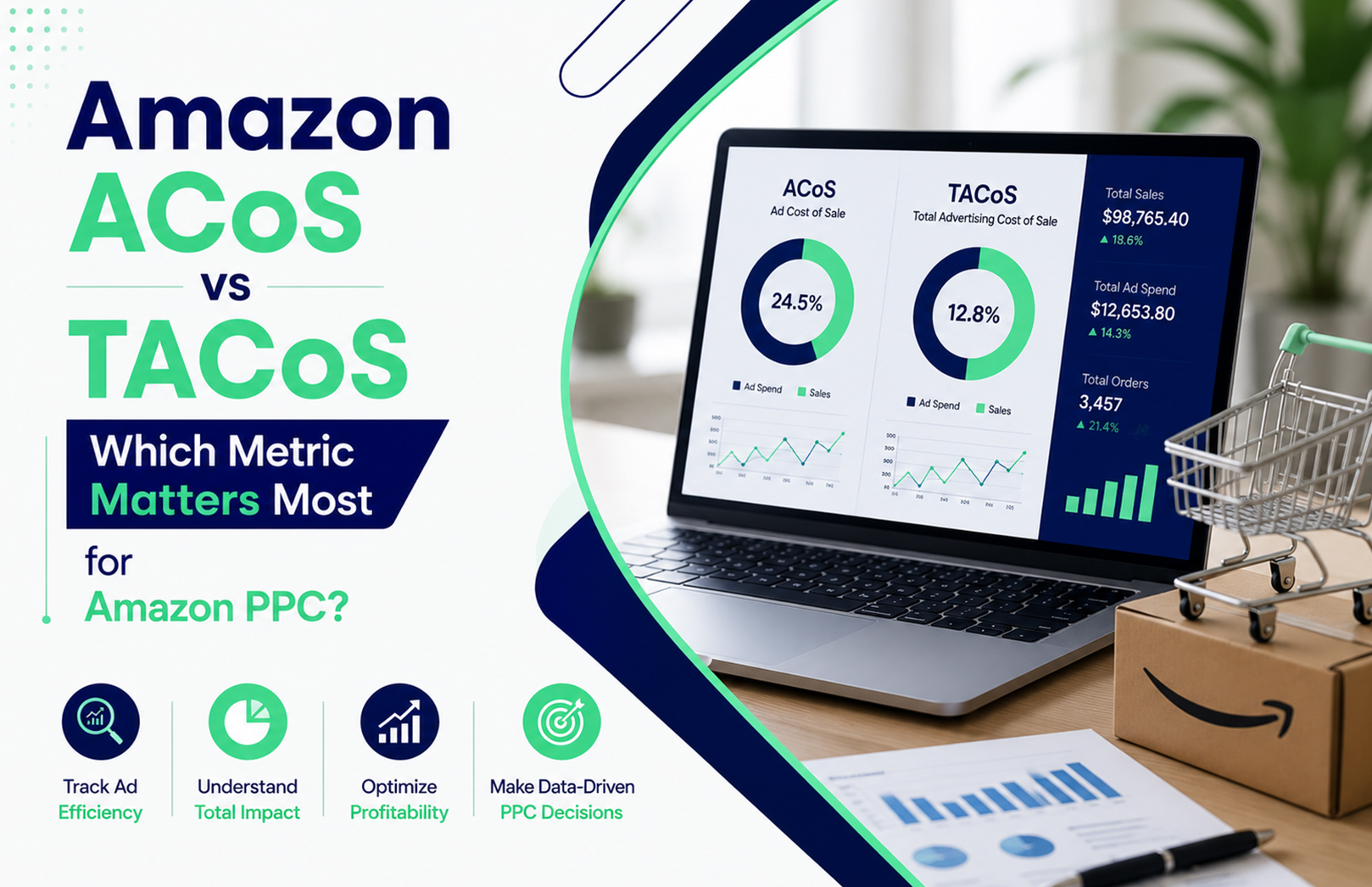
Advertising Cost of Sales (ACoS) is a metric that reflects the ratio of advertising spend to the revenue generated by those advertisements. For example, if you spend 10,000 INR on Sponsored Products ads and get 50,000 INR in sales, your ACoS will be 20%.

This figure is useful at the campaign level and really helps understand how a given campaign, ad group, or keyword is performing in terms of profitability. But sellers sometimes make a big mistake applying ACoS as the ultimate indicator of business performance, which it actually was never meant to be.

What TACoS Actually Tells You

Total Advertising Cost of Sales flips the denominator. Instead of comparing ad spend to ad-attributed sales alone, TACoS compares ad spend to your total sales, organic and paid combined. Same ₹10,000 ad spend, but now measured against your entire revenue for that period, including sales that came from organic search, repeat customers, or external traffic.

This is the metric that determines if your advertising is driving actual business growth for you – for the money you’re spending on ads. A campaign might demonstrate a healthy ACoS while failing to provide tangible value if your overall sales are stagnant – in other words, if your ad spend isn’t fueling real growth, but rather simply redirecting would-be organic sales to your ads, making effective marketplace performance optimisation critical to true long-term profitability. 

Why This Distinction Actually Matters for Amazon ACoS vs TACoS

Here’s where the confusion causes real damage. A seller chasing a lower ACoS will often decrease spend on marketing campaigns as soon as the metric begins to rise, even if a particular channel was responsible for bringing new customers to the brand, which then begin to contribute organically to the overall TACoS in the long run.

Amazon ACoS vs TACoS isn’t really a competition between two metrics; it’s a question of timeframe and purpose. ACoS answers “was this specific ad spend efficient?” TACoS answers “is my advertising, taken as a whole, actually reducing my dependency on paid traffic as my organic presence strengthens?” Sellers optimising for ACoS alone frequently end up trapped paying for the same sales indefinitely because they never let campaigns build the organic momentum that would eventually allow them to spend less.

Where Amazon Sponsored Products Fits Into Both Numbers

Amazon Sponsored Products campaigns are usually the biggest lever pulling both metrics in either direction, since they typically represent the largest share of a seller’s ad spend. A properly executed Sponsored Products campaign, which targets the right set of keywords, should be able to generate a healthy ACoS, on its own, while simultaneously boosting organic ranks (thereby driving sales via non-paid channels) due to the inherent velocity of sales that Sponsored Products campaigns are capable of generating, thus further lowering your ACoS months down the line, despite the same level of ad spend.

This is why judging a Sponsored Products campaign purely on its 30-day ACoS misses the longer compounding effect it may be having on organic visibility, an effect that only shows up when you’re actually tracking TACoS alongside it.

Why Advertising Optimisation Needs Both Numbers, Not One

Genuine Amazon advertising optimisation requires holding both metrics in view simultaneously rather than picking a favourite. ACoS tells you where to trim inefficient spend at the keyword and campaign level. TACoS tells you whether your overall advertising strategy is building sustainable, less ad-dependent growth or simply maintaining an expensive treadmill.

Sellers who fixate on ACoS optimise themselves into a smaller and smaller set of campaigns that shrink towards an ever-lower ACoS, potentially sacrificing long-term organic growth by reducing spend that would build future volume. Sellers who fixate on TACoS miss the nuanced ability to identify truly wasteful spend at the keyword level.

The Role of PPC Optimisation in Balancing Both Metrics

Effective Amazon PPC optimisation isn’t about hitting an arbitrary ACoS target in isolation; it’s about understanding which campaigns are worth a temporarily higher ACoS because of what they’re doing for TACoS, and which campaigns show a low ACoS but are contributing nothing to genuine business growth.

A product launch campaign, for instance, often runs a deliberately higher ACoS in its first sixty days, which is expected and often correct, provided TACoS shows organic sales beginning to climb as a result. Cutting that campaign early because ACoS looks uncomfortable can quietly kill the exact momentum that campaign was meant to build.

Why Listing Quality Determines How Efficiently Either Metric Improves

No advertising strategy compensates for a weak product page. Strong Amazon products listing optimisation clear titles, complete bullet points, quality imagery, solid reviews directly improves conversion rate, and conversion rate improvement is one of the few levers that genuinely improves both ACoS and TACoS simultaneously, since better-converting traffic requires less spend to produce the same sales.

Sellers chasing metric improvements purely through bid adjustments while ignoring listing quality are optimising the wrong end of the funnel.

Why This Requires Ongoing Account-Level Attention

Getting this balance right isn’t a one-time calculation; it requires consistent Amazon seller account management that tracks both metrics together over rolling periods, not isolated snapshots. A single week’s ACoS spike means little in isolation. A sustained TACoS trend over several months tells a genuinely useful story about whether the business is becoming healthier or more dependent on ad spend.

This is exactly the kind of performance optimisation that separates sellers scaling sustainably from sellers stuck spending more each year just to maintain the same sales level.

Conclusion

ACoS and TACoS were never meant to compete for your attention; they’re meant to work together, each answering a question the other one can’t. Chase ACoS alone and you risk starving the campaigns quietly building your organic future. Chase TACoS alone and you lose the precision needed to catch real waste before it adds up.

At HRL Infotechs, this dual-metric approach is exactly what shapes how we build ecommerce growth services for Amazon sellers because sustainable growth on the platform has never been about optimising one number in isolation. It’s about understanding what each one is actually telling you, and building a strategy around both.
Why Smart Indian Brands Are Choosing Experts for Amazon Ads Management


Indian ecommerce has changed dramatically in the last few years, and Amazon is now the primary growth engine for thousands of brands. Yet many sellers still treat Amazon Ads like a side task, instead of a specialist function that can decide whether a product takes off or disappears on page three. That is exactly why smart Indian brands are shifting to professional Amazon Ads management services in India.

When campaigns are handled by experts who understand the marketplace, the algorithm, and the Indian shopper, ad spend turns into predictable sales instead of random clicks. By aligning Amazon PPC, listing optimization, and account strategy, brands are discovering that expert-led advertising is not a cost but a scalable growth lever.

Why Indian Brands Need Dedicated Amazon Ads Experts

Most growing sellers reach a point where basic manual campaigns and guesswork stop working. Competition increases, cost per click rises, and suddenly the same budget delivers fewer orders. This is usually the moment when brands realize they need specialized Amazon Ads management services in India to stay visible and profitable.

Dedicated experts bring structured processes, data-backed decisions, and marketplace experience that in-house generalists rarely have. They understand how to balance visibility and profitability, when to scale, when to pause, and how to protect brand share from aggressive competitors targeting your key search terms.

From Trial-and-Error To Data-Driven PPC Decisions

Many Indian sellers start with trial-and-error campaigns, bidding on broad keywords and hoping for conversions. This approach might work briefly, but it usually leads to wasted spend and inconsistent results. Amazon Ads management services in India replace guesswork with systematic keyword research, segmentation, and continuous optimization.

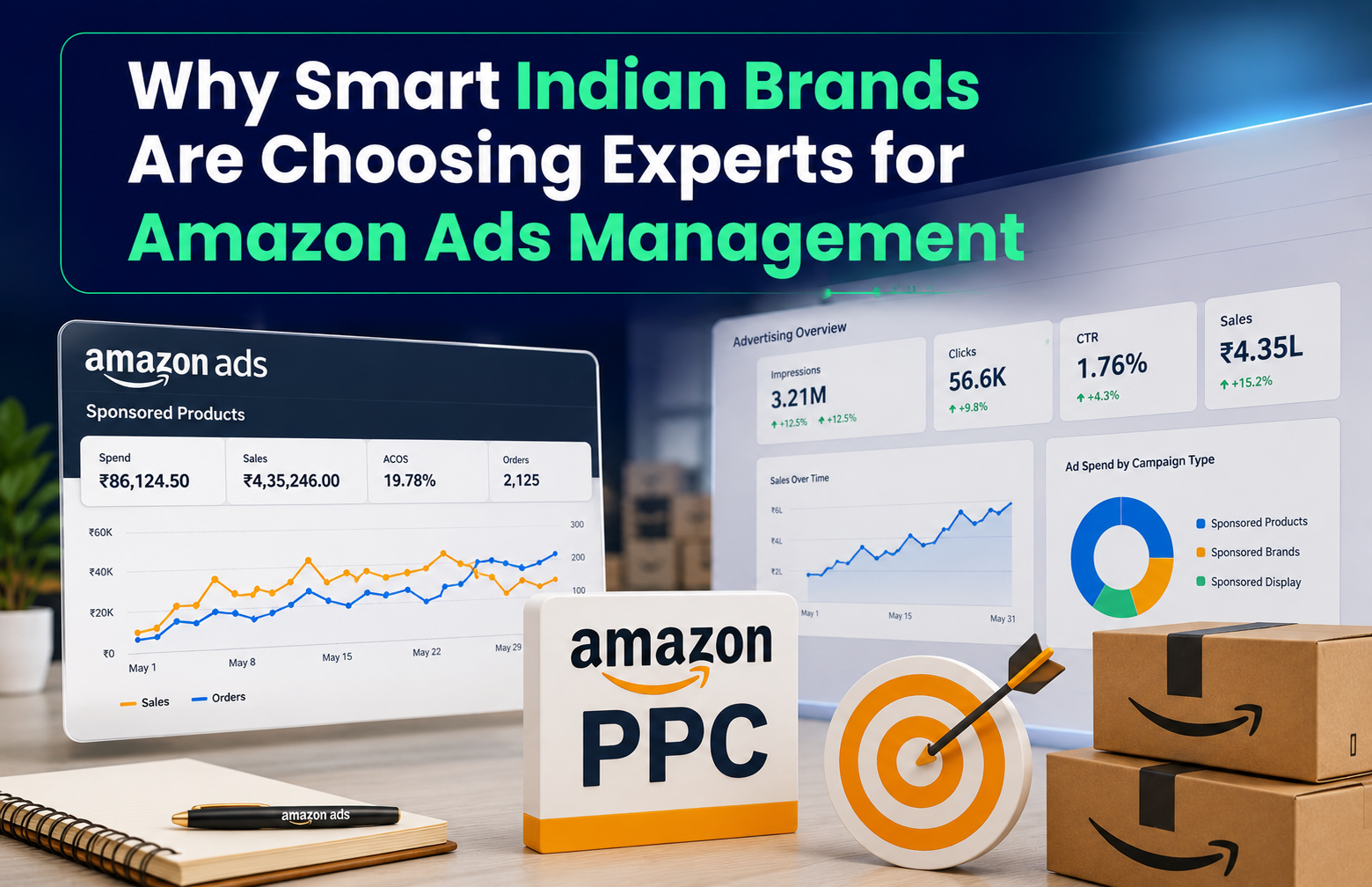
Experts monitor search term reports, adjust bids by placement, and refine match types to capture high-intent traffic. They also track metrics like ACoS, TACoS, and conversion rate at a granular level, making sure every rupee invested in ads has a clear path to measurable revenue and long-term ranking gains.

Aligning Ads Strategy With Indian Shopper Behaviour

Indian buyers respond differently to pricing, discounts, and seasonality compared to global markets. Effective Amazon PPC management services recognize these nuances and build campaigns around local buying patterns, regional events, and category-specific peaks such as festive seasons or exam periods.

By tailoring ad copy, keyword focus, and budgets to Indian consumer behavior, brands can improve click-through rates and conversion rates simultaneously. This localized approach is a key reason why Indian brands need Amazon Ads experts instead of relying on generic, copy-paste strategies from other marketplaces.

Key Benefits Of Professional Amazon PPC Management Services

Investing in expert Amazon Ads management services in India delivers more than just better campaign performance. It creates a structured growth engine that supports product launches, inventory planning, and long-term brand building on the marketplace.

When campaigns are handled by specialists, brands gain clarity on which products deserve more investment, which keywords drive profitable sales, and how to scale without burning through budgets. This clarity is essential for sustainable Amazon seller growth through PPC advertising.

Improved Return On Ad Spend And Lower Wasted Budget

One of the biggest advantages of expert management is the reduction of wasted ad spend. Professionals use negative keywords, bid optimization, and campaign restructuring to cut out non-performing traffic. As a result, more of the budget goes toward high-intent shoppers who are ready to buy.

Over time, this disciplined approach improves return on ad spend and stabilizes ACoS, even in competitive categories. Brands that previously struggled to justify their ad budgets often find that structured Amazon PPC management services transform advertising from a cost center into a predictable profit driver.

Stronger Organic Rankings Through Strategic PPC

Paid and organic performance on Amazon are closely linked. When campaigns are designed strategically, they not only drive immediate sales but also support long-term organic ranking improvements. This is where the best Amazon advertising agency for Indian sellers focuses on full-funnel impact, not just short-term clicks.

By pushing targeted traffic to well-optimized listings, experts help products climb search results for important keywords. Over time, this combination of paid visibility and organic strength reduces dependency on high daily budgets while still maintaining strong sales velocity.

The Role Of Account Management In Scaling Amazon Brands

Advertising alone cannot fix weak account structures, poor catalog organization, or operational gaps. That is why many brands look for a complete Amazon account management agency in India that can align PPC, listings, inventory, and pricing under one unified strategy.

Comprehensive account management ensures that every campaign leads to a smooth buying experience. From product detail pages to stock availability and review management, each element supports higher conversion rates, making ad traffic more valuable and sustainable.

Integrated Strategy Across Ads, Listings, And Operations

A fragmented approach, where ads, listings, and operations are handled separately, often leads to missed opportunities. An integrated Amazon account management agency in India coordinates all moving parts, ensuring that campaigns are launched only when listings, pricing, and stock levels are ready to support scale.

This integration reduces the risk of running ads on out-of-stock products, poorly written listings, or weak images. It also allows brands to plan promotions, coupons, and deals in sync with PPC pushes, maximizing visibility during critical sales windows.

Why A+ Content And Creative Strategy Matter For PPC Success

Even the best-optimized campaigns will struggle if shoppers land on dull or incomplete product pages. That is where Amazon A+ Content management services become essential. Enhanced content can significantly increase conversion rates, which in turn improves the performance of Amazon Ads management services in India.

High-quality A+ Content gives buyers more confidence through detailed visuals, comparison charts, and storytelling. When combined with strong reviews and competitive pricing, this richer experience helps turn ad clicks into loyal customers instead of one-time buyers.

Boosting Conversion Rates With Enhanced Brand Storytelling

Effective Amazon A+ Content management services focus on more than just design. They highlight product benefits, address common objections, and showcase use cases that resonate with Indian shoppers. This storytelling approach helps differentiate your brand in crowded categories.

Higher conversion rates mean that every click from your Amazon PPC campaigns becomes more valuable. As a result, you can afford to bid more aggressively on important keywords, outcompete rivals, and still maintain healthy profitability across your catalog.

Choosing The Right Amazon Advertising Partner In India

With so many agencies and freelancers offering Amazon Ads management services in India, selecting the right partner can feel overwhelming. However, a few clear criteria can help brands identify which providers are truly equipped to drive growth in the Indian marketplace.

Instead of focusing only on pricing, brands should evaluate experience, transparency, and strategic thinking. The best Amazon advertising agency for Indian sellers will act as a long-term partner, not just a campaign operator, and will be comfortable discussing both opportunities and risks.

What To Look For In An Amazon Ads Management Team

When evaluating potential partners, ask about their approach to keyword research, campaign structure, and reporting. A strong team will explain how they segment branded and non-branded keywords, how they manage bids, and how often they optimize campaigns based on performance data.

It is also important to check whether they offer related services such as Amazon A+ Content management services and broader account management. A partner that understands the full ecosystem is better positioned to deliver consistent Amazon seller growth through PPC advertising.

Conclusion: Turning Amazon Ads Into A Scalable Growth Engine

As competition intensifies on Amazon India, relying on basic campaigns and occasional optimizations is no longer enough. Brands that treat the marketplace strategically, invest in expert Amazon Ads management services in India, and align advertising with content and operations are the ones building durable market share.

For Indian sellers ready to move beyond experimentation and turn Amazon into a reliable growth channel, partnering with a specialist team like HRL Infotechs can be the catalyst that transforms scattered efforts into a structured, scalable, and profitable advertising engine.

Why Most Amazon PPC Campaigns Waste Budget in the First 30 Days


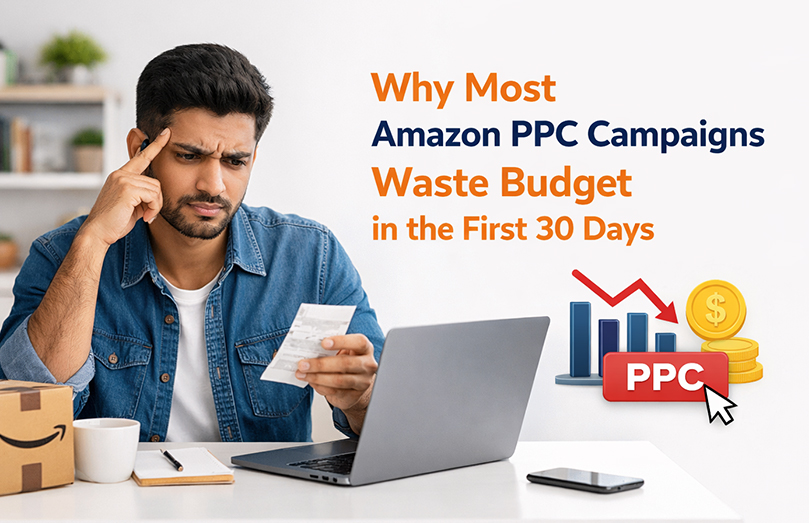
Most Amazon PPC campaigns don’t fail because the product is bad. They fail because the first 30 days are chaotic, unstructured, and driven by guesswork instead of data. Those first weeks decide whether your ads become a profit engine or a constant drain on your margins.

When sellers launch new Amazon PPC campaigns, they often rush to get impressions and clicks without a clear Amazon advertising strategy. As a result, budgets vanish fast, ACoS spikes, and it becomes hard to tell what is actually working. Understanding why this happens—and how to fix it—is the key to building scalable, profitable Amazon PPC campaigns.

Why the First 30 Days of Amazon PPC Campaigns Are So Critical

The first 30 days of Amazon PPC campaigns act as your learning phase. Amazon’s algorithm is testing where to show your ads, which keywords respond, and how shoppers behave. If your structure and targeting are weak, the system learns the wrong signals and keeps spending on unprofitable clicks.

During this period, many sellers confuse visibility with profitability. They chase impressions and broad keywords, thinking more traffic will equal more sales. Instead, they end up paying for irrelevant clicks, low-intent traffic, and shoppers who never convert. That is how most Amazon PPC campaigns quietly waste budget in the first month.

Common Amazon PPC Campaign Mistakes That Burn Budget Fast

Most wasted ad spend comes from a handful of predictable Amazon PPC campaign mistakes. These errors usually show up in keyword targeting, match types, and bidding strategy. Fixing them early can transform your Amazon PPC campaigns from money pits into data-driven growth engines.

When you analyze top-performing sellers, you notice they avoid these traps from day one. Their Amazon ads optimization process is intentional, controlled, and aligned with a clear Amazon advertising strategy. They treat the first 30 days as a structured test, not a random experiment.

Overusing Broad Match and Irrelevant Keywords

One of the biggest Amazon PPC campaign mistakes is relying too heavily on broad match keywords. Broad match can trigger your ads for loosely related searches, which often have low buying intent. This quickly inflates spend while generating few qualified clicks.

Instead, a smart Amazon PPC strategy uses a mix of exact, phrase, and carefully selected broad match. You start with tighter targeting, then expand once you see which terms convert. This approach protects your budget while still allowing Amazon PPC campaigns to discover new opportunities.

Ignoring Negative Keywords in the First 30 Days

Another silent budget killer is failing to add negative keywords early. Without negatives, your ads keep showing for irrelevant or low-intent searches. Over 30 days, this can drain a significant portion of your daily budget without producing sales.

A disciplined Amazon ads optimization process includes weekly search term reviews. You identify non-converting queries and add them as negatives. This simple habit keeps your Amazon PPC campaigns focused on profitable traffic and prevents runaway waste.

Setting Bids and Budgets Without a Clear Strategy

Many sellers launch Amazon PPC campaigns with random bids and flat budgets. They either bid too high to “win” placements or too low to gather meaningful data. Both approaches lead to poor decisions and inconsistent performance in the first 30 days.

A better Amazon advertising strategy starts with target ACoS and realistic CPC benchmarks. You set initial bids based on margin, not emotion, and adjust as data comes in. This disciplined approach allows Amazon PPC campaigns to scale sustainably instead of burning cash.

How to Optimize Amazon PPC Campaigns in the First 30 Days

To stop wasting budget, you need a clear framework for how to optimize Amazon PPC campaigns from day one. The goal is not just to get clicks, but to collect clean, actionable data. That data becomes the foundation of a long-term Amazon PPC strategy.

Think of the first 30 days as a structured testing sprint. You are validating assumptions about keywords, placements, and shopper behavior. With the right Amazon seller account management strategy, every dollar spent teaches you something useful.

Start With a Clean, Intent-Driven Campaign Structure

Effective Amazon PPC campaigns separate keywords by intent, match type, and product relevance. Instead of dumping everything into one auto campaign, you design a structure that mirrors how shoppers search. This makes optimization faster and more precise.

A strong starting structure often includes:

  • One auto campaign for discovery and harvesting new terms
  • Manual campaigns for exact and phrase match high-intent keywords
  • Separate campaigns for branded and non-branded terms
  • Dedicated campaigns for top-converting ASINs

This structure supports better Amazon ads optimization and gives you clear performance signals in the first 30 days.

Use Auto Campaigns Strategically, Not Blindly

Auto campaigns are powerful, but they can also waste budget quickly if left unchecked. Many Amazon PPC campaigns rely only on auto targeting, hoping Amazon will “figure it out.” In reality, auto campaigns need guardrails and ongoing refinement.

A smart Amazon PPC strategy uses auto campaigns as keyword discovery tools. You monitor search term reports, identify converting queries, and move them into manual campaigns. At the same time, you add poor performers as negatives. This turns auto campaigns into controlled testing labs instead of budget black holes.

Aligning Amazon PPC Strategy With Product Pages and Storefront

Even the best-structured Amazon PPC campaigns will struggle if your product detail pages are weak. Shoppers click your ads, land on the listing, and bounce if they do not see trust signals or clear value. That wasted traffic shows up as high spend and low conversion.

To support your Amazon PPC strategy, you need optimized titles, bullet points, images, and A+ content. Strong creative and clear messaging increase conversion rates, which in turn improve your ad efficiency. This is where Amazon storefront design management also becomes a strategic asset.

Improving Storefront and Brand Presentation

A well-designed storefront builds trust and improves the performance of your Amazon PPC campaigns. When shoppers click Sponsored Brands or Sponsored Display ads, they expect a cohesive brand experience. A cluttered or outdated storefront can undermine even the best Amazon advertising strategy.

Investing in Amazon storefront design management helps you showcase collections, highlight bestsellers, and guide shoppers to high-margin products. This not only increases average order value but also makes your Amazon PPC campaigns more profitable over time.

Data-Driven Optimization: Turning 30 Days of Spend Into Long-Term Profit

After 30 days, you should have enough data to make informed decisions about your Amazon PPC campaigns. The key is to review performance at the keyword, ASIN, and placement level. You are looking for patterns: which terms convert, which waste spend, and where you can reallocate budget.

At this stage, how to optimize Amazon PPC campaigns becomes a question of refinement, not guesswork. You lower bids on poor performers, increase bids on winners, and pause unprofitable segments. Over time, this data-driven approach compounds into a powerful Amazon advertising strategy.

Key Metrics to Monitor and Adjust

To keep Amazon PPC campaigns efficient, you should track a focused set of metrics. These indicators show whether your first 30 days are building toward profitability or drifting into waste. Reviewing them weekly keeps your strategy aligned with your business goals.

Important metrics include:

  • ACoS and TACoS by campaign and keyword
  • Click-through rate (CTR) and conversion rate (CVR)
  • Cost per click (CPC) and average order value (AOV)
  • Search term performance and wasted spend segments

When combined with a solid Amazon seller account management strategy, these insights help you scale winning campaigns and cut losses quickly.

Conclusion: Turn the First 30 Days Into a Strategic Advantage

Most Amazon PPC campaigns waste budget in the first 30 days because there is no clear structure, no negative keyword discipline, and no alignment between ads and product pages. But with a focused Amazon PPC strategy, those same 30 days can become your strongest competitive advantage.

If you want expert support in building data-driven Amazon PPC campaigns, optimizing your storefront, and tightening your Amazon seller account management strategy, partnering with a specialist team like HRL Infotechs can help you turn ad spend into predictable, scalable growth.