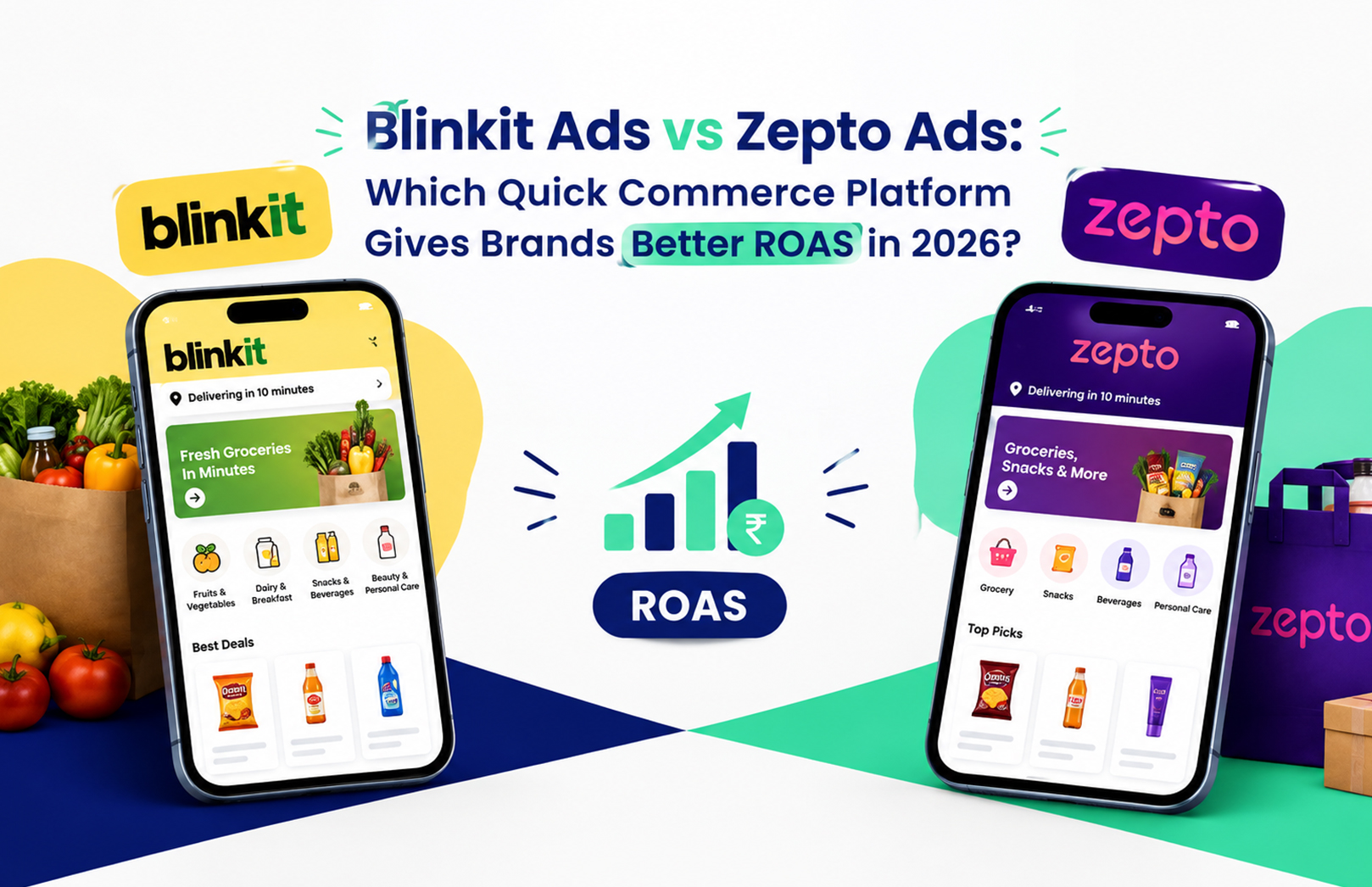
Blinkit Ads vs Zepto Ads: Which Quick Commerce Platform Gives Brands Better ROAS in 2026?


Your Blinkit dashboard says 4.2x ROAS this month. Your Zepto dashboard says 5.1x. Someone on the team suggests pulling budget off Blinkit and pouring it into Zepto, and on paper, that looks obvious. It usually isn’t. Before you move a single rupee, you need to know what each platform actually lets you control, what each ad format costs to run, and which one fits the stage your brand is at right now, not just which dashboard number is bigger this week.

That’s the decision HRL Infotechs works through with D2C and FMCG brands every time a new SKU goes live on quick commerce. This guide breaks down how Blinkit Ads and Zepto Ads work differently, what each format is built for, what a realistic budget looks like, and how to decide where your next rupee should go.

How Do Blinkit Ads Actually Work for Brands?

Blinkit runs advertising through Brand Central, a self-serve dashboard reached from the Ads tab in your Seller Hub. You pick an ad format, set a daily budget and bid, and the campaign goes live without waiting on an account manager. That control is the single biggest reason brands lean on Blinkit Ads first when testing a new category.

Brand Central offers eight formats, and not all of them deserve equal budget. Product Booster sits at the top of search results and category pages, and it’s the workhorse: a new brand should put the bulk of its early spend here because it catches shoppers who are already looking for something in your category. Prime Banner and Brand Spotlight build visibility higher up the funnel, Brand Store gives you a dedicated page within the app, and Recommendation Ads, Product Shelf, E-com Shelf, and Listing Spotlight each target a different moment in the browsing journey. Running all eight on day one spreads a small budget too thin to learn anything useful. Start narrow, see what converts, then widen.

How Does Zepto Advertising Differ From Blinkit’s Setup?

Zepto doesn’t offer the same dashboard-level control. Most sellers set up and manage campaigns through Zepto’s category or brand solutions teams rather than a self-serve portal, which means turnaround on bid changes or new creative can take a few days instead of minutes. If you’re used to Blinkit’s instant edits, this is the adjustment that trips people up first.

What Zepto gives up in speed, it makes up for in placement variety that’s harder to buy elsewhere. Search Takeover lets a brand claim the top result for a specific search term, which is a strong play during a launch week when you want category-defining visibility. Swap and Save targets shoppers at the cart stage, nudging them toward your product as a substitute or add-on right before checkout, a format that plays to impulse buying in a way Blinkit’s search-first formats don’t. If your category lives on impulse purchases, snacks, beverages, personal care, a well-placed Zepto Ads campaign can out-convert a straightforward search ad.

Blinkit Ads vs Zepto Ads: What Do They Actually Cost?

Neither platform publishes an official rate card, and figures quoted by different agencies vary enough that you should treat any number here as a planning range, not a guarantee.

  • Blinkit doesn’t enforce a fixed minimum. Brand Central lets you set a daily budget as low as a few hundred rupees to test, but most agencies find you need somewhere between ₹50,000 and ₹2-3 lakh a month before you’re seeing enough volume to make confident bidding decisions, especially in competitive categories like snacks or personal care.
  • Zepto typically asks for a larger upfront commitment, often bundling homepage banners, in-feed placements, and a brand store into a package, with agency-reported figures starting around ₹5-6 lakh. That’s a judgment call worth making early: a smaller D2C brand testing Zepto for the first time should go in knowing the entry cost is structurally higher than Blinkit’s.
  • Click costs on Product Booster typically fall between ₹2 and ₹15, depending on how contested your category is. Zepto’s search and swap formats tend to sit at the lower end of that range in less competitive categories, though that gap narrows fast once a few national brands start bidding on the same keywords.

Which Platform Gives Brands Better ROAS in 2026?

There isn’t a single winner. Blinkit tends to deliver steadier, more predictable ROAS because of its wider store footprint and the self-serve control that lets you cut a losing keyword the same day you spot it. Zepto tends to win on cheaper clicks and faster trial in the handful of dense metro markets where its dark store network is strongest.

What decides it for most brands we work with comes down to three questions:

  1. Does your demand sit mostly in metros, or does it stretch into tier 2 cities? Blinkit’s broader store network keeps ROAS more consistent outside the top six cities.
  2. Are you launching a new SKU or scaling a proven one? A first-order ROAS under 2x on a new product isn’t a failure signal on either platform. Judge launches on repeat purchase over four to six weeks, not week-one numbers.
  3. What’s your testing budget? If you’re working with under ₹1 lakh a month, Blinkit’s lower entry point and granular controls make it easier to learn fast without overcommitting.

One judgment call that catches newer sellers out: a strong ROAS number on either platform can mask a stock problem. If your product is out of stock at the dark stores closest to where your ads are serving, you’re paying for impressions that can never convert, and raising your bid only makes the math worse. Checking fill rate by pincode before touching a bid is a step worth building into your weekly routine, something we’ve written about in more detail in our guide to reducing out-of-stock penalties on Blinkit and Zepto ads.

How Should You Split Budget Between the Two?

A reasonable starting split for a brand selling nationally is 60-70% on Blinkit and 30-40% on Zepto, then rebalance every two weeks based on which platform is actually returning margin, not just which one shows the bigger ROAS figure. Tilt harder toward Zepto if your sales are concentrated in Mumbai, Bengaluru, or similarly dense metros, or if you’re pushing a new product and want the visibility that Search Takeover buys you during launch week.

The trade-off worth remembering: chasing the higher headline number without checking where your actual customers live is how brands end up overspending on a platform that simply doesn’t reach them. We’ve also found that discount-led campaigns underperform visibility-led ones once a brand has decent reviews in place, a pattern we cover in why visibility matters more than discounts in Zepto ads.

A Practical Starting Checklist

Before you commit a full month’s budget to either platform, run through this sequence:

  1. Pull SKU-level ad data from both dashboards and check fill rate at the pincode level, not just overall stock status.
  2. Put 80-90% of new Blinkit spend into Product Booster on your top two or three SKUs before touching the awareness formats.
  3. Confirm with your Zepto account contact which launch formats, like Search Takeover, are actually open to your brand and category.
  4. Set a review cadence of two weeks, not one, since Zepto’s account-led changes take longer to show results.
  5. Track repeat purchase rate for any new SKU for at least four weeks before calling a launch campaign a win or a loss.

If working through that list surfaces more questions than answers, especially around what your real margin looks like once commission and ad spend are both accounted for, that’s usually the sign to bring in a team that manages this daily rather than guessing with each platform’s dashboard numbers. HRL Infotechs runs this exact audit for brands across both platforms, and you can start with a free quick commerce ads audit to see where your current spend is actually working.

Frequently Asked Questions

Q1. Is Zepto Ads self-serve like Blinkit?
A1. Not fully. Blinkit runs campaigns through Brand Central, a self-serve dashboard where you control bids directly. Zepto advertising has typically gone through category or brand solutions teams, so changes can take a few days rather than minutes. Access terms shift, so confirm the current process with your Zepto contact before setting a testing timeline.

Q2. What is the minimum budget to start advertising on Blinkit?
A2. Blinkit doesn’t publish an official minimum, and Brand Central lets you start with a small daily budget. In practice, most brands need roughly ₹50,000 to ₹2-3 lakh a month to gather enough clicks per keyword to make confident bidding decisions, especially in competitive categories.

Q3. How does Blinkit Brand Central work?
A3. Brand Central is Blinkit’s self-serve advertising platform, reached from the Ads tab in your Seller Hub. It covers eight formats, including Product Booster for search and category placements and Brand Store for a dedicated brand page, and reports impressions, clicks, and ROAS in real time.

Q4. What is Zepto Search Takeover?
A4. Search Takeover is a Zepto ad format that lets a brand claim the top result for a chosen search term, giving it category-defining visibility during that search. It’s commonly used during product launches or sale events when a brand wants to dominate a specific keyword rather than compete for it via standard bidding.

Q5. Should a new product launch on Blinkit or Zepto first?
A5. It depends on where your buyers are concentrated. Brands with strong metro demand often see faster trial on Zepto, helped by formats like Search Takeover. Brands with national or tier 2 reach usually get more consistent results from Blinkit’s wider store network. Many brands launch on both and weight spend by city performance.

Q6. Why might ROAS drop even when bids haven’t changed?
A6. Stock availability is the most common cause. Ads only serve where inventory is physically present at the dark store, so patchy stock wastes impressions and drags down conversion even with an unchanged bid. Checking fill rate pincode by pincode, before adjusting any bid, usually resolves this faster than a bidding fix would.
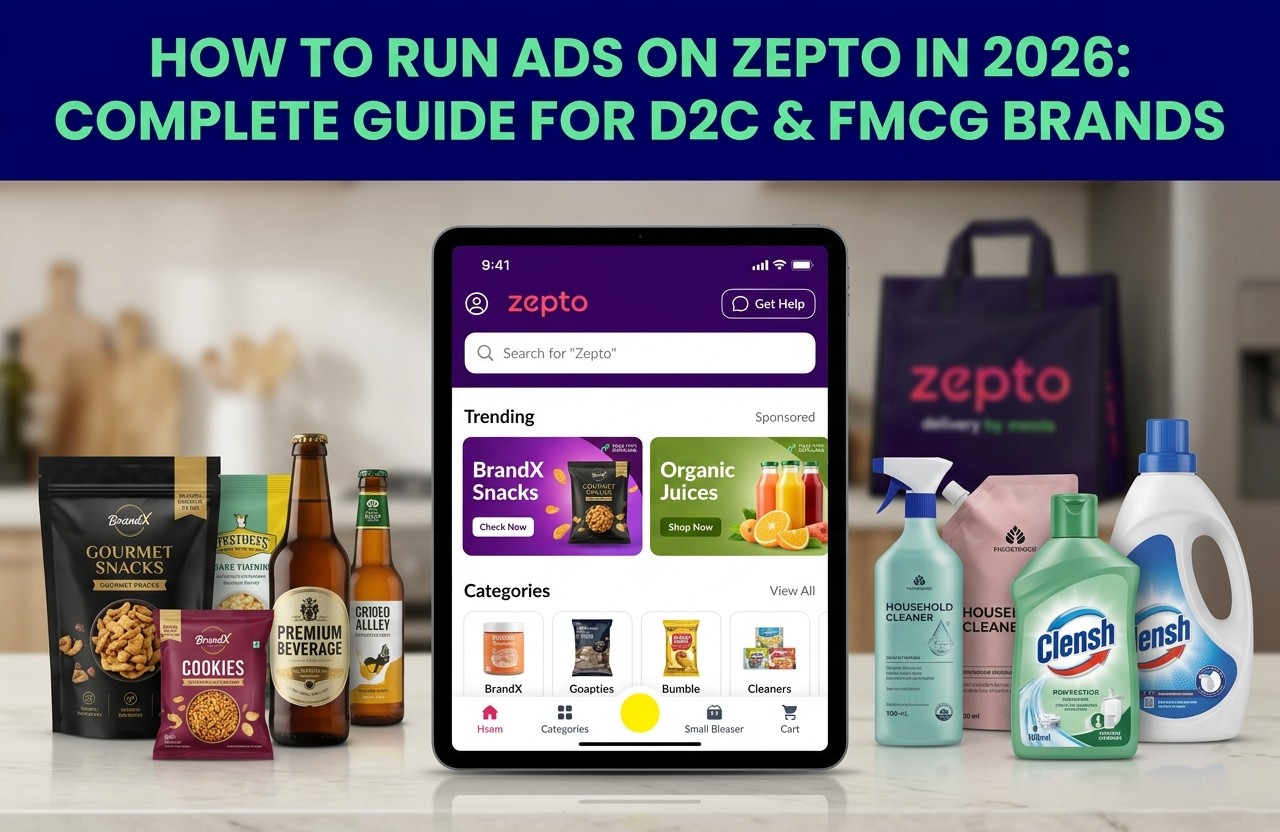
How to Run Ads on Zepto in 2026: Complete Guide for D2C & FMCG Brands


Quick commerce has changed how Indian shoppers discover and buy groceries, snacks, and daily essentials. For D2C and FMCG brands, Zepto is no longer just a delivery app; it is a powerful performance marketing channel where the right zepto ads strategy can drive visibility, trials, and repeat purchases at scale.

If you are planning how to run ads on Zepto in 2026, you need more than a basic overview. You need a practical zepto advertising guide that covers campaign structure, targeting, budgets, and optimization specifically for Indian consumers and retail realities. This complete guide will walk you through everything from seller onboarding to advanced zepto campaign management.

Understanding Zepto Ads Strategy For D2C & FMCG Brands

Before launching campaigns, it is important to understand how a strong zepto ads strategy fits into your broader quick commerce advertising services mix. Zepto is a high-intent platform where users are already in buying mode, which means your ads can influence decisions right at the digital shelf.

Most top-performing brands treat Zepto as a hybrid of marketplace and retail media. Your zepto ads guide 2026 should focus on three pillars: discoverability, share of shelf, and conversion. When these are aligned with your pricing, inventory, and promotions, your media spends start translating into measurable revenue.

Setting Up For Success: Zepto Seller Onboarding & Readiness

Before you think about creative or bids, you must ensure your presence as a seller is strong. Zepto seller onboarding services and zepto account management services are often the foundation for sustainable performance, especially for brands with large catalogs or multiple SKUs.

During onboarding, pay attention to product titles, images, and taxonomy. A winning zepto ads strategy will fail if your listings are incomplete, wrongly categorized, or out of stock. Treat your catalog setup as the first step of your zepto advertising guide, not a back-end task to be rushed.

Catalog Hygiene And Content Optimization

Clean, optimized product data is critical for both organic and paid visibility. When planning how to run ads on Zepto, start by auditing your catalog for naming consistency, pack size clarity, and keyword relevance that matches how Indian shoppers search.

Use clear product titles, high-resolution pack shots, and concise descriptions that highlight benefits such as health, taste, convenience, or value. This approach supports your zepto ads for sellers by improving click-through rates and reducing wasted impressions on irrelevant queries.

Inventory, Pricing, And Availability Alignment

Quick commerce shoppers expect instant fulfillment. If your ads drive traffic to items that are frequently out of stock or overpriced compared to competitors, your zepto ads strategy will underperform. Align inventory planning with campaign calendars and promotional pushes.

Coordinate with your supply and sales teams to ensure priority SKUs have stable stock and competitive pricing. This alignment is especially important for zepto ads for FMCG brands, where competition is intense and shoppers often compare similar items within seconds.

Core Zepto Advertising Formats And Placements

Understanding available formats is central to any zepto advertising guide. While specific names and layouts may evolve by 2026, the core logic of placements remains similar: visibility at search, category, and product levels, plus occasional homepage or banner opportunities.

Each format serves a different role in your zepto ads strategy. Some are better for awareness and share of shelf, while others are designed for bottom-funnel conversion. The right mix depends on your brand maturity, category, and seasonal priorities.

Search And Category Sponsored Listings

Search and category placements are usually the backbone of how to run ads on Zepto effectively. These ads appear when users search for generic terms like “atta” or “chips” or browse within a category such as dairy, beverages, or personal care.

For D2C and FMCG brands, prioritize high-intent keywords and categories where you have strong product-market fit. Use your zepto campaign management data to identify which terms drive the best balance of volume, cost per acquisition, and repeat purchase.

Product Detail Page And Cross-Sell Placements

Product detail page placements help you intercept shoppers who are considering competitor SKUs. These are powerful for brand switching, new launches, and premiumization strategies within your zepto ads strategy.

Cross-sell and recommendation slots are also valuable for basket building. For example, pairing sauces with snacks or beverages with ready-to-eat meals. Use these placements to increase average order value while staying relevant to the shopper’s mission.

Building A High-Performance Zepto Ads Strategy In 2026

Once your foundations are ready, you can design a structured zepto ads strategy that aligns with your business goals. In 2026, data-driven planning and continuous optimization will separate average performers from category leaders on Zepto.

Think of your plan as a living zepto advertising guide that evolves every quarter. As competition grows and consumer behavior shifts, you will need to revisit targeting, budgets, and creative regularly to maintain your edge in quick commerce advertising services.

Defining Objectives, Budgets, And Targeting

Start by defining clear objectives: are you focused on new user acquisition, market share in a specific pin code, or driving trials for a new variant. Your goals will influence how to run ads on Zepto and how aggressively you bid on priority placements.

Allocate budgets by category, city, and product line, then refine based on performance data. Use geo-level insights to prioritize high-potential neighborhoods and store clusters. This structured approach supports scalable zepto ads for sellers across multiple regions.

Creative Strategy And Offer Design

Even in a performance-driven environment, creative matters. Pack visibility, offer clarity, and messaging all impact click-through and conversion. Your zepto advertising guide should include clear rules for using discounts, combo packs, and limited-time offers.

Test different hooks such as “family value packs”, “low sugar”, or “ready in 2 minutes” depending on your category. For FMCG and D2C brands, small creative tweaks can significantly improve results without increasing media spends.

Ongoing Zepto Campaign Management And Optimization

Launching campaigns is only the beginning. Effective zepto campaign management requires weekly and monthly reviews, especially in a dynamic market like India where demand patterns change with festivals, weather, and local events.

Use performance dashboards to track impressions, clicks, conversion rates, and return on ad spend. Over time, this data becomes the backbone of your evolving zepto ads strategy and helps you justify higher investments in winning segments.

Key Metrics And Optimization Levers

Focus on a few core metrics: cost per acquisition, share of voice on priority keywords, and contribution to overall category sales. These indicators show whether your zepto ads for FMCG brands are genuinely moving the needle or just adding noise.

Optimization levers include bid adjustments, negative keyword refinement, creative refresh, and assortment changes. For example, you might shift spends from low-margin SKUs to higher-value packs once you see stable repeat purchase behavior.

When To Consider A Zepto Advertising Agency Partner

As your scale grows, managing everything in-house can become complex. This is where specialized zepto advertising agency partners or zepto marketing services India providers can add value with deeper platform expertise and dedicated resources.

Look for partners who understand both performance marketing and modern trade dynamics. They should help with zepto account management services, campaign planning, reporting, and experimentation so your internal teams can focus on brand and product strategy.

Future-Proofing Your Zepto Ads Strategy For 2026 And Beyond

Quick commerce will continue to evolve, with new formats, data capabilities, and competition. A resilient zepto ads strategy in 2026 will be flexible, insight-led, and closely integrated with your broader ecommerce and offline retail plans.

Invest in building internal knowledge, documenting learnings, and running structured experiments. Over time, your own data will become the most valuable part of your zepto advertising guide, helping you make smarter decisions than competitors who rely only on generic best practices.

Conclusion: Turning Zepto Into A Growth Engine

Zepto offers D2C and FMCG brands a rare combination of high intent, rich shopper data, and rapid experimentation. With the right zepto ads strategy, strong catalog foundations, disciplined zepto campaign management, and smart use of quick commerce advertising services, you can turn the platform into a consistent growth engine.

If you are ready to scale your presence and want expert support on how to run ads on Zepto effectively across India, partnering with a specialist like HRL Infotechs can help you move faster, reduce waste, and unlock the full potential of quick commerce for your brand.

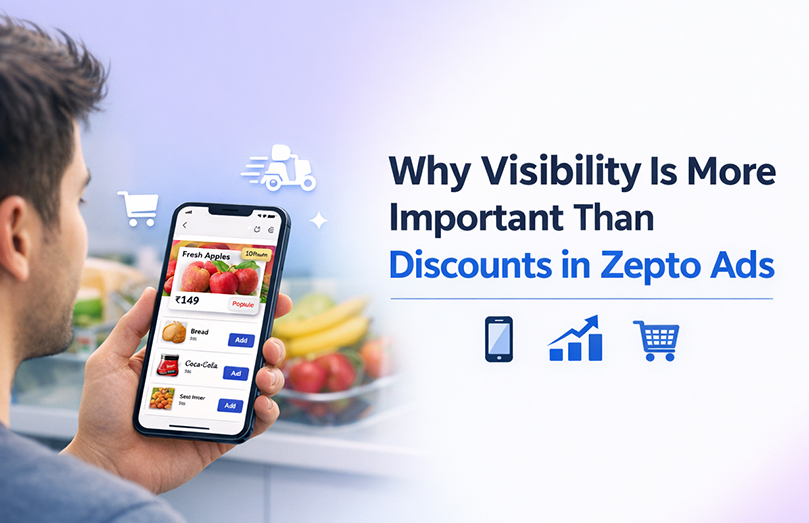
Why Visibility Is More Important Than Discounts in Zepto Ads


Quick commerce platforms are crowded, competitive, and constantly changing. In this environment, a smart Zepto ads strategy can be the difference between products that get noticed and products that never leave the shelf. Many brands rush to offer heavy discounts, hoping lower prices will drive instant sales. But in quick commerce, visibility often beats discounts, because shoppers buy what they see first and most often.

When you understand how Zepto sponsored ads work and how product placement influences buying behavior, you can build a zepto advertising guide that focuses on strategic visibility instead of margin-killing offers. This approach not only boosts conversions but also builds long-term brand recall and sustainable growth. Let’s explore why visibility should be the core of your quick commerce ads strategy and how to grow sales with Zepto ads the smart way.

Why Visibility Drives More Sales Than Discounts in Zepto Ads

On Zepto, most shoppers are not browsing for long; they are searching, scanning, and checking out within minutes. This makes your zepto ads strategy heavily dependent on how often and where your products appear. If your products are buried on page three, even a deep discount will not save them from being ignored. Visibility ensures your brand enters the customer’s consideration set before price even becomes a factor.

Discounts can create short-term spikes, but they also train customers to wait for offers and erode your margins. A visibility-first quick commerce marketing strategy focuses on winning premium placements, top-of-search positions, and repeat impressions. Over time, this builds familiarity and trust, which often leads to higher conversion rates even at standard pricing.

Understanding How Zepto Ads Work in Quick Commerce

To design an effective zepto ads strategy, you need to understand how sponsored placements influence the shopper journey. Zepto sponsored ads typically appear in high-intent zones such as search results, category pages, and recommendation carousels. These are the moments when customers are ready to choose, and visibility here can dramatically increase click-through and conversion.

Your zepto advertising guide should map each ad format to a specific objective. For example, search ads help you capture demand for generic terms, while category placements help you win against direct competitors. When you align formats with goals, your quick commerce ads strategy becomes more efficient, and every impression works harder for your brand.

The Role of Search Behavior in Zepto Product Visibility

Most Zepto users start with a search query, often using generic terms like “milk,” “chips,” or “shampoo.” This means your zepto product visibility depends heavily on how you rank for these non-branded searches. If your products do not appear in the top rows, customers will likely pick a competitor they see first.

A strong zepto ads strategy uses sponsored search ads to secure prominent positions for high-intent keywords. By combining relevant titles, sharp images, and competitive but sustainable pricing, you can capture attention quickly. Over time, this improves organic ranking as well, reinforcing your visibility even when ads are not running.

Why Over-Reliance on Discounts Hurts Long-Term Growth

While discounts can help clear inventory or support launches, relying on them as your primary lever is risky. Constant offers reduce perceived value and make it harder to sustain profitability. Customers may start associating your brand with “cheap” rather than “quality” or “reliable.”

In contrast, a visibility-led quick commerce marketing strategy positions your brand as a consistent, trusted choice. You still use promotions, but as a support tool rather than the hero. This balance helps you increase sales on Zepto while protecting margins and brand equity.

Core Pillars of a High-Impact Zepto Ads Strategy

A winning zepto ads strategy is built on a few core pillars that work together to maximize visibility and conversions. When these elements are aligned, your campaigns become more predictable, scalable, and profitable. Instead of chasing short-term spikes, you build a repeatable system for growth.

Think of your zepto advertising guide as a framework that covers targeting, creatives, bidding, and measurement. Each pillar supports the others, ensuring your quick commerce ads strategy is not just about spending more but about spending smarter. This is how to grow sales with Zepto ads in a sustainable way.

Smart Targeting and Keyword Selection

Targeting is the foundation of any zepto ads strategy. Start by identifying high-intent keywords related to your category, use cases, and problems your product solves. Include a mix of generic, category, and occasion-based terms to capture different stages of the shopper journey.

Then, refine your targeting based on performance data. Pause low-performing terms, double down on high-ROAS keywords, and test variations. This ongoing optimization ensures your zepto product visibility is focused where it matters most, reducing wasted spend and improving return on ad spend.

Creative Optimization for Higher Engagement

Even the best placements will underperform if your creatives are weak. Your zepto advertising guide should emphasize strong product images, clear titles, and benefit-led descriptions. Shoppers make decisions in seconds, so every element must communicate value quickly and clearly.

Test different images, pack shots, and messaging angles to see what drives higher click-through and conversion. Over time, you will identify patterns that inform your broader quick commerce marketing strategy. Better creatives not only improve paid performance but also enhance organic engagement.

Balancing Visibility, Pricing, and Promotions

Visibility does not mean ignoring pricing; it means using price and promotions strategically. Your zepto ads strategy should balance competitive pricing with healthy margins, supported by selective offers during key moments. This approach helps you win the shelf without racing to the bottom.

Consider using promotions to support specific goals, such as new product launches or seasonal peaks. Pair these offers with strong Zepto sponsored ads to maximize exposure. When visibility and value work together, you can increase sales on Zepto without relying on constant deep discounts.

When to Use Discounts as a Strategic Lever

Discounts still have a place in a mature quick commerce ads strategy. They are especially useful for driving trials, clearing short-dated stock, or defending share during competitive pushes. The key is to deploy them with intention, not by default.

Set clear objectives and time limits for each promotion, and always measure impact on both sales and profitability. Over time, you will see that visibility-led campaigns with selective offers outperform discount-heavy tactics. This insight will guide how to grow sales with Zepto ads more efficiently.

Measuring Success and Scaling Your Zepto Advertising

No zepto ads strategy is complete without a strong measurement framework. Track metrics like impressions, click-through rate, conversion rate, and return on ad spend. These indicators show whether your focus on visibility is translating into real business outcomes.

Use these insights to refine your quick commerce marketing strategy over time. Scale campaigns that deliver profitable growth, and cut or rework those that do not. As you iterate, your zepto product visibility and sales performance will improve in a predictable, data-driven way.

Key Metrics to Track for Continuous Improvement

To keep your zepto advertising guide actionable, define a core dashboard of metrics. At minimum, monitor impressions, clicks, conversions, average order value, and cost per acquisition. These numbers reveal how effectively your visibility is turning into revenue.

Additionally, track repeat purchase rates and share of category over time. These metrics show whether your zepto ads strategy is building long-term loyalty, not just one-time spikes. With this view, you can confidently invest more in the tactics that truly move the needle.

Conclusion: Build a Visibility-First Zepto Ads Strategy

In quick commerce, shoppers move fast, and attention is limited. That is why a visibility-first zepto ads strategy consistently outperforms a discount-first approach. By focusing on premium placements, smart targeting, strong creatives, and selective promotions, you can increase sales on Zepto while protecting your margins and brand value.

If you want expert support in designing and scaling a high-performance quick commerce ads strategy tailored to Zepto, HRL Infotechs can help you turn visibility into predictable, profitable growth.