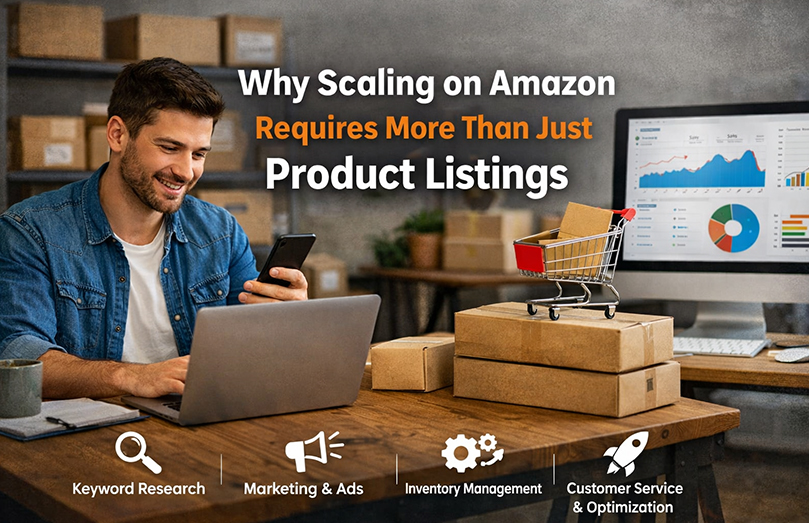
Scaling on Amazon is no longer about uploading a few product listings and waiting for sales. Competition is intense, ad costs are rising, and customers have endless options. To achieve sustainable Amazon account growth, sellers need a strategic, data-driven approach that looks at every part of the business, not just the catalog.
Today, successful brands treat Amazon like a full ecosystem. That means aligning product, pricing, inventory, advertising, and customer experience under a clear Amazon business growth strategy. When these elements work together, sellers can unlock consistent revenue, stronger margins, and long-term brand equity on the marketplace.
Why Product Listings Alone Don’t Drive Amazon Account Growth
Many sellers assume that optimized titles, bullet points, and images are enough to drive Amazon account growth. While listings are essential, they are only one piece of a much larger growth engine. Without the right strategy behind them, even the best listings struggle to rank, convert, and scale profitably.
Amazon’s algorithm rewards more than keywords. It looks at sales velocity, stock health, pricing competitiveness, ad performance, and customer satisfaction. If any of these are weak, your visibility and sales suffer, no matter how polished your product pages appear.
The Limits of Listing-Only Optimization
Listing optimization improves click-through and conversion, but it cannot fix structural issues. If your Amazon inventory management strategy is weak, you risk stockouts or overstock, both of which hurt rankings and cash flow. Listings cannot compensate for poor availability or slow fulfillment.
Similarly, if your pricing or reviews are not competitive, shoppers will scroll past your offers. A strong Amazon seller growth strategy must address these operational and commercial levers, not just on-page content. This is where many sellers hit a ceiling in their Amazon account growth.
How the Algorithm Rewards Holistic Performance
Amazon’s A9 algorithm favors products that sell consistently, stay in stock, and delight customers. That means your Amazon business growth strategy must focus on improving conversion, maintaining inventory, and driving repeat sales. The algorithm connects these signals to determine which products deserve top placement.
When your ads, pricing, reviews, and inventory all align, your listings gain momentum. Over time, this synergy builds organic ranking power, which is the foundation of sustainable Amazon account growth. The goal is to create a flywheel where every sale improves your future visibility.
Building a Strategic Foundation for Amazon Account Growth
To scale effectively, you need a clear roadmap for how to scale on Amazon. This starts with understanding your category, competitors, and customer behavior. Without this foundation, it is easy to waste budget on the wrong products, keywords, or audiences.
A robust Amazon seller growth strategy defines which SKUs to prioritize, how to position them, and what success looks like. It also sets measurable goals for revenue, profitability, and market share. With this clarity, every decision supports long-term Amazon account growth instead of short-term spikes.
Defining Your Growth Levers and KPIs
Not all products contribute equally to Amazon account growth. Identify your hero products, high-margin items, and seasonal winners. Then, assign specific KPIs such as target ACOS, conversion rate, and inventory turns to track performance. This helps you focus resources where they matter most.
In addition, map your customer journey on Amazon. Understand which keywords drive discovery, which pages convert, and where shoppers drop off. This insight shapes your Amazon business growth strategy and helps you prioritize optimization efforts that move the needle.
Aligning Catalog, Pricing, and Positioning
Strategic catalog management is central to how to scale on Amazon. You may need to rationalize underperforming SKUs, bundle products, or introduce variations to capture more search demand. Each decision should support your broader Amazon account growth goals.
Pricing and positioning also play a critical role. You must balance competitiveness with profitability, especially as fees and ad costs rise. Clear positioning, supported by strong content and reviews, allows you to command better prices while still driving volume.
Amazon Inventory Management Strategy as a Growth Engine
Inventory is often the hidden driver of Amazon account growth. Stockouts kill momentum, while excess stock ties up capital and increases storage fees. A smart Amazon inventory management strategy keeps products available without overcommitting resources.
Effective planning requires accurate demand forecasting, seasonality analysis, and close monitoring of lead times. When you consistently stay in stock on your best sellers, your rankings stabilize and your advertising becomes more efficient.
Balancing FBA, FBM, and 3PL Options
Choosing the right fulfillment mix is a key part of how to scale on Amazon. FBA offers Prime eligibility and strong conversion, but it comes with storage and handling fees. FBM or third-party logistics can provide flexibility for bulky or slower-moving items.
Your Amazon inventory management strategy should segment products by velocity, size, and margin. This allows you to assign the most cost-effective fulfillment method while maintaining service levels. The result is healthier cash flow and more predictable Amazon account growth.
Designing a Profitable Amazon Ads Strategy
Advertising is now central to how to grow sales on Amazon. However, simply increasing ad spend does not guarantee profitable Amazon account growth. You need a structured Amazon ads strategy that aligns with your goals and margins.
Start by segmenting campaigns by product type, match type, and intent. This gives you better control over bids and budgets. Over time, you can shift investment toward the highest-converting keywords and placements, improving both sales and efficiency.
Balancing Organic and Paid Visibility
A mature Amazon seller growth strategy treats ads as a catalyst for organic ranking, not a permanent crutch. Use Sponsored Products, Sponsored Brands, and Sponsored Display to accelerate sales on key SKUs. As organic rankings improve, gradually rebalance spend to protect profitability.
Track how ad-driven sales impact your organic position for target keywords. This feedback loop helps refine your Amazon ads strategy and ensures that every dollar spent contributes to long-term Amazon account growth, not just short bursts of traffic.
When to Leverage Amazon Account Management and Consulting Services
As your catalog, ad spend, and operations expand, managing everything in-house becomes challenging. This is where Amazon account management services and Amazon seller consulting services can create real leverage. They bring specialized expertise, tools, and processes that most internal teams lack.
These partners can help refine your Amazon business growth strategy, optimize campaigns, and streamline operations. More importantly, they provide an outside perspective on risks and opportunities, helping you avoid costly mistakes and accelerate Amazon account growth.
Key Areas Where Expert Support Adds Value
Strategic partners can support you across multiple growth levers, including:
- Comprehensive account audits and growth roadmaps
- Advanced keyword research and listing optimization
- End-to-end Amazon ads strategy and campaign management
- Inventory planning and demand forecasting support
- Brand protection, compliance, and policy guidance
With the right support, you can focus on product and brand development while experts manage the complexity of how to scale on Amazon. This collaboration often unlocks faster, more predictable Amazon account growth.
Conclusion: Turning Amazon into a Scalable Growth Channel
Scaling on Amazon requires more than attractive listings and occasional ad campaigns. Sustainable Amazon account growth comes from a coordinated strategy that connects catalog, pricing, inventory, advertising, and customer experience. When these elements align, Amazon becomes a powerful, predictable revenue engine rather than a volatile sales channel.
If you are ready to move beyond basic listing optimization and build a true Amazon seller growth strategy, partnering with experienced specialists like HRL Infotechs can help you turn Amazon into a scalable, long-term profit center for your brand.