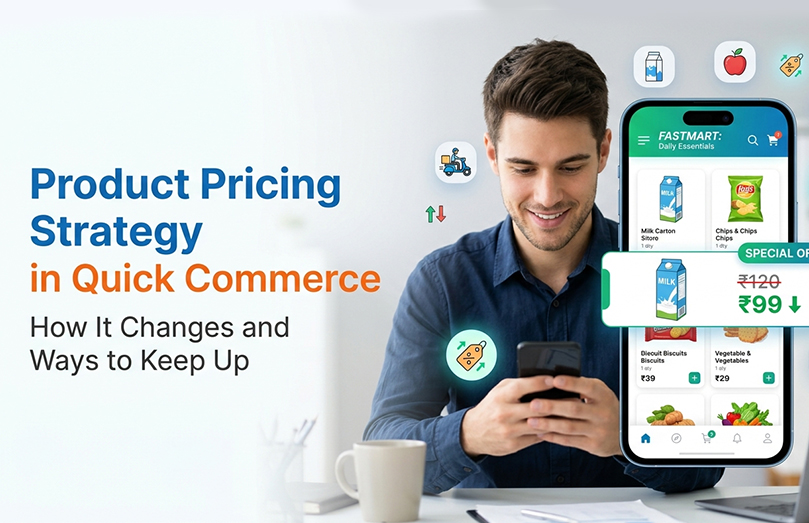
Quick commerce has changed how consumers discover, compare, and buy everyday products. With platforms like Blinkit, Zepto, and JioMart promising deliveries in minutes, brands can no longer rely on traditional pricing playbooks. The right quick commerce marketing strategy now demands dynamic, data-driven pricing that adapts to demand, competition, and customer expectations in real time.
As more sellers join these platforms, competition intensifies and margins shrink. To stay profitable while still winning the digital shelf, you need a clear product pricing strategy in quick commerce that aligns with your overall growth goals. This guide breaks down how pricing works in q commerce, how it keeps changing, and practical ways to keep up.
Understanding Quick Commerce Marketing Strategy and Pricing Dynamics
A strong quick commerce marketing strategy starts with understanding how consumers behave on instant delivery apps. Shoppers are highly impulsive, compare prices quickly, and expect convenience, speed, and value in a single experience. This means your q commerce pricing strategy must support both visibility and conversion, not just margin.
Unlike traditional eCommerce, quick commerce marketplace pricing changes faster due to limited inventory, hyperlocal demand, and frequent platform-led promotions. Pricing strategy for Blinkit and Zepto, for example, must consider local competition, delivery radius, and time-based demand spikes such as evenings or weekends.
Key Components of a Product Pricing Strategy in Quick Commerce
To build a winning product pricing strategy in quick commerce, you need to balance three pillars: competitiveness, profitability, and brand positioning. Focusing only on low prices can erode margins, while ignoring competition can push you off the first page of search results within the app.
A robust quick commerce seller strategy should define clear pricing rules for each category, pack size, and region. This includes base price, discount thresholds, and participation in platform campaigns. When aligned with your broader quick commerce marketing strategy, these rules help you scale without losing control over profitability.
Base Price Architecture for Q Commerce Platforms
Your base price is the foundation of your q commerce pricing strategy. It should reflect your offline MRP, cost structure, and desired margin, while staying flexible enough to adapt to platform dynamics. A rigid approach often leads to lost visibility or forced heavy discounting later.
For pricing strategy for Blinkit and Zepto, brands often create a differentiated price ladder across SKUs. Smaller packs may carry slightly higher per-unit margins due to convenience, while larger packs can be priced more aggressively to drive basket value and repeat orders.
Discounts, Offers, and Platform-Led Promotions
Quick commerce marketplace pricing is heavily influenced by ongoing offers and promotions. Platforms frequently run category sales, bank offers, and coupon-based discounts to drive app engagement. Your quick commerce marketing strategy must decide when to participate and at what depth.
Instead of flat discounts across all SKUs, focus on hero products and high-frequency items. This approach keeps your brand visible in promotional slots while protecting margins on long-tail SKUs. It also helps align with Blinkit marketing strategy or Zepto marketing strategy initiatives without over-subsidizing every product.
Regional and Hyperlocal Price Differentiation
Demand, competition, and willingness to pay can vary sharply between neighborhoods. A refined product pricing strategy in quick commerce often includes regional or hyperlocal price variations. This is especially relevant for essentials, premium categories, or seasonal products.
By aligning your q commerce pricing strategy with local market realities, you can stay competitive where it matters most. This also supports better collaboration with dark stores, local warehouses, and last-mile partners to maintain healthy unit economics.
How Pricing Strategy Differs Across Blinkit, Zepto, and JioMart
Each quick commerce platform has its own user base, positioning, and promotional playbook. As a result, your pricing strategy for Blinkit and Zepto cannot be a simple copy-paste of your JioMart approach. You need platform-specific rules that still align with your central quick commerce seller strategy.
Blinkit marketing strategy often emphasizes speed and convenience for urban consumers, while Zepto marketing strategy leans into youthful branding and discovery. Jio Mart marketing services, on the other hand, may focus more on value and assortment. Your quick commerce marketing strategy should adapt prices and offers to match these different expectations.
Aligning with Blinkit and Zepto User Behavior
On Blinkit and Zepto, many shoppers add products during quick, need-based sessions. They are often less price-sensitive on urgent items but more price-aware on staples. Your q commerce pricing strategy should reflect this by segmenting SKUs into urgency-based and value-based buckets.
For urgency-based products, focus on availability and visibility with moderate discounts. For value-based products, sharpen your quick commerce marketplace pricing to stay within the competitive band. This balance helps you capture both impulse and planned purchases.
Leveraging JioMart Marketing Services for Value Positioning
Jio Mart marketing services typically appeal to value-seeking households that plan their baskets more carefully. Here, your product pricing strategy in quick commerce should emphasize multi-pack offers, combo deals, and consistent everyday pricing rather than frequent deep discounts.
By aligning your quick commerce marketing strategy with JioMart’s value-driven audience, you can build loyalty and higher average order values. This also allows you to maintain stable margins while still appearing attractive in price comparisons within the app.
Data-Driven Ways to Keep Up with Fast-Changing Q Commerce Pricing
Because prices and offers change so quickly, manual adjustments are no longer sustainable. A modern quick commerce marketing strategy relies on data, automation, and continuous testing to stay ahead. The goal is to react faster than competitors while protecting profitability.
To strengthen your q commerce pricing strategy, track key signals such as buy box wins, search ranking, conversion rate, and cart abandonment. These metrics reveal when your quick commerce marketplace pricing is either too aggressive or not competitive enough.
Practical Tactics to Stay Competitive
Brands that win in quick commerce use a mix of tactical and strategic levers. These tactics help them respond to competitors, seasonality, and platform campaigns without losing control of margins or brand perception.
Consider integrating the following into your quick commerce seller strategy:
- Set pricing guardrails for minimum and maximum discounts per SKU.
- Use A/B tests on price points to find the optimal conversion band.
- Align promo calendars with platform events and paydays.
- Bundle complementary products to increase basket size.
- Review competitor pricing weekly at a category and region level.
Building a Future-Ready Quick Commerce Seller Strategy
The future of quick commerce will be even more dynamic, with AI-driven recommendations, personalized offers, and tighter delivery SLAs. Your product pricing strategy in quick commerce must be flexible enough to plug into these innovations while still serving your brand’s long-term goals.
As platforms evolve, a strong quick commerce marketing strategy will integrate assortment planning, inventory visibility, and pricing intelligence into one unified engine. This will help you maintain consistent brand value across Blinkit, Zepto, JioMart, and emerging q commerce platforms.
From Reactive Discounting to Strategic Pricing
Many brands still treat quick commerce as a discount-heavy channel to clear inventory. This reactive approach can damage brand equity and train customers to wait for offers. Instead, shift towards a strategic q commerce pricing strategy that defines clear roles for every SKU.
Classify products as traffic drivers, margin builders, or loyalty anchors, and price them accordingly. Over time, this structured quick commerce marketplace pricing model will deliver more predictable revenue, healthier margins, and stronger customer retention.
Conclusion: Turning Pricing into a Competitive Advantage
Quick commerce is no longer just about being present on Blinkit, Zepto, or JioMart. To win, you need a sharp, data-led product pricing strategy in quick commerce that aligns with your broader growth ambitions. When your quick commerce marketing strategy connects pricing, promotions, and platform behavior, every rupee you discount works harder for your brand.
By investing in structured pricing rules, platform-specific strategies, and continuous optimization, you can turn q commerce pricing from a margin drain into a competitive advantage. If you are ready to professionalize your approach and scale profitably across instant delivery platforms, HRL Infotechs can help you design and execute a future-ready quick commerce seller strategy tailored to your business.