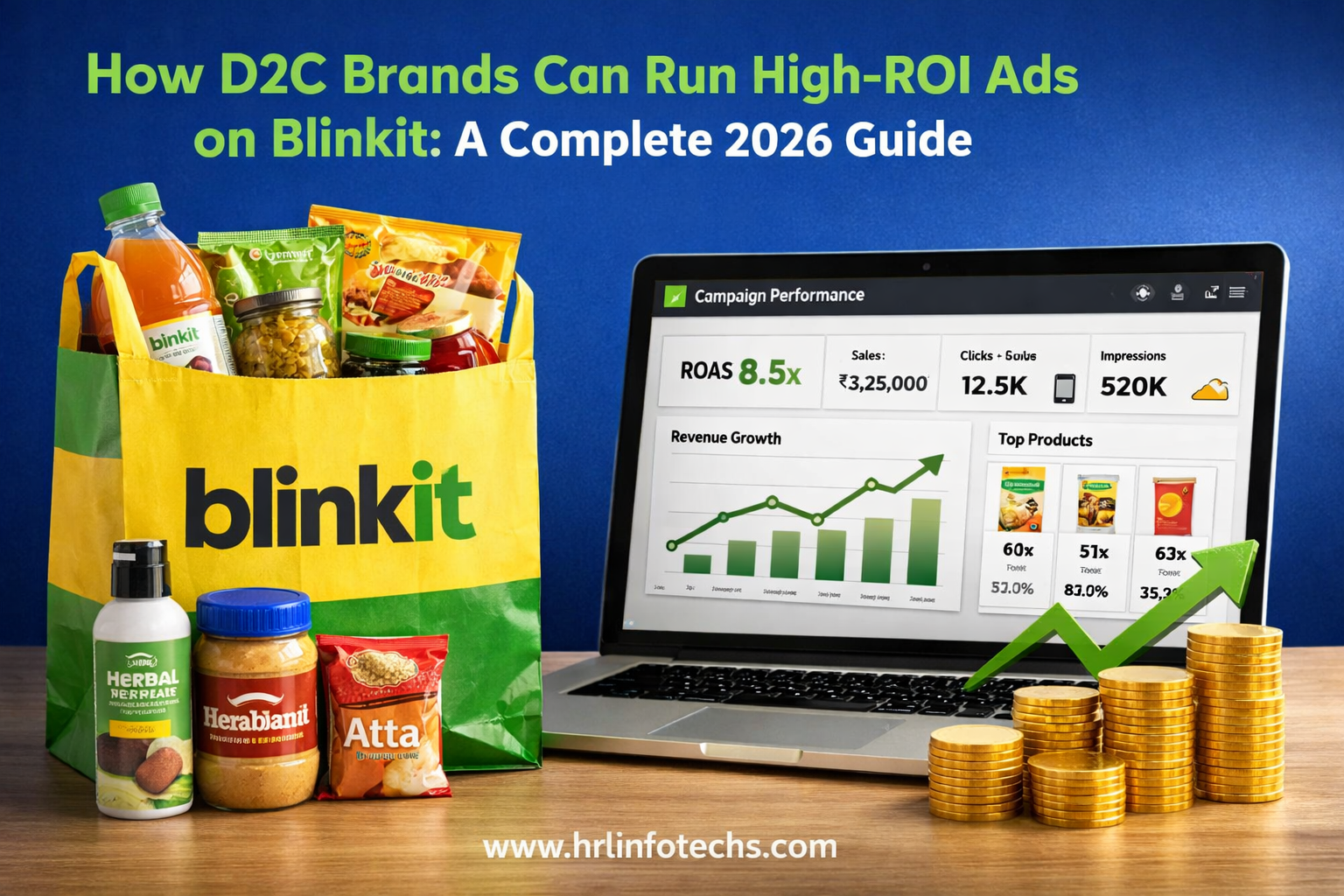
Quick commerce has changed how D2C brands reach customers, and Blinkit is now one of the most powerful performance channels in India. But as more brands compete for the same ad inventory, only those with a sharp Blinkit Advertising Management approach will see consistent, high ROI.
This complete 2026 guide breaks down how D2C brands can plan, launch, and scale high-ROI ads on Blinkit. You will learn practical Blinkit ads strategy for D2C brands, how to run ads on Blinkit for brands step by step, and how to plug Blinkit into a broader quick commerce marketing strategy.
Why Blinkit Advertising Management Matters for D2C Brands in 2026
Blinkit has moved from being just a grocery delivery app to a full-funnel commerce platform where users discover, compare, and purchase products in minutes. For D2C brands, this means Blinkit Advertising Management is no longer optional; it is a core performance channel that can drive incremental revenue and market share.
Because user intent on Blinkit is highly transactional, well-structured campaigns can convert at a much higher rate than traditional social or display ads. When your Blinkit marketing strategy for ecommerce brands is aligned with inventory, pricing, and demand, you can turn quick commerce into a predictable growth engine.
Understanding Search and Shopping Intent on Blinkit
To run high-ROI ads on quick commerce platforms, you must first understand how users behave inside the app. Most users either search for specific products or browse through curated categories and collections. Your Blinkit Advertising Management framework should map to both behaviors.
On the search side, users type brand names, generic product terms, or problem-based queries. On the browse side, they explore categories like snacks, beverages, personal care, or home essentials. A strong blinkit ads strategy for D2C brands aligns keyword targeting, placements, and creatives with these high-intent journeys.
Key User Journeys You Must Optimize For
There are three primary journeys that matter most for Blinkit Advertising Management. First, branded search, where users already know your brand and are looking for it directly. Second, generic search, where they search for a category and can be persuaded to try your product.
Third, impulse discovery, where users scroll through offers, banners, and recommended products. High ROI ads on quick commerce platforms come from covering all three journeys with tailored campaigns, not just bidding on your own brand terms.
Matching Ad Formats to Buyer Intent
Blinkit offers multiple placements such as sponsored product listings, category banners, and homepage features. Each format plays a different role in your Blinkit marketing strategy for ecommerce brands. Sponsored listings are ideal for capturing bottom-funnel intent and driving immediate conversions.
Category and homepage placements, on the other hand, are better suited for awareness, new launches, and share-of-voice battles. Effective Blinkit Advertising Management means assigning budgets and KPIs to each format based on its role in the funnel, instead of treating all placements the same.
Core Components of a High-ROI Blinkit Ads Strategy for D2C Brands
Building a winning blinkit ads strategy for D2C brands starts with clarity on goals, unit economics, and product readiness. You need to know your target CAC, contribution margin, and repeat rate before scaling. This ensures your Blinkit Advertising Management decisions are driven by profitability, not vanity metrics.
Next, you must align your in-app presence with your ad strategy. That includes optimized product titles, clear pack sizes, strong images, and competitive pricing. Even the best quick commerce marketing agency cannot fix poor product fundamentals, so treat merchandising as part of your advertising strategy.
Campaign Structuring and Targeting Best Practices
For 2026, the most effective Blinkit Advertising Management structures separate campaigns by objectives and product roles. Create distinct campaigns for hero SKUs, new launches, and long-tail products. This allows you to control bids, budgets, and placements with precision.
Within each campaign, segment ad groups by keyword themes or category clusters. For example, group all high-intent generic terms together and keep brand terms separate. This structure improves control, simplifies optimization, and helps you identify where your highest ROI actually comes from.
Creative and Offer Strategy for Higher Conversions
On Blinkit, users make decisions quickly, so your creatives and offers must be clear and compelling. Use high-resolution pack shots, readable labels, and consistent branding across SKUs. Your Blinkit Advertising Management approach should include regular creative refreshes to avoid ad fatigue.
Pair strong visuals with smart offers such as limited-time discounts, combo packs, or free delivery thresholds. When combined with the right placements, these offers can significantly improve click-through and conversion rates, making your blinkit ads strategy for D2C brands more profitable.
How to Run Ads on Blinkit for Brands: Step-by-Step Framework
To simplify execution, you can follow a clear framework for how to run ads on Blinkit for brands. Start with a pilot phase focused on a limited set of SKUs and tightly controlled budgets. Use this phase to validate demand, test placements, and understand your baseline performance metrics.
Once you have data, move into a scale phase where you expand winning campaigns, add new keywords, and test additional formats. Throughout this process, your Blinkit Advertising Management should be data-led, with weekly reviews of ROAS, CAC, and contribution margins.
Measurement, Attribution, and Optimization Loops
High-ROI Blinkit Advertising Management depends on disciplined measurement. Track impressions, clicks, conversions, average order value, and repeat purchase behavior. Combine platform data with your internal analytics to understand the true impact of Blinkit on your overall ecommerce performance.
Set up optimization loops where you review search term reports, prune poor-performing keywords, and reallocate budgets to top performers. Over time, this process will refine your blinkit ads strategy for D2C brands and help you scale without eroding profitability.
Integrating Blinkit into a Broader Quick Commerce Marketing Strategy
Blinkit should not operate in isolation. The most successful D2C performance marketing setups integrate Blinkit with other quick commerce platforms and owned channels. This allows you to build a unified quick commerce marketing strategy that maximizes reach and efficiency.
For example, you can use social and search ads to drive awareness, while Blinkit captures high-intent conversions. A mature Blinkit Advertising Management approach also considers inventory planning, regional focus, and cross-platform learnings to avoid channel silos.
When to Bring in a D2C Performance Marketing Agency in India
As your Blinkit spends grow, managing everything in-house can become complex. This is where partnering with a specialized D2C performance marketing agency in India can accelerate results. The right partner will understand category nuances, platform algorithms, and quick commerce merchandising.
They can also help you design ROI driven ecommerce advertising services that span Blinkit, other quick commerce platforms, and your own D2C site. When evaluating partners, look for proven experience in Blinkit Advertising Management, transparent reporting, and a clear focus on profitability, not just scale.
Conclusion: Turning Blinkit into a Scalable Growth Engine
By 2026, competition on quick commerce will only intensify, but brands with disciplined Blinkit Advertising Management will continue to win. If you understand user intent, structure campaigns intelligently, and optimize relentlessly, Blinkit can become one of your most efficient revenue channels.
For D2C brands that want expert support in building a high-ROI blinkit ads strategy for D2C brands and integrating it into a larger quick commerce ecosystem, HRL Infotechs can help design and execute a performance roadmap tailored to your growth and profitability goals.