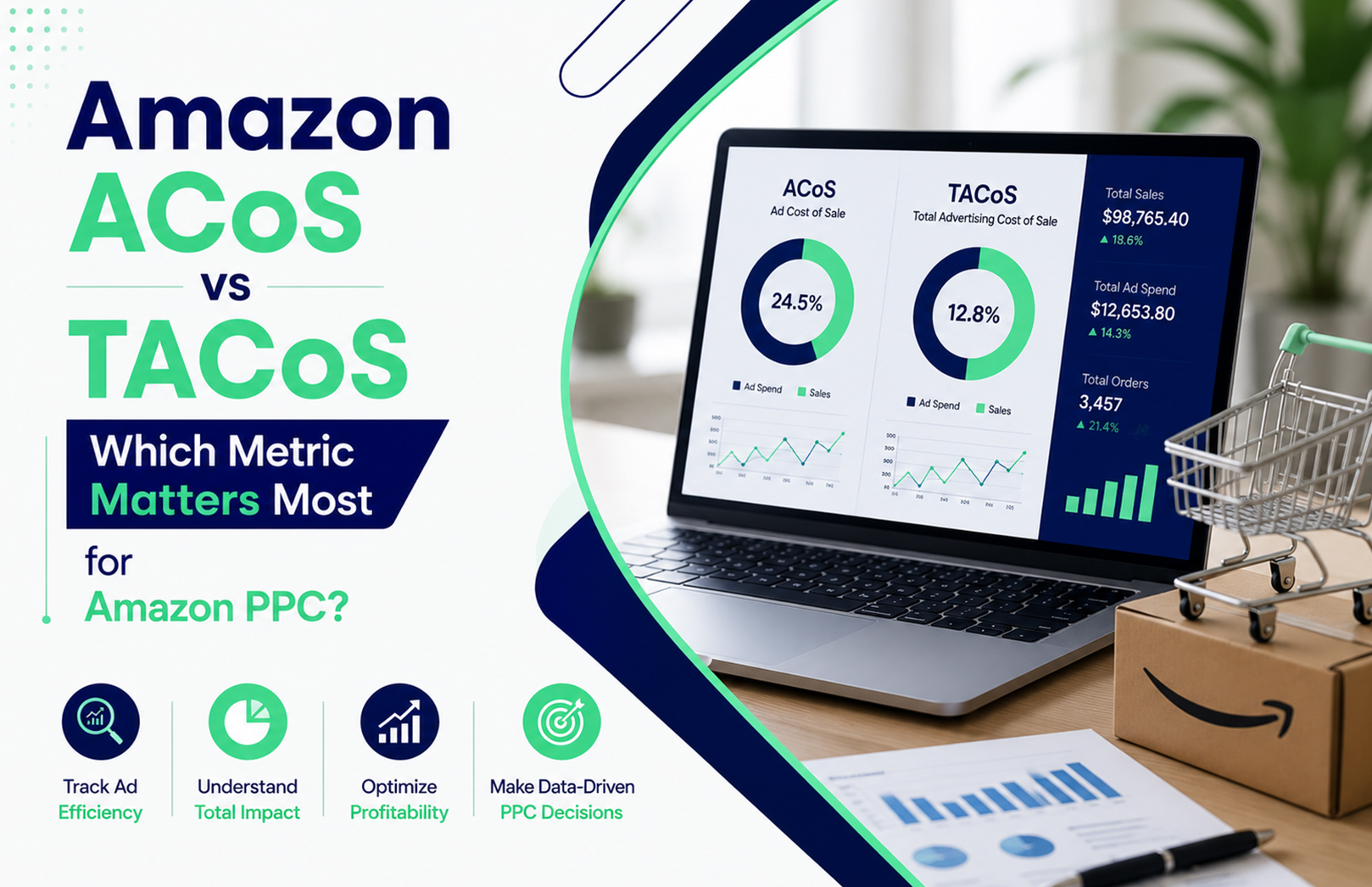
Ask ten Amazon sellers about their ad performance, and at least nine will be able to quote an ACoS figure without hesitation – 18%, 22% or perhaps a particularly impressive 12% for their best-performing campaign. Ask the same sellers about their TACoS, however, and you’ll be met with blank looks. This information asymmetry is costing Indian sellers millions of rupees in lost profits, as they optimise based on an incomplete view of their advertising costs.
Both metrics matter. But they answer completely different questions, and confusing them is one of the most common reasons Amazon PPC management decisions end up working against a seller’s actual profitability instead of for it.
What ACoS Actually Tells You
Advertising Cost of Sales (ACoS) is a metric that reflects the ratio of advertising spend to the revenue generated by those advertisements. For example, if you spend 10,000 INR on Sponsored Products ads and get 50,000 INR in sales, your ACoS will be 20%.
This figure is useful at the campaign level and really helps understand how a given campaign, ad group, or keyword is performing in terms of profitability. But sellers sometimes make a big mistake applying ACoS as the ultimate indicator of business performance, which it actually was never meant to be.
What TACoS Actually Tells You
Total Advertising Cost of Sales flips the denominator. Instead of comparing ad spend to ad-attributed sales alone, TACoS compares ad spend to your total sales, organic and paid combined. Same ₹10,000 ad spend, but now measured against your entire revenue for that period, including sales that came from organic search, repeat customers, or external traffic.
This is the metric that determines if your advertising is driving actual business growth for you – for the money you’re spending on ads. A campaign might demonstrate a healthy ACoS while failing to provide tangible value if your overall sales are stagnant – in other words, if your ad spend isn’t fueling real growth, but rather simply redirecting would-be organic sales to your ads, making effective marketplace performance optimisation critical to true long-term profitability.
Why This Distinction Actually Matters for Amazon ACoS vs TACoS
Here’s where the confusion causes real damage. A seller chasing a lower ACoS will often decrease spend on marketing campaigns as soon as the metric begins to rise, even if a particular channel was responsible for bringing new customers to the brand, which then begin to contribute organically to the overall TACoS in the long run.
Amazon ACoS vs TACoS isn’t really a competition between two metrics; it’s a question of timeframe and purpose. ACoS answers “was this specific ad spend efficient?” TACoS answers “is my advertising, taken as a whole, actually reducing my dependency on paid traffic as my organic presence strengthens?” Sellers optimising for ACoS alone frequently end up trapped paying for the same sales indefinitely because they never let campaigns build the organic momentum that would eventually allow them to spend less.
Where Amazon Sponsored Products Fits Into Both Numbers
Amazon Sponsored Products campaigns are usually the biggest lever pulling both metrics in either direction, since they typically represent the largest share of a seller’s ad spend. A properly executed Sponsored Products campaign, which targets the right set of keywords, should be able to generate a healthy ACoS, on its own, while simultaneously boosting organic ranks (thereby driving sales via non-paid channels) due to the inherent velocity of sales that Sponsored Products campaigns are capable of generating, thus further lowering your ACoS months down the line, despite the same level of ad spend.
This is why judging a Sponsored Products campaign purely on its 30-day ACoS misses the longer compounding effect it may be having on organic visibility, an effect that only shows up when you’re actually tracking TACoS alongside it.
Why Advertising Optimisation Needs Both Numbers, Not One
Genuine Amazon advertising optimisation requires holding both metrics in view simultaneously rather than picking a favourite. ACoS tells you where to trim inefficient spend at the keyword and campaign level. TACoS tells you whether your overall advertising strategy is building sustainable, less ad-dependent growth or simply maintaining an expensive treadmill.
Sellers who fixate on ACoS optimise themselves into a smaller and smaller set of campaigns that shrink towards an ever-lower ACoS, potentially sacrificing long-term organic growth by reducing spend that would build future volume. Sellers who fixate on TACoS miss the nuanced ability to identify truly wasteful spend at the keyword level.
The Role of PPC Optimisation in Balancing Both Metrics
Effective Amazon PPC optimisation isn’t about hitting an arbitrary ACoS target in isolation; it’s about understanding which campaigns are worth a temporarily higher ACoS because of what they’re doing for TACoS, and which campaigns show a low ACoS but are contributing nothing to genuine business growth.
A product launch campaign, for instance, often runs a deliberately higher ACoS in its first sixty days, which is expected and often correct, provided TACoS shows organic sales beginning to climb as a result. Cutting that campaign early because ACoS looks uncomfortable can quietly kill the exact momentum that campaign was meant to build.
Why Listing Quality Determines How Efficiently Either Metric Improves
No advertising strategy compensates for a weak product page. Strong Amazon products listing optimisation clear titles, complete bullet points, quality imagery, solid reviews directly improves conversion rate, and conversion rate improvement is one of the few levers that genuinely improves both ACoS and TACoS simultaneously, since better-converting traffic requires less spend to produce the same sales.
Sellers chasing metric improvements purely through bid adjustments while ignoring listing quality are optimising the wrong end of the funnel.
Why This Requires Ongoing Account-Level Attention
Getting this balance right isn’t a one-time calculation; it requires consistent Amazon seller account management that tracks both metrics together over rolling periods, not isolated snapshots. A single week’s ACoS spike means little in isolation. A sustained TACoS trend over several months tells a genuinely useful story about whether the business is becoming healthier or more dependent on ad spend.
This is exactly the kind of performance optimisation that separates sellers scaling sustainably from sellers stuck spending more each year just to maintain the same sales level.
Conclusion
ACoS and TACoS were never meant to compete for your attention; they’re meant to work together, each answering a question the other one can’t. Chase ACoS alone and you risk starving the campaigns quietly building your organic future. Chase TACoS alone and you lose the precision needed to catch real waste before it adds up.
At HRL Infotechs, this dual-metric approach is exactly what shapes how we build ecommerce growth services for Amazon sellers because sustainable growth on the platform has never been about optimising one number in isolation. It’s about understanding what each one is actually telling you, and building a strategy around both.