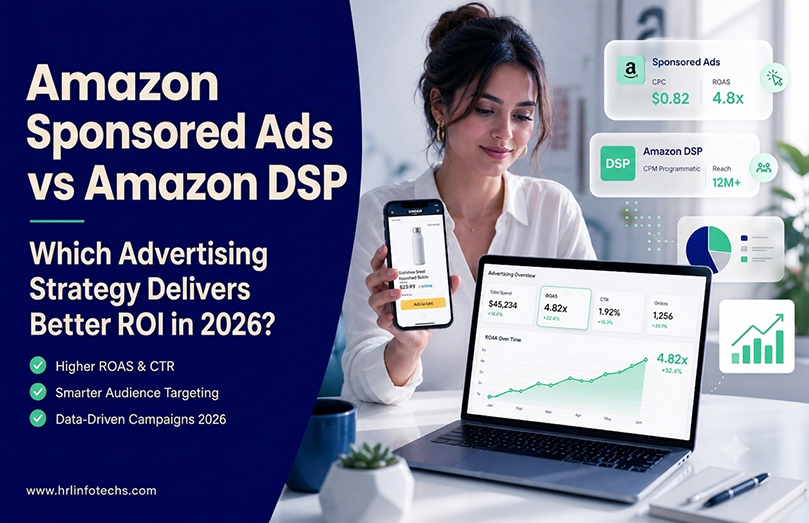
Amazon Sponsored Ads vs Amazon DSP: Which Advertising Strategy Delivers Better ROI in 2026?


An ecommerce brand selling on Amazon India spent eighteen months running only Sponsored Ads. Sales were steady. ACoS sat around 22%, comfortably profitable. Then a private label competitor entered the category with a near-identical product at a similar price, and the brand’s growth flattened within two quarters, not because their campaigns got worse, but because Sponsored Ads alone had no answer for a competitor building awareness before shoppers ever typed a search term.

The brand added a modest DSP retargeting campaign six months later. Within one quarter, repeat purchase rate increased, and their branded search volume, people typing the brand name directly rather than a generic category term, grew 31%. Sponsored Ads had never been the wrong choice. It had simply never been the complete answer.

This is the real question behind Amazon Sponsored Ads vs Amazon DSP in 2026, not which one wins, but which one is solving the specific growth problem a brand actually has right now.

Understanding Amazon Sponsored Ads

Amazon-sponsored ads represent keyword-targeted placement opportunities on search result pages and product pages, targeting active customers searching for similar goods, with purchase intent, and at the highest stage of the purchasing funnel.

A successful Amazon Sponsored Ads strategy should focus on selecting the right keywords, optimising listings, increasing conversion rates, and adjusting bids based on performance. Moreover, because such advertising initially targets those already interested in the product, it helps generate sales more quickly.

Sponsored ads are most useful for such purposes as introducing new products, creating sales, increasing a website’s traffic due to their velocity, and taking advantage of narrow promotional opportunities where timing is more important than building brand awareness. For most small and mid-sized Amazon India sellers, Sponsored Ads remain the correct starting foundation on which the e-commerce brand built eighteen months of profitable growth on this alone before hitting its ceiling.

What Is Amazon DSP?

Amazon DSP advertising operates differently at a fundamental level. Rather than waiting for a keyword search, DSP uses audience data, shopping behaviour, demographics, and browsing history to place targeted display and video ads on Amazon-owned properties, third-party websites, mobile apps, and streaming platforms.

Amazon DSP for brands is valuable for building brand awareness before product searches, retargeting those who viewed a listing but didn’t purchase, remarketing to those who abandoned a cart, reaching out to new customers with your product, and for premium brand-building creative. This is exactly the opportunity that the E-commerce brand found that DSP does not wait for a customer to begin searching. It takes place before shoppers even start their search.

Comparing Advertising Objectives

Both platforms generate sales, but they solve different problems. Sponsored Ads capture demand that already exists in a shopper actively comparing products right now. DSP creates demand by introducing a brand before that search behaviour begins, supporting the upper-funnel influence that shapes decisions over a longer window.

Businesses needing immediate conversions typically prioritise Sponsored Ads. Brands focused on long-term acquisition and defending market position against new competitors, exactly the situation the appliance brand faced, which increasingly needed DSP as part of the mix, not as a replacement.

Which Platform Delivers Better ROI?

There is no universal winner when evaluating Amazon advertising ROI. Sponsored Ads typically produce stronger short-term returns because they target high-intent shoppers, with lower acquisition costs and faster, easier-to-measure sales.

DSP campaigns usually require larger investment and longer optimisation cycles, but contribute to brand recognition, retention, and repeat purchases that individual campaign metrics understate. The appliance brand’s 31% branded search increase never showed up as a direct DSP conversion; it showed up weeks later as improved Sponsored Ads efficiency, because more shoppers were now searching by brand name rather than generic category terms.

Evaluating ROI in isolation, campaign by campaign, misses this compounding effect. Evaluating it at the level of overall business growth reveals what each platform is actually contributing.

The Importance of Campaign Optimisation

Running ads without optimisation can drain profits on any platform. It means regular Amazon campaign optimisation to examine the search terms, audiences, bids, placements, creatives, and conversions.

This includes eliminating low-performing keywords, raising the cost for effective campaigns, and testing new audiences. In addition, teams should refresh their creative assets ahead of performance fatigue, evaluate their customer acquisition costs weekly (vs. monthly), and reallocate budgets depending on demand fluctuations throughout the year. Consistent optimisation is what separates advertising spend that compounds from spend that simply maintains a plateau, the exact plateau the appliance brand experienced before adding DSP.

Why Professional Campaign Management Matters

As Amazon advertising grows more sophisticated across both Sponsored Ads and DSP simultaneously, most internal teams struggle to manage both channels with the depth either requires. Professional Amazon PPC management brings dedicated expertise in campaign structure, keyword research, bidding strategy, and continuous reporting across both platforms.

Experienced specialists identify exactly the kind of growth ceiling the appliance brand hit, recognising when Sponsored Ads alone have plateaued and a DSP layer is the actual fix, rather than assuming the answer is simply higher Sponsored Ads bids on a strategy that has already reached its natural limit.

Building a Complete Ecommerce Advertising Strategy

Nowadays, the most successful advertisers already use a combination of channels to drive their sales instead of relying on one particular platform. To maximise revenues, they develop an integrated e-commerce advertising strategy that employs Sponsored Ads, DSP advertising, Brand Store optimisation, product content, SEO, and reviews management. All these tools are used to reach different audiences throughout the sales funnel.

Choosing the Right Solution for Your Business

Choose Sponsored Ads if you want short-term sales gains, faster keyword rankings, quicker product launches with instant ROI, and easier performance tracking. Choose DSP if your priority is building brand awareness, accessing non-Amazon channels, boosting customer retention, and preparing for competitive inroads. Note that most companies, like the appliance manufacturer mentioned, will likely need both types of advertising, though not necessarily simultaneously or in equal measure, as their business grows.

Conclusion

The debate around Amazon Sponsored Ads vs Amazon DSP is less about picking a winner and more about recognising which stage of growth your brand is actually in. Sponsored Ads capture active buyers and generate immediate conversions. DSP builds the brand recognition and retention that keeps a category competitor from quietly eating your growth the way it nearly did to the appliance brand before they adjusted their strategy.

At HRL Infotechs, we help businesses develop data-driven Amazon advertising services that combine strategic planning, performance analysis, and continuous optimisation across both Sponsored Ads and DSP. Whether your goal is immediate sales, long-term brand defence, or both together, our tailored approach is built to identify exactly which growth ceiling you are approaching before it becomes a plateau.

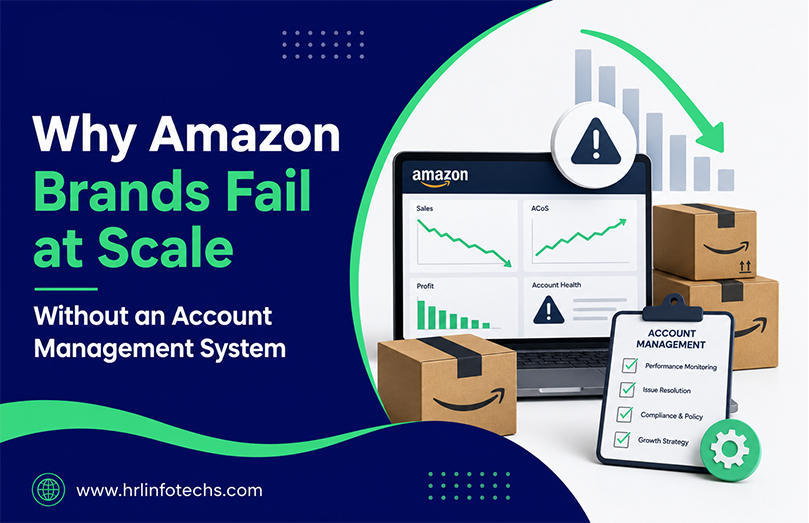
Why Amazon Brands Fail at Scale Without an Account Management System


Most Amazon brands have a good first year.

A product catches on, the ads start performing, and sales climb month over month. Everyone’s happy. Then, somewhere around month eight or nine, things that used to run smoothly start breaking quietly in the background.

Inventory runs out at the worst possible moment. Advertising costs creep up without anyone noticing why. A listing that was ranking well two months ago has slipped to page two. Customer complaints start showing up that nobody has time to chase down properly.

None of this happens because the product got worse. It happens because growth exposed gaps that were always there; they just weren’t visible when order volume was small enough to manage by memory. This is exactly the moment where real Amazon account management services stop being optional and start being the thing that decides whether a brand keeps growing or quietly stalls.

The brands that keep scaling and the ones that plateau usually aren’t separated by who has the better product. They’re separated by who built a system before they needed one.

Why Growth Creates Problems Nobody Saw Coming

In the early days, running a seller account is genuinely manageable solo. A handful of SKUs, a couple of ad campaigns, maybe an hour a day checking on things. That’s fine.

Here’s how it piles up. More ad campaigns mean more daily monitoring. Inventory guesses start carrying real financial weight. Listings demand constant tweaking instead of a one-time setup. Customer questions start overflowing whatever spare time used to exist. Account metrics deserve a much closer look than a glance. Performance data piles up faster than anyone can read it properly. Pricing decisions stop being something you can put off till next week.

Without a real Amazon seller growth strategy behind all of that, these things stop being manageable tasks and start becoming bottlenecks that quietly slow everything down.

The Costs Nobody Budgets For

A lot of sellers assume that more sales automatically mean things are going well. It’s not quite that simple.

Unmanaged growth tends to bring its own problems along with it: stock running out at the wrong time, ad spend climbing without a clear reason, account health numbers slipping, listings getting suppressed out of nowhere, conversion rates quietly dropping, and storage fees piling up on inventory that isn’t moving fast enough.

All of this works directly against sustainable Amazon business scaling, even while the top-line sales numbers might still look fine for a while. The brands without proper systems usually end up spending more time firefighting these issues than actually working on the next stage of growth.

Why Scaling Actually Requires a System

Growing a brand on Amazon isn’t just about selling more units. It’s about staying consistent while the operation gets bigger and messier.

Real growth depends on a few things working together: tight Amazon PPC management that doesn’t bleed budget, Amazon listing optimisation that treats every page as something living rather than set-and-forget, inventory planned instead of reacted to, and an honest read of the data instead of a gut-feel guess.

Without that, brands end up reactive. And here’s the part that catches people off guard: a small mistake that barely matters at ten orders a day becomes a serious problem once you’re doing a thousand. Scale doesn’t just multiply revenue. It multiplies the cost of every small thing you’ve been ignoring.

What an Account Management System Actually Does

A proper account management system puts structure around every part of the business that used to run on memory and good intentions.

Most times it involves watching how listings perform, staying aware of stock condition, tracking ad results closely, noticing price shifts before they cost money, reading what customers are actually saying, checking account numbers regularly, and keeping an eye on what competitors are doing, all gathered neatly in one place, updated consistently, rather than floating loose inside someone’s head.

With things finally clear, attention shifts naturally toward building the company, not just putting out morning emergencies.

The Marketplace Itself Keeps Getting Harder

Amazon today is a genuinely different environment than it was even two years ago.

New sellers show up in every category constantly. Advertising costs keep climbing. The search algorithm keeps shifting. Customers expect more than they used to, faster than they used to.

A sharp Amazon advertising strategy helps brands stay steady through all of that, not by avoiding the chaos, but by having enough operational consistency to absorb it without falling behind. Brands that don’t adapt tend to lose ground quietly to competitors who simply have better systems running underneath them.

Building Something That Actually Lasts

Short-term promotions and discount sprints can move the needle for a week. They don’t build a business.

Real Amazon sales optimisation is built around things that compound profitability, repeat customers, ad spend that’s actually efficient, inventory that’s planned instead of reactive, listings that keep improving, and a brand that’s actually building something recognisable over time.

The brands that focus on operational stability tend to outperform the ones chasing aggressive discounting or ad spend spikes, simply because stability is what survives past the first good quarter.

Why the Small Stuff Matters More Than It Seems

It’s rarely one big disaster that tanks an account. It’s usually a handful of small things compounding quietly.

A weak product title here. Incomplete backend keywords there. Inventory is running a little too low too often. Conversion rates are slowly drifting down. Ad costs are creeping up. A few unanswered negative reviews.

Catching these early is exactly what proper Amazon brand management is supposed to do, not after a quarterly review shows the damage already done, but continuously, before small issues turn into lost sales nobody noticed slipping away.

When It’s Time to Bring in Real Expertise

At some point, the operational demands of running an Amazon brand outgrow what an internal team can reasonably handle alone.

Most times, this is where real expertise across Amazon A+ Content Design, Amazon Storefront Design, advertising, inventory, and account standing actually starts mattering. The goal isn’t to swap out the people who built the brand. It’s to free them up to stay focused on products and customers, while someone else takes charge of the daily operational demands that have grown too heavy to juggle part-time.

A storefront that actually looks built, and A+ Content that actually explains the product properly, are the kind of things that get pushed aside when the team is stretched thin, and they’re exactly the things that quietly cost conversions when they’re missing.

Why This Never Really Stops

Amazon doesn’t sit still. Algorithms shift. Competitors adjust pricing overnight. What customers want changes. Ad costs go up and down without warning.

Real growth management isn’t a project you finish and walk away from. It’s ongoing, constant monitoring, constant small adjustments. The brands still growing two or three years from now will almost certainly be the ones that kept adapting the whole way through, not the ones that set something up once and assumed it would keep working forever.

Conclusion

Most Amazon brands that hit a wall didn’t fail because of a bad product or weak demand. They failed because growth introduced problems that a system would have caught, and they didn’t have one.

Real Amazon account management services give you the structure to handle inventory properly, keep listings sharp, run advertising efficiently, and protect account health before small issues turn into expensive ones.

At HRL Infotechs, this is genuinely what we help brands build: scalable systems backed by real account management, sharp PPC and listing strategy, strong A+ Content and Storefront work, and the kind of operational support that lets a brand grow without quietly falling apart in the background. As the marketplace keeps getting more competitive, the brands that invest properly in this now are the ones that’ll still be growing profitably a few years from today.

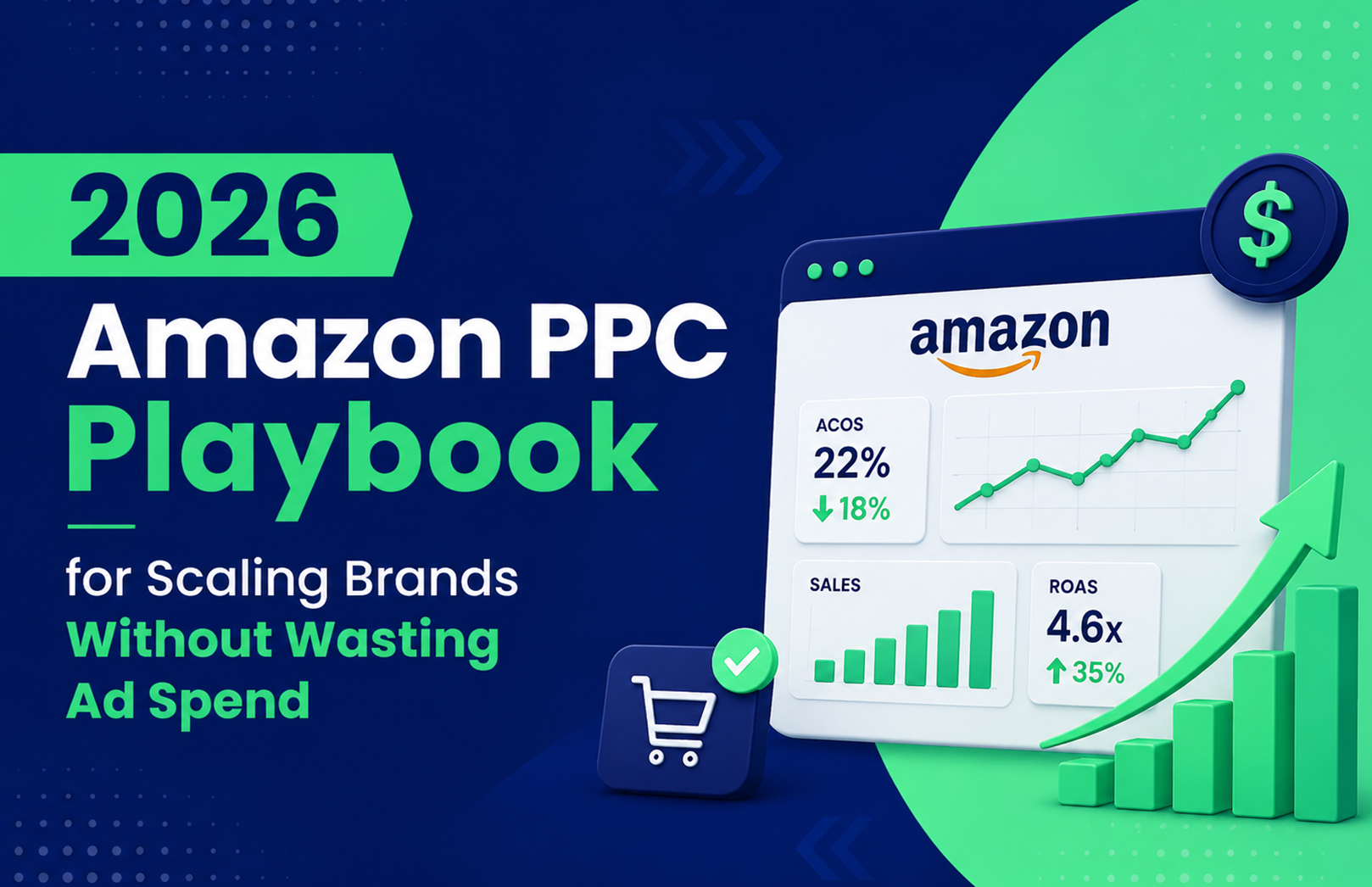
The 2026 Amazon PPC Playbook for Scaling Brands Without Wasting Ad Spend


A kitchenware brand selling on Amazon doubled its monthly ad spend between January and March 2025. Their revenue did not double. It grew 11%. Their ACoS climbed from 18% to 31%. By April, they were generating more gross sales than ever before and taking home less profit than the previous year.

This is the trap most Amazon sellers walk into when competition increases. The instinct is to spend more. The data almost always says spend smarter.

In 2026, the brands outperforming their categories are not the ones with the largest advertising budgets. They are the ones operating with a clear Amazon advertising strategy built around profitability, campaign structure, and continuous optimisation rather than budget increases alone.

Why Traditional Amazon Advertising No Longer Works

Back then, firing up large-scale automated ad runs worked just fine if you bumped budgets toward items showing sales. Less noise in the space meant cheaper clicks. Speed to rank leaned heavily on how much money moved, more than now. Spending power opened doors faster.

That environment no longer exists. Amazon PPC management in 2026 requires structure, intent alignment, and weekly optimisation discipline, as the cost of running unstructured campaigns has compounded alongside rising competition. Brands still running 2022-era campaign architecture in a 2026 competitive environment consistently experience the same outcomes: rising CPCs, declining ROAS, and budgets that generate activity without generating profit.

The playbook has changed. Most sellers have not changed with it.

Build Campaigns Around Business Goals First

The most common structural mistake is building campaigns before defining what success actually means for each product.

A product in the launch phase needs velocity and ranking data, not profitability optimisation. A mature hero product needs margin protection, not aggressive keyword expansion. A seasonal product needs structured planning, not year-round bid stability. Effective Amazon product listing and SEO management starts by defining the objective. Before opening any tools, figure out the goal. A single keyword can shift direction entirely – bidding too high when awareness isn’t needed pulls resources off track. Match type choices behave differently if growth or conversion is the target. Budget spread matters most when aligned with intent. Outcomes hinge not on setup alone but on whether strategy matches actual product stage.

Structure Amazon Sponsored Ads for Control and Measurement

Major difficulties start when every keyword gets dumped into one pile. Budgets get eaten by winners too fast, leaving little for newer ones trying to grow. Losing terms slip through because numbers look okay on paper – until money vanishes. Fixing it late costs more than planning early.

High-performing brands segment Amazon sponsored ads into four distinct layers. Automatic campaigns run continuously to capture new search term data without manual keyword input. Manual exact match campaigns isolate top-performing terms with dedicated budgets and precise bid control. Product targeting campaigns use competitor ASINs and complementary listings to intercept buyers mid-comparison. Brand defence campaigns protect branded search terms from competitor conquest.

One level handles one kind of goal. When needed, it can run faster, slower, or stop altogether. Put together, the pieces form a structure that tracks clearly, responds when nudged, and uses resources far better than lumped-together methods ever could.

Prioritise Amazon ACoS Optimisation Over Raw Spend Reduction

Amazon ACoS optimisation is widely misunderstood. Lower ACoS is not always the goal; it depends entirely on what the product needs at its current stage.

A launch into fresh categories might carry a 45% ACoS for two months – just long enough to gather reviews, lift visibility. Stop ads too soon, though, and the slow climb in natural search fades fast. Chasing the smallest number on performance reports misses the point entirely. What matters sits upstream: decide the correct cost per sale based on where the item stands now, well ahead of any ad run, rather than adjusting later under pressure.

Weekly search term report reviews, negative keyword additions, and bid adjustments based on conversion data rather than impression volume are what move ACoS in the right direction sustainably.

Listing Quality Determines How Far Your Budget Goes

No Amazon sales growth strategy survives a weak product listing. A perfectly structured campaign sending qualified traffic to a listing with poor images, a generic title, and missing social proof is simply an expensive way to generate impressions that do not convert.

Conversion rate is the multiplier on every advertising dollar. A listing converting at 12% generates three times the sales from the same traffic as one converting at 4% at identical ad spend. Start by making sure the product earns more spend first. An effective title packed with clear intent matters most. The main photo must show its worth even when tiny on screen. Bullet points work better when they ease concerns instead of just stating what’s included. Rich visuals and explanations build trust before checkout. Good ratings lower resistance to click buy now.  These are the conversion foundations that make Amazon PPC optimisation produce returns worth measuring.

Make Decisions From Data, Not Assumptions

The gap between brands that scale profitably and those that plateau at unprofitable scale is almost always data discipline, not budget size.

Weekly analysis of placement performance, top of search versus product pages versus the rest of search, reveals where conversion is strongest and where spend should concentrate. Click-through rate analysis identifies titles and primary images, creating search result friction before the listing even gets a chance to convert. Keyword profitability analysis at the individual term level surfaces the 20% of search terms generating 80% of profitable conversions, and the terms consuming budget without contributing revenue.

Small, consistent adjustments made weekly compound into significantly better performance than quarterly campaign overhauls made reactively when results have already deteriorated.

Why Professional Amazon Advertising Services Matter

As campaigns grow in complexity, the management overhead grows proportionally. Brands managing ten SKUs across four campaign types with weekly optimisation requirements across multiple marketplaces are running a specialist operation, not a side function of the marketing manager’s role.

Professional Amazon advertising services bring the structural expertise, platform access, and optimisation discipline that produce consistent performance improvement without requiring internal headcount to develop those capabilities from scratch. Combined with Amazon account management services that keep inventory, listing health, and account compliance supporting rather than undermining campaign performance, professional management typically pays for itself within the first ninety days of engagement.

The 2026 Amazon PPC Playbook

  1. Define the product-level objective before building any campaign
  2. Separate campaigns by intent: auto, manual exact, product targeting, brand defence
  3. Fix the listing conversion rate before scaling the budget
  4. Set ACoS targets based on product stage, not category averages
  5. Review search term reports and adjust bids weekly without exception
  6. Concentrate spending on the 20% of keywords driving 80% of profitable conversions
  7. Measure profitability at the product level, not blended account averages

Conclusion

The kitchenware brand, from the opening, restructured its campaign architecture in May 2025. Same products. Same marketplace. Reduced total ad spend by 22%. Revenue held within 8% of the previous peak. Profit margin returned to target within sixty days.

At HRL Infotechs, we help Amazon brands build exactly this kind of structured, profitable advertising operation combining strategic Amazon campaign management, continuous Amazon ACoS optimisation, and complete marketplace oversight into a growth system that scales revenue without proportionally scaling waste. The brands winning in 2026 are not outspending competitors. They are outthinking them.

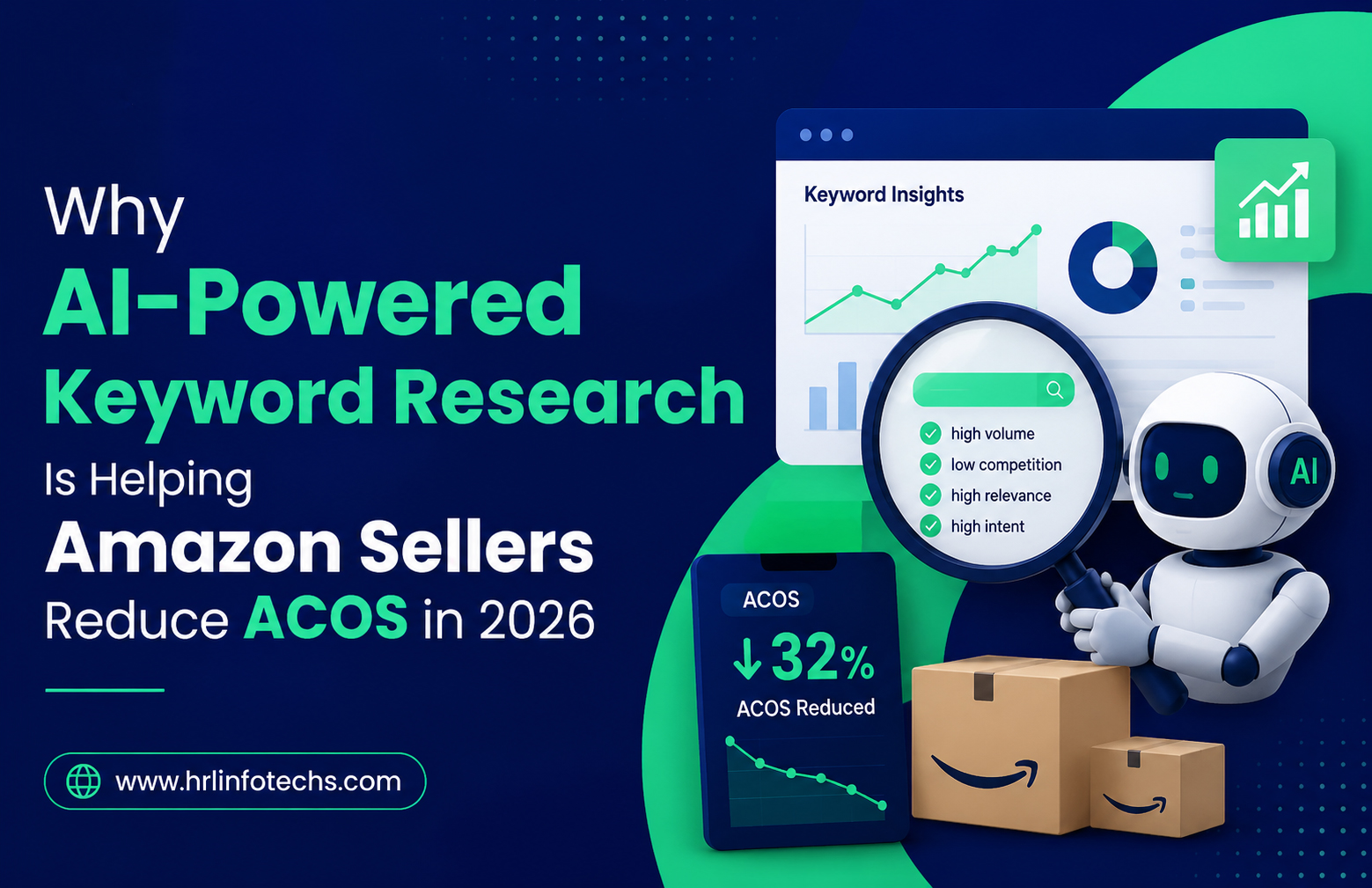
How AI-Powered Keyword Research Is Helping Amazon Sellers Reduce ACOS in 2026


Amazon advertising has become more competitive than ever in 2026. Rising CPCs, smarter competitors, and changing buyer behavior are forcing sellers to rethink how they manage PPC campaigns. Traditional keyword research methods are no longer enough for brands trying to scale profitably. This is where AI-powered keyword research for Amazon is creating a major shift.

Sellers are now using artificial intelligence to identify high-converting keywords, eliminate wasted ad spend, and improve campaign targeting faster than manual research ever allowed. Instead of spending hours analyzing spreadsheets and search term reports, AI tools are helping advertisers make real-time decisions based on customer intent and performance data.

Recent industry reports show that AI-driven PPC optimization helps sellers uncover hidden search trends, automate keyword clustering, and improve bidding accuracy for better advertising efficiency.

How AI-Powered Keyword Research Works for Amazon PPC

AI-powered keyword research for Amazon uses machine learning and automation to analyze millions of shopper search queries, competitor listings, and ad performance signals. These tools identify patterns that are difficult to detect manually, especially when managing large product catalogs or multiple campaigns.

Unlike traditional Amazon PPC keyword research, AI systems continuously monitor keyword performance and buyer intent. They can quickly identify which search terms generate conversions and which keywords are draining budget without producing sales. This allows sellers to focus only on profitable traffic sources.

Modern Amazon keyword research tools also evaluate seasonal demand trends, click-through rates, search intent, and competitor movements. Instead of relying on guesswork, sellers receive data-backed recommendations that improve campaign precision and help lower ACOS on Amazon.

Why Manual Keyword Research Is No Longer Effective

Manual keyword research may still work for small sellers with limited campaigns, but it becomes inefficient as advertising budgets grow. Managing hundreds of keywords manually often leads to delayed optimizations, irrelevant targeting, and wasted ad spend.

One of the biggest problems with traditional research methods is the inability to process large amounts of search term data quickly. Amazon shoppers constantly change their search behavior, and trends can shift within days. Sellers relying only on spreadsheets or basic reports often react too late.

AI tools for Amazon sellers solve this problem by automating keyword discovery and performance analysis. They instantly identify negative keywords, profitable long-tail terms, and emerging search opportunities. This level of automation helps improve Amazon advertising optimization while reducing unnecessary spending.

How AI Helps Reduce ACOS Amazon PPC Campaigns

Reducing advertising cost of sales requires more than simply lowering bids. Successful Amazon PPC optimization 2026 strategies focus on improving keyword relevance and conversion quality.

AI systems help sellers reduce ACOS Amazon PPC campaigns through:

Smarter Keyword Targeting

AI tools analyze customer intent instead of focusing only on search volume. This helps sellers target keywords with higher purchase probability rather than broad traffic terms that waste budget.

Automated Negative Keyword Detection

Many campaigns lose money because irrelevant search terms continue spending without conversions. AI identifies poor-performing keywords automatically and recommends exclusions to prevent wasted clicks.

Real-Time Bid Adjustments

Advanced Amazon PPC management platforms use AI to optimize bids based on performance trends, competition, and conversion likelihood. This improves ad efficiency without constant manual intervention.

Long-Tail Keyword Discovery

Long-tail keywords usually have lower competition and stronger buyer intent. AI-powered Amazon seller keyword research tools uncover these hidden opportunities faster than manual analysis.

Industry research in 2026 highlights that automated keyword optimization and negative keyword filtering significantly improve PPC profitability for growing sellers.

The Role of Search Term Analysis in Amazon Advertising Optimization

One of the most valuable benefits of AI is advanced search term analysis. Campaign keywords alone do not reveal how customers actually search on Amazon. Search term data provides deeper insight into buyer behavior and conversion intent.

AI platforms analyze thousands of search queries to identify patterns that human analysts often miss. For example, two search terms may appear different but reflect the same purchase intent. AI groups these related terms together to improve targeting efficiency.

This process helps sellers improve:

  • Sponsored Products campaigns
  • Sponsored Brands targeting
  • Product listing optimization
  • Backend keyword relevance
  • Negative keyword management

Better search term analysis also improves overall Amazon advertising optimization because campaigns become more aligned with real customer behavior instead of assumptions.

Best Practices for AI-Driven Amazon PPC Optimization 2026

Using AI alone is not enough. Sellers still need a structured strategy to maximize campaign performance.

Combine AI Insights With Manual Oversight

Automation works best when paired with human decision-making. Sellers should regularly review campaign goals, profit margins, and product performance alongside AI recommendations.

Focus on Conversion Data Instead of Traffic Volume

High search volume keywords do not always generate profitable sales. Prioritizing conversion-focused keywords helps improve ROAS and lower ACOS on Amazon over time.

Build Separate Campaign Structures

Separating branded, non-branded, and competitor campaigns allows AI systems to optimize performance more accurately. Structured campaigns produce cleaner data and better optimization opportunities.

Continuously Refresh Keywords

Buyer behavior changes frequently. AI-powered keyword research for Amazon should be an ongoing process rather than a one-time setup.

Why AI Keyword Research Is Becoming Essential for Amazon Sellers

The Amazon marketplace is becoming increasingly data-driven. Sellers who continue using outdated keyword research methods risk overspending on ineffective traffic while competitors gain better visibility through automation.

AI tools for Amazon sellers are helping businesses scale campaigns more efficiently by improving targeting accuracy, identifying profitable search trends, and reducing wasted spend. This creates a significant advantage in highly competitive categories where every advertising dollar matters.

More importantly, AI helps sellers make faster decisions. Instead of manually reviewing reports for hours, advertisers can quickly act on performance insights and focus on business growth strategies.

Conclusion

Amazon PPC is evolving rapidly, and successful sellers in 2026 are relying on smarter advertising strategies powered by artificial intelligence. AI-powered keyword research for Amazon is helping brands improve targeting precision, discover high-converting search terms, and eliminate wasted ad spend that increases ACOS.

As competition and CPC costs continue to rise, businesses that adopt advanced Amazon PPC optimization 2026 strategies will have a stronger advantage in scaling profitable campaigns. For sellers looking to improve campaign performance, lower ACOS on Amazon, and build a more data-driven advertising strategy, The HRL Infotechs can help deliver smarter Amazon PPC management solutions designed for long-term growth.

Amazon Account Management Services in Gujarat for Scalable Growth


If you talk to Amazon sellers in Gujarat long enough, a familiar pattern emerges. Sales start well. A few products gain traction. Reviews come in. Then… growth stalls. Ads get expensive. Listings slip down the rankings. Account health warnings pop up at the worst possible time.

At that point, most sellers realise something important: running an Amazon business is no longer a side task. It’s an operation. And operations need systems, experience, and constant attention.

That’s precisely where Amazon Account Management services come into the picture, especially for businesses in Gujarat that want scalable, sustainable growth rather than short-term spikes.

Why Gujarat Sellers Are Turning to Amazon Experts

Gujarat has long been a hub for trade. Textiles, jewellery, manufacturing, private labels, and entrepreneurship are part of the culture here. Naturally, many local brands have moved to Amazon to reach a national (and global) audience
.

But Amazon in 2025 is not Amazon from five years ago. Today, success depends on understanding algorithms, advertising efficiency, compliance, account health, and making data-driven decisions.

This is why Amazon account management services in Gujarat are no longer “nice to have.” They’re becoming essential for sellers who want to compete seriously.

What Amazon Account Management Actually Covers

Many sellers assume account management means uploading products and checking orders. That’s a small slice of the pie.

Professional Amazon seller account management is a combination of strategy, execution, and daily optimisation. It usually includes:

  • Product listing creation and maintenance
  • Keyword research and ranking strategy
  • Advertising setup and optimisation
  • Inventory and pricing coordination
  • Performance tracking and reporting
  • Policy compliance and issue resolution

Think of it less as outsourcing work and more as adding a specialised Amazon team to your business.

The Real Value of Local Expertise in Gujarat

Here’s something sellers often overlook: local context matters.

Agencies that understand Gujarat’s business ecosystem know:

  • Seasonal demand patterns
  • Common supplier and logistics challenges
  • Pricing sensitivities in competitive categories
  • How fast-growing local brands operate

When you work with a team like HRL Infotechs, that local understanding blends with platform expertise. It’s not generic advice; it’s practical, market-aware execution.

Amazon Listing Optimisation: Where Growth Usually Starts

Most underperforming Amazon accounts share one issue: weak listings. Not bad listings. Just average ones. Effective Amazon listing optimisation services go beyond adding keywords. They focus on:

  • Search intent, not keyword stuffing
  • Conversion-focused titles and bullet points
  • Straightforward visual storytelling through images
  • Backend search term optimisation

Small changes here often lead to noticeable improvements in both organic ranking and ad performance. It’s usually the fastest win for struggling accounts.

Amazon PPC Management: Controlling Spend, Not Just Traffic

Ads are powerful. Ads are expensive. Both statements are factual.

Without proper management, Amazon PPC becomes a money drain. With the right approach, it becomes a growth engine.

Professional Amazon PPC management services focus on structuring campaigns logically, identifying high-converting keywords, cutting wasted spend early, and scaling only what’s proven.

A good PPC isn’t about spending more. It’s about spending smarter and knowing when to pause instead of pushing.

Store Management: Scaling Without Chaos

As product counts grow, complexity increases. Inventory issues, suppressed listings, and pricing mismatches don’t announce themselves. They quietly damage performance.

That’s where Amazon store management services come in.

Daily monitoring ensures:

  • Listings stay compliant
  • Stock levels remain balanced
  • Buy Box issues are resolved quickly
  • Account health metrics stay in the safe zone.

For growing Gujarat-based sellers, this kind of oversight often prevents costly disruptions before they happen.

Why DIY Amazon Management Stops Working at Scale

Many sellers start out managing Amazon themselves. And honestly, that’s fine, at the beginning.

But as order volumes increase, the margin for error shrinks.

  1. One missed policy update.
  2. One poorly optimised ad campaign.
  3. One ignored performance notification.

Suddenly, revenue dips or accounts face restrictions. Professional Amazon Account Management exists to reduce these risks while freeing business owners to focus on sourcing, branding, and expansion.

How Amazon Account Management Supports Scalable Growth

Scalability isn’t just about selling more units. It’s about building systems that can handle growth without breaking.

Strong Amazon account management helps by:

  • Creating repeatable optimisation processes
  • Using data to guide decisions
  • Preparing accounts for seasonal spikes
  • Planning ad budgets strategically
  • Supporting category expansion

Growth feels less chaotic when someone is watching the dashboard every day.

Choosing the Right Amazon Partner in Gujarat

Not all service providers are equal. Before committing, sellers should look for transparent reporting, clear communication, proven Amazon-specific experience, and custom strategies (not templates)

HRL Infotechs focuses on building long-term partnerships rather than one-size-fits-all solutions, something that matters when your Amazon store becomes a significant revenue channel.

Common Myths About Amazon Account Management

“It’s only for big sellers.”

Not true. Many small and mid-sized sellers benefit the most because they can’t afford mistakes.

“I’ll lose control of my account.”

A good partner works collaboratively, not secretly.

“Results should be instant.”

Amazon’s growth is cumulative. Sustainable results take consistency, not shortcuts.

Final Thoughts: Amazon Growth Is a Process, Not a Hack

Selling on Amazon today is less about luck and more about execution. The platform rewards structure, relevance, and discipline.

For Gujarat-based businesses aiming to grow beyond trial-and-error selling, professional Ecommerce account management services in Gujarat provide clarity in a complex ecosystem.

With the right mix of listing optimisation, advertising control, and daily management, Amazon becomes what it’s meant to be: a scalable growth channel, not a constant stress point.

And when growth starts feeling organised instead of overwhelming, that’s usually a sign you’re doing something right.

Why Should You Hire the Amazon PPC Management Services for Your Business


Whenever we discuss managing Amazon advertising campaigns, what precisely do we presume? An Amazon advertising company often supervises and controls a label’s PPC campaign plan and advertising budget to increase sales and enhance business outcomes. The best  Amazon PPC advertising agency, like HRL Infotechs, looks at all facets of your Amazon profile to assist you in maximizing your Amazon advertising strategy and controlling your ad budget. They enhance your advertising strategy by utilizing tested techniques that boost sales and brand recognition.

Amazon PPC management services include:

  • Study and selection of keywords
  • Optimizing campaign strategy and targeting
  • Project cost management and PPC advertising bid modification
  • Analyzing and adjusting for patterns and seasonality in the marketplace
  • Monitoring and analysis of campaigns
  • Expert advertising specialists provide guidance and essential insights.

Take Advantage of Amazon PPC Management Services for These 5 Reasons

The complexity of Amazon’s marketing is more significant than most people realize. As they seek to develop their brands and sell more products, millions of competing retailers strive for consumer attention. Although if you invest much money in promoting, there is no assurance that your business will attract more clients or boost sales. Your advertisements are unlikely to be successful without the need for a competent Amazon ad plan. You’ll wind up investing significant money and time with little to show for ROI.

Many Amazon merchants use ad managing platforms to avoid wasting time and money. Improve the efficiency of your marketing spending. Using Amazon PPC management services can be beneficial if you’re troubled with:

  • Establishing precise, attainable marketing objectives.
  • Creating a marketing plan that is well-organized and meets your company’s needs.
  • Get a decent return on the money you spend on advertising (RoAS).
  • Enhanced earnings.
  • Raising incomes while lowering ACoS.
  • Keep a close eye to other crucial company activities.

Following are five tactics used daily by Amazon PPC management services to enable e-commerce retailers’ goods to arrive at the head of the page.

1. Complete Keyword Study and Evaluation to Cut Down on Wasted Advertising Spend

Successful PPC ads aim to get your adverts placed in front of customers who are currently looking for a commodity similar to yours. One keyword technique is crucial since you’ll be squandering dollars on clicks that won’t result in a purchase without it.

Broad match, exact match, or phrase match are the ideal keyword match types to use when optimizing Amazon Sponsored Ads for relevance and budget. To reduce unnecessary advertising costs and boost revenue, PPC experts use patented keywords utilized by the researchers and an optimization approach to developing customized keyword bidding strategies.

2. To Increase Marketing ROI, Apply Negative Keyword Matching

Unflattering terms must be eliminate using negative matching to maximize your returns on ad expenditure.

Negative keywords can prevent you from spending for clicks unlikely to result in a purchase. You and Amazon should not wish your adverts to be display before a group of unsuitable customers.

Negative keywords instruct Amazon not to display your adverts when people look for items using such terms or keywords. For example, including “women’s jeans” as a negative keyword may save you from overspending on searches irrelevant to your products if your company only sells men’s jeans.

Negative keyword matching is one of the most useful tactics in Amazon’s advertising toolbox. If you want to find the keywords that are wasting your dollars, you may study your campaign information in great detail with a professional advertising agency.

3. Create a Successful Amazon PPC Bidding Plan to Boost Revenue

Improve your bidding strategy, and it’s like making modifications to an automobile. It takes perseverance, expertise, and regular updates to ensure everything goes as planned. You’re going to face many issues if you ignore them. Think of Amazon advertising professionals as your handyman. They could help by providing your bidding strategy with a critical eye, as they understand how PPC advertising works internally.

Hire the amazon PPC management experts and increase your sales today

4. Maintain Competitive Advantage Through Observation of Your Rivals

The goal of competitive research is to explore your rivals’ performance and then determine and plan the strategy through which your Amazon firm can outperform them.

The detailed competitive analysis identifies your main rivals, what they are undertaking to succeed, and how vigorous your marketing strategy has to be to beat rivals to Amazon’s Buy Box.

For instance, you may have to choose between competing directly by bidding on identical terms and focusing on inquiries that your rivals ignore.

You may learn which keywords are functioning effectively, which searches have been most frequently used, and whether any keywords are being underutilized by attentively going through your statistics. You’ll have a much greater understanding after doing that. Following that, you’ll better understand search traffic, keyword rankings, and ad positioning.

The weaknesses you may exploit will be shown by fusing these Amazon sales skills with data on your leading rivals. The main issue is that this procedure necessitates a significant amount of time and takes much skill to complete appropriately.

Many firms employ Amazon PPC management services to remain one step forward in the game.

They’ll assist you in monitoring your Amazon SEO, aid you in positioning for popular search terms that none of your rivals is utilizing, enhance your total gain on investment and promote revenue.

5. Examine Amazon Ad Campaigns for Constantly Greater Efficiency

How frequently have online shopping carts for your products been abandoned? What proportion of clicks resulted in a purchase? What was the percentage of brand-new purchases?

Moreover, who intends to keep a record of all that?

Few individuals desire to pass their lives looking at spreadsheets. Analyzing the effectiveness of your Amazon PPC advertising takes time, but it’s an essential step in the process of getting better outcomes. The primary objective of Amazon PPC management firms is to ensure the overall wellness of their customers’ businesses. As a result, companies also track and analyze marketing efficiency and Amazon PPC management cost throughout to determine how modifications to the advertising affect profits and revenues.

Lastly

Hiring HRL InfoTech’s Amazon PPC management service provider and best ecommerce marketing agency can bring many benefits to your business. These services have the expertise and experience to optimize your PPC campaigns, resulting in increased visibility, higher conversion rates, and lower cost-per-click. Additionally, they can track your campaign performance and adjust strategies as needed to ensure maximum return on investment. Furthermore, they stay up-to-date with the latest Amazon advertising trends and algorithms, ensuring that your campaigns are always running effectively. By outsourcing Amazon PPC management, you can concentrate on other significant elements of your company while letting the experts handle the technical details of advertising on the platform.