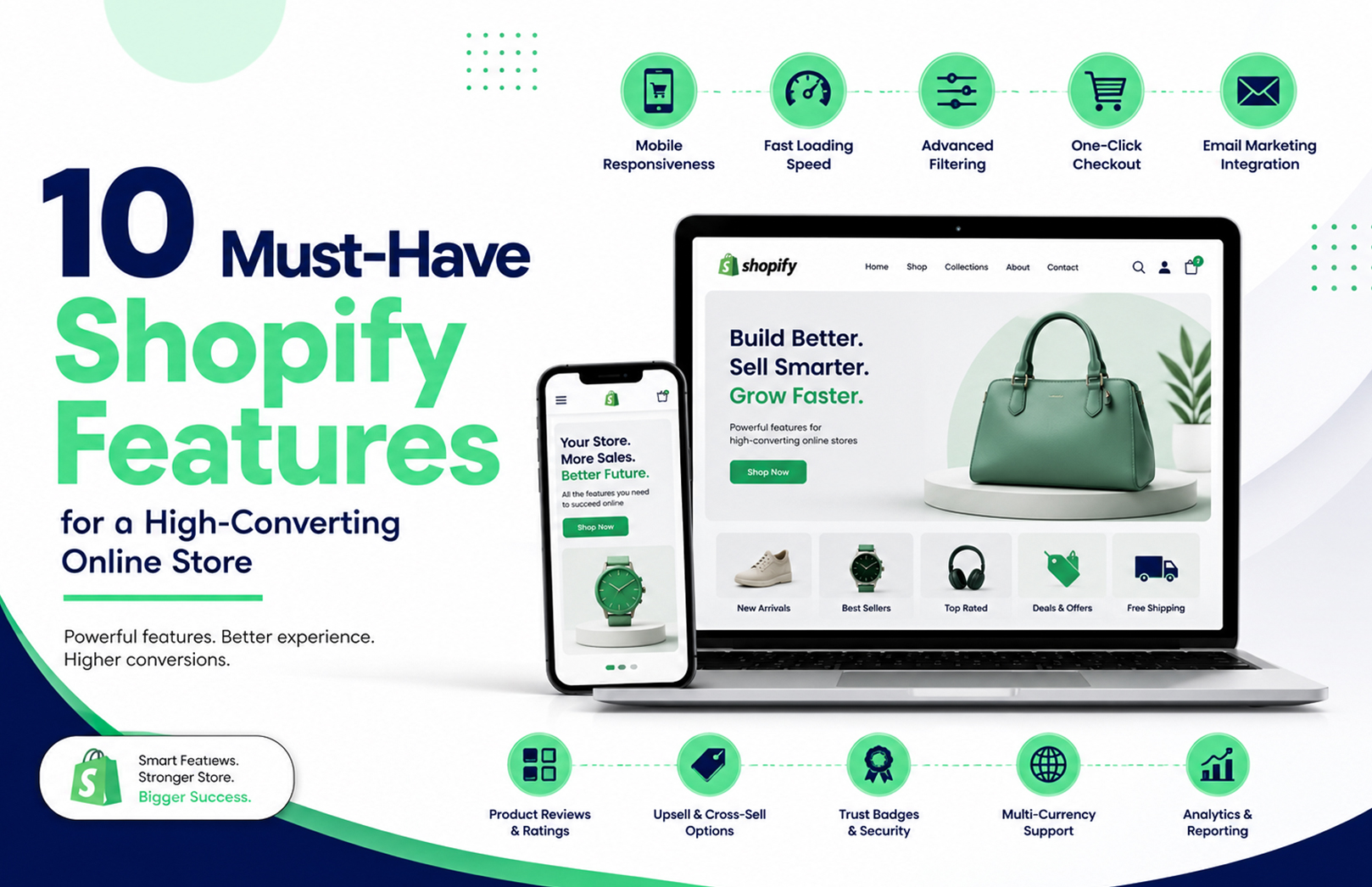
10 Must-Have Shopify Features for a High-Converting Online Store


Two stores sell the same product at the same price, have similar traffic, allocate comparable ad budgets, and offer identical goods, but one store makes sales at a rate of 1%, while the other hits 4%. What gives? The critical difference lies in the short period from the user’s arrival on the page to the moment they decide to make a purchase.

That gap is rarely about the product. It’s almost always about the store itself. Here are the ten features that genuinely separate a store that just exists from a high-converting Shopify store that actually earns the sale.

1. A Checkout Built for Speed, Not Just Function

Every extra field, every click, every moment of confusion, is a chance for your customer to abandon the cart. By offering Shop Pay, one-page checkout and saved payment information in general, you’re removing roadblocks for them.

This single optimisation feature oftentimes is where you are going to be able to see the most conversions from real Shopify conversion optimisation work, and this is because checkout abandonment is frequently the single largest conversion leak in the whole sales system. It is also frequently the simplest problem to actually fix.

2. Mobile-First Design That Doesn’t Feel Like an Afterthought

Over 75% of Indian e-commerce traffic is now mobile, but many stores are still desktop-first, squeezed onto a smaller screen afterwards.

A true mobile-first development considers bigger touch targets, smaller image sizes, and a more natural scrolling experience than what was technically possible by default in a responsive theme.

3. Product Pages That Answer Questions Before They’re Asked

The most effective product pages are those that recognise and answer hesitations up front, instead of making customers wade through menus and tabs searching for the information they need to complete a purchase

Sizing, materials, estimated delivery dates, and nuanced explanations of what makes something special should all be included directly on the page as opposed to in a policy link buried three layers deep in the checkout process.

4. Genuine Site Speed, Not Just a Passing Lighthouse Score

A 1-second delay is a huge issue; it is a deal breaker for conversions. The cause of such a slowdown on Shopify, in particular, is often the presence of too many apps, unoptimized images, and themes with much more code than necessary to perform the required functions.

This is exactly the kind of technical detail real Shopify store optimisation addresses, not chasing a perfect score on a testing tool, but genuinely lightening the load for everyday visitors browsing on spotty connections and everyday mobile data. 

5. Trust Signals Placed Where Hesitation Actually Happens

Reviews, secure payment badges, and clear return policies don’t do much sitting only on a dedicated “About Us” page nobody visits before buying. They need to appear exactly where a shopper is deciding whether to trust this specific store with their money, right on the product page and again at checkout.

For newer D2C brands especially, this is often the single biggest lever available, because trust is the actual currency being spent in that final decision moment, more than price ever is.

6. Smart Product Recommendations That Feel Genuinely Relevant

“Customers also bought” sections only work when the suggested products are actually relevant to users, as opposed to randomly generated from the same collection.

A well-developed Shopify ecommerce solution uses genuine purchase data to drive revenue-growing product suggestions, ensuring that the average order value is increased organically without annoying customers with irrelevant upsells

7. Search That Actually Understands What Customers Are Typing

Native Shopify search is genuinely limited; it often misses typos entirely and struggles badly with synonyms a real customer would naturally use.

Upgraded on-site search has a direct effect on conversion because the person searching knows what they are looking for and is prepared to buy. If a potential buyer is searching for something that we have but not showing up on our site, we are making a huge mistake by not supplying that information to them at the most crucial moment of the sale.

8. Custom Functionality Built Around How the Business Actually Works

Standard Shopify apps solve generic problems reasonably well. They rarely solve the specific workflow quirks of an individual business: a particular bundling logic, a loyalty structure, a subscription model that doesn’t fit any existing template.

This is exactly where custom Shopify development earns its cost by building functionality shaped around how a business genuinely operates, instead of forcing the business to bend awkwardly around whatever a generic app happens to allow.

9. Post-Purchase Flows That Actually Build Repeat Customers

Conversion does not end with a customer’s payment being processed. What happens right after order confirmation, shipment status updates, and a sincere “thank you” experience determines whether the customer will return for another purchase.

Stores treating this moment as an afterthought are consistently leaving real retention value on the table, value that costs considerably less to capture than acquiring an entirely new customer through paid ads.

10. Analytics That Actually Show What’s Working

You can’t fix what you can’t see. Comprehensive event tracking, heatmaps, and funnel analysis allow you to identify the exact points of abandonment – instead of having to guess in the dark.

This simple addition transforms your e-commerce store optimisation from a one-time audit into an ever-evolving, continuous process.

Why These Features Rarely Work Well in Isolation

Here’s the part most sellers miss: these ten features are genuinely compound. A fast site with a confusing checkout still loses sales. Great product pages with weak trust signals still create hesitation at the worst possible moment. This is exactly why real Shopify features for online stores need to be considered together as one connected system, not treated as a checklist to tick off independently, one feature at a time.

Getting all ten right simultaneously is genuinely difficult to manage internally, especially for a growing brand already stretched thin managing inventory, marketing, and day-to-day operations. This is precisely where professional Shopify development services earn their place: not building a store that merely looks polished, but one that’s genuinely engineered to convert from the very first visit.

Why This Matters Even More for Growing Indian Brands

Indian D2C brands are growing at an unprecedented rate, and the competition is becoming tougher every day by leaps and bounds. A store that converts at 2% instead of 1% has twice the impact as far as the ad budget is concerned.

This is exactly why serious Shopify ecommerce development goes well beyond simply picking an attractive theme and calling the job finished. It means genuinely understanding how Indian shoppers specifically browse, hesitate, and ultimately decide to buy, then building every single feature above around that real behaviour, not around generic best practices copied from a Western market with entirely different shopping habits.

Conclusion

A high-converting Shopify store was never really an accident, and it was never solely about the product being sold either. It’s the accumulated result of ten specific decisions, made deliberately and working together as one coherent system rather than ten disconnected checkboxes.

At HRL Infotechs, our ecommerce website development services are built around exactly this principle, treating conversion as genuine engineering, not decoration applied at the end. Whether that means a full custom build or targeted optimisation of an existing store, the goal stays consistent throughout: a Shopify store built to convert from day one, not one that simply looks the part while quietly underperforming behind the scenes.
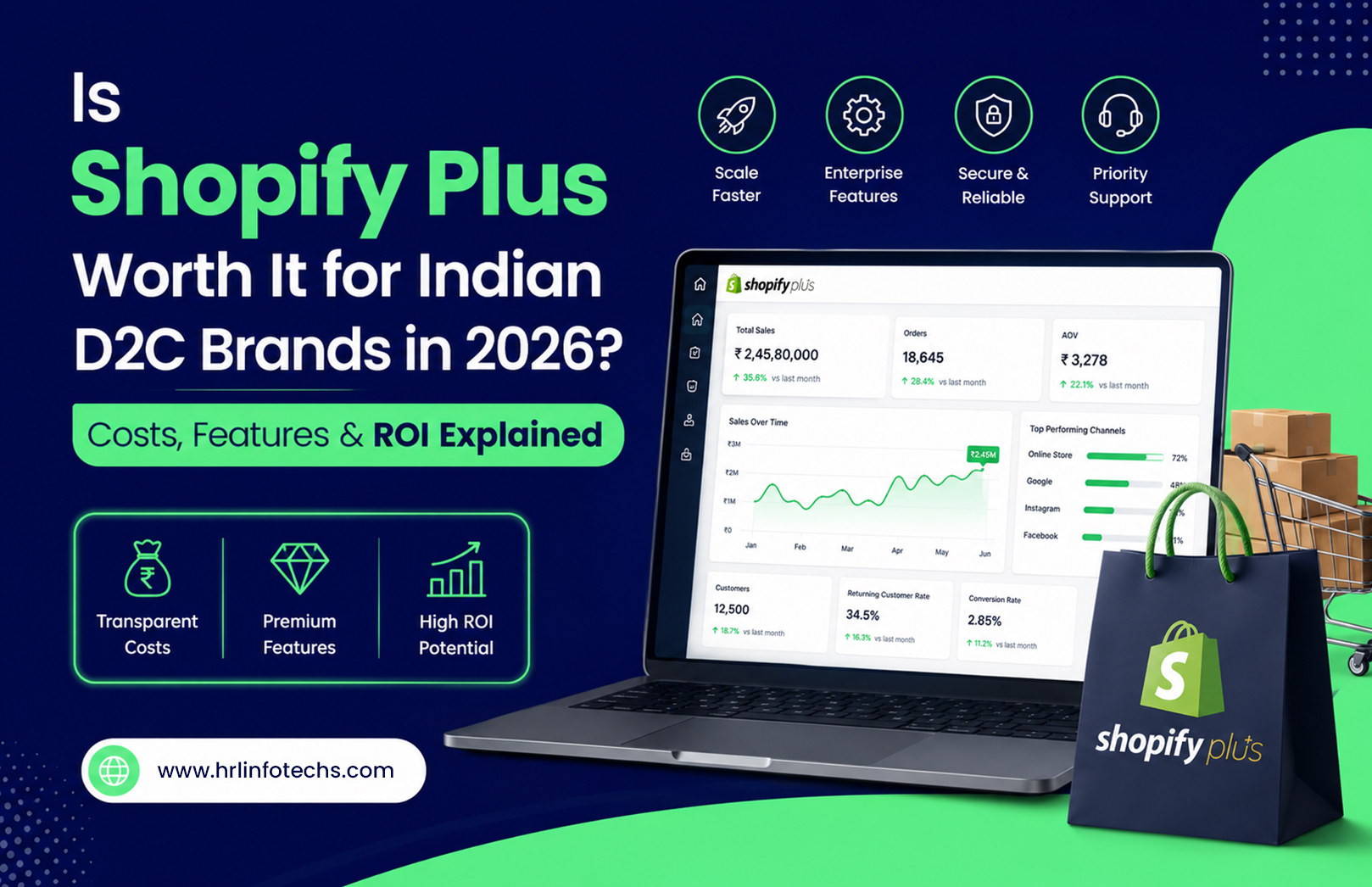

Is Shopify Plus Worth It for Indian D2C Brands in 2026? Costs, Features & ROI Explained


India’s D2C space is moving fast right now. Brands are scaling quicker than most teams can actually keep up with operationally. And at some point, almost every growing business hits the same wall, the platform that worked fine at ₹10 lakh a month starts genuinely struggling at ₹1 crore.

That’s usually when the question comes up: Is Shopify Plus worth it, or is this just an expensive upgrade for features you don’t really need?

It is all relative and depends on the specific use case. Shopify’s standard plans are great for start-ups and small-scale operations, whereas the increased complexity of the catalogue, order-processing volume, and other elements makes the ROI more difficult to achieve. If your business has an aspiration to grow significantly in 2026, understanding whether Shopify Plus for Indian D2C brands actually makes sense is worth thirty minutes of your time.

Why Indian D2C Brands Are Growing This Fast

Consumer behaviour in India has witnessed a dramatic change in the past few years. Internet shopping has penetrated even the remotest parts of the country, and the customers now expect the same seamless digital experience everywhere.

As enterprises continue to evolve in a landscape where they sell across markets, through social commerce, apps, and their website, complexity grows exponentially. Inventory fit for all channels, personalised experiences, frictionless checkout, and marketing automation that actually converts: brands are realising that to scale efficiently, it’s time to consider enterprise solutions to power their growth.

What Shopify Plus Actually Is

Shopify Plus India is the enterprise tier built specifically for brands running large catalogues, heavy traffic, and genuinely complex operations.

It is not about new functionality on the standard plan; it is about customisation, full automation, extended support, and infrastructure for scalability. The idea is to optimise the business process while providing a significantly better customer experience.

Is the Price Actually Justified?

Shopify Plus pricing in India is the number that scares people off before they’ve even looked at the value side of the equation. Enterprise platforms cost more than entry-level tools; that part’s obvious.

But the cost of a subscription is not the only criterion when comparing products. The most important factors should be the increase in efficiency, the reduction of manual processes, conversion rates, and revenue growth after achieving the point where the selected solution is no longer a limiting factor.

For brands doing serious monthly revenue, these gains routinely outweigh what the platform costs. For brands still finding their footing, they usually don’t yet.

What Actually Sets Shopify Plus Apart

A handful of things genuinely separate this from the standard plan.

Real automation. 

Order tagging, inventory workflows, customer segmentation, promotional campaigns, all of it can run without someone manually clicking through it every day.

A checkout that doesn’t lose people.

A faster, smoother checkout genuinely reduces cart abandonment, and that alone can move revenue meaningfully.

Room to actually customise. 

Growing brands often need a storefront that doesn’t look like every other Shopify store out there. Plus gives you the flexibility to build that.

Stability when traffic spikes hard. 

Flash sales, festive campaigns, and a viral influencer moment send traffic through the roof in minutes. Shopify Plus is built to hold steady through that, not buckle under it.

When Does an Upgrade Actually Make Sense?

A Shopify store upgrade becomes worth it when you’re genuinely hitting operational limits, not just when a competitor mentions they upgraded, and you feel like you should too.

The real signs: order volumes growing steadily, multiple warehouses to manage, a catalogue that has grown beyond your current capabilities, marketing complexity that is too time-consuming to manage manually, impending international expansion, or multi-channel selling.

If manual processes are genuinely the thing slowing growth down, upgrading stops being an expense and starts being a strategic move.

What Actually Supports Long-Term D2C Growth

Good product pages alone don’t build a lasting D2C business.

Prominent D2C ecommerce growth requires a tech-stack that is efficient, a website that loads rapidly, a customer experience that is tailored rather than generic, marketing automation that can do the heavy lifting, lean operations, and infrastructure that doesn’t need to be rethought every eighteen months.

Enterprise platforms give you that foundation, so growth doesn’t mean constantly tearing down and rebuilding your tech stack every time you hit a new milestone.

Why the Development Partner You Choose Matters

Picking the right platform is honestly only half the decision.

A genuinely skilled Shopify website development agency is what actually determines whether your store performs well, ranks properly, converts consistently, and can scale later without a rebuild. Done right, that means faster load speeds, solid mobile optimisation, secure integrations, a checkout that actually converts, and an architecture flexible enough to grow with you.

Get the implementation wrong, and even the best platform in the world won’t deliver what it’s capable of.

Why Custom Development Genuinely Matters

No two D2C brands run their business the same way, and this is exactly why custom Shopify development has become so valuable.

Custom functionality refers to making the platform work around the business rather than forcing the business into the software’s default structure. This includes subscription systems, loyalty programs, product personalisation, ERP systems, warehouse management, and internal dashboards for staff. These features enable a company to differentiate itself against competitors that offer the same standard set of functions.

Handling Complexity as You Scale

As revenue grows, so does operational complexity almost without exception.

Solid enterprise Shopify solutions help manage multiple storefronts, international expansion, blended B2B and B2C operations, high-volume order processing, marketing automation, and the kind of reporting that actually informs decisions. Instead of bolting on disconnected tools for every new problem, you get one centralised system that actually talks to itself.

Built to Handle Serious Volume

One of the clearest advantages of Shopify Plus is how well it supports genuinely high-volume ecommerce stores.

Festive season traffic, an influencer post that goes bigger than expected, a product launch that catches fire, these can spike traffic dramatically within minutes. And platform stability during exactly those moments is what protects the revenue you’re actually trying to capture.

Why the Platform Alone Doesn’t Deliver Growth

Even the best platform in the world doesn’t generate revenue by itself. It needs visibility behind it.

Pairing Shopify Plus with genuine ecommerce marketing services, such as SEO, paid advertising, email marketing, conversion optimisation, retention campaigns, and real performance analytics, is what actually turns the platform investment into revenue growth. Technology and marketing genuinely need to work together here. Neither one does the job alone.

So, is Shopify Plus Actually Worth It?

For smaller businesses with relatively modest order volumes, standard Shopify plans are often sufficient. There’s no need to overpay for capacity you’re not using yet.

But for brands experiencing real growth, increasing operational complexity, and ambitious targets ahead, Shopify Plus tends to be a genuinely strong investment better scalability, real operational efficiency, meaningful automation, stronger customer experience, and infrastructure that supports where you’re actually headed, not just where you are today.

Conclusion

Indian D2C brands have entered the stage where customer expectations, operating excellence, and sustainable scalability will define true success. The choice of the right platform has become much more than an infrastructural necessity; it has taken on a strategic role.

If your business is set to scale, grow its catalogue, or experience an increase in order volumes, Shopify Plus can be relied upon to scale alongside it.

At HRL Infotechs, we help brands evaluate, build, and optimise scalable Shopify ecosystems built around their actual growth goals from platform migration and custom development through to performance optimisation and genuinely integrated ecommerce marketing strategy, all built to help brands unlock what enterprise ecommerce can genuinely deliver.