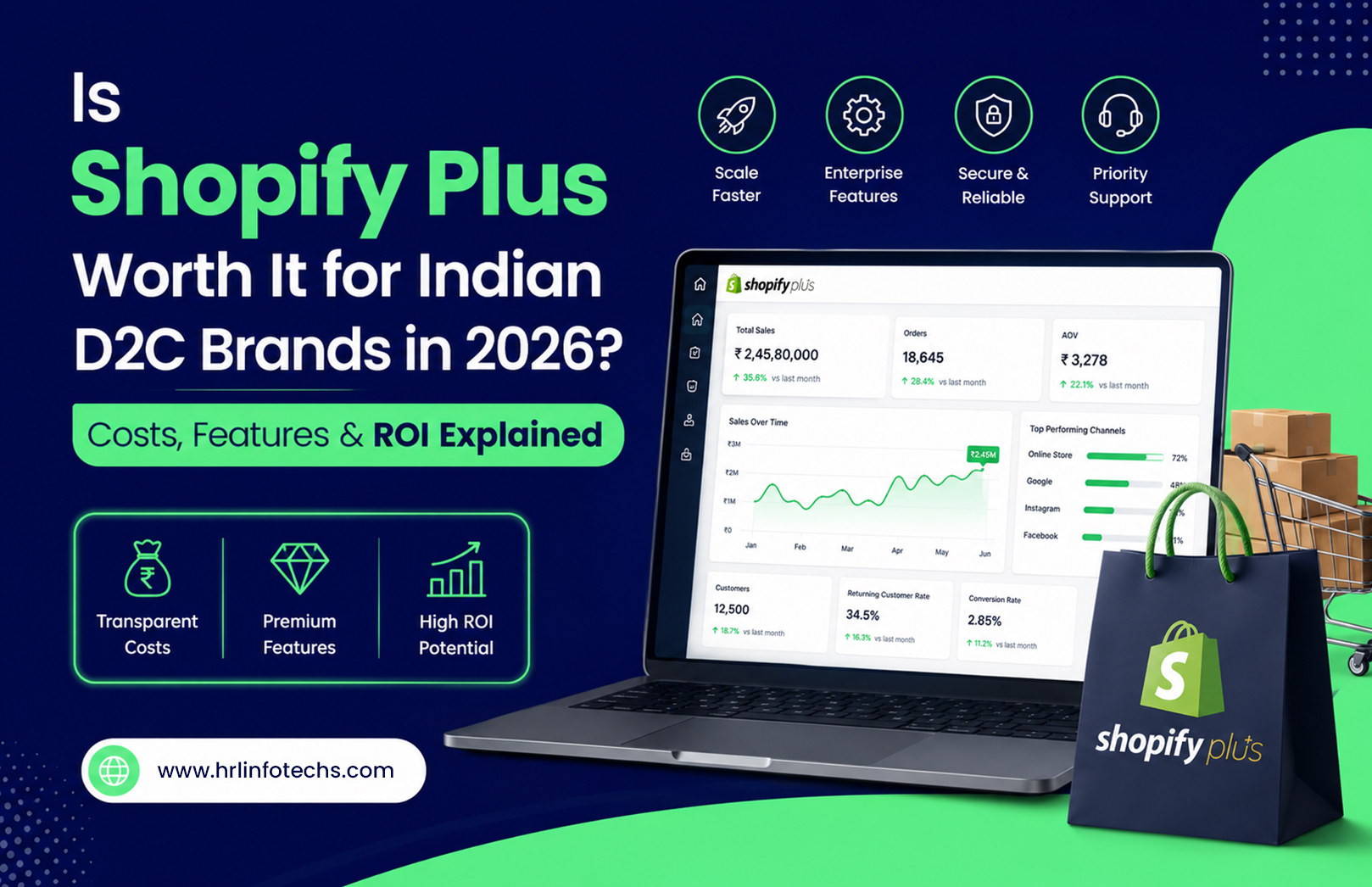
India’s D2C space is moving fast right now. Brands are scaling quicker than most teams can actually keep up with operationally. And at some point, almost every growing business hits the same wall, the platform that worked fine at ₹10 lakh a month starts genuinely struggling at ₹1 crore.
That’s usually when the question comes up: Is Shopify Plus worth it, or is this just an expensive upgrade for features you don’t really need?
It is all relative and depends on the specific use case. Shopify’s standard plans are great for start-ups and small-scale operations, whereas the increased complexity of the catalogue, order-processing volume, and other elements makes the ROI more difficult to achieve. If your business has an aspiration to grow significantly in 2026, understanding whether Shopify Plus for Indian D2C brands actually makes sense is worth thirty minutes of your time.
Why Indian D2C Brands Are Growing This Fast
Consumer behaviour in India has witnessed a dramatic change in the past few years. Internet shopping has penetrated even the remotest parts of the country, and the customers now expect the same seamless digital experience everywhere.
As enterprises continue to evolve in a landscape where they sell across markets, through social commerce, apps, and their website, complexity grows exponentially. Inventory fit for all channels, personalised experiences, frictionless checkout, and marketing automation that actually converts: brands are realising that to scale efficiently, it’s time to consider enterprise solutions to power their growth.
What Shopify Plus Actually Is
Shopify Plus India is the enterprise tier built specifically for brands running large catalogues, heavy traffic, and genuinely complex operations.
It is not about new functionality on the standard plan; it is about customisation, full automation, extended support, and infrastructure for scalability. The idea is to optimise the business process while providing a significantly better customer experience.
Is the Price Actually Justified?
Shopify Plus pricing in India is the number that scares people off before they’ve even looked at the value side of the equation. Enterprise platforms cost more than entry-level tools; that part’s obvious.
But the cost of a subscription is not the only criterion when comparing products. The most important factors should be the increase in efficiency, the reduction of manual processes, conversion rates, and revenue growth after achieving the point where the selected solution is no longer a limiting factor.
For brands doing serious monthly revenue, these gains routinely outweigh what the platform costs. For brands still finding their footing, they usually don’t yet.
What Actually Sets Shopify Plus Apart
A handful of things genuinely separate this from the standard plan.
Real automation.
Order tagging, inventory workflows, customer segmentation, promotional campaigns, all of it can run without someone manually clicking through it every day.
A checkout that doesn’t lose people.
A faster, smoother checkout genuinely reduces cart abandonment, and that alone can move revenue meaningfully.
Room to actually customise.
Growing brands often need a storefront that doesn’t look like every other Shopify store out there. Plus gives you the flexibility to build that.
Stability when traffic spikes hard.
Flash sales, festive campaigns, and a viral influencer moment send traffic through the roof in minutes. Shopify Plus is built to hold steady through that, not buckle under it.
When Does an Upgrade Actually Make Sense?
A Shopify store upgrade becomes worth it when you’re genuinely hitting operational limits, not just when a competitor mentions they upgraded, and you feel like you should too.
The real signs: order volumes growing steadily, multiple warehouses to manage, a catalogue that has grown beyond your current capabilities, marketing complexity that is too time-consuming to manage manually, impending international expansion, or multi-channel selling.
If manual processes are genuinely the thing slowing growth down, upgrading stops being an expense and starts being a strategic move.
What Actually Supports Long-Term D2C Growth
Good product pages alone don’t build a lasting D2C business.
Prominent D2C ecommerce growth requires a tech-stack that is efficient, a website that loads rapidly, a customer experience that is tailored rather than generic, marketing automation that can do the heavy lifting, lean operations, and infrastructure that doesn’t need to be rethought every eighteen months.
Enterprise platforms give you that foundation, so growth doesn’t mean constantly tearing down and rebuilding your tech stack every time you hit a new milestone.
Why the Development Partner You Choose Matters
Picking the right platform is honestly only half the decision.
A genuinely skilled Shopify website development agency is what actually determines whether your store performs well, ranks properly, converts consistently, and can scale later without a rebuild. Done right, that means faster load speeds, solid mobile optimisation, secure integrations, a checkout that actually converts, and an architecture flexible enough to grow with you.
Get the implementation wrong, and even the best platform in the world won’t deliver what it’s capable of.
Why Custom Development Genuinely Matters
No two D2C brands run their business the same way, and this is exactly why custom Shopify development has become so valuable.
Custom functionality refers to making the platform work around the business rather than forcing the business into the software’s default structure. This includes subscription systems, loyalty programs, product personalisation, ERP systems, warehouse management, and internal dashboards for staff. These features enable a company to differentiate itself against competitors that offer the same standard set of functions.
Handling Complexity as You Scale
As revenue grows, so does operational complexity almost without exception.
Solid enterprise Shopify solutions help manage multiple storefronts, international expansion, blended B2B and B2C operations, high-volume order processing, marketing automation, and the kind of reporting that actually informs decisions. Instead of bolting on disconnected tools for every new problem, you get one centralised system that actually talks to itself.
Built to Handle Serious Volume
One of the clearest advantages of Shopify Plus is how well it supports genuinely high-volume ecommerce stores.
Festive season traffic, an influencer post that goes bigger than expected, a product launch that catches fire, these can spike traffic dramatically within minutes. And platform stability during exactly those moments is what protects the revenue you’re actually trying to capture.
Why the Platform Alone Doesn’t Deliver Growth
Even the best platform in the world doesn’t generate revenue by itself. It needs visibility behind it.
Pairing Shopify Plus with genuine ecommerce marketing services, such as SEO, paid advertising, email marketing, conversion optimisation, retention campaigns, and real performance analytics, is what actually turns the platform investment into revenue growth. Technology and marketing genuinely need to work together here. Neither one does the job alone.
So, is Shopify Plus Actually Worth It?
For smaller businesses with relatively modest order volumes, standard Shopify plans are often sufficient. There’s no need to overpay for capacity you’re not using yet.
But for brands experiencing real growth, increasing operational complexity, and ambitious targets ahead, Shopify Plus tends to be a genuinely strong investment better scalability, real operational efficiency, meaningful automation, stronger customer experience, and infrastructure that supports where you’re actually headed, not just where you are today.
Conclusion
Indian D2C brands have entered the stage where customer expectations, operating excellence, and sustainable scalability will define true success. The choice of the right platform has become much more than an infrastructural necessity; it has taken on a strategic role.
If your business is set to scale, grow its catalogue, or experience an increase in order volumes, Shopify Plus can be relied upon to scale alongside it.
At HRL Infotechs, we help brands evaluate, build, and optimise scalable Shopify ecosystems built around their actual growth goals from platform migration and custom development through to performance optimisation and genuinely integrated ecommerce marketing strategy, all built to help brands unlock what enterprise ecommerce can genuinely deliver.