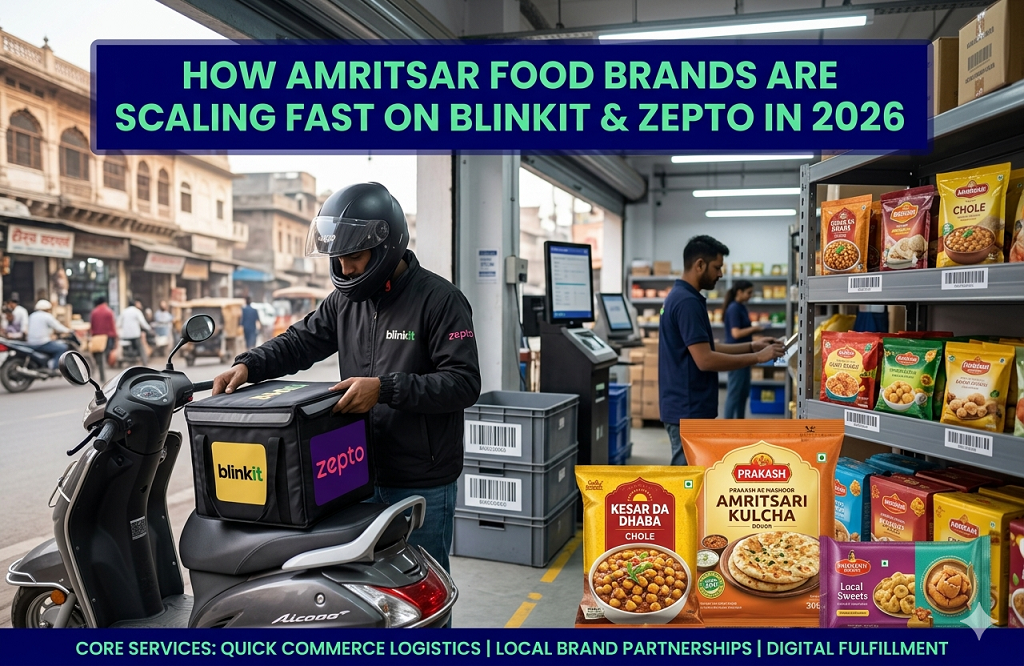
uick commerce has transformed how Amritsar’s food brands reach customers in minutes, not days. Platforms like Blinkit and Zepto are no longer just delivery apps; they are powerful growth engines for local FMCG and D2C brands that understand the right Quick Commerce marketing strategy and execute it with discipline.
In 2026, the most successful Amritsar food brands are those that treat quick commerce as a dedicated sales and branding channel, not an afterthought. By combining data-driven decisions, sharp content, and platform-native tactics, they are scaling faster than ever on Blinkit and Zepto while building long-term brand equity.
Why Quick Commerce Is a Game-Changer for Amritsar Food Brands
Quick commerce has unlocked hyperlocal demand for snacks, staples, beverages, and ready-to-eat products across Amritsar. Instead of fighting for shelf space in modern trade, brands can now win digital shelf space on Blinkit and Zepto, where buying decisions happen in seconds. This shift has made a focused Quick Commerce marketing strategy essential for every ambitious food business.
For many local brands, the question is no longer whether to be on quick commerce, but how to sell on Blinkit in India in a way that is profitable and scalable. The brands that win are those that understand category dynamics, optimize their presence for search and discovery, and treat every order as a data point to refine their quick commerce growth strategy in India.
Understanding the Search Intent Behind Quick Commerce Shoppers
To scale on Blinkit and Zepto, Amritsar food brands must align with how users actually search and shop. Most quick commerce users are high-intent buyers who already know what they want. They search by product type, flavor, use case, or occasion rather than by brand name. A strong Quick Commerce marketing strategy starts by mapping these search patterns.
Top-performing brands study how customers search for snacks, masalas, pickles, bakery items, and beverages in their city. They then align product titles, descriptions, and images to match those queries. This is how food brands grow on Blinkit: not only by listing products, but by matching the language, needs, and urgency of the shopper.
Core Elements of a Winning Quick Commerce Marketing Strategy
Scaling FMCG brands on quick commerce requires a structured approach rather than random experiments. The most successful Amritsar brands follow a clear Quick Commerce marketing strategy that covers assortment, pricing, content, and performance marketing. They treat Blinkit and Zepto as performance channels with measurable inputs and outputs.
Instead of uploading every SKU, they prioritize hero products and high-repeat items that move fast. This is especially important for how D2C food brands scale in India, because it keeps operations lean while maximizing visibility and reviews. Once a few SKUs gain traction, brands expand the range around proven winners.
Optimizing Product Listings for Discovery and Conversion
Product listing optimization is often the difference between a product that sits invisible and one that sells out daily. A robust Quick Commerce marketing strategy focuses on three pillars: titles, images, and descriptions. Each element must be crafted for both the algorithm and the human buyer.
High-performing listings usually include clear product names, key ingredients, flavor cues, and pack sizes. Descriptions highlight benefits like freshness, local sourcing, or health positioning. Sharp, well-lit images that show the actual pack and serving suggestion can significantly lift click-through and conversion rates.
Leveraging Ratings, Reviews, and Social Proof
Quick commerce shoppers make decisions fast, and social proof helps them trust new brands. Encouraging early customers to rate and review products is a crucial part of how local food brands grow online. Even a small base of positive reviews can dramatically improve conversion and ranking on Blinkit and Zepto.
Brands that scale quickly often run targeted sampling or discount campaigns to generate initial volume and feedback. They monitor reviews closely, fix recurring issues, and update content to address common questions. Over time, this feedback loop becomes a competitive moat that new entrants struggle to match.
Smart Pricing, Offers, and Pack-Size Strategy
Quick commerce is highly price-sensitive, but that does not mean brands must always discount. Instead, a refined quick commerce growth strategy in India uses smart pack sizes and value-driven offers. Smaller trial packs can help new customers sample products without high commitment, while family packs drive higher average order values.
Limited-time offers, combo packs, and festival-specific bundles also work well on Blinkit and Zepto. The key is to align promotions with real demand spikes, such as evenings, weekends, or local events in Amritsar. This approach keeps margins healthy while still driving aggressive growth.
How to Sell on Blinkit in India: Operational Excellence from Amritsar
Many brands focus only on marketing but ignore operations, which can quietly kill growth. To truly master how to sell on Blinkit in India, Amritsar food brands must ensure consistent stock availability, accurate inventory sync, and reliable packaging. Quick commerce algorithms reward brands that fulfill orders reliably and on time.
Operational excellence also includes forecasting demand for weekends, festivals, and seasonal peaks. Brands that understand their repeat rates and basket patterns can pre-position inventory in the right dark stores. This not only improves service levels but also supports a more aggressive Quick Commerce marketing strategy with confidence.
Data-Driven Decisions Using Platform Analytics
Both Blinkit and Zepto provide performance data that can guide smarter decisions. Leading brands review metrics like impressions, click-through rates, conversion rates, and repeat purchase behavior. This data is central to how D2C food brands scale in India on quick commerce platforms.
By analyzing which SKUs perform best in which neighborhoods, brands can refine assortments and localize their Quick Commerce marketing strategy. They can also identify underperforming products and either optimize their content or phase them out to focus on higher-potential items.
Using Zepto Ads Services and Sponsored Placements
Paid visibility is becoming essential as more brands compete for the same digital shelf. Zepto ads services and Blinkit sponsored placements allow Amritsar food brands to appear at the top of category pages and search results. When combined with strong content and reviews, this can accelerate scaling FMCG brands on quick commerce.
A disciplined Quick Commerce marketing strategy treats ads as an investment, not an expense. Brands set clear goals for share of voice, cost per acquisition, and return on ad spend. They test different creatives, keywords, and time slots to identify the most profitable combinations for their category.
Retargeting and Cross-Selling Within Quick Commerce
Once a brand has a base of customers, the next step is maximizing lifetime value. Many platforms now support basic retargeting and cross-selling tools that can be integrated into a broader quick commerce growth strategy in India. For example, snack brands can cross-sell dips or beverages, while breakfast brands can bundle spreads and cereals.
Brands that think in terms of baskets rather than single SKUs often see better unit economics. They design product ranges and offers that naturally fit together, making it easier for customers to add more items in a single order. This approach compounds the impact of every marketing rupee spent.
How Local Food Brands Grow Online Beyond Quick Commerce
While Blinkit and Zepto are powerful, long-term winners think beyond a single channel. The same principles that drive how food brands grow on Blinkit also apply to marketplaces, D2C websites, and social commerce. Consistent branding, sharp content, and data-driven decisions create a unified growth engine.
For Amritsar brands, this means using insights from quick commerce to shape product development, packaging, and messaging across all touchpoints. Over time, a well-executed Quick Commerce marketing strategy becomes the backbone of a broader digital presence that attracts investors, distributors, and loyal customers.
Conclusion: Turning Quick Commerce into a Scalable Growth Engine
In 2026, the fastest-growing Amritsar food brands are those that treat quick commerce as a strategic pillar, not a side channel. They invest in product listing optimization, operational excellence, smart pricing, and performance marketing to build a repeatable Quick Commerce marketing strategy that compounds over time.
By combining strong fundamentals with platform-native tactics on Blinkit and Zepto, local FMCG and D2C brands can scale far beyond their home neighborhoods. For brands that want expert support in building and executing this kind of high-performance quick commerce growth strategy in India, HRL Infotechs can be a powerful partner in the journey.