Amazon Search Query Performance Report: How to Read It and What to Change Next Week


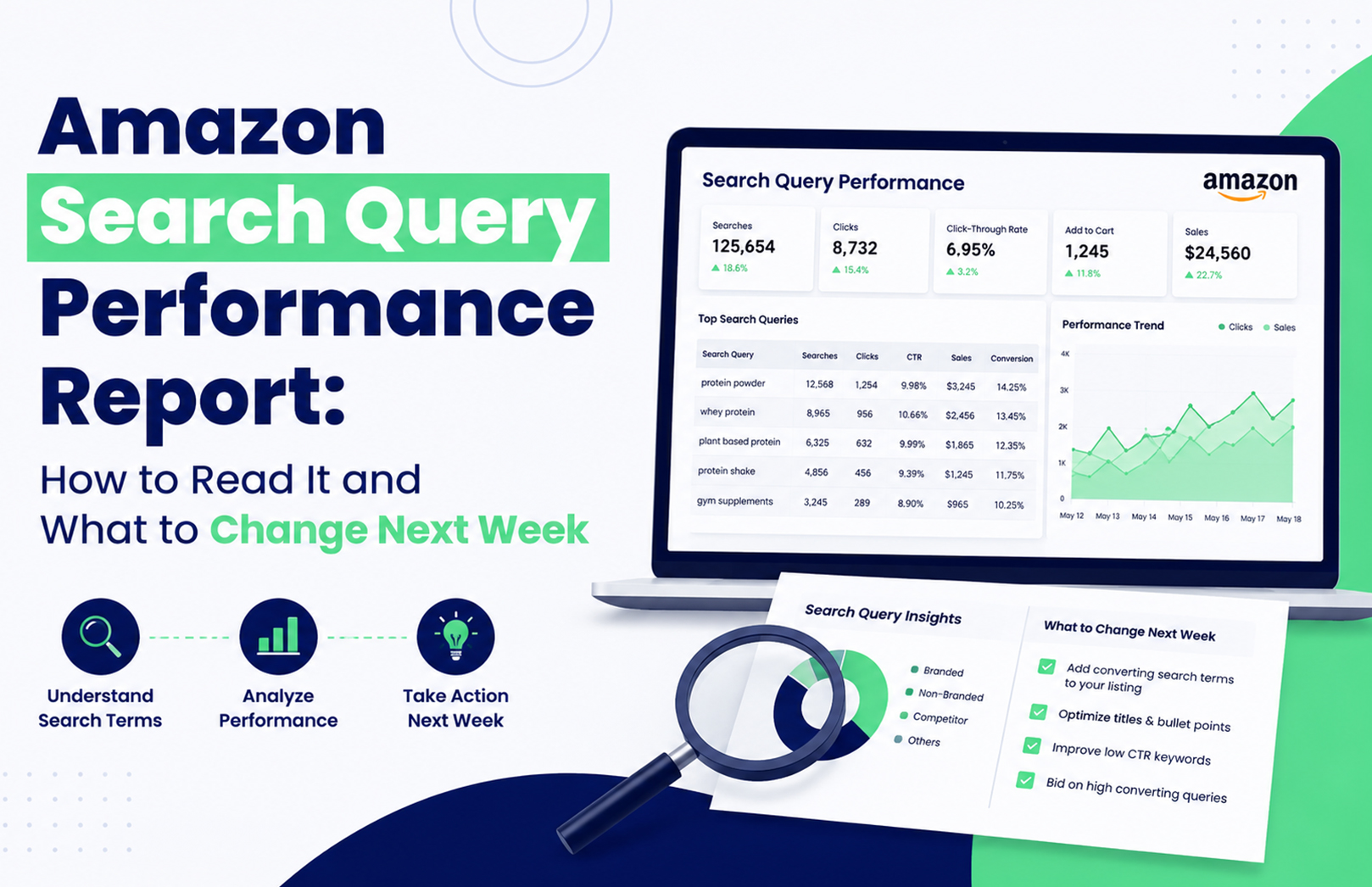
Your Amazon product is getting 40,000 impressions for a search query, but only 800 clicks. Another query gets fewer impressions yet produces significantly more cart adds and purchases. Which one deserves your attention next week? The Amazon Search Query Performance report helps answer that question by showing how shoppers move from search impressions to clicks, cart adds, and purchases for queries associated with your brand.

The mistake is treating SQP as another keyword report. It isn’t. Used properly, it tells you where your brand is losing potential customers and whether the next action should be listing optimisation, advertising, pricing, or broader account management.

What Is the Amazon Search Query Performance Report?

The Amazon Search Query Performance report is a Brand Analytics report that shows how your brand performs for customer search queries. It provides query-level visibility into stages such as impressions, clicks, cart adds, and purchases, helping you compare your brand’s performance with the wider query opportunity.

For eligible brands, Search Query Performance sits within Amazon Brand Analytics in Seller Central. Amazon’s Brand Analytics tools are designed to give registered brands access to customer and search behaviour insights, but availability depends on account and Brand Registry eligibility.

The practical value is simple: instead of asking “Which keyword should I add?”, you can ask “At which stage are shoppers dropping away?”

How Do You Read Amazon SQP Data?

Read the report as a search-to-purchase funnel, not as a list of keywords. Start with relevant queries, then compare your performance across impressions, clicks, cart adds, and purchases before deciding what to change.

SQP SignalWhat It Usually IndicatesFirst Thing to Check
High impressions, low clicksVisibility without enough shopper interestMain image, title, price
High clicks, low cart addsProduct page isn’t convincing enoughListing content, reviews, offer
High cart adds, low purchasesPurchase frictionPrice, delivery, availability
Low impressionsWeak visibility or query coverageRelevance, SEO, PPC
Strong purchases, low brand shareOpportunity to capture more demandListing + advertising

1. Start With Commercially Relevant Queries

Don’t automatically select the query with the highest search volume.

Suppose you sell a ₹799 vitamin supplement in India. A broad query such as “vitamins” may generate huge search activity, but a more specific query such as “multivitamin for daily energy” could have stronger purchase intent for your particular product.

This is one of the judgement calls that matters in real Amazon optimisation: the biggest query isn’t necessarily the best query to win.

If the query is relevant but your listing isn’t sufficiently aligned with the customer’s language, review your Amazon SEO and listing optimisation strategy before simply increasing advertising spend. HRL Infotechs’ Amazon SEO service specifically combines keyword research with product-page optimisation.

2. Compare Impressions With Clicks

High impressions mean your products are appearing, but they don’t tell you whether shoppers care enough to click.

If your brand receives substantial impressions for a query but very few clicks, compare your product with the competing results visible for the same search. Look at the main image, price, rating, review count, title presentation, and product type.

A common mistake is changing keywords first. If Amazon is already showing the product for a relevant query, the bigger problem may be search-result competitiveness rather than keyword coverage.

What Should You Do When Amazon Impressions Are High but Clicks Are Low?

When impressions are healthy but clicks are weak, improve the elements shoppers see before entering your product detail page. The main image, visible title, price, rating, reviews, and relevance should be checked before you touch the campaign structure.

This is particularly important on mobile, where shoppers scroll quickly through competing products. HRL Infotechs’ analysis of how Amazon product images affect rankings, clicks and conversions highlights why product imagery should be treated as a performance element rather than decoration.

Don’t change five listing elements simultaneously if you want to understand what worked. Test the most obvious weakness first, document the change, and compare the next meaningful reporting period.

What Does Low Cart-Add Performance Mean?

High clicks but weak cart adds usually mean the search result did its job, but the product page didn’t complete the next step. The shopper was interested enough to visit but didn’t find sufficient reason to move closer to purchase.

Check your bullets, images, A+ Content, reviews, price, variations, product information and offer. Also ask whether the search query actually matches what your product delivers.

This is where Amazon listing optimisation and SQP analysis work together. The report identifies the leak; the listing work addresses the leak.

What If Cart Adds Are Strong but Purchases Are Low?

Strong cart activity with weak purchases can indicate purchase friction rather than poor keyword targeting. Price, delivery expectations, stock availability, promotions, competition and customer confidence can all influence the final decision.

Don’t automatically respond by increasing PPC bids. More traffic won’t necessarily fix a purchase-stage problem.

This is another practical trade-off: if the listing already generates clicks and cart adds, sending more paid traffic before fixing the purchase barrier can increase spend without solving conversion.

Amazon Search Query Performance vs Search Term Report: What’s the Difference?

The Amazon Search Query Performance report and the Search Term Report serve different purposes. SQP focuses on customer search-query performance around your brand, while the Search Term Report helps advertisers analyse the customer search terms associated with their advertising activity.

That distinction matters because an important customer query might represent a broader organic opportunity even when your current PPC activity isn’t capturing it effectively.

If the SQP data identifies a valuable query, compare it against your advertising data before deciding whether to increase keyword coverage, adjust bids, add negative targeting, or leave the query primarily to organic optimisation.

For broader advertising execution, Amazon advertising services can connect search-term analysis with Sponsored Products, Sponsored Brands, Sponsored Display and other advertising activities.

How Can Amazon Brand Analytics Search Terms Improve Your Keyword Strategy?

Amazon Brand Analytics search data can help you understand the language customers use and identify queries worth investigating for your catalogue. But don’t copy every high-volume search term into your listing.

A query should pass three tests before becoming a priority:

  1. Relevance: Does the query accurately describe your product?
  2. Commercial value: Do shoppers using it show meaningful buying behaviour?
  3. Competitive opportunity: Can your product realistically improve its position?

This approach prevents a common problem: building a keyword-heavy listing around searches that generate traffic but don’t generate the right customers.

How Do You Use Amazon Impression Share by Keyword?

Amazon impression share should be interpreted alongside the rest of the funnel. A low share can indicate an opportunity, but it doesn’t automatically mean you should spend more.

If your brand has low impression share but strong clicks and purchases whenever it appears, increasing visibility may be worth testing. If impression share is low and conversion is also poor, fixing the listing or offer may come first.

The same principle applies to advertising. Your goal isn’t simply to maximise impressions. You want qualified visibility that has a realistic path to conversion.

What Should You Change Next Week?

Once you’ve identified the biggest SQP gap, turn it into one clearly defined action rather than making broad account changes.

Monday: Segment the Queries

Separate relevant queries into four groups:

  • High impressions
  • High clicks
  • High cart adds
  • High purchases

Then identify where your brand is disproportionately weak.

Tuesday: Diagnose the Listing

For high-impression/low-click queries, compare your main image, title, rating, reviews and price against competing products.

For high-click/low-cart queries, inspect your detail page and product positioning.

If several products need this work, a structured Amazon product listing and SEO strategy can help connect query analysis with catalogue-level optimisation.

Wednesday: Review Advertising

Match priority queries against your advertising search terms.

Ask:

  • Are valuable queries being targeted?
  • Are bids competitive enough?
  • Are irrelevant searches consuming spend?
  • Are converting search terms isolated appropriately?
  • Is your listing strong enough to justify additional paid traffic?

Thursday: Check Price and Availability

Don’t ignore operational factors. A search-query problem can sometimes be caused by price, stock availability, delivery expectations or the competitive offer.

Friday: Make the Smallest Meaningful Change

Change one major variable at a time where practical.

For example, if the main image is clearly weaker than competitors, test the image before rewriting the entire listing and changing PPC bids on the same day.

Following Week: Compare Before and After

SQP data shouldn’t be judged from a single movement. Search volume changes, seasonality, promotions and reporting delays can affect short periods.

Keep a simple record of the query, original performance, change made and subsequent performance. That turns SQP from a reporting exercise into a repeatable optimisation process.

How Should SQP Data Influence Amazon PPC?

SQP should tell you where to investigate the opportunity. Advertising data should help determine how to capture it.

For example, imagine a query with strong customer demand and healthy purchase behaviour but weak brand visibility. That is a reasonable candidate for deeper PPC investigation.

But if the query generates plenty of clicks while your product rarely converts, increasing bids may simply buy more expensive traffic.

This is why advertising shouldn’t be evaluated through ACoS alone. HRL Infotechs’ recent Amazon ACoS vs TACoS analysis explains why sellers need to distinguish campaign-level advertising efficiency from broader business performance.

When Should You Use Amazon Account Management Services?

SQP becomes significantly more useful when someone actually turns the findings into weekly execution. That can involve listing changes, advertising adjustments, catalogue maintenance, inventory checks, reporting and account-health monitoring.

For brands managing multiple ASINs, these tasks can quickly become difficult to coordinate. Amazon account management services can bring those activities into one operational workflow, including catalogue management, account-health monitoring, performance tracking and other marketplace tasks.

The goal isn’t to generate another dashboard. The goal is to make sure the insight from that dashboard produces an action.

What Are the Biggest Amazon SQP Mistakes?

The biggest mistake is assuming that every low metric requires an immediate optimisation.

SQP data needs context. Query relevance, competition, product availability, pricing, promotions and the reporting period can all affect what you see.

The second mistake is making too many changes simultaneously. If you change your listing, increase PPC bids, reduce price and launch a promotion in the same week, you may improve sales without knowing which action created the improvement.

Experienced Amazon teams usually work with a clearer sequence: identify the bottleneck → choose the most relevant intervention → document it → measure the result → iterate.

Final Takeaway: Use SQP to Decide What Changes Next

The Amazon Search Query Performance report is most valuable when you use it to answer a practical question: where are customers dropping out of my search journey?

Start with commercially relevant queries. Compare impressions, clicks, cart adds and purchases. Then connect the gap to the appropriate action—listing optimisation, advertising, pricing, availability or account-level execution.

If your SQP report repeatedly shows the same gaps across important queries, that’s a sign that you need a consistent optimisation process rather than another one-off report. HRL Infotechs provides Amazon account management and marketplace optimisation support for brands that need the analysis and execution to work together.

Frequently Asked Questions

Q1. How often should I check the Amazon Search Query Performance report?

A weekly review is useful for active Amazon brands because it helps identify emerging visibility and conversion gaps. However, don’t make major decisions from a single short period. Compare relevant periods and account for seasonality, promotions, inventory changes and reporting delays before judging whether an optimisation worked.

Q2. What does a high Amazon SQP impression share mean?

High impression share means your brand is capturing a meaningful portion of the available visibility associated with a query. It doesn’t automatically mean the query is profitable or that your listing is converting well. Always evaluate impression share alongside clicks, cart adds, purchases and commercial relevance.

Q3. Can Amazon SQP data help with Amazon SEO?

Yes. SQP can provide useful evidence about customer search behaviour and your brand’s performance for relevant queries. Use it alongside keyword research, listing relevance, conversion data and competitive analysis. SQP should inform your Amazon SEO decisions rather than replace broader keyword and listing research.

Q3. Is Amazon SQP the same as the Amazon Search Term Report?

No. Search Query Performance is a Brand Analytics tool focused on customer search-query performance around your brand. The Search Term Report is primarily an advertising analysis tool. They can be used together: SQP can identify valuable search opportunities, while advertising reports can show how your paid campaigns capture those searches.

Q4. Should I increase PPC bids if my SQP impressions are low?

Not necessarily. Low impressions can result from weak relevance, limited advertising coverage, competition, inventory problems or other factors. First determine whether the query is commercially valuable and whether your product is capable of converting. Increase PPC coverage only when advertising is genuinely the missing part of the funnel.

Q5. Can an Amazon agency manage SQP analysis every week?

Yes. SQP analysis can be incorporated into a broader Amazon management process that combines search-query analysis, listing optimisation, PPC management, catalogue operations and performance reporting. The benefit is that the report becomes an input for specific weekly actions rather than remaining a passive performance document.
Amazon’s 75-Character Title Limit: How to Optimize Product Titles for SEO, CTR & Sales in 2026


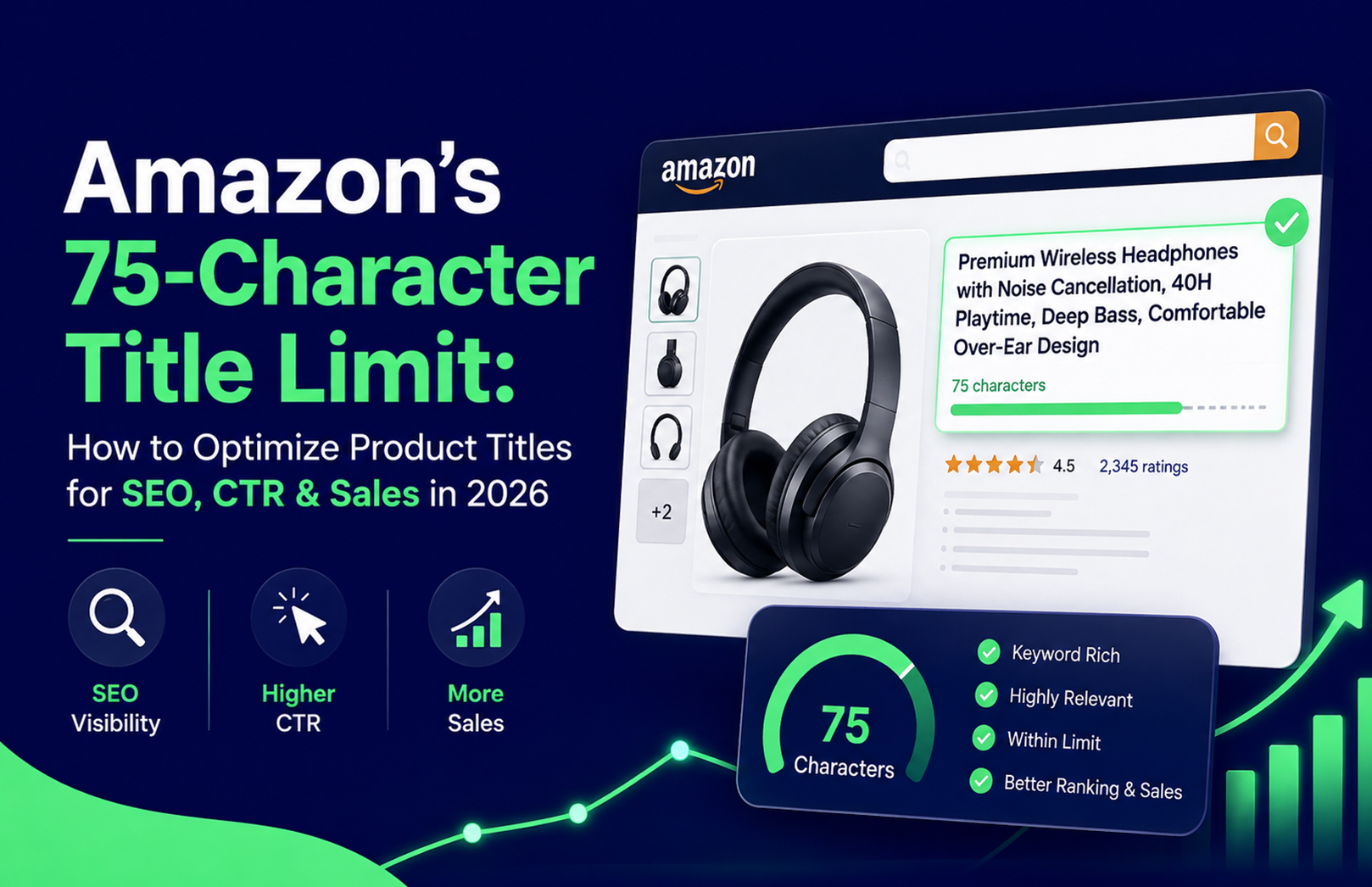
Amazon sellers in India need to rethink how they create and optimize product titles in 2026. Amazon announced that, starting July 27, 2026, product titles in all categories except media must be 75 characters or fewer, including spaces. Amazon says the change is intended to make product titles display more clearly on mobile devices and create a more consistent shopping experience.

For sellers, this makes Amazon product title optimization more important than ever. Instead of trying to fit as many keywords as possible into a title, brands now need to prioritize the right keyword, essential product information and conversion-focused messaging within a much smaller character limit.

A well-optimized Amazon product title can help shoppers understand a product quickly, support relevance for Amazon search and encourage more clicks. In 2026, the goal is not simply to write a shorter title—it is to make every character work harder.

What Is Amazon’s 75-Character Title Limit?

Amazon’s new requirement states that titles for categories other than media must contain 75 characters or fewer, including spaces. Amazon also introduced Item Highlights, which provide an additional 125 characters for information such as materials and recommended use cases. This content is searchable and can appear with titles in search results and on product detail pages.

Amazon is also providing AI-powered tools to help sellers create titles and Item Highlights that comply with the new limits. Sellers can access recommendations through Manage All Inventory and review suggested changes before implementation.

This means the Amazon title character limit should not be viewed only as a compliance requirement. It should be treated as an opportunity to make product listings more concise, relevant and shopper-friendly.

Why Amazon Product Title Optimization Matters in 2026

The title is one of the first pieces of information shoppers encounter when browsing Amazon search results. It tells customers what the product is and can immediately communicate important attributes such as size, quantity, material, compatibility or use case.

At the same time, your title contributes to how Amazon understands your product and its relevance to customer searches. This makes Amazon SEO and title optimization closely connected.

However, keyword placement alone is not enough. A title can contain relevant keywords and still perform poorly if it is difficult to read or does not communicate a compelling reason to click.

The best approach combines search relevance + readability + conversion intent.

How to Optimize an Amazon Product Title Within 75 Characters

1. Start With the Most Important Keyword

The primary product keyword should generally appear early in the title so shoppers can understand the product immediately.

For example, instead of:

“Premium Quality Best Wireless Bluetooth Earbuds for Music Calls”

consider:

“Wireless Bluetooth Earbuds, Noise Cancellation, 40H Battery”

The second version removes unnecessary promotional wording and focuses on product identity and meaningful attributes.

When performing Amazon title optimization, identify the search terms most closely connected to the product and customer buying intent. Do not automatically choose a keyword simply because it has the highest search volume.

2. Remove Unnecessary Words

The new Amazon 75 character title limit means sellers have less room for filler.

Words such as “best,” “amazing,” “premium quality,” “high quality” and “perfect” can consume valuable space without helping shoppers understand the product.

Instead, use characters for information that helps customers make a purchasing decision.

Prioritize:

  • Product type
  • Primary keyword
  • Important feature
  • Size or quantity
  • Material
  • Compatibility
  • Key use case
  • Meaningful differentiator

Every word should either improve relevance or help the shopper understand the product.

3. Use High-Intent Keywords

Effective Amazon SEO begins with understanding what shoppers actually search for when they are ready to purchase.

For an Indian seller, keyword research can include:

  • Core product keywords
  • Long-tail search terms
  • Product attributes
  • Size and quantity terms
  • Material-related searches
  • Compatibility keywords
  • Usage-based searches
  • Category-specific terminology
  • Commercial search phrases

Rather than inserting every keyword into the title, select the strongest primary term and use the remaining relevant terms naturally across the listing.

This is particularly important because Amazon’s new title format forces sellers to make stronger keyword prioritization decisions.

4. Optimize for CTR, Not Just Rankings

A common mistake is to think that Amazon product title optimization is only about rankings.

Your title also has a direct role in the shopper’s decision to click.

Consider these examples:

Generic:
“Face Serum 30ml”

More informative:
“Vitamin C Face Serum 30ml, Brightening, Lightweight”

The second title quickly communicates the product, size and relevant benefit. It gives the shopper more context without becoming unnecessarily long.

A good title should answer the shopper’s basic question:

“Is this the product I am looking for?”

If the answer is immediately clear, the listing has a stronger opportunity to earn the click.

Use Item Highlights Instead of Overloading the Title

The 75-character requirement does not mean every product benefit needs to disappear.

Amazon’s new Item Highlights feature provides up to 125 additional characters for information such as materials and recommended use cases. Amazon states that this content is searchable and visible with titles in search results and on product detail pages.

This creates an opportunity to separate information strategically.

Product title:
Product identity + primary keyword + critical attribute

Item Highlights:
Material + recommended use + supporting product information

For example:

Title:
“Stainless Steel Water Bottle 1L, Leakproof, Insulated”

Item Highlight:
“Suitable for office, gym, school and travel; durable stainless steel construction.”

This approach keeps the title focused while giving customers additional information elsewhere in the listing.

Amazon Product Title Character Limit: Mistakes to Avoid

The biggest mistake sellers can make is treating the Amazon product title character limit as a keyword puzzle.

Avoid these common errors:

  • Repeating the same keyword multiple times
  • Adding unrelated high-volume keywords
  • Using unnecessary promotional claims
  • Writing the entire title in capital letters
  • Adding excessive punctuation
  • Including information that belongs elsewhere in the listing
  • Hiding the primary product keyword
  • Sacrificing readability to add another keyword
  • Ignoring category-specific Amazon requirements

Amazon’s guidance emphasizes concise titles and provides title requirements and best practices for sellers. Amazon also notes that titles exceeding applicable requirements can be subject to changes through its enforcement process.

The objective should always be relevance without keyword stuffing.

A Simple Formula for Amazon Title Optimization

A practical structure for creating a 75-character title is:

[Primary Product Keyword] + [Key Feature] + [Size/Quantity] + [Critical Differentiator]

For example:

“Cotton Bedsheet King Size, 300 TC, Floral Print”

Or:

“Yoga Mat 6mm, Non-Slip, Extra Wide for Home Workouts”

The exact structure will vary by category, but the principle remains the same: start with what the product is, then use the remaining space for the information most likely to influence search relevance and purchasing decisions.

Before publishing, check:

  1. Is the main product keyword clear?
  2. Is the product immediately understandable?
  3. Is the most important information near the beginning?
  4. Have filler words been removed?
  5. Is the title 75 characters or fewer?
  6. Does it follow category-specific requirements?
  7. Would a real shopper find the title useful?

How Better Titles Can Improve CTR and Sales

An optimized title cannot guarantee higher sales on its own. Amazon performance depends on several factors, including pricing, reviews, availability, advertising, images, conversion rate and overall listing quality.

However, a strong title can contribute to the customer journey in several ways.

Better relevance: A clearly structured title helps communicate what the product is and which searches it is relevant to.

Better readability: Customers can understand the offer faster, particularly when browsing on mobile.

Better click potential: A title that clearly matches customer intent can provide a stronger reason to open the product detail page.

This is why Amazon listing optimization should go beyond the title. Sellers should also optimize bullet points, product images, backend search terms, A+ Content and other listing elements.

If your catalogue contains multiple ASINs, maintaining all of these elements consistently can become difficult. Professional Amazon account management services can help brands manage catalogue optimization, listing performance, account health and other ongoing marketplace activities. HRL Infotechs provides account management covering catalogue optimization, performance analysis and broader Seller Central operations.

Combine Amazon SEO With Complete Listing Optimization

A product title works best when the rest of the listing supports it.

Imagine a customer searches for a product and clicks because the title matches their intent. If the product images are unclear, bullet points are weak or the description does not answer their questions, the click may not turn into a purchase.

That is why Amazon listing optimization should cover the entire product detail page.

A strong optimization strategy can include:

  • Keyword research
  • Amazon product title optimization
  • Bullet point optimization
  • Backend search term optimization
  • Product image optimization
  • A+ Content
  • Competitor analysis
  • Conversion-focused content
  • Search performance monitoring

For brands that need professional support, HRL Infotechs offers Amazon product listing and SEO services, helping businesses optimize product titles, keywords and other listing elements as part of a broader Amazon growth strategy.

Connect Title Optimization With Amazon Marketing

Optimizing a listing is only one part of growing on Amazon. Once your product page is properly structured, paid advertising can help bring qualified shoppers to it.

This is where Amazon marketing services become valuable.

Amazon PPC campaigns can be aligned with listing keywords so that the search terms being targeted through advertising are also reflected naturally within the product detail page. HRL Infotechs’ Amazon advertising approach combines keyword research, campaign management and listing optimization to help paid traffic reach product pages designed to convert.

For example, if your PPC campaign identifies a high-converting search term, your listing strategy can evaluate whether that term is appropriately represented in the title or another relevant listing field.

This creates a stronger connection between:

Keyword research → Amazon SEO → Listing optimization → PPC → Conversion → Sales

Should You Rewrite Existing Amazon Titles?

If you already have Amazon listings, do not blindly rewrite every title simply to make it shorter.

Start with your highest-priority ASINs.

Review:

  • Current title length
  • Organic ranking
  • Main search terms
  • Click performance
  • Conversion rate
  • Sales contribution
  • Competitor titles
  • Product relevance
  • Category requirements

Then prioritize titles that are over the new limit or contain unnecessary wording.

Amazon states that titles exceeding 75 characters after the July 27 change will be updated to AI recommendations gradually. Sellers can review, modify and approve AI-generated recommendations during the specified review period.

For brands with a large catalogue, this makes a systematic title audit more valuable than making random changes.

A 2026 Amazon Title Optimization Checklist

Before finalizing any Amazon product title, use this quick checklist:

  • Keep the title within the applicable character limit.
  • Place the primary product keyword naturally.
  • Describe the product clearly.
  • Add only important attributes.
  • Remove repetitive keywords.
  • Remove unnecessary promotional language.
  • Keep the title easy to read.
  • Optimize for mobile shoppers.
  • Follow category-specific requirements.
  • Use Item Highlights for additional information where applicable.
  • Review performance after optimization.

A title should not be written once and forgotten. Amazon search behavior, competition and customer preferences can change, so ongoing performance analysis is essential.

Final Thoughts

Amazon’s 75-character title limit is changing how sellers should approach product listing optimization in 2026. With less space available, brands cannot rely on long keyword-heavy titles to communicate every possible product detail.

Instead, successful Amazon product title optimization requires prioritization.

Start with the strongest relevant keyword. Clearly identify the product. Add the most important attribute or differentiator. Remove unnecessary words and use Item Highlights and other listing fields for additional information.

For Indian Amazon sellers, this is an opportunity to create cleaner, more focused listings that work better for mobile shoppers while supporting broader Amazon SEO and conversion strategies.

When title optimization is combined with complete Amazon listing optimization, professional account management and targeted Amazon marketing services, sellers can build a more consistent foundation for visibility, traffic and long-term marketplace growth.

If your Amazon catalogue needs to be reviewed for the new 75-character requirements, connect with HRL Infotechs for Amazon marketing and listing support.

FAQs

1. What is Amazon’s 75-character title limit?

Starting July 27, 2026, Amazon requires product titles in categories other than media to be 75 characters or fewer, including spaces.

2. Does the Amazon 75-character title limit apply to sellers in India?

Yes. Amazon’s Seller Central India announcement specifies that titles in all categories except media must be 75 characters or less, including spaces.

3. Can I still use keywords in my Amazon product title?

Yes. Keywords remain important for Amazon SEO, but sellers should focus on the most relevant, high-intent terms instead of repeating keywords or trying to include every search phrase.

4. What should I do if important product information does not fit within 75 characters?

Amazon introduced Item Highlights, which provide up to 125 additional characters for information such as materials and recommended use cases. This information is also searchable.

5. Can Amazon product title optimization increase sales?

An optimized title cannot guarantee sales, but it can improve product clarity, search relevance and click potential. Strong results usually require title optimization alongside images, bullet points, A+ Content, pricing, reviews, inventory and advertising.

6. Should I optimize all my Amazon product titles?

It is advisable to audit your catalogue, particularly high-traffic and high-revenue ASINs. Prioritize titles that exceed the new limit, contain unnecessary wording or are not clearly aligned with high-intent customer searches.

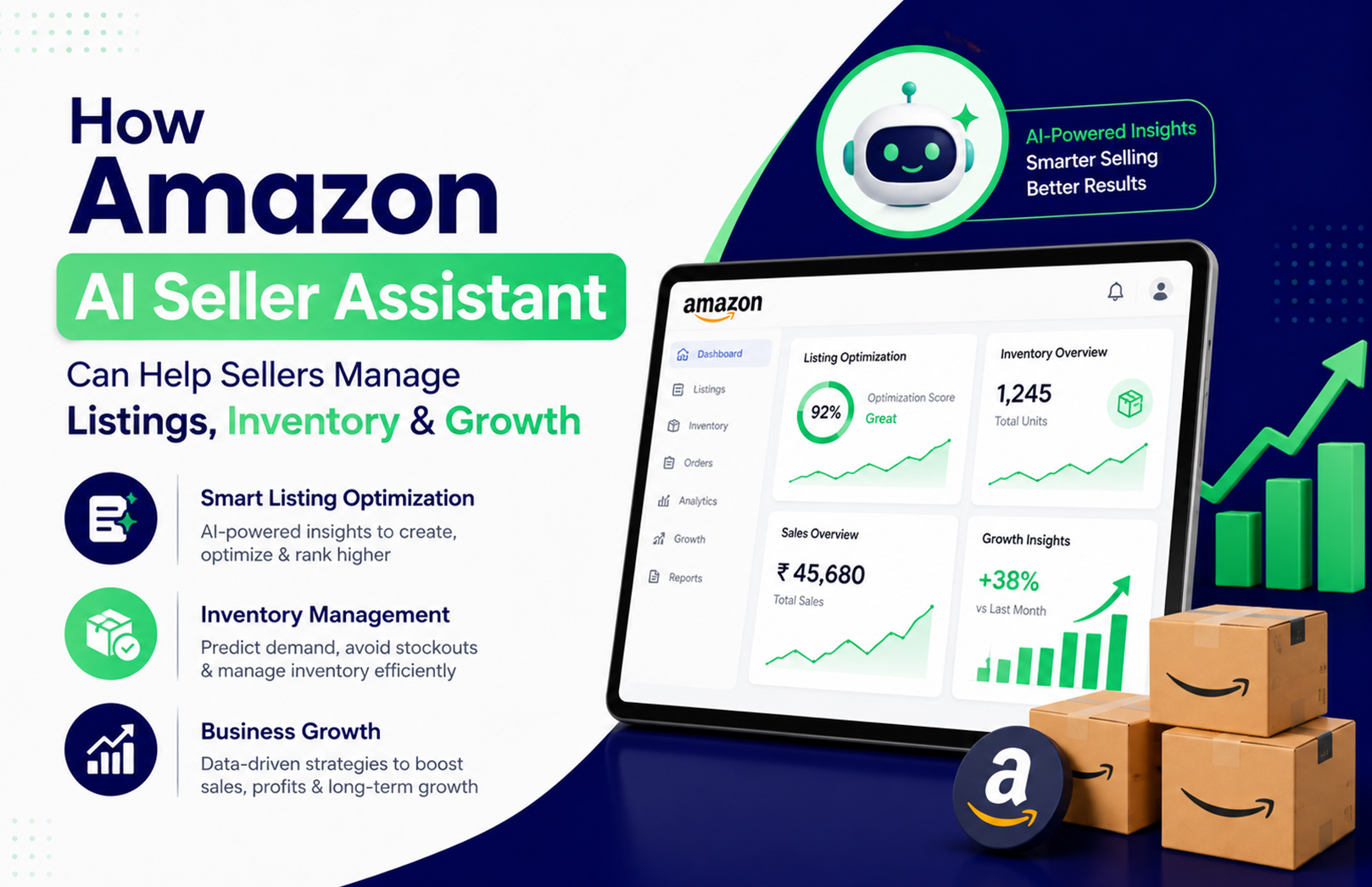
How Amazon AI Seller Assistant Can Help Sellers Manage Listings, Inventory & Growth


Amazon selling in India is becoming increasingly data-driven. Managing product listings, inventory, orders, pricing, advertising and account health manually can quickly become overwhelming, particularly as a seller’s catalogue grows.

Amazon is responding to this complexity with Seller Assistant, an AI-powered, conversational tool designed to help sellers launch, manage and grow their businesses. Amazon says the assistant can provide business insights across areas such as sales performance, inventory management, listings and catalogues, shipments and returns, orders and fees, while also helping sellers take certain actions with their approval.

For Indian sellers, this creates an important opportunity: AI can reduce the time spent analysing Seller Central data and help identify problems and opportunities faster. However, AI should complement not completely replace structured amazon seller account management and marketplace expertise.

What Is Amazon Seller Assistant?

Amazon Seller Assistant is an AI-powered assistant available within the Amazon selling ecosystem. Sellers can interact with it using natural-language questions instead of manually searching through multiple Seller Central reports and menus.

Amazon describes it as an always-on, generative AI and agentic system that can understand seller needs, surface relevant insights and, where supported, take actions with seller approval. Its capabilities cover areas including listings, inventory, sales performance, orders, fees, shipments and returns.

For Indian sellers, Amazon has also introduced Seller Assistant with support for English and Hinglish, making it more accessible to sellers who prefer conversational guidance over complicated dashboards. Amazon says the tool is available at no cost to sellers in India.

How AI Can Improve Amazon Listing Management

Product listings are one of the most important parts of an Amazon business. A seller can have a strong product and competitive price, but poor titles, bullet points, images or product information can still reduce visibility and conversions.

Seller Assistant can help sellers understand listing and catalogue-related issues and obtain guidance about their products. This makes AI particularly useful for sellers managing large catalogues where manually reviewing every ASIN is time-consuming.

However, AI recommendations should be reviewed against keyword strategy, customer intent, competitor positioning and Amazon’s listing requirements. This is where professional amazon listing management services can add significant value.

An experienced team can combine AI-assisted analysis with keyword research, backend keyword optimisation, content improvements and ongoing listing monitoring. HRL Infotechs’ Amazon SEO & Listing Optimization service, for example, focuses on improving listing visibility through listing optimisation, keyword research and backend keyword additions.

Using AI for Better Inventory Management

Inventory problems can quickly turn into lost sales.

Too little stock can create out-of-stock situations, while excessive inventory can tie up working capital and increase storage-related costs. Amazon’s Seller Assistant provides sellers with insights related to inventory management and can help identify actions associated with inventory and business performance.

Indian sellers can use these insights to ask practical questions such as:

  • Which products need immediate replenishment?
  • Which SKUs are selling slower than expected?
  • Where could inventory costs become a concern?
  • Which products require closer monitoring before major sales events?
  • How should inventory decisions align with expected demand?

AI can make the analysis faster, but sellers still need accurate sales history, lead times, supplier information and business context before making purchasing decisions.

Turning Seller Central Data Into Growth Insights

One of the biggest advantages of AI tools for Amazon sellers is the ability to turn large amounts of marketplace data into easier-to-understand insights.

Instead of checking multiple reports individually, sellers can use conversational questions to explore areas such as sales performance, orders, fees, inventory and catalogue performance. Amazon specifically highlights these business-insight capabilities within Seller Assistant.

For example, a seller could investigate why a product’s sales have declined, identify inventory-related concerns or understand which areas require attention.

But growth does not come from data alone. Sellers need to connect those insights with pricing, advertising, content, customer behaviour and profitability.

This is where amazon account management services become valuable. A professional account management team can continuously monitor performance, identify opportunities and coordinate different parts of the Amazon strategy instead of treating each metric separately.

Can AI Replace Amazon Seller Account Management?

Not completely.

AI can significantly reduce repetitive analysis and help sellers access information faster, but successful marketplace growth still requires strategic decision-making.

Professional amazon seller management services can cover areas such as account health monitoring, case management, FBA reimbursement, catalogue management and ongoing marketplace optimisation. HRL Infotechs’ Amazon Account Management service includes account health monitoring, case log management and FBA reimbursement support.

Think of AI as an additional layer of intelligence rather than a replacement for experienced Amazon professionals.

AI can identify a potential issue. A human expert can determine why it happened, assess its commercial impact and decide what should happen next.

Combining AI With Amazon Marketing Services

AI-assisted account management becomes even more powerful when combined with a structured advertising strategy.

A listing with strong organic visibility can still underperform if advertising campaigns are poorly structured. Similarly, increasing ad spend will not necessarily solve a conversion problem caused by weak product content.

Professional amazon marketing services can connect listing optimisation, keyword targeting, PPC management, competitor analysis and conversion improvements into one growth strategy.

An amazon marketing agency can also use Seller Central insights alongside advertising data to determine where budget should be increased, reduced or reallocated.

HRL Infotechs provides Amazon Advertising Services designed around campaign performance, conversions, traffic and ROI.

The Best Approach for Indian Amazon Sellers

For sellers in India, the strongest approach is not simply choosing between AI and human expertise. It is combining both.

A practical Amazon growth system can look like this:

AI insights → human analysis → strategic action → performance monitoring → continuous optimisation

Seller Assistant can help surface information and opportunities. A professional team can then validate those insights against business objectives, margins, competition and marketplace strategy.

This approach is particularly useful for established sellers managing multiple SKUs, advertising campaigns and fulfilment requirements.

Why Sellers Should Start Using AI Now

The Amazon marketplace is becoming increasingly dependent on automation, data and AI-driven experiences. Amazon is already expanding Seller Assistant’s capabilities beyond simple question answering into business insights and approved actions.

For Indian sellers, learning how to work alongside these tools can create an operational advantage.

The objective should not be to automate every decision. Instead, sellers should automate repetitive analysis while keeping important commercial decisions under expert control.

This can help teams spend less time navigating Seller Central and more time improving products, customer experience, profitability and growth.

Final Thoughts

Amazon AI Seller Assistant represents an important development for sellers who want faster access to marketplace insights. From listings and inventory to sales performance and account operations, AI can help simplify many parts of the selling process.

However, AI alone is not an Amazon growth strategy. Sellers still need strong listings, effective advertising, inventory planning, account health management and ongoing optimisation.

The most effective model is therefore a combination of AI tools for Amazon sellers and professional amazon seller account management. AI provides speed and insights, while experienced marketplace specialists provide strategy, context and execution.

If your Amazon business is growing and managing Seller Central is becoming difficult to handle internally, professional support can help you build a more structured and scalable marketplace operation.

Frequently Asked Questions

Q1. What is Amazon Seller Assistant?

Ans. Amazon Seller Assistant is an AI-powered conversational tool that helps Amazon sellers access information, receive business insights and manage aspects of their selling operations. Amazon says it covers areas including sales, inventory, listings, orders, fees, shipments and returns.

Q2. Is Amazon Seller Assistant available to Indian sellers?

Ans. Yes. Amazon India announced Seller Assistant for Indian sellers, with support for English and Hinglish. Amazon describes it as a free AI tool available to sellers in India.

Q3. Can Seller Assistant manage Amazon listings?

Ans. Seller Assistant can provide insights and guidance related to listings and catalogues. Sellers should still review AI-generated recommendations for accuracy, compliance, keyword relevance and brand positioning before implementing important changes.

Q4. Can AI replace Amazon account managers?

Ans. AI can automate and simplify many analytical and repetitive tasks, but it does not eliminate the need for strategic account management. Human expertise remains important for advertising, catalogue strategy, account health, profitability and complex marketplace decisions.

Q5. What are the best AI tools for Amazon sellers?

Ans. Amazon Seller Assistant is one of the key AI tools available within the Amazon seller ecosystem. Sellers can also use specialised AI and analytics solutions for keyword research, listing optimisation, advertising analysis and forecasting, depending on their requirements.

Q6. When should an Amazon seller consider professional account management?

Ans. Professional support becomes particularly valuable when a seller is managing a growing catalogue, increasing advertising spend, experiencing account-health issues, struggling with inventory or lacking the internal resources to monitor Seller Central consistently.

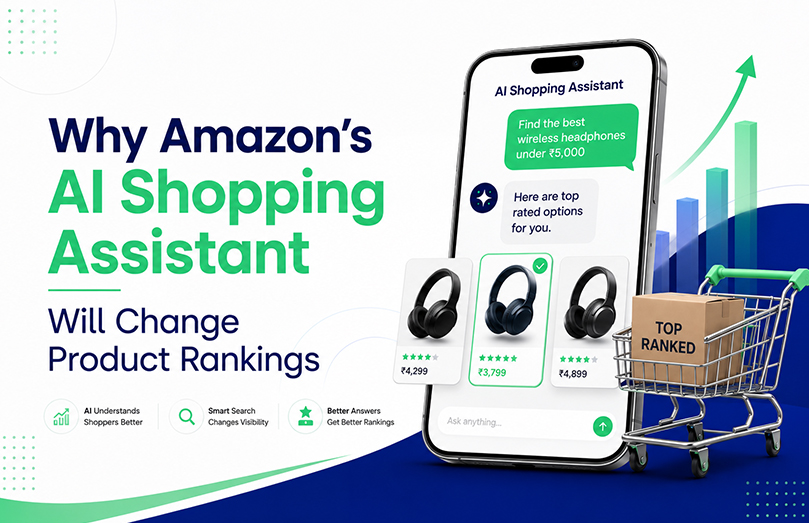
Why Amazon’s AI Shopping Assistant Will Change Product Rankings


Fifty products used to compete for one shopper’s attention. Now it’s five.

That’s the actual shift happening on Amazon right now, and most sellers still haven’t registered how large it is. A traditional Amazon search returns a full page of results dozens of products, endless scroll, plenty of room for a mediocre listing to still get found eventually. Amazon AI shopping assistant does something fundamentally different: ask it a question, and it narrows that same field down to roughly five named products. If your product isn’t one of those five, it simply doesn’t exist for that shopper; there’s no scroll to fall back on.

As of May 2026, Amazon officially renamed this assistant from Rufus to Alexa for Shopping, unifying it with Alexa+’s personalisation across the app, website, and Echo devices. The underlying system the one reading listings, reviews, and Q&A to decide who makes that shortlist of five hasn’t changed. What’s changed is how central it’s becoming to how Indian shoppers actually find products.

Why This Isn’t Just Another Feature Update

Amazon reported over 300 million monthly users engaging with this assistant by the end of 2025, and during Black Friday alone, it was involved in 38% of all Amazon shopping sessions. This isn’t a niche feature a handful of early adopters are testing; it is the new frontier for Amazon product ranking optimisation. It’s rapidly becoming a primary discovery channel, sitting alongside and, in growing cases, replacing traditional search entirely.

For sellers, the implication is straightforward and slightly uncomfortable: the rules that got a product ranking well in classic search results don’t automatically translate into getting recommended by an AI system deciding who makes a shortlist of five.

How the Underlying Logic Actually Differs

Amazon’s traditional Amazon search algorithm, the system most sellers spent years learning to optimise for, is heavily driven by keyword matching, sales velocity, and click-through data. It’s mechanical in a genuinely learnable way.

The AI shopping assistant works differently. Instead of matching typed keywords, it interprets intent from a conversational question, then reads across your entire listing title, bullets, description, A+ content, customer reviews, and the Q&A section to synthesise whether your product genuinely fits what the shopper actually asked. A listing stuffed with repeated keywords but thin on real explanation tends to get recommended less. A listing that reads naturally and actually answers the kind of question a real person would ask tends to surface more often.

This is precisely why real product ranking optimisation in 2026 can’t stop at backend keyword fields the way it used to. The system is reading for meaning now, not just matching strings of text.

What Actually Changes in How Listings Get Built

Solid Amazon listing optimisation going forward means writing content that could genuinely answer a spoken question, not just satisfy a search algorithm scanning for keyword density.

If someone asks the assistant “which of these blenders is quiet enough to use early morning without waking the house,” a listing that’s proactively addressed noise level in the bullets, in the A+ content, ideally reinforced by review content mentioning it has a real shot at being one of the five names returned. A listing that only lists wattage and blade count, however keyword-optimised, genuinely doesn’t.

Why Reviews and Q&A Matter More Than They Used To

Here’s a detail most sellers haven’t fully internalised yet: this assistant doesn’t rely solely on what the seller wrote. It’s actively reading review content and Q&A sections as source material for its own answers.

That means a thin Q&A section the one most sellers genuinely ignore after launch is now a real ranking gap, not just a minor oversight. Proactively seeding a handful of genuinely useful Q&A entries, and actively encouraging detailed reviews that mention specific use cases, has become a real lever for visibility, not just a nice-to-have for social proof.

Why This Reshapes Advertising Strategy Too

Getting genuine Amazon advertising optimisation right now means thinking beyond simply winning a sponsored placement in a search results grid.

If the AI assistant is increasingly deciding the shortlist a shopper actually sees, ad spend that only targets classic search placement is fighting for a shrinking share of real discovery. Smart advertising strategy in 2026 increasingly means making sure the listing itself is strong enough to earn assistant recommendations organically, with paid placement supporting that visibility rather than trying to substitute for it entirely.

Why Account Health Quietly Feeds Into This Too

Sound Amazon seller account management affects this system just as directly as it always affected classic search. Inconsistent stock, unresolved account health flags, or thin catalogue data all undermine the confidence signals the AI assistant is reading before it decides whether to recommend a product at all.

A technically strong listing sitting inside a poorly managed account doesn’t get the benefit of the doubt. The assistant is synthesising trust signals across the whole account experience, not evaluating one listing in complete isolation from everything else.

Why This Extends Well Beyond a Single Listing

This shift is really part of a much broader move toward genuine Amazon marketplace optimisation because a shopper’s experience spans the whole account, not one product page in isolation.

Brands with consistent quality across their entire catalogue, not just their single bestseller, tend to build the kind of trust signals an AI system can actually pick up on across multiple interactions, rather than betting everything on one hero listing carrying the whole brand.

What This Means Beyond Amazon Specifically

The pattern showing up here AI systems narrowing choice down to a handful of recommendations instead of a full results page isn’t unique to Amazon. It’s the same shift reshaping ecommerce marketplace optimisation broadly, as Flipkart, Myntra, and other platforms increasingly build their own AI-assisted discovery layers following the same logic.

Brands that learn to write for genuine intent now, rather than pure keyword density, are building a skill that transfers directly across every marketplace moving in this direction, not just the one that got there first.

Conclusion

The shift from fifty visible results to five AI-recommended ones is the biggest change to Amazon discoverability since the platform introduced sponsored ads. Sellers still optimising purely for classic keyword-matching are optimising for a shrinking share of how shoppers actually find products in 2026.

At HRL Infotechs, real Amazon SEO services now mean building listings, review strategy, and account health together, treating the AI shopping assistant as the primary discovery layer it’s rapidly becoming, not an experimental feature to revisit later once it’s “proven itself.” By the time it’s proven itself to everyone, the sellers who prepared early will already own the shortlist.

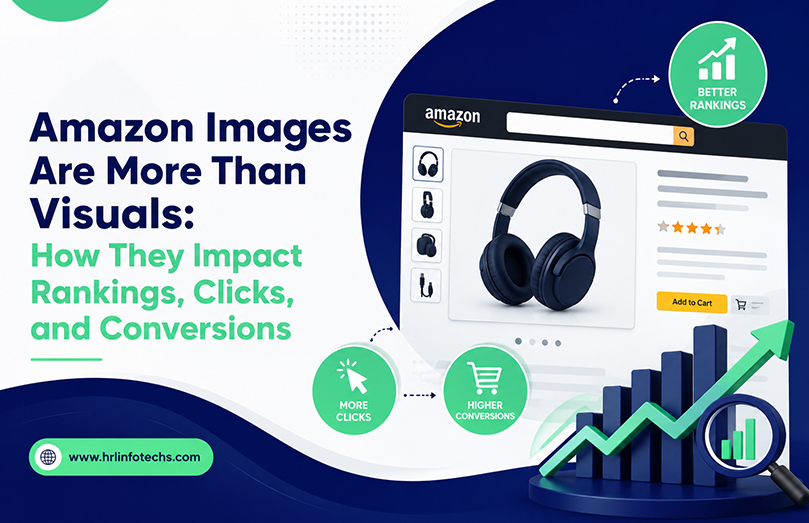
Amazon Images Are More Than Visuals: How They Impact Rankings, Clicks, and Conversions


Scroll through Amazon on your phone for 30 seconds and count how many product titles you have read in full. Realistically, not a single one of them probably caught your eye. What determined whether you continued scrolling or stopped to read more? The image beside the title, which most sellers continue to overlook, despite being their most important tool.

That’s the gap worth talking about, because it touches nearly every part of how a listing actually performs, not just how it looks.

Why Images Are Doing More Work Than Sellers Realise

Most sellers think of Amazon listing optimisation as a title-and-bullet-points exercise, with images treated as decoration added at the end once the copy is finalised.

That’s backwards. On a results page full of dozens of similar products, the image is the first and sometimes only information the shopper takes in before clicking through to your product detail page. Get it wrong, and no one will see your great title at all.

The Click Decision Happens Before Anyone Reads Anything

Real Amazon product image optimisation starts with understanding a simple, slightly uncomfortable truth: shoppers judge a product visually before they judge it rationally.

A messy main image, poorly lit product, or oddly framed shot in an otherwise perfect ad could cause a visitor to pause for half a second – just long enough to go back and pick a competitor instead. Your main image is all it takes to sell someone on your service before they’ve read a single word of your ad.

Why This Connects Directly to Search Visibility

Here’s the part most sellers genuinely don’t expect: images influence Amazon SEO services work more than people assume, because click-through rate is a ranking signal Amazon’s algorithm actively tracks.

A snippet that is clicked on more often than not will steadily improve its position in results, as it’s rewarded by higher levels of traffic. In other words, a well-performing snippet will continue doing well for months to come as a result of being clicked on more often than not.

Getting the Technical Side Right

Good Amazon image optimisation isn’t just about creative quality; it’s also about meeting Amazon’s actual technical requirements properly, something a surprising number of listings still get wrong.

That means using the full 85% of the frame Amazon recommends, keeping the background genuinely pure white on the main image, uploading at a resolution high enough to support zoom, and using every available image slot instead of stopping at three or four of the seven or nine available slots. Each unused slot is a missed opportunity to answer a question a shopper hasn’t asked yet.

Why Images Are the Real Conversion Lever

Traffic getting a shopper to your page is only half the job. The other half genuinely the harder half is convincing them to actually buy once they’ve arrived, and this is where Amazon conversion optimisation lives or dies.

Infographic-style images explaining size, material, or use case answer objections before a shopper has to type a question into the Q&A section. Lifestyle images showing the product genuinely in use build a kind of confidence that specification text alone simply can’t replicate. A shopper who can picture themselves actually using the product converts at a meaningfully higher rate than one left to imagine it purely from a bullet list.

Why This Needs Ongoing Attention, Not a One-Time Fix

A lot of sellers treat product imagery as something you do once at launch and never revisit, which is exactly where professional Amazon listing management services genuinely earn their value.

Seasonal changes, experimenting with alternate lifestyles, refreshing your image, studying the results to determine which image drives traffic and which one is a dud- they all add up to work that most solo sellers can not afford to do regularly.

The Bigger Picture Beyond a Single Listing

Zoom out, and this is really part of a much broader conversation about Amazon marketplace optimisation because images don’t function in isolation from everything else happening on your account.

A brand that leverages strong imagery across its catalogue – not just for the bestseller, but for everything else – can build an image appeal that its buyers will recognise across their purchases. This creates a powerful competitive advantage in a crowded product category, where multiple offerings have similar descriptions and target the same search queries.

Why Account Health Quietly Affects This Too

Here’s a connection most sellers don’t immediately see: solid Amazon seller account management directly supports how well your imagery actually gets to perform in the first place.

Hidden listings, policy issues, or faulty catalogue entries may bury even the most compelling images deep within the search maze, rendering them invisible to potential buyers despite your best efforts. After all, if there is no healthy and compliant account to showcase them on in the first place, all that creative energy goes to waste.

Why This Extends Beyond Amazon Specifically

This isn’t purely an Amazon-specific conversation either. The same visual principles apply directly to broader ecommerce marketplace optimisation across Flipkart, Myntra, and other platforms where Indian sellers increasingly operate simultaneously.

A brand that’s built a genuinely strong visual system for one marketplace can adapt that same underlying strategy across every other platform it sells on rather than starting the entire creative process over from scratch for each channel.

Conclusion

Product images on Amazon were never just visuals sitting next to a title. They’re doing real, measurable work across click-through rate, search ranking, conversion rate, and long-term brand perception, often more work than the copy surrounding them.

Sellers still treating imagery as a final, cosmetic step are consistently leaving performance on the table that better-optimised competitors are already capturing.

At HRL Infotechs, we help Indian sellers treat product imagery as the genuine strategic asset it actually is, building visuals that don’t just look good, but measurably move rankings, clicks, and conversions together, across every marketplace where a brand actually sells.

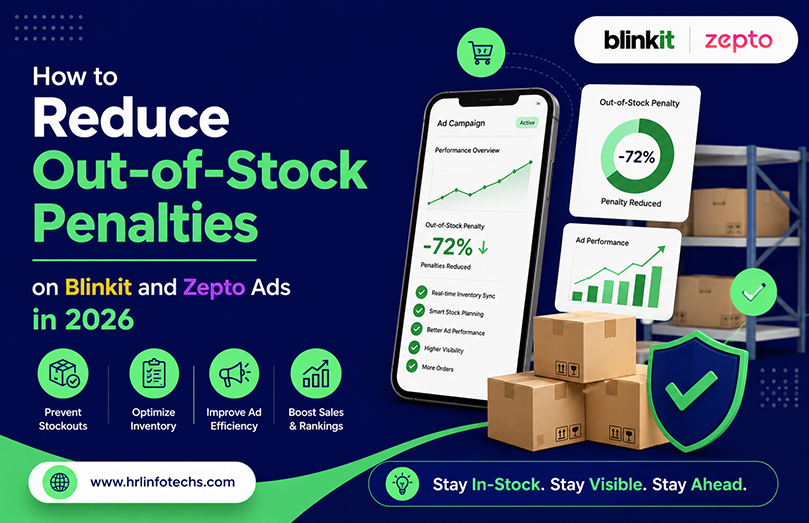
How to Reduce Out-of-Stock Penalties on Blinkit and Zepto Ads in 2026


Quick commerce has completely changed how Indian consumers shop for everyday essentials. Platforms like Blinkit and Zepto have trained customers to expect delivery within minutes, which makes product availability one of the single biggest factors deciding whether a seller actually succeeds.

However, there are many companies that continue to invest significantly in advertising while at the same time understating the importance of inventory. At the same time, advertising out-of-stock products leads to wasted resources, low campaign efficiency, and poor marketplace positioning that may take a long time to reverse.

This is why effective Blinkit inventory management has become a strategic priority for businesses. Through accurate planning and smart advertising, companies can mitigate the consequences of stock shortages, optimise expenditures, and provide a high level of customer service.

Why Out-of-Stock Products Quietly Wreck Ad Performance

Every campaign exists to drive visibility and conversion. When a customer clicks a promoted product and finds it’s unavailable, both the customer experience and the campaign itself take a hit at the same time.

Quick commerce platforms track availability closely because stock directly affects customer satisfaction. Frequent stockouts tend to bring reduced ad efficiency, lower conversion rates, eroded customer trust, missed sales that never come back, and declining visibility across the marketplace. Instead of driving genuine growth, that advertising budget becomes increasingly inefficient the moment inventory can’t keep pace with demand.

Why Inventory Planning on Zepto Genuinely Matters

Inventory problems get more serious in fast-moving categories, where demand can shift multiple times within a single day.

Strong Zepto inventory management practices enable firms to forecast demand accurately, maintain healthy stock levels, and prevent disruptions deriving from unexpected sales increases. The companies that are strong at inventory management tend to pay continuous attention to their stock, base their demand forecasts on realistic assumptions, establish supply chain relationships, and allocate resources wisely rather than speculate on the demand.

Get these right, and products stay available while active campaigns keep bringing in traffic instead of quietly going dark mid-campaign.

Advertising Only Works When Inventory Can Back It Up

Many companies have the wrong idea that increasing the ad budget will automatically lead to an increase in sales. In reality, advertising and inventory management must be coordinated, or the former will fail to produce the desired results.

A truly effective quick commerce marketing strategy would promote products in a manner that does not lead to their immediate sell-through. Instead of simply advertising all available goods, it would be more effective to focus on those that are actually selling. A smart strategy would prioritise those products that have a steady supply and high margins, ensuring long-term success and avoiding empty shelves.

Managing Campaigns With Inventory in Mind

Stock availability should genuinely shape advertising decisions, not sit as a separate consideration handled by a different team entirely.

Smart, quick commerce advertising means continuously adjusting budgets based on real inventory performance, pushing visibility harder for products with healthy stock, pulling back spend on anything running low, pausing campaigns outright for genuinely unavailable items, and shifting that freed-up budget toward alternatives that are actually performing. Dynamic management like this stops wasted spend before it happens, rather than discovering the problem in a monthly report.

Why Professional Blinkit Advertising Management Actually Helps

Managing campaigns manually gets genuinely harder as a catalogue grows past a handful of SKUs.

Professional Blinkit advertising services allow companies to combine inventory management with campaign optimisation as an integrated task, not as two separate activities handled by different workers. Unlike a generic company, a specialist examines the state of stock, the existing demand, current performance, and profitability of a campaign more frequently than just on a weekly or monthly basis. Such an approach allows one to identify a greater number of ways to cut costs without affecting the overall growth and profitability.

Building Better Seller Operations on Zepto

Inventory problems rarely come from advertising decisions alone. More often, they come from operational processes that were never properly connected in the first place.

Real Zepto seller management focuses on genuinely smoother coordination between inventory, fulfilment, pricing, and advertising teams, not letting each function operate in its own silo. Brands that monitor their seller operations regularly tend to catch potential stock shortages before they ever start hurting campaign performance, which means faster reaction time and considerably fewer lost sales along the way.

Why Visibility Needs More Than Just Advertising

Ads alone can no longer assure a business of long-term viability on any given quick commerce platform. In many cases, the companies that continue to thrive are those that go beyond simply offering good value for money and begin to provide an altogether satisfying customer experience, including consistent product availability.

This is exactly why marketplace SEO matters even inside a closed marketplace ecosystem like Blinkit or Zepto. Discoverability improves noticeably when listings maintain accurate inventory data, genuinely relevant product information, consistent availability, real customer engagement, and dependable fulfilment. Advertising drives the immediate spike in visibility. Marketplace optimisation is what sustains it organically once the campaign budget slows down.

Why Catalogue Quality Directly Supports Inventory Accuracy

A well-organised product catalogue makes inventory management significantly easier to manage day-to-day.

Proper catalogue optimisation helps eliminate duplicate listings, keep product information genuinely accurate, improve categorisation, and simplify tracking across multiple fulfilment locations simultaneously. Cleaner catalogues also cut down the errors that quietly cause stock mismatches between internal systems and what’s actually showing on the marketplace, which becomes a real competitive edge once you’re managing hundreds of SKUs at once.

Why Integrated Account Management Delivers Better Outcomes

Advertising, inventory, catalogue management, and operational planning should never run as four separate, disconnected processes.

Strong, quick commerce account management brings all of this together into one coordinated strategy, rather than fixing inventory problems only after they’ve already damaged a campaign. Real integrated management catches potential issues early through regular monitoring and genuine operational review, a proactive approach that improves efficiency while significantly reducing costly, avoidable campaign interruptions.

Measuring Success Beyond Just Revenue

The strongest quick commerce brands are tracking far more than top-line sales alone.

Genuine quick commerce performance optimisation means analysing inventory availability, stock turnover, campaign ROI, conversion rates, customer retention, and fulfilment performance together, not in isolation. Monitoring all of this simultaneously gives a much clearer picture of how operational decisions are actually shaping advertising results, and businesses that optimise the entire customer journey consistently outperform those focused purely on ad spend alone.

How HRL Infotechs Supports Quick Commerce Growth

As quick commerce keeps expanding across India, managing inventory and advertising together has stopped being optional for sustainable growth.

HRL Infotechs helps brands simplify their Blinkit and Zepto operations through genuinely integrated marketplace solutions combining inventory planning, catalogue management, advertising optimisation, account management, and broader marketplace growth strategy. Rather than treating each of these as separate functions, HRL Infotechs builds connected workflows that improve operational efficiency while genuinely maximising campaign performance and customer satisfaction together.

Conclusion

Out-of-stock penalties are never just a temporary inventory hiccup. They directly affect advertising performance, customer trust, marketplace visibility, and overall profitability, often long after the actual stockout is resolved.

Brands combining accurate inventory planning with genuinely intelligent campaign management are far better positioned to make every advertising rupee count while still delivering a consistent customer experience. As quick commerce competition keeps intensifying through 2026, the businesses that bring inventory management, catalogue optimisation, advertising, and operational planning together into one unified strategy will hold a real competitive advantage over those still managing each piece separately.

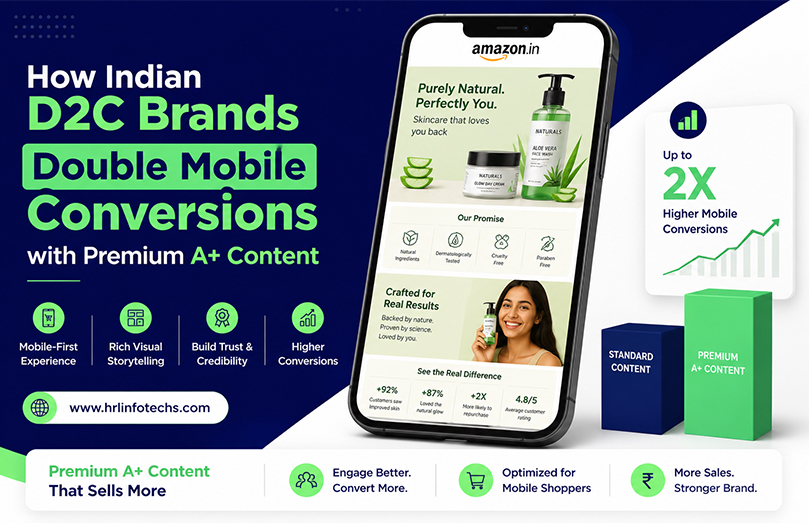
How Indian D2C Brands Double Mobile Conversions with Premium A+ Content  


Open Amazon on your phone right now and scroll through five random product listings. Chances are, at least three of them look almost identical: a title, five bullet points, maybe one lifestyle image squeezed awkwardly into a mobile screen that was clearly designed for desktop first.

That gap is exactly where Premium A+ Content is quietly reshaping outcomes for D2C brands across India in 2026. Not because it’s a new feature, Amazon’s had A+ Content for years. What’s changed is how brands are finally building it specifically for the screen most Indian shoppers actually use to buy.

Why Mobile Changes Everything About A+ Content

Over 80% of Amazon India’s traffic now comes from mobile devices. That number alone should reshape how every brand thinks about its listing, but most still don’t.

Mobile conversion optimisation on Amazon isn’t just about making things load faster. It’s about accepting that a shopper on a five-inch screen decides in roughly eight seconds, scrolling with a thumb, comparing three tabs open at once. A desktop-first A+ module with dense paragraphs and tiny comparison charts simply doesn’t survive that environment. The information might be accurate. It just never gets read.

Premium A+ Content solves this differently than standard A+ modules. It unlocks comparison charts, brand story modules, and interactive Q&A blocks specifically built to render cleanly on mobile, with bigger touch targets, cleaner visual hierarchy, and content that actually breathes instead of cramming everything above the fold.

What “Doubling Conversions” Actually Looks Like in Practice

The claim sounds bold until you break down what’s actually happening structurally.

Standard A+ Content typically improves conversion by 3-10%, according to Amazon’s own internal benchmarks. Amazon Premium A+ Content, specifically the comparison chart module and premium video placement, is showing meaningfully higher lift for D2C brands that build it correctly, particularly in categories where shoppers are comparing multiple similar products before deciding: skincare, supplements, home appliances, and personal care.

The mechanism is simple. A shopper who has to scroll through generic bullet points to figure out why your serum is different from the one three listings down abandons the decision entirely, often heading back to search results rather than committing. A comparison chart that answers that exact question at a glance keeps them on your page and moving toward checkout instead.

Why Amazon Listing Optimisation Alone Isn’t Enough Anymore

For years, Amazon listing optimisation meant getting your title right, your bullets keyword-rich, and your backend search terms filled in properly. That work still matters. It’s just no longer sufficient on its own.

Amazon product page optimisation in 2026 requires that we think of the entire page as a joined-up sales mechanism, rather than a group of independent elements (title, images, A+ modules, reviews, etc.) which can be individually audited and optimised as part of a product listing review. A brand might have a great title, but kill their chances with a poorly optimised A+ Content module, which was written once, at launch, and never revised.

The Real Driver: Amazon Conversion Rate Optimisation

Everything genuinely comes back to one number: Amazon conversion rate optimisation. Traffic without conversion is just an expensive vanity metric.

Amazon’s layout works because it directly addresses the two biggest reasons a mobile shopper hesitates: uncertainty about whether the product actually solves their problem, and uncertainty about whether this brand can be trusted over a cheaper alternative sitting right next to it in search results. Implementing Amazon A+ Content optimisation answers both, using visual proof instead of asking the shopper to take a bullet point’s word for it.

What This Means for D2C Ecommerce Conversion Specifically

D2C ecommerce conversion carries a particular challenge most established brands don’t face: you’re usually competing against products with more reviews, more history, and more built-in trust signals.

A+ Content will become your equaliser. This is where you can tell the story of your sourcing, your production, the journey of your founder – something a 5-year-old competitor listing, full of positive reviews, may have neglected to do. For categories like Indian skincare and Indian wellness that are seeing explosive growth on Amazon, this type of engagement may outweigh the power of reviews during that all-important first-purchase window.

Why This Matters Specifically for Premium A+ Content India

Access to Premium A+ Content in India requires a brand registry and, in most cases, a qualifying sales history, meaning it’s genuinely earned and not available to every seller from day one. That exclusivity is part of what makes it so effective. Shoppers on Indian marketplaces are becoming more aware of the difference between listings that lack personality and those developed with care, even if they can’t always put their finger on why one inspires more trust than the other.

Getting proper content services involved early, rather than treating A+ Content as a final step tacked on after the product launches, consistently produces stronger results than retrofitting it onto a listing that’s already live and underperforming.

Building It Right: What Actually Works on Mobile

The brands seeing genuine lift aren’t just uploading prettier images. They’re rethinking structure specifically for how mobile shoppers actually scroll.

That means comparison charts are kept to three or four rows maximum, not ten. Video modules under thirty seconds are front-loaded with the strongest hook in the first three seconds. Text is kept genuinely short, a sentence, not a paragraph, per module. When utilising professional Amazon brand managment services, the strategy always involves testing the entire page on an actual phone before publishing, rather than just previewing it on a desktop monitor and assuming it translates perfectly to mobile. 

Conclusion

Mobile isn’t a channel anymore. For most Indian D2C brands selling on Amazon, it’s simply the channel, the primary and often only way most customers ever encounter a listing.

Brands treating Premium A+ Content as a genuine mobile-first conversion tool, rather than a decorative add-on built once and forgotten, are the ones pulling ahead in 2026. The opportunity isn’t really about doing something entirely new. It’s about finally building for the screen customers are already holding.

At HRL Infotechs, this is precisely the gap we help D2C brands close, building A+ Content that’s genuinely designed mobile-first, tested on real devices, and structured around what actually moves a thumb toward the buy button, not just what looks impressive in a desktop preview.

Amazon Sponsored Ads vs Amazon DSP: Which Advertising Strategy Delivers Better ROI in 2026?


An ecommerce brand selling on Amazon India spent eighteen months running only Sponsored Ads. Sales were steady. ACoS sat around 22%, comfortably profitable. Then a private label competitor entered the category with a near-identical product at a similar price, and the brand’s growth flattened within two quarters, not because their campaigns got worse, but because Sponsored Ads alone had no answer for a competitor building awareness before shoppers ever typed a search term.

The brand added a modest DSP retargeting campaign six months later. Within one quarter, repeat purchase rate increased, and their branded search volume, people typing the brand name directly rather than a generic category term, grew 31%. Sponsored Ads had never been the wrong choice. It had simply never been the complete answer.

This is the real question behind Amazon Sponsored Ads vs Amazon DSP in 2026, not which one wins, but which one is solving the specific growth problem a brand actually has right now.

Understanding Amazon Sponsored Ads

Amazon-sponsored ads represent keyword-targeted placement opportunities on search result pages and product pages, targeting active customers searching for similar goods, with purchase intent, and at the highest stage of the purchasing funnel.

A successful Amazon Sponsored Ads strategy should focus on selecting the right keywords, optimising listings, increasing conversion rates, and adjusting bids based on performance. Moreover, because such advertising initially targets those already interested in the product, it helps generate sales more quickly.

Sponsored ads are most useful for such purposes as introducing new products, creating sales, increasing a website’s traffic due to their velocity, and taking advantage of narrow promotional opportunities where timing is more important than building brand awareness. For most small and mid-sized Amazon India sellers, Sponsored Ads remain the correct starting foundation on which the e-commerce brand built eighteen months of profitable growth on this alone before hitting its ceiling.

What Is Amazon DSP?

Amazon DSP advertising operates differently at a fundamental level. Rather than waiting for a keyword search, DSP uses audience data, shopping behaviour, demographics, and browsing history to place targeted display and video ads on Amazon-owned properties, third-party websites, mobile apps, and streaming platforms.

Amazon DSP for brands is valuable for building brand awareness before product searches, retargeting those who viewed a listing but didn’t purchase, remarketing to those who abandoned a cart, reaching out to new customers with your product, and for premium brand-building creative. This is exactly the opportunity that the E-commerce brand found that DSP does not wait for a customer to begin searching. It takes place before shoppers even start their search.

Comparing Advertising Objectives

Both platforms generate sales, but they solve different problems. Sponsored Ads capture demand that already exists in a shopper actively comparing products right now. DSP creates demand by introducing a brand before that search behaviour begins, supporting the upper-funnel influence that shapes decisions over a longer window.

Businesses needing immediate conversions typically prioritise Sponsored Ads. Brands focused on long-term acquisition and defending market position against new competitors, exactly the situation the appliance brand faced, which increasingly needed DSP as part of the mix, not as a replacement.

Which Platform Delivers Better ROI?

There is no universal winner when evaluating Amazon advertising ROI. Sponsored Ads typically produce stronger short-term returns because they target high-intent shoppers, with lower acquisition costs and faster, easier-to-measure sales.

DSP campaigns usually require larger investment and longer optimisation cycles, but contribute to brand recognition, retention, and repeat purchases that individual campaign metrics understate. The appliance brand’s 31% branded search increase never showed up as a direct DSP conversion; it showed up weeks later as improved Sponsored Ads efficiency, because more shoppers were now searching by brand name rather than generic category terms.

Evaluating ROI in isolation, campaign by campaign, misses this compounding effect. Evaluating it at the level of overall business growth reveals what each platform is actually contributing.

The Importance of Campaign Optimisation

Running ads without optimisation can drain profits on any platform. It means regular Amazon campaign optimisation to examine the search terms, audiences, bids, placements, creatives, and conversions.

This includes eliminating low-performing keywords, raising the cost for effective campaigns, and testing new audiences. In addition, teams should refresh their creative assets ahead of performance fatigue, evaluate their customer acquisition costs weekly (vs. monthly), and reallocate budgets depending on demand fluctuations throughout the year. Consistent optimisation is what separates advertising spend that compounds from spend that simply maintains a plateau, the exact plateau the appliance brand experienced before adding DSP.

Why Professional Campaign Management Matters

As Amazon advertising grows more sophisticated across both Sponsored Ads and DSP simultaneously, most internal teams struggle to manage both channels with the depth either requires. Professional Amazon PPC management brings dedicated expertise in campaign structure, keyword research, bidding strategy, and continuous reporting across both platforms.

Experienced specialists identify exactly the kind of growth ceiling the appliance brand hit, recognising when Sponsored Ads alone have plateaued and a DSP layer is the actual fix, rather than assuming the answer is simply higher Sponsored Ads bids on a strategy that has already reached its natural limit.

Building a Complete Ecommerce Advertising Strategy

Nowadays, the most successful advertisers already use a combination of channels to drive their sales instead of relying on one particular platform. To maximise revenues, they develop an integrated e-commerce advertising strategy that employs Sponsored Ads, DSP advertising, Brand Store optimisation, product content, SEO, and reviews management. All these tools are used to reach different audiences throughout the sales funnel.

Choosing the Right Solution for Your Business

Choose Sponsored Ads if you want short-term sales gains, faster keyword rankings, quicker product launches with instant ROI, and easier performance tracking. Choose DSP if your priority is building brand awareness, accessing non-Amazon channels, boosting customer retention, and preparing for competitive inroads. Note that most companies, like the appliance manufacturer mentioned, will likely need both types of advertising, though not necessarily simultaneously or in equal measure, as their business grows.

Conclusion

The debate around Amazon Sponsored Ads vs Amazon DSP is less about picking a winner and more about recognising which stage of growth your brand is actually in. Sponsored Ads capture active buyers and generate immediate conversions. DSP builds the brand recognition and retention that keeps a category competitor from quietly eating your growth the way it nearly did to the appliance brand before they adjusted their strategy.

At HRL Infotechs, we help businesses develop data-driven Amazon advertising services that combine strategic planning, performance analysis, and continuous optimisation across both Sponsored Ads and DSP. Whether your goal is immediate sales, long-term brand defence, or both together, our tailored approach is built to identify exactly which growth ceiling you are approaching before it becomes a plateau.

Is Shopify Plus Worth It for Indian D2C Brands in 2026? Costs, Features & ROI Explained


India’s D2C space is moving fast right now. Brands are scaling quicker than most teams can actually keep up with operationally. And at some point, almost every growing business hits the same wall, the platform that worked fine at ₹10 lakh a month starts genuinely struggling at ₹1 crore.

That’s usually when the question comes up: Is Shopify Plus worth it, or is this just an expensive upgrade for features you don’t really need?

It is all relative and depends on the specific use case. Shopify’s standard plans are great for start-ups and small-scale operations, whereas the increased complexity of the catalogue, order-processing volume, and other elements makes the ROI more difficult to achieve. If your business has an aspiration to grow significantly in 2026, understanding whether Shopify Plus for Indian D2C brands actually makes sense is worth thirty minutes of your time.

Why Indian D2C Brands Are Growing This Fast

Consumer behaviour in India has witnessed a dramatic change in the past few years. Internet shopping has penetrated even the remotest parts of the country, and the customers now expect the same seamless digital experience everywhere.

As enterprises continue to evolve in a landscape where they sell across markets, through social commerce, apps, and their website, complexity grows exponentially. Inventory fit for all channels, personalised experiences, frictionless checkout, and marketing automation that actually converts: brands are realising that to scale efficiently, it’s time to consider enterprise solutions to power their growth.

What Shopify Plus Actually Is

Shopify Plus India is the enterprise tier built specifically for brands running large catalogues, heavy traffic, and genuinely complex operations.

It is not about new functionality on the standard plan; it is about customisation, full automation, extended support, and infrastructure for scalability. The idea is to optimise the business process while providing a significantly better customer experience.

Is the Price Actually Justified?

Shopify Plus pricing in India is the number that scares people off before they’ve even looked at the value side of the equation. Enterprise platforms cost more than entry-level tools; that part’s obvious.

But the cost of a subscription is not the only criterion when comparing products. The most important factors should be the increase in efficiency, the reduction of manual processes, conversion rates, and revenue growth after achieving the point where the selected solution is no longer a limiting factor.

For brands doing serious monthly revenue, these gains routinely outweigh what the platform costs. For brands still finding their footing, they usually don’t yet.

What Actually Sets Shopify Plus Apart

A handful of things genuinely separate this from the standard plan.

Real automation. 

Order tagging, inventory workflows, customer segmentation, promotional campaigns, all of it can run without someone manually clicking through it every day.

A checkout that doesn’t lose people.

A faster, smoother checkout genuinely reduces cart abandonment, and that alone can move revenue meaningfully.

Room to actually customise. 

Growing brands often need a storefront that doesn’t look like every other Shopify store out there. Plus gives you the flexibility to build that.

Stability when traffic spikes hard. 

Flash sales, festive campaigns, and a viral influencer moment send traffic through the roof in minutes. Shopify Plus is built to hold steady through that, not buckle under it.

When Does an Upgrade Actually Make Sense?

A Shopify store upgrade becomes worth it when you’re genuinely hitting operational limits, not just when a competitor mentions they upgraded, and you feel like you should too.

The real signs: order volumes growing steadily, multiple warehouses to manage, a catalogue that has grown beyond your current capabilities, marketing complexity that is too time-consuming to manage manually, impending international expansion, or multi-channel selling.

If manual processes are genuinely the thing slowing growth down, upgrading stops being an expense and starts being a strategic move.

What Actually Supports Long-Term D2C Growth

Good product pages alone don’t build a lasting D2C business.

Prominent D2C ecommerce growth requires a tech-stack that is efficient, a website that loads rapidly, a customer experience that is tailored rather than generic, marketing automation that can do the heavy lifting, lean operations, and infrastructure that doesn’t need to be rethought every eighteen months.

Enterprise platforms give you that foundation, so growth doesn’t mean constantly tearing down and rebuilding your tech stack every time you hit a new milestone.

Why the Development Partner You Choose Matters

Picking the right platform is honestly only half the decision.

A genuinely skilled Shopify website development agency is what actually determines whether your store performs well, ranks properly, converts consistently, and can scale later without a rebuild. Done right, that means faster load speeds, solid mobile optimisation, secure integrations, a checkout that actually converts, and an architecture flexible enough to grow with you.

Get the implementation wrong, and even the best platform in the world won’t deliver what it’s capable of.

Why Custom Development Genuinely Matters

No two D2C brands run their business the same way, and this is exactly why custom Shopify development has become so valuable.

Custom functionality refers to making the platform work around the business rather than forcing the business into the software’s default structure. This includes subscription systems, loyalty programs, product personalisation, ERP systems, warehouse management, and internal dashboards for staff. These features enable a company to differentiate itself against competitors that offer the same standard set of functions.

Handling Complexity as You Scale

As revenue grows, so does operational complexity almost without exception.

Solid enterprise Shopify solutions help manage multiple storefronts, international expansion, blended B2B and B2C operations, high-volume order processing, marketing automation, and the kind of reporting that actually informs decisions. Instead of bolting on disconnected tools for every new problem, you get one centralised system that actually talks to itself.

Built to Handle Serious Volume

One of the clearest advantages of Shopify Plus is how well it supports genuinely high-volume ecommerce stores.

Festive season traffic, an influencer post that goes bigger than expected, a product launch that catches fire, these can spike traffic dramatically within minutes. And platform stability during exactly those moments is what protects the revenue you’re actually trying to capture.

Why the Platform Alone Doesn’t Deliver Growth

Even the best platform in the world doesn’t generate revenue by itself. It needs visibility behind it.

Pairing Shopify Plus with genuine ecommerce marketing services, such as SEO, paid advertising, email marketing, conversion optimisation, retention campaigns, and real performance analytics, is what actually turns the platform investment into revenue growth. Technology and marketing genuinely need to work together here. Neither one does the job alone.

So, is Shopify Plus Actually Worth It?

For smaller businesses with relatively modest order volumes, standard Shopify plans are often sufficient. There’s no need to overpay for capacity you’re not using yet.

But for brands experiencing real growth, increasing operational complexity, and ambitious targets ahead, Shopify Plus tends to be a genuinely strong investment better scalability, real operational efficiency, meaningful automation, stronger customer experience, and infrastructure that supports where you’re actually headed, not just where you are today.

Conclusion

Indian D2C brands have entered the stage where customer expectations, operating excellence, and sustainable scalability will define true success. The choice of the right platform has become much more than an infrastructural necessity; it has taken on a strategic role.

If your business is set to scale, grow its catalogue, or experience an increase in order volumes, Shopify Plus can be relied upon to scale alongside it.

At HRL Infotechs, we help brands evaluate, build, and optimise scalable Shopify ecosystems built around their actual growth goals from platform migration and custom development through to performance optimisation and genuinely integrated ecommerce marketing strategy, all built to help brands unlock what enterprise ecommerce can genuinely deliver.