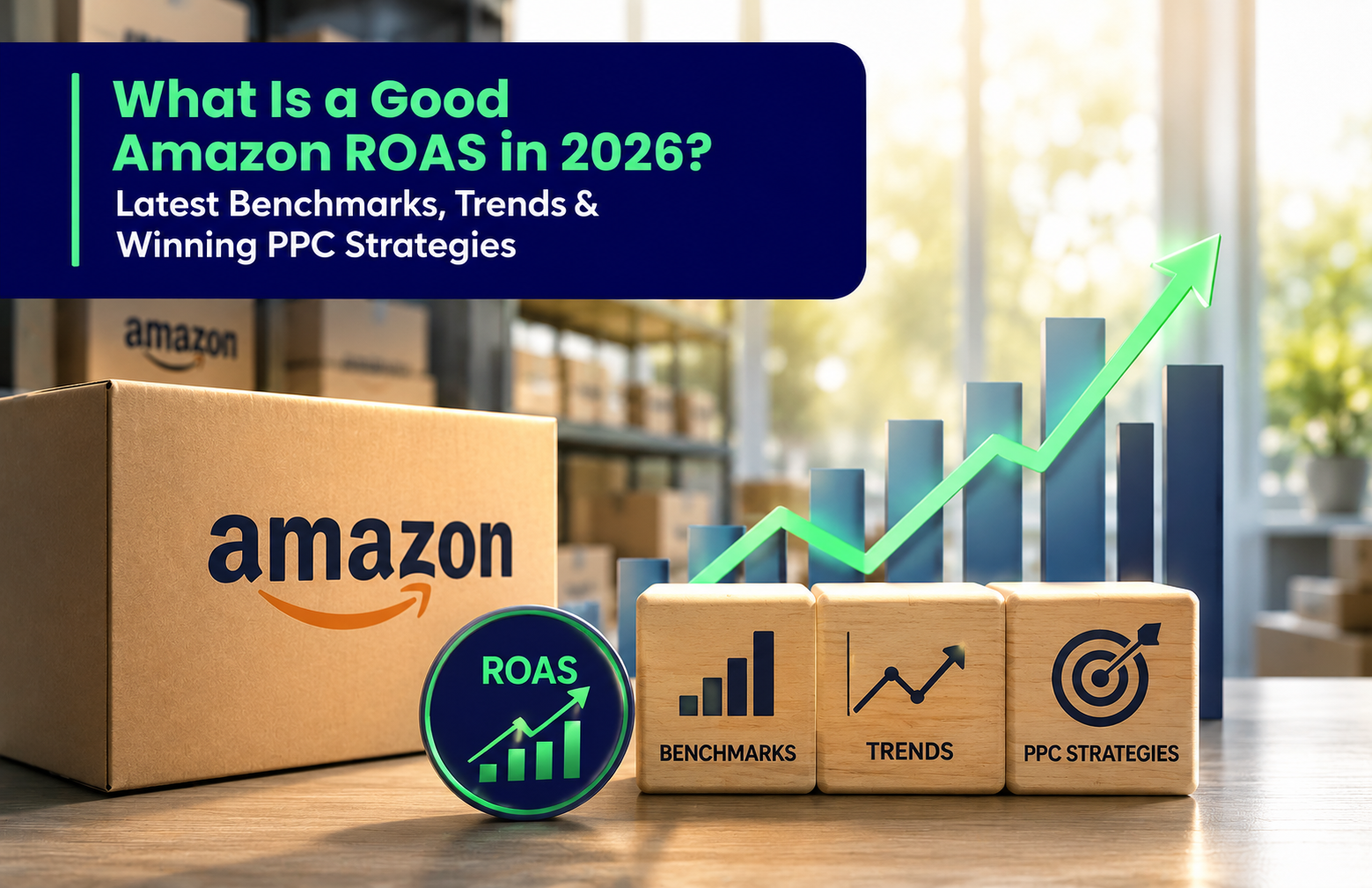
Amazon advertising has become one of the most important growth levers for ecommerce brands, but many sellers still struggle to understand what a good Amazon ROAS actually looks like. As we move into 2026, competition, ad costs, and customer behavior are shifting, so your ROAS targets must evolve too. Knowing the latest benchmarks and how to interpret them is now critical for profitable scaling.
This guide breaks down what Amazon ROAS means in plain language, what is considered a good Amazon ROAS in 2026, how it compares to ACOS, and the key factors that impact your results. You will also learn proven strategies to improve Amazon PPC ROAS and how to use benchmarks by industry to set realistic goals for your brand.
What Is Amazon ROAS and Why It Matters in 2026
Amazon ROAS, or Return on Ad Spend, measures how much revenue you generate for every dollar spent on Amazon PPC. The formula is simple: Revenue from ads divided by ad spend. If you spend $1,000 and generate $4,000 in attributed sales, your Amazon ROAS is 4.0. This metric shows how efficiently your campaigns turn ad budget into sales.
In 2026, Amazon ROAS matters more than ever because ad auctions are more crowded and CPCs are rising in most categories. Sellers can no longer rely on guesswork or vanity metrics. A clear understanding of Amazon ROAS helps you decide which campaigns to scale, which to fix, and which to pause so that your advertising supports long-term profitability.
Amazon ACOS vs ROAS Explained
Many advertisers still confuse Amazon ACOS vs ROAS, even though they are closely related. ACOS, or Advertising Cost of Sales, is calculated as ad spend divided by revenue. ROAS is the inverse: revenue divided by ad spend. If your ACOS is 25 percent, your ROAS is 4.0. Both metrics tell a similar story but from different angles.
Understanding both Amazon ACOS benchmark ranges and ROAS targets gives you a more complete view of performance. ACOS is often easier to align with profit margins, while ROAS is useful when comparing performance across different platforms or campaigns. In 2026, top-performing brands track both, but they usually set goals and optimization rules around one primary metric for clarity.
What Is Considered a Good Amazon ROAS in 2026?
There is no single universal answer to what is considered a good Amazon ROAS in 2026, because it depends on your margins, category, and growth stage. However, based on current Amazon PPC benchmarks by industry, most healthy accounts fall within a few common ranges. Brands focused on aggressive growth may accept lower ROAS, while profit-focused brands push for higher returns.
For many ecommerce brands, a baseline Amazon ROAS of 3.0 to 5.0 is considered acceptable for always-on campaigns. High-margin products and mature brands often target 5.0 to 8.0 or higher. Launch campaigns, branded search, and defensive strategies might run at a lower ROAS if they support long-term sales velocity and organic ranking gains.
Amazon PPC Benchmarks by Industry in 2026
Average Amazon advertising metrics in 2026 vary widely by niche. Categories like beauty, supplements, and home decor often see higher CPCs but also higher conversion rates, which can still support a strong Amazon ROAS. On the other hand, low-margin categories such as consumer electronics may operate with tighter ROAS targets due to intense price competition.
When reviewing Amazon PPC benchmarks by industry, treat them as directional rather than absolute rules. Use them to sanity-check your own data, but always calculate your break-even ACOS and minimum viable ROAS based on your landed cost, fees, and target profit. This approach keeps your strategy grounded in your actual business economics.
How Average Amazon Advertising Metrics in 2026 Are Changing
Average Amazon advertising metrics in 2026 are being shaped by several trends: more brand advertisers, improved creative formats, and better targeting options. These shifts often increase competition on high-intent keywords, which can push ACOS up and ROAS down if you do not optimize proactively. Sellers who rely on outdated structures usually see performance erode over time.
At the same time, better tools and reporting make it easier to manage bids, placements, and search term harvesting. Brands that lean into data-driven optimization, audience segmentation, and creative testing often maintain a strong Amazon ROAS even as the marketplace evolves. The gap between optimized and unoptimized accounts is widening each year.
Key Factors That Impact Amazon ROAS
Several controllable and uncontrollable factors impact Amazon ROAS. Understanding these levers helps you decide where to focus your Amazon PPC optimization efforts. While you cannot change your category’s competitiveness, you can influence how effectively you convert traffic and how efficiently you buy clicks.
Some of the most important factors that impact Amazon ROAS include product economics, listing quality, targeting strategy, and customer experience. When these elements are aligned, your ads work harder for you, and your ROAS naturally improves. When one of them is weak, even the best bidding strategy will struggle to deliver sustainable results.
Product Margins, Pricing, and Fees
Your margin structure is the foundation of your Amazon ROAS targets. If your landed cost, FBA fees, and other expenses leave only a small profit per unit, you will need a very efficient ACOS and high ROAS to remain profitable. In contrast, high-margin products can tolerate lower ROAS during launch or seasonal pushes.
Regularly review your pricing, fee changes, and cost of goods to update your break-even points. This ensures your Amazon ACOS benchmark and ROAS goals stay realistic. Without this discipline, you may think a 3.0 ROAS is strong, only to discover that rising costs have eroded your actual profit per sale.
Listing Quality and Conversion Rate
Even the most sophisticated Amazon PPC strategy will underperform if your product detail pages do not convert. High-quality images, clear benefit-driven copy, strong social proof, and mobile-friendly layouts all contribute to a better conversion rate. A higher conversion rate usually leads directly to a better Amazon ROAS, since more clicks turn into sales.
Audit your top ASINs regularly and test improvements such as enhanced brand content, video, and clearer value propositions. Small conversion lifts can significantly improve your Amazon ROAS, especially on high-volume campaigns. This is often one of the fastest ways to move from average to above-average performance.
Proven Strategies to Improve Amazon PPC ROAS
Improving Amazon PPC ROAS in 2026 requires a mix of smart structure, disciplined optimization, and thoughtful creative. Rather than chasing hacks, focus on building a repeatable process that you can apply across campaigns and products. This approach supports both short-term wins and long-term marketplace growth.
Below are practical strategies that consistently help brands improve Amazon ROAS while maintaining or even increasing scale. You can implement many of these changes within a few weeks and start seeing measurable impact on your advertising efficiency.
Refine Targeting and Keyword Strategy
Start by tightening your targeting. Use search term reports to identify high-spend, low-conversion queries and add them as negatives. Shift budget toward exact and phrase match keywords with strong performance while using broad match more selectively. This helps concentrate spend on proven intent and improves Amazon ROAS over time.
Consider building separate campaigns for branded, competitor, and generic terms. Branded terms often deliver the highest Amazon ROAS, while generic terms can be more expensive but essential for discovery. By separating them, you can set different bids, budgets, and optimization rules that match the intent of each group.
Optimize Bids, Placements, and Dayparting
Bid management remains one of the most powerful levers for Amazon PPC optimization. Use performance data to lower bids on underperforming keywords and increase bids on high-ROAS winners. Test placement adjustments for top-of-search and product pages to see where your ads deliver the best return.
If your data volume allows, explore dayparting strategies, reducing bids during low-conversion hours and increasing them when shoppers are most active. Over time, these refinements can significantly improve Amazon ROAS without requiring major structural changes to your account.
Leverage Creative Testing and Sponsored Ad Types
Creative quality is becoming a bigger driver of Amazon ROAS as ad inventory expands. Test different main images, headlines, and value propositions in Sponsored Brands and Sponsored Display campaigns. Strong creative can lift click-through rates and conversion rates, both of which support better ROAS.
Use a mix of Sponsored Products, Sponsored Brands, and Sponsored Display to cover the full shopper journey. Sponsored Products often drive the bulk of sales, while the other formats help with awareness, cross-selling, and retargeting. When coordinated properly, this mix can raise your overall Amazon ROAS while growing total revenue.
When to Partner With an Amazon Account Management Agency
As your catalog and ad spend grow, managing Amazon PPC in-house can become overwhelming. This is often the point where brands consider working with an Amazon account management agency or a broader ecommerce marketing agency. The right partner brings specialized expertise, tools, and processes that are difficult to replicate internally.
Look for a team that understands Amazon PPC benchmarks by industry, can clearly explain Amazon ACOS vs ROAS, and is comfortable working toward specific profitability or growth targets. A strategic partner should help you align advertising with your overall ecommerce marketplace growth services, not just manage bids in isolation.
Conclusion: Turn Amazon ROAS Into a Scalable Growth Engine
In 2026, understanding Amazon ROAS is no longer optional for serious ecommerce brands. By knowing what a good Amazon ROAS looks like for your category, tracking the right Amazon PPC benchmarks, and applying disciplined optimization, you can turn advertising from a cost center into a predictable growth engine. The key is to connect ROAS targets with real margins, strong listings, and a clear marketplace marketing strategy.
If you are ready to push beyond average Amazon advertising metrics in 2026 and build a scalable ecommerce sales strategy across marketplaces, partnering with a full-service team like HRL Infotechs can help you move faster, avoid costly mistakes, and unlock higher, more sustainable ROAS from your Amazon PPC investment.