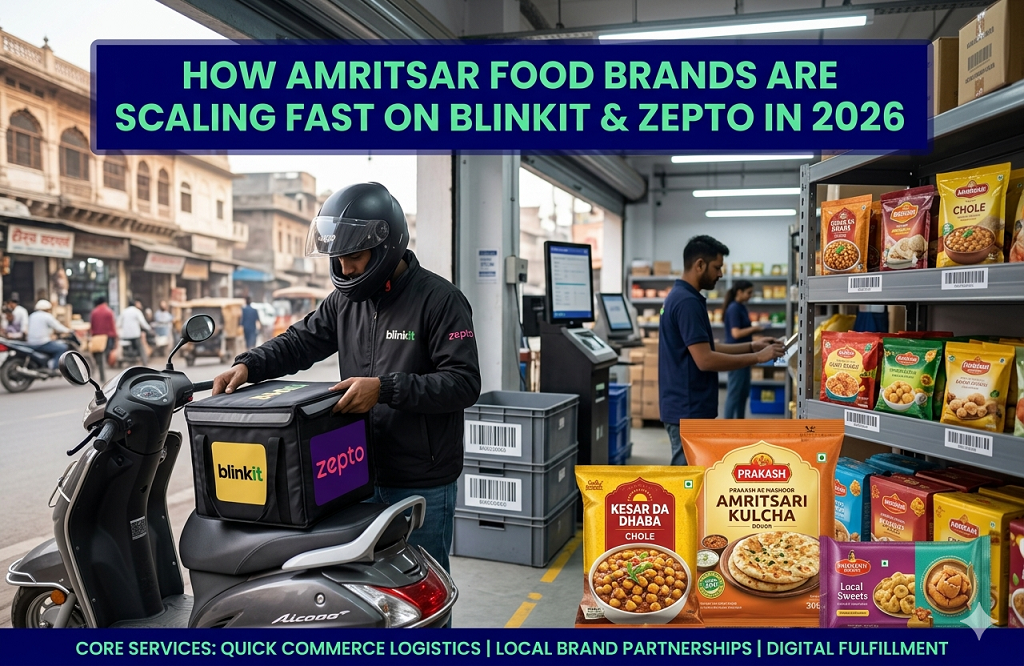
How Amritsar Food Brands Are Scaling Fast on Blinkit & Zepto in 2026


uick commerce has transformed how Amritsar’s food brands reach customers in minutes, not days. Platforms like Blinkit and Zepto are no longer just delivery apps; they are powerful growth engines for local FMCG and D2C brands that understand the right Quick Commerce marketing strategy and execute it with discipline.

In 2026, the most successful Amritsar food brands are those that treat quick commerce as a dedicated sales and branding channel, not an afterthought. By combining data-driven decisions, sharp content, and platform-native tactics, they are scaling faster than ever on Blinkit and Zepto while building long-term brand equity.

Why Quick Commerce Is a Game-Changer for Amritsar Food Brands

Quick commerce has unlocked hyperlocal demand for snacks, staples, beverages, and ready-to-eat products across Amritsar. Instead of fighting for shelf space in modern trade, brands can now win digital shelf space on Blinkit and Zepto, where buying decisions happen in seconds. This shift has made a focused Quick Commerce marketing strategy essential for every ambitious food business.

For many local brands, the question is no longer whether to be on quick commerce, but how to sell on Blinkit in India in a way that is profitable and scalable. The brands that win are those that understand category dynamics, optimize their presence for search and discovery, and treat every order as a data point to refine their quick commerce growth strategy in India.

Understanding the Search Intent Behind Quick Commerce Shoppers

To scale on Blinkit and Zepto, Amritsar food brands must align with how users actually search and shop. Most quick commerce users are high-intent buyers who already know what they want. They search by product type, flavor, use case, or occasion rather than by brand name. A strong Quick Commerce marketing strategy starts by mapping these search patterns.

Top-performing brands study how customers search for snacks, masalas, pickles, bakery items, and beverages in their city. They then align product titles, descriptions, and images to match those queries. This is how food brands grow on Blinkit: not only by listing products, but by matching the language, needs, and urgency of the shopper.

Core Elements of a Winning Quick Commerce Marketing Strategy

Scaling FMCG brands on quick commerce requires a structured approach rather than random experiments. The most successful Amritsar brands follow a clear Quick Commerce marketing strategy that covers assortment, pricing, content, and performance marketing. They treat Blinkit and Zepto as performance channels with measurable inputs and outputs.

Instead of uploading every SKU, they prioritize hero products and high-repeat items that move fast. This is especially important for how D2C food brands scale in India, because it keeps operations lean while maximizing visibility and reviews. Once a few SKUs gain traction, brands expand the range around proven winners.

Optimizing Product Listings for Discovery and Conversion

Product listing optimization is often the difference between a product that sits invisible and one that sells out daily. A robust Quick Commerce marketing strategy focuses on three pillars: titles, images, and descriptions. Each element must be crafted for both the algorithm and the human buyer.

High-performing listings usually include clear product names, key ingredients, flavor cues, and pack sizes. Descriptions highlight benefits like freshness, local sourcing, or health positioning. Sharp, well-lit images that show the actual pack and serving suggestion can significantly lift click-through and conversion rates.

Leveraging Ratings, Reviews, and Social Proof

Quick commerce shoppers make decisions fast, and social proof helps them trust new brands. Encouraging early customers to rate and review products is a crucial part of how local food brands grow online. Even a small base of positive reviews can dramatically improve conversion and ranking on Blinkit and Zepto.

Brands that scale quickly often run targeted sampling or discount campaigns to generate initial volume and feedback. They monitor reviews closely, fix recurring issues, and update content to address common questions. Over time, this feedback loop becomes a competitive moat that new entrants struggle to match.

Smart Pricing, Offers, and Pack-Size Strategy

Quick commerce is highly price-sensitive, but that does not mean brands must always discount. Instead, a refined quick commerce growth strategy in India uses smart pack sizes and value-driven offers. Smaller trial packs can help new customers sample products without high commitment, while family packs drive higher average order values.

Limited-time offers, combo packs, and festival-specific bundles also work well on Blinkit and Zepto. The key is to align promotions with real demand spikes, such as evenings, weekends, or local events in Amritsar. This approach keeps margins healthy while still driving aggressive growth.

How to Sell on Blinkit in India: Operational Excellence from Amritsar

Many brands focus only on marketing but ignore operations, which can quietly kill growth. To truly master how to sell on Blinkit in India, Amritsar food brands must ensure consistent stock availability, accurate inventory sync, and reliable packaging. Quick commerce algorithms reward brands that fulfill orders reliably and on time.

Operational excellence also includes forecasting demand for weekends, festivals, and seasonal peaks. Brands that understand their repeat rates and basket patterns can pre-position inventory in the right dark stores. This not only improves service levels but also supports a more aggressive Quick Commerce marketing strategy with confidence.

Data-Driven Decisions Using Platform Analytics

Both Blinkit and Zepto provide performance data that can guide smarter decisions. Leading brands review metrics like impressions, click-through rates, conversion rates, and repeat purchase behavior. This data is central to how D2C food brands scale in India on quick commerce platforms.

By analyzing which SKUs perform best in which neighborhoods, brands can refine assortments and localize their Quick Commerce marketing strategy. They can also identify underperforming products and either optimize their content or phase them out to focus on higher-potential items.

Using Zepto Ads Services and Sponsored Placements

Paid visibility is becoming essential as more brands compete for the same digital shelf. Zepto ads services and Blinkit sponsored placements allow Amritsar food brands to appear at the top of category pages and search results. When combined with strong content and reviews, this can accelerate scaling FMCG brands on quick commerce.

A disciplined Quick Commerce marketing strategy treats ads as an investment, not an expense. Brands set clear goals for share of voice, cost per acquisition, and return on ad spend. They test different creatives, keywords, and time slots to identify the most profitable combinations for their category.

Retargeting and Cross-Selling Within Quick Commerce

Once a brand has a base of customers, the next step is maximizing lifetime value. Many platforms now support basic retargeting and cross-selling tools that can be integrated into a broader quick commerce growth strategy in India. For example, snack brands can cross-sell dips or beverages, while breakfast brands can bundle spreads and cereals.

Brands that think in terms of baskets rather than single SKUs often see better unit economics. They design product ranges and offers that naturally fit together, making it easier for customers to add more items in a single order. This approach compounds the impact of every marketing rupee spent.

How Local Food Brands Grow Online Beyond Quick Commerce

While Blinkit and Zepto are powerful, long-term winners think beyond a single channel. The same principles that drive how food brands grow on Blinkit also apply to marketplaces, D2C websites, and social commerce. Consistent branding, sharp content, and data-driven decisions create a unified growth engine.

For Amritsar brands, this means using insights from quick commerce to shape product development, packaging, and messaging across all touchpoints. Over time, a well-executed Quick Commerce marketing strategy becomes the backbone of a broader digital presence that attracts investors, distributors, and loyal customers.

Conclusion: Turning Quick Commerce into a Scalable Growth Engine

In 2026, the fastest-growing Amritsar food brands are those that treat quick commerce as a strategic pillar, not a side channel. They invest in product listing optimization, operational excellence, smart pricing, and performance marketing to build a repeatable Quick Commerce marketing strategy that compounds over time.

By combining strong fundamentals with platform-native tactics on Blinkit and Zepto, local FMCG and D2C brands can scale far beyond their home neighborhoods. For brands that want expert support in building and executing this kind of high-performance quick commerce growth strategy in India, HRL Infotechs can be a powerful partner in the journey.
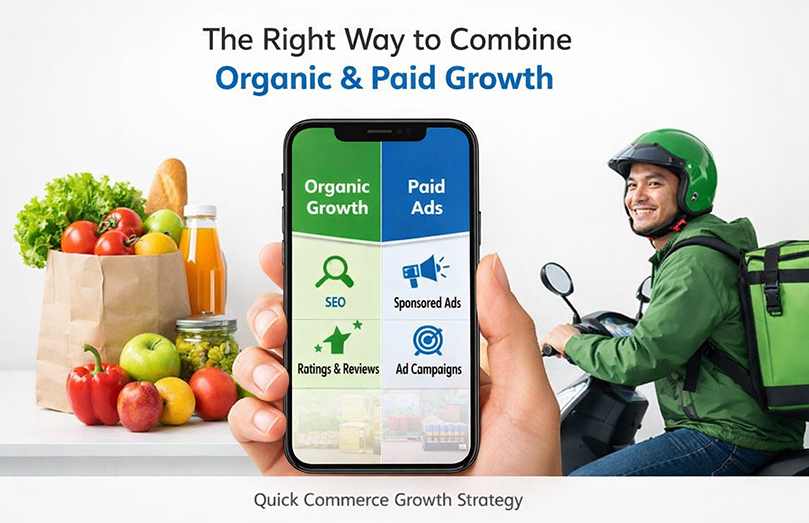
The Right Way to Combine Organic and Paid Growth on Quick Commerce


Quick commerce has changed how consumers shop, and how brands grow. But many brands still treat organic and paid growth as separate tracks, missing out on the real power of an integrated quick commerce growth strategy. When organic and paid work together, brands can scale faster, lower acquisition costs, and build long-term loyalty on platforms like Blinkit, Zepto, Instamart, and JioMart.

This guide breaks down the right way to combine organic and paid growth on quick commerce platforms. You will learn how to design a quick commerce marketing strategy that aligns content, performance ads, and marketplace optimization into one unified quick commerce growth engine.

Understanding Quick Commerce Growth and Today’s Search Intent

Quick commerce growth is no longer just about being visible on a few platforms. It is about owning high-intent moments when customers search, browse, and reorder. Most decision-makers now search for proven quick commerce growth strategy frameworks, not just generic tips or platform overviews.

The dominant search intent around quick commerce growth is commercial and informational. Leaders want to know what works, how to structure budgets, and how to blend organic and paid growth strategy into a single, measurable roadmap that drives revenue, not vanity metrics.

Why You Must Combine Organic and Paid Growth on Quick Commerce

Relying only on paid ads can drive short-term spikes but weak long-term profitability. On the other hand, depending only on organic visibility can slow down scale, especially in competitive categories. The most successful quick commerce growth strategies blend both in a coordinated way.

When organic and paid are aligned, your quick commerce marketing strategy can achieve three key outcomes: higher share of search, better conversion rates, and more efficient quick commerce customer acquisition. This is especially critical on platforms where rankings, visibility, and ad auctions are tightly connected.

The Compounding Effect of Organic Visibility

Strong organic presence on quick commerce platforms improves your baseline performance. Better content, reviews, and merchandising increase click-through and conversion rates. This, in turn, makes your paid campaigns more efficient because ads drive traffic to high-converting product pages.

Over time, this compounding effect reduces your cost per acquisition. Your quick commerce growth strategy should treat organic optimization as the foundation, not an afterthought. Paid media then becomes an accelerator layered on top of a strong organic base.

Paid Media as a Strategic Accelerator

Paid campaigns on quick commerce platforms help you win critical moments: launches, seasonal peaks, and competitive pushes. With the right organic and paid growth strategy, you can use ads to defend branded searches and capture generic category demand at scale.

Instead of running isolated campaigns, align your paid efforts with organic signals. Use paid to test new keywords, validate demand pockets, and then build organic content and merchandising around what performs best. This is how quick commerce growth becomes data-driven and sustainable.

Designing a Full-Funnel Quick Commerce Marketing Strategy

A high-performing quick commerce marketing strategy must cover the full funnel: awareness, consideration, conversion, and retention. Each stage should use a mix of organic and paid tactics tailored to how customers behave on specific platforms.

Think beyond single campaigns. Build a repeatable quick commerce growth framework that you can apply across Blinkit, Zepto, Instamart, and JioMart. While each marketplace has unique tools, the underlying growth principles remain consistent.

Top-of-Funnel: Discoverability and Awareness

At the top of the funnel, your goal is to make your brand and products discoverable. Focus on category-level keywords and generic search behavior that signals early interest. This is where your quick commerce growth strategy starts building reach.

Key tactics include optimizing titles, images, and descriptions for high-volume keywords, and running sponsored placements on category and search result pages. Combine these with off-platform awareness campaigns that drive branded searches directly into quick commerce listings.

Mid-Funnel: Consideration and Differentiation

In the consideration stage, shoppers compare options. Your quick commerce marketing strategy should highlight differentiation through content, packaging, and social proof. This is where strong organic presence and smart paid targeting intersect.

Use A/B testing on creatives, benefit messaging, and pricing bundles. Retarget engaged users with tailored offers and emphasize ratings, reviews, and trust signals. The goal is to move shoppers from browsing to adding your products to cart.

Bottom-Funnel: Conversion and Repeat Purchases

At the bottom of the funnel, your quick commerce growth strategy must remove friction. Ensure inventory reliability, competitive pricing, and clear delivery promises. Paid campaigns should focus on high-intent keywords and cart recovery.

Post-purchase, use platform tools such as subscription prompts, reorder nudges, and personalized recommendations. This is where quick commerce customer acquisition turns into long-term customer value, driving profitable growth over time.

Platform-Specific Tactics: Blinkit, JioMart, Zepto, and Instamart

While the core principles of quick commerce growth apply everywhere, each platform offers unique levers. Tailoring your approach to each ecosystem can unlock incremental gains and protect your share against aggressive competitors.

Instead of copying one playbook across platforms, design a modular quick commerce growth strategy. Keep your brand positioning consistent but adapt creatives, offers, and bidding strategies to each marketplace’s algorithms and user behavior.

Optimizing Blinkit Marketing Strategy

An effective Blinkit marketing strategy starts with strong catalog hygiene. Ensure accurate categorization, sharp product imagery, and benefit-led titles that match how users search on the app. This improves both organic rankings and ad performance.

Layer in targeted promotions during peak hours and local events. Use performance data to identify top-performing SKUs and then push them harder with sponsored listings. Over time, this integrated approach compounds your quick commerce brand growth on Blinkit.

Scaling JioMart Marketing Strategy

A winning JioMart marketing strategy leans on breadth and depth. Optimize for regional preferences, pack sizes, and price points that resonate with value-conscious shoppers. Strong organic visibility in key categories can significantly lift your baseline sales.

Combine this with smart bidding on high-intent keywords and cross-selling opportunities. Use insights from JioMart campaigns to refine your overall quick commerce growth strategy, especially for markets where omnichannel behavior is strong.

Building a Zepto Seller Growth Strategy

A robust Zepto seller growth strategy focuses on speed, availability, and assortment. Ensure your top SKUs are always in stock and well-positioned in relevant categories. Organic optimization here supports both discovery and repeat orders.

Use paid placements to launch new SKUs, test bundles, and defend your bestsellers. Over time, integrate these learnings into your broader organic and paid growth strategy so that Zepto becomes a reliable growth pillar, not just an experimental channel.

Refining Instamart Advertising Strategy

An effective Instamart advertising strategy blends precision targeting with strong creative. Focus on high-intent search terms and contextual placements near complementary categories. This helps you capture shoppers who are ready to buy.

Pair this with optimized product pages, clear benefits, and compelling pack sizes. As your campaigns mature, feed performance insights back into your quick commerce growth strategy to improve both organic ranking and paid efficiency across all platforms.

Measuring and Optimizing Your Quick Commerce Growth Engine

To sustain quick commerce growth, you must measure beyond impressions and clicks. Track contribution to revenue, share of search, repeat purchase rates, and blended customer acquisition cost across platforms and campaigns.

Set up a unified reporting framework that compares performance across Blinkit, Zepto, Instamart, and JioMart. Use these insights to reallocate budgets, refine creatives, and continuously improve your quick commerce marketing strategy.

Conclusion: Turning Quick Commerce Growth into a Competitive Advantage

Quick commerce growth is no longer optional for consumer brands; it is a core competitive battlefield. The brands that win are those that treat organic and paid not as separate teams, but as a single, integrated growth engine tuned for each platform and each stage of the funnel.

By aligning your quick commerce marketing strategy, platform-specific tactics, and measurement framework, you can turn quick commerce customer acquisition into sustained profitability and market leadership, especially when partnered with a specialist like HRL Infotechs.

How to Grow Your D2C Brand in Indore Using Zepto Marketing


Indore has emerged as one of India’s rapidly growing Tier-2 business hubs. An increasing number of people are shopping online through e-commerce and quick commerce platforms. Convenience is becoming a habit, and it is presenting D2C (Direct-to-customers) brands with a massive opportunity to grow and scale like never before. One of the major players in this shift towards the ultra-fast delivery game is Zepto. With items getting delivered within 15 to 20 minutes, Zepto has become a go-to app for groceries, personal essentials, food, and household products. If you are a D2C brand looking to scale into the Indore quick commerce market, Zepto is a perfect place to start if you use it correctly. 

In this blog, we are going to talk about what are the Zepto seller strategy that you should follow to grow on this platform.

Why is Zepto a Big Opportunity for D2C Brands?

With the rise of quick commerce in India over the past few years, the patience level of customers has gotten less simultaneously. They don’t want to wait 2 to 3 days to get their products delivered. They want convenience, and Zepto is delivering just that. It works through small warehouses called dark stores, placed in different parts of the city. When someone places an order, products are delivered from the nearest dark store.

Indore has:

  • A young working population
  • A growing number of residential areas
  • A high number of smartphone users
  • A strong delivery infrastructure

These people have fast lives, and they expect an even faster delivery. For the D2C brands, Zepto is a great way to build local demand for their products through satisfactory customer service and higher chances of repeat sales.

How To Ensure Growth on Zepto

To grow D2C brands in Indore through Zepto requires special attention to many aspects. A step-by-step guide is given below for that detail necessary practices for growth.

Step 1: Optimise Your Product Listing

In quick commerce, decisions are made fast; the first impression of your product decides if you get the sale or not, which is why having optimized product listings is very crucial for growth. You can hire a Zepto SEO Optimization Agency in Indore who focus on making:

  • Clear Product Titles: Your title should include brand name, product type, flavour, and/or size. This helps customers understand the product.
  • High Quality Images: Good product images increase click-through rate. Ensure packaging is visible and the background is clean.
  • Simple Product Description: Keep your product descriptions simple and easy to read, and make sure they answer common customer questions. 

Step 2: Keep Your Inventory in Stock

One of the most common and biggest mistakes brands make is not maintaining their inventory levels according to demand, resulting in them running out of stock. Make sure your products are always available in Indore’s dark stores, and regular stock planning is done to avoid situations of understocking or overstocking. If your product is not available:

  • The customer will buy your competitor’s products
  • Your ranking on search results will drop
  • You can lose a potential buyer and sales

Step 3: Price Your Product Smartly

Customers compare prices quickly on quick commerce platforms. This does not mean you have to be the lowest priced, but your product should look worth the money. Small offers increase sales significantly. You can avail Zepto Account Management Services in Indore, which can ask you important questions before finalizing a price, such as:

  • Is your pricing similar to competitors’?
  • Can you offer combo packs?
  • Can you give limited-time discounts?

Step 4: Use Zepto Ads for Faster Growth

Zepto offers paid promotion, which includes sponsored listings, category visibility, and banner placements. In case you are launching a new product, with the help of Zepto PPC Advertising, you can get noticed quickly. And once a customer starts buying regularly from you, your sales will improve on their own. The best way to start advertising successfully is by:

  • Promoting your popular and most loved SKUs
  • Running ads during weekends, when buyers are most active
  • Increasing visibility during festivals with special offers

Step 5: Improve Your Storefront Design

Keeping your storefront clear and attractive is important in this fast-moving marketplace. How your product looks on the screen matters a lot. Many D2C brands utilize Zepto Storefront Design Services in Indore to give their store a professional and trustworthy look so that the customers become more likely to make a purchase. Focus on:

  • Keeping the layout simple and clean, without crowding it with text
  • Use the same colour, font, and style to make your brand recognizable
  • Highlight key benefits of your product that will attract customers

When Should You Hire A Marketing Agency?

As competition increases on every platform, it becomes increasingly difficult for brands to scale their businesses online. Many sellers have started hiring Zepto Marketing Services in Indore to help manage their online presence and growth.

You may need help if:

  • Your product sales have become stagnant
  • Advertisements are not bringing any results
  • Your products are ranking low in search results
  • You are not able to evaluate your performance

Conclusion

Indore is a strong and growing market for D2C brands. With the rising demand for delivery within minutes, brands like Zepto are becoming very important growth channels, especially for D2C brands. If you adapt quickly to change and understand the platform, you will grow faster than others.

At HRL Infotechs, you can get experienced guidance from our marketing and growth specialists and take your brand to new heights, like never before.