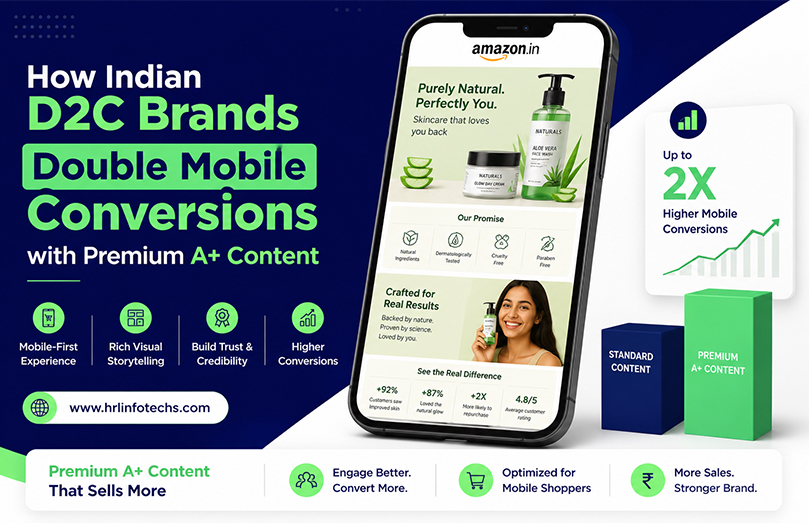
Open Amazon on your phone right now and scroll through five random product listings. Chances are, at least three of them look almost identical: a title, five bullet points, maybe one lifestyle image squeezed awkwardly into a mobile screen that was clearly designed for desktop first.
That gap is exactly where Premium A+ Content is quietly reshaping outcomes for D2C brands across India in 2026. Not because it’s a new feature, Amazon’s had A+ Content for years. What’s changed is how brands are finally building it specifically for the screen most Indian shoppers actually use to buy.
Why Mobile Changes Everything About A+ Content
Over 80% of Amazon India’s traffic now comes from mobile devices. That number alone should reshape how every brand thinks about its listing, but most still don’t.
Mobile conversion optimisation on Amazon isn’t just about making things load faster. It’s about accepting that a shopper on a five-inch screen decides in roughly eight seconds, scrolling with a thumb, comparing three tabs open at once. A desktop-first A+ module with dense paragraphs and tiny comparison charts simply doesn’t survive that environment. The information might be accurate. It just never gets read.
Premium A+ Content solves this differently than standard A+ modules. It unlocks comparison charts, brand story modules, and interactive Q&A blocks specifically built to render cleanly on mobile, with bigger touch targets, cleaner visual hierarchy, and content that actually breathes instead of cramming everything above the fold.
What “Doubling Conversions” Actually Looks Like in Practice
The claim sounds bold until you break down what’s actually happening structurally.
Standard A+ Content typically improves conversion by 3-10%, according to Amazon’s own internal benchmarks. Amazon Premium A+ Content, specifically the comparison chart module and premium video placement, is showing meaningfully higher lift for D2C brands that build it correctly, particularly in categories where shoppers are comparing multiple similar products before deciding: skincare, supplements, home appliances, and personal care.
The mechanism is simple. A shopper who has to scroll through generic bullet points to figure out why your serum is different from the one three listings down abandons the decision entirely, often heading back to search results rather than committing. A comparison chart that answers that exact question at a glance keeps them on your page and moving toward checkout instead.
Why Amazon Listing Optimisation Alone Isn’t Enough Anymore
For years, Amazon listing optimisation meant getting your title right, your bullets keyword-rich, and your backend search terms filled in properly. That work still matters. It’s just no longer sufficient on its own.
Amazon product page optimisation in 2026 requires that we think of the entire page as a joined-up sales mechanism, rather than a group of independent elements (title, images, A+ modules, reviews, etc.) which can be individually audited and optimised as part of a product listing review. A brand might have a great title, but kill their chances with a poorly optimised A+ Content module, which was written once, at launch, and never revised.
The Real Driver: Amazon Conversion Rate Optimisation
Everything genuinely comes back to one number: Amazon conversion rate optimisation. Traffic without conversion is just an expensive vanity metric.
Amazon’s layout works because it directly addresses the two biggest reasons a mobile shopper hesitates: uncertainty about whether the product actually solves their problem, and uncertainty about whether this brand can be trusted over a cheaper alternative sitting right next to it in search results. Implementing Amazon A+ Content optimisation answers both, using visual proof instead of asking the shopper to take a bullet point’s word for it.
What This Means for D2C Ecommerce Conversion Specifically
D2C ecommerce conversion carries a particular challenge most established brands don’t face: you’re usually competing against products with more reviews, more history, and more built-in trust signals.
A+ Content will become your equaliser. This is where you can tell the story of your sourcing, your production, the journey of your founder – something a 5-year-old competitor listing, full of positive reviews, may have neglected to do. For categories like Indian skincare and Indian wellness that are seeing explosive growth on Amazon, this type of engagement may outweigh the power of reviews during that all-important first-purchase window.
Why This Matters Specifically for Premium A+ Content India
Access to Premium A+ Content in India requires a brand registry and, in most cases, a qualifying sales history, meaning it’s genuinely earned and not available to every seller from day one. That exclusivity is part of what makes it so effective. Shoppers on Indian marketplaces are becoming more aware of the difference between listings that lack personality and those developed with care, even if they can’t always put their finger on why one inspires more trust than the other.
Getting proper content services involved early, rather than treating A+ Content as a final step tacked on after the product launches, consistently produces stronger results than retrofitting it onto a listing that’s already live and underperforming.
Building It Right: What Actually Works on Mobile
The brands seeing genuine lift aren’t just uploading prettier images. They’re rethinking structure specifically for how mobile shoppers actually scroll.
That means comparison charts are kept to three or four rows maximum, not ten. Video modules under thirty seconds are front-loaded with the strongest hook in the first three seconds. Text is kept genuinely short, a sentence, not a paragraph, per module. When utilising professional Amazon brand managment services, the strategy always involves testing the entire page on an actual phone before publishing, rather than just previewing it on a desktop monitor and assuming it translates perfectly to mobile.
Conclusion
Mobile isn’t a channel anymore. For most Indian D2C brands selling on Amazon, it’s simply the channel, the primary and often only way most customers ever encounter a listing.
Brands treating Premium A+ Content as a genuine mobile-first conversion tool, rather than a decorative add-on built once and forgotten, are the ones pulling ahead in 2026. The opportunity isn’t really about doing something entirely new. It’s about finally building for the screen customers are already holding.
At HRL Infotechs, this is precisely the gap we help D2C brands close, building A+ Content that’s genuinely designed mobile-first, tested on real devices, and structured around what actually moves a thumb toward the buy button, not just what looks impressive in a desktop preview.