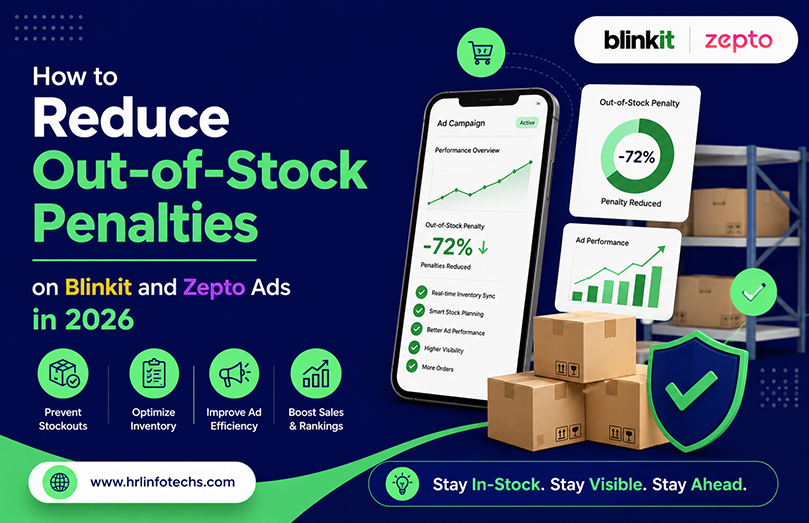
Quick commerce has completely changed how Indian consumers shop for everyday essentials. Platforms like Blinkit and Zepto have trained customers to expect delivery within minutes, which makes product availability one of the single biggest factors deciding whether a seller actually succeeds.
However, there are many companies that continue to invest significantly in advertising while at the same time understating the importance of inventory. At the same time, advertising out-of-stock products leads to wasted resources, low campaign efficiency, and poor marketplace positioning that may take a long time to reverse.
This is why effective Blinkit inventory management has become a strategic priority for businesses. Through accurate planning and smart advertising, companies can mitigate the consequences of stock shortages, optimise expenditures, and provide a high level of customer service.
Why Out-of-Stock Products Quietly Wreck Ad Performance
Every campaign exists to drive visibility and conversion. When a customer clicks a promoted product and finds it’s unavailable, both the customer experience and the campaign itself take a hit at the same time.
Quick commerce platforms track availability closely because stock directly affects customer satisfaction. Frequent stockouts tend to bring reduced ad efficiency, lower conversion rates, eroded customer trust, missed sales that never come back, and declining visibility across the marketplace. Instead of driving genuine growth, that advertising budget becomes increasingly inefficient the moment inventory can’t keep pace with demand.
Why Inventory Planning on Zepto Genuinely Matters
Inventory problems get more serious in fast-moving categories, where demand can shift multiple times within a single day.
Strong Zepto inventory management practices enable firms to forecast demand accurately, maintain healthy stock levels, and prevent disruptions deriving from unexpected sales increases. The companies that are strong at inventory management tend to pay continuous attention to their stock, base their demand forecasts on realistic assumptions, establish supply chain relationships, and allocate resources wisely rather than speculate on the demand.
Get these right, and products stay available while active campaigns keep bringing in traffic instead of quietly going dark mid-campaign.
Advertising Only Works When Inventory Can Back It Up
Many companies have the wrong idea that increasing the ad budget will automatically lead to an increase in sales. In reality, advertising and inventory management must be coordinated, or the former will fail to produce the desired results.
A truly effective quick commerce marketing strategy would promote products in a manner that does not lead to their immediate sell-through. Instead of simply advertising all available goods, it would be more effective to focus on those that are actually selling. A smart strategy would prioritise those products that have a steady supply and high margins, ensuring long-term success and avoiding empty shelves.
Managing Campaigns With Inventory in Mind
Stock availability should genuinely shape advertising decisions, not sit as a separate consideration handled by a different team entirely.
Smart, quick commerce advertising means continuously adjusting budgets based on real inventory performance, pushing visibility harder for products with healthy stock, pulling back spend on anything running low, pausing campaigns outright for genuinely unavailable items, and shifting that freed-up budget toward alternatives that are actually performing. Dynamic management like this stops wasted spend before it happens, rather than discovering the problem in a monthly report.
Why Professional Blinkit Advertising Management Actually Helps
Managing campaigns manually gets genuinely harder as a catalogue grows past a handful of SKUs.
Professional Blinkit advertising services allow companies to combine inventory management with campaign optimisation as an integrated task, not as two separate activities handled by different workers. Unlike a generic company, a specialist examines the state of stock, the existing demand, current performance, and profitability of a campaign more frequently than just on a weekly or monthly basis. Such an approach allows one to identify a greater number of ways to cut costs without affecting the overall growth and profitability.
Building Better Seller Operations on Zepto
Inventory problems rarely come from advertising decisions alone. More often, they come from operational processes that were never properly connected in the first place.
Real Zepto seller management focuses on genuinely smoother coordination between inventory, fulfilment, pricing, and advertising teams, not letting each function operate in its own silo. Brands that monitor their seller operations regularly tend to catch potential stock shortages before they ever start hurting campaign performance, which means faster reaction time and considerably fewer lost sales along the way.
Why Visibility Needs More Than Just Advertising
Ads alone can no longer assure a business of long-term viability on any given quick commerce platform. In many cases, the companies that continue to thrive are those that go beyond simply offering good value for money and begin to provide an altogether satisfying customer experience, including consistent product availability.
This is exactly why marketplace SEO matters even inside a closed marketplace ecosystem like Blinkit or Zepto. Discoverability improves noticeably when listings maintain accurate inventory data, genuinely relevant product information, consistent availability, real customer engagement, and dependable fulfilment. Advertising drives the immediate spike in visibility. Marketplace optimisation is what sustains it organically once the campaign budget slows down.
Why Catalogue Quality Directly Supports Inventory Accuracy
A well-organised product catalogue makes inventory management significantly easier to manage day-to-day.
Proper catalogue optimisation helps eliminate duplicate listings, keep product information genuinely accurate, improve categorisation, and simplify tracking across multiple fulfilment locations simultaneously. Cleaner catalogues also cut down the errors that quietly cause stock mismatches between internal systems and what’s actually showing on the marketplace, which becomes a real competitive edge once you’re managing hundreds of SKUs at once.
Why Integrated Account Management Delivers Better Outcomes
Advertising, inventory, catalogue management, and operational planning should never run as four separate, disconnected processes.
Strong, quick commerce account management brings all of this together into one coordinated strategy, rather than fixing inventory problems only after they’ve already damaged a campaign. Real integrated management catches potential issues early through regular monitoring and genuine operational review, a proactive approach that improves efficiency while significantly reducing costly, avoidable campaign interruptions.
Measuring Success Beyond Just Revenue
The strongest quick commerce brands are tracking far more than top-line sales alone.
Genuine quick commerce performance optimisation means analysing inventory availability, stock turnover, campaign ROI, conversion rates, customer retention, and fulfilment performance together, not in isolation. Monitoring all of this simultaneously gives a much clearer picture of how operational decisions are actually shaping advertising results, and businesses that optimise the entire customer journey consistently outperform those focused purely on ad spend alone.
How HRL Infotechs Supports Quick Commerce Growth
As quick commerce keeps expanding across India, managing inventory and advertising together has stopped being optional for sustainable growth.
HRL Infotechs helps brands simplify their Blinkit and Zepto operations through genuinely integrated marketplace solutions combining inventory planning, catalogue management, advertising optimisation, account management, and broader marketplace growth strategy. Rather than treating each of these as separate functions, HRL Infotechs builds connected workflows that improve operational efficiency while genuinely maximising campaign performance and customer satisfaction together.
Conclusion
Out-of-stock penalties are never just a temporary inventory hiccup. They directly affect advertising performance, customer trust, marketplace visibility, and overall profitability, often long after the actual stockout is resolved.
Brands combining accurate inventory planning with genuinely intelligent campaign management are far better positioned to make every advertising rupee count while still delivering a consistent customer experience. As quick commerce competition keeps intensifying through 2026, the businesses that bring inventory management, catalogue optimisation, advertising, and operational planning together into one unified strategy will hold a real competitive advantage over those still managing each piece separately.