An ecommerce brand selling on Amazon India spent eighteen months running only Sponsored Ads. Sales were steady. ACoS sat around 22%, comfortably profitable. Then a private label competitor entered the category with a near-identical product at a similar price, and the brand’s growth flattened within two quarters, not because their campaigns got worse, but because Sponsored Ads alone had no answer for a competitor building awareness before shoppers ever typed a search term.
The brand added a modest DSP retargeting campaign six months later. Within one quarter, repeat purchase rate increased, and their branded search volume, people typing the brand name directly rather than a generic category term, grew 31%. Sponsored Ads had never been the wrong choice. It had simply never been the complete answer.
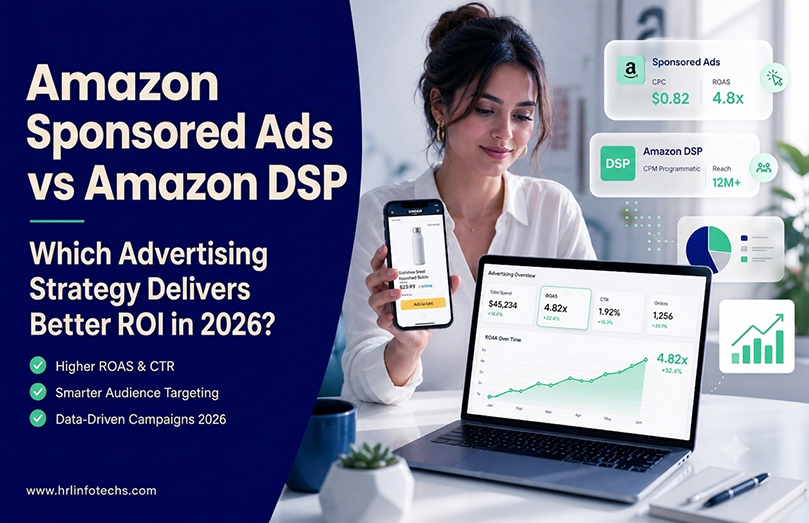
This is the real question behind Amazon Sponsored Ads vs Amazon DSP in 2026, not which one wins, but which one is solving the specific growth problem a brand actually has right now.
Understanding Amazon Sponsored Ads
Amazon-sponsored ads represent keyword-targeted placement opportunities on search result pages and product pages, targeting active customers searching for similar goods, with purchase intent, and at the highest stage of the purchasing funnel.
A successful Amazon Sponsored Ads strategy should focus on selecting the right keywords, optimising listings, increasing conversion rates, and adjusting bids based on performance. Moreover, because such advertising initially targets those already interested in the product, it helps generate sales more quickly.
Sponsored ads are most useful for such purposes as introducing new products, creating sales, increasing a website’s traffic due to their velocity, and taking advantage of narrow promotional opportunities where timing is more important than building brand awareness. For most small and mid-sized Amazon India sellers, Sponsored Ads remain the correct starting foundation on which the e-commerce brand built eighteen months of profitable growth on this alone before hitting its ceiling.
What Is Amazon DSP?
Amazon DSP advertising operates differently at a fundamental level. Rather than waiting for a keyword search, DSP uses audience data, shopping behaviour, demographics, and browsing history to place targeted display and video ads on Amazon-owned properties, third-party websites, mobile apps, and streaming platforms.
Amazon DSP for brands is valuable for building brand awareness before product searches, retargeting those who viewed a listing but didn’t purchase, remarketing to those who abandoned a cart, reaching out to new customers with your product, and for premium brand-building creative. This is exactly the opportunity that the E-commerce brand found that DSP does not wait for a customer to begin searching. It takes place before shoppers even start their search.
Comparing Advertising Objectives
Both platforms generate sales, but they solve different problems. Sponsored Ads capture demand that already exists in a shopper actively comparing products right now. DSP creates demand by introducing a brand before that search behaviour begins, supporting the upper-funnel influence that shapes decisions over a longer window.
Businesses needing immediate conversions typically prioritise Sponsored Ads. Brands focused on long-term acquisition and defending market position against new competitors, exactly the situation the appliance brand faced, which increasingly needed DSP as part of the mix, not as a replacement.
Which Platform Delivers Better ROI?
There is no universal winner when evaluating Amazon advertising ROI. Sponsored Ads typically produce stronger short-term returns because they target high-intent shoppers, with lower acquisition costs and faster, easier-to-measure sales.
DSP campaigns usually require larger investment and longer optimisation cycles, but contribute to brand recognition, retention, and repeat purchases that individual campaign metrics understate. The appliance brand’s 31% branded search increase never showed up as a direct DSP conversion; it showed up weeks later as improved Sponsored Ads efficiency, because more shoppers were now searching by brand name rather than generic category terms.
Evaluating ROI in isolation, campaign by campaign, misses this compounding effect. Evaluating it at the level of overall business growth reveals what each platform is actually contributing.
The Importance of Campaign Optimisation
Running ads without optimisation can drain profits on any platform. It means regular Amazon campaign optimisation to examine the search terms, audiences, bids, placements, creatives, and conversions.
This includes eliminating low-performing keywords, raising the cost for effective campaigns, and testing new audiences. In addition, teams should refresh their creative assets ahead of performance fatigue, evaluate their customer acquisition costs weekly (vs. monthly), and reallocate budgets depending on demand fluctuations throughout the year. Consistent optimisation is what separates advertising spend that compounds from spend that simply maintains a plateau, the exact plateau the appliance brand experienced before adding DSP.
Why Professional Campaign Management Matters
As Amazon advertising grows more sophisticated across both Sponsored Ads and DSP simultaneously, most internal teams struggle to manage both channels with the depth either requires. Professional Amazon PPC management brings dedicated expertise in campaign structure, keyword research, bidding strategy, and continuous reporting across both platforms.
Experienced specialists identify exactly the kind of growth ceiling the appliance brand hit, recognising when Sponsored Ads alone have plateaued and a DSP layer is the actual fix, rather than assuming the answer is simply higher Sponsored Ads bids on a strategy that has already reached its natural limit.
Building a Complete Ecommerce Advertising Strategy
Nowadays, the most successful advertisers already use a combination of channels to drive their sales instead of relying on one particular platform. To maximise revenues, they develop an integrated e-commerce advertising strategy that employs Sponsored Ads, DSP advertising, Brand Store optimisation, product content, SEO, and reviews management. All these tools are used to reach different audiences throughout the sales funnel.
Choosing the Right Solution for Your Business
Choose Sponsored Ads if you want short-term sales gains, faster keyword rankings, quicker product launches with instant ROI, and easier performance tracking. Choose DSP if your priority is building brand awareness, accessing non-Amazon channels, boosting customer retention, and preparing for competitive inroads. Note that most companies, like the appliance manufacturer mentioned, will likely need both types of advertising, though not necessarily simultaneously or in equal measure, as their business grows.
Conclusion
The debate around Amazon Sponsored Ads vs Amazon DSP is less about picking a winner and more about recognising which stage of growth your brand is actually in. Sponsored Ads capture active buyers and generate immediate conversions. DSP builds the brand recognition and retention that keeps a category competitor from quietly eating your growth the way it nearly did to the appliance brand before they adjusted their strategy.
At HRL Infotechs, we help businesses develop data-driven Amazon advertising services that combine strategic planning, performance analysis, and continuous optimisation across both Sponsored Ads and DSP. Whether your goal is immediate sales, long-term brand defence, or both together, our tailored approach is built to identify exactly which growth ceiling you are approaching before it becomes a plateau.