Your Amazon listing is getting 50,000 impressions but only 250 clicks. Or perhaps your ads are generating hundreds of clicks every week, but orders remain disappointing. These are two very different problems, and treating them the same can waste your advertising budget.
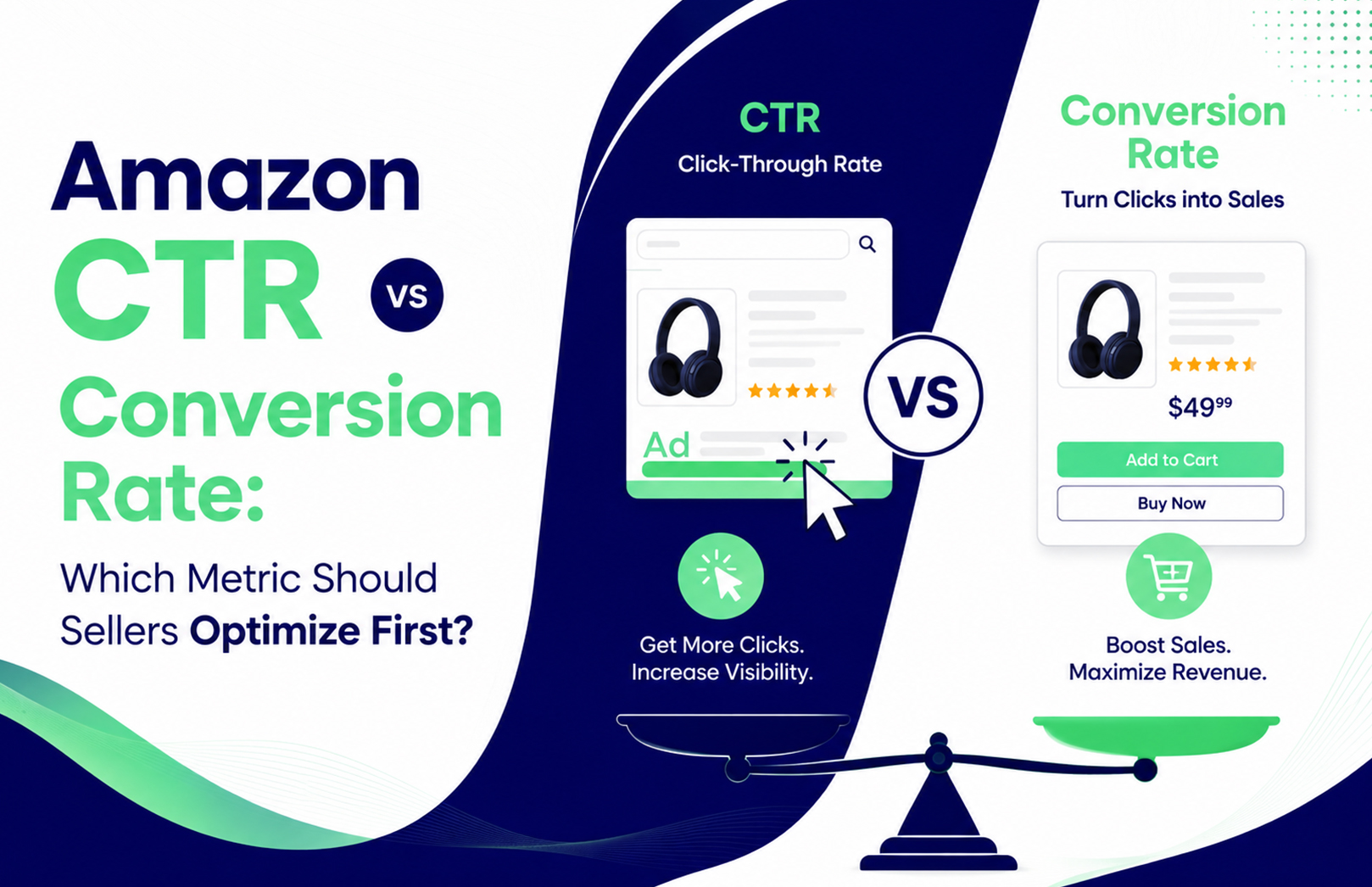
So, should you optimize Amazon CTR or conversion rate first? Start with the metric showing the bigger funnel problem. If impressions are high but clicks are weak, prioritize Amazon CTR. If clicks are healthy but purchases are weak, prioritize conversion rate. Once both are performing reasonably well, move your attention to CPC, ACoS, ROAS, TACoS and profit. Amazon Ads itself positions CTR as a consideration-stage metric and conversion rate as a purchase-stage metric.
What Should Amazon Sellers Optimize First: CTR or Conversion Rate?
Optimize CTR first when your product is visible but shoppers aren’t clicking. Optimize conversion rate first when shoppers are clicking but not buying. This simple diagnostic prevents sellers from increasing ad spend before fixing the actual bottleneck.
Think about your Amazon funnel as:
Impressions → Clicks → Product Page → Purchase → Revenue → Profit
If the first transition is weak, improving the product page won’t immediately solve the traffic problem. If the second transition is weak, buying more traffic can simply increase wasted spend.
For example, consider an illustrative Amazon seller receiving 100,000 impressions, a 0.4% CTR and a 10% conversion rate. That produces approximately 400 clicks and 40 orders. If the seller improves CTR to 0.8% while maintaining the same conversion rate, the same impression volume could produce around 80 orders.
But there is a catch.
If the new clicks are less relevant and conversion falls from 10% to 4%, the seller would generate only about 32 orders. A higher CTR can therefore produce fewer sales if the additional traffic is poor quality.
That is one of the biggest mistakes sellers make when optimizing Amazon advertising metrics: treating an improving percentage as automatically meaning better business performance.
What Is Amazon Click-Through Rate and Why Does It Matter?
Amazon click-through rate, or CTR, is the percentage of ad impressions that result in clicks. Amazon Ads calculates CTR as clicks divided by impressions, multiplied by 100.
CTR tells you whether your ad is attracting attention from shoppers who see it. It does not tell you whether those shoppers will purchase.
For sellers, a weak Amazon listing CTR can point to several issues:
- Your product is appearing for irrelevant searches.
- Your main image isn’t competitive in the search results.
- Your title doesn’t communicate the product clearly.
- Your price looks uncompetitive.
- A competitor has stronger ratings, reviews or offers.
- Your ad placement is reaching shoppers with weaker intent.
- Your keyword targeting is too broad.
This is why you shouldn’t immediately increase bids when CTR is poor.
If your product appears beside five stronger offers and shoppers repeatedly ignore yours, paying more to obtain that placement doesn’t necessarily solve the problem.
Amazon Ads recommends reviewing CTR alongside campaign goals and other KPIs rather than using it in isolation.
For sellers managing multiple campaigns, the more useful question is not simply “What is my Amazon CTR?” but:
“Which keywords, placements and products are generating impressions without earning enough qualified clicks?”
That distinction makes CTR actionable.
What Is Amazon Conversion Rate?
Amazon conversion rate measures how effectively shoppers who reach your product experience complete the desired action, such as making a purchase. Amazon Ads notes that conversion rate depends on how the conversion is defined and measured, so sellers should always understand which report and denominator they’re using.
For an Amazon seller, conversion performance is affected by much more than advertising.
Your product page has to answer the shopper’s questions quickly:
Is this the right product?
Is it worth the price?
Can I trust the seller?
Will it solve my problem?
Can I get it when I need it?
A seller can have excellent PPC targeting and still experience poor conversion because the product detail page doesn’t close the sale.
Common conversion blockers include:
- Weak or unclear product images
- Poor review rating or insufficient reviews
- Uncompetitive pricing
- Confusing variations
- Weak bullet points
- Missing product benefits
- Poor A+ Content
- Weak offer or delivery proposition
- Traffic that doesn’t match the product’s actual use case
Amazon itself recommends relevant product content and product detail page optimisation as part of improving conversion performance.
This is where Amazon product listing and SEO optimization becomes part of the advertising strategy, rather than a separate SEO exercise. HRL Infotechs aligns listing content, keywords and conversion elements so paid traffic lands on a product page designed to continue the buying journey.
How Do Amazon CTR and Conversion Rate Work Together?
CTR measures how effectively you turn visibility into traffic. Conversion rate measures how effectively you turn that traffic into customers. You need both because improving only one part of the funnel can produce misleading results.
Consider three seller situations:
High impressions, low CTR
Your product is being seen but isn’t earning enough attention.
Priority: Investigate search relevance, main image, title, offer, placement and competitive positioning.
Do not assume that higher bids are the answer.
Healthy CTR, low conversion
Shoppers are interested enough to click, but something on the product page or offer is stopping them from buying.
Priority: Audit the listing, pricing, reviews, images, A+ Content, variations and traffic quality.
Increasing the campaign budget before fixing the listing can make the problem more expensive.
Healthy CTR, healthy conversion
Now you have a stronger foundation for scaling.
Priority: Evaluate CPC, ACoS, ROAS, TACoS, contribution margin, search-term performance and incremental sales.
This is where the seller’s goal changes from “Can I get more traffic?” to “Can I acquire more profitable customers?”
How Can Sellers Diagnose a Low Amazon CTR?
Start with the search results, not the advertising dashboard. Look at what a shopper actually sees when your product appears beside competing products.
Search your primary keywords manually and compare your listing against the products receiving the most attention.
Look at:
- Main image
- Product title
- Price
- Discount or coupon
- Star rating
- Review volume
- Prime or delivery proposition
- Product differentiation
- Brand familiarity
One practical lesson from Amazon listing work is that sellers often try to solve a creative problem with a bidding solution.
If your product has a poor main image, increasing the bid may help you win more impressions, but it doesn’t necessarily make shoppers want to click.
HRL Infotechs’ analysis of Amazon product images and their impact on clicks and conversions makes this distinction particularly relevant. Your main image competes for attention before the shopper reads most of your listing copy.
You should also segment CTR instead of looking at one account-wide number.
Compare:
Brand vs non-brand → Exact vs phrase/broad → Search terms → Placements → Products → Time periods
A 2% CTR on branded searches doesn’t mean your generic keyword campaigns are equally strong.
How Can Sellers Fix a Low Amazon Conversion Rate?
Start by determining whether the problem is the product page or the traffic reaching it. A low conversion rate caused by irrelevant traffic requires campaign optimisation. A low conversion rate caused by a weak listing requires product-page optimisation.
This distinction matters because the wrong fix can make your account worse.
Suppose you’re selling a premium protein powder and your campaign receives clicks for searches related to cheap protein supplements. Your listing might be excellent, yet conversion remains poor because the shopper’s price expectation is wrong.
In that case, rewriting the listing may have limited impact.
But if shoppers are searching for your exact product type, clicking your ad and then choosing competitors, investigate:
- Price positioning
- Main image
- Benefits
- Product specifications
- Reviews
- A+ Content
- Coupons
- Delivery
- Competitor offers
- Product differentiation
A useful rule is:
Poor traffic quality = fix targeting.
Good traffic + poor purchase rate = fix the offer or listing.
Don’t automatically reduce price. That’s another trade-off experienced sellers learn quickly. A discount can increase conversion while reducing contribution margin. If your product can win through better positioning, stronger content or more relevant traffic, discounting may be the wrong first move.
Should Sellers Increase Amazon PPC Bids When CTR Is Low?
Not necessarily. Increasing a bid can help your ad compete for placements, but it does not directly fix weak shopper appeal or irrelevant targeting. First determine why CTR is low.
Amazon’s Sponsored Products guidance recommends monitoring impressions, clicks, sales and CPC and using search-term, targeting, advertised-product and placement reports to understand performance.
A better workflow is:
- Check whether the search term is relevant.
- Compare CTR with similar keywords in the account.
- Review the placement.
- Inspect the product’s search-result appearance.
- Check competitor pricing and offers.
- Improve the listing or targeting where necessary.
- Adjust the bid only after the underlying issue is understood.
This is the difference between bid management and genuine Amazon advertising optimisation.
If you need account-level support, Amazon PPC management and advertising services can connect search-term analysis, bid optimisation, campaign structure and conversion data rather than treating each metric separately. HRL Infotechs specifically positions PPC management around qualified traffic, search-term analysis, conversion data and advertising efficiency.
What Amazon PPC Metrics Should Sellers Check After CTR and Conversion?
CTR and conversion rate tell you where the funnel is leaking, but they don’t tell you whether the resulting sales are profitable. Once the funnel is functioning, sellers should connect these metrics to CPC, ACoS, ROAS, TACoS and ultimately contribution margin.
Amazon defines ACoS as ad spend divided by attributed sales and ROAS as ad sales divided by ad spend.
For example, an illustrative campaign might show:
CTR improving → clicks increasing → conversion stable → CPC rising → ACoS worsening
That isn’t necessarily a successful optimisation.
You may have improved the front of the funnel while making customer acquisition more expensive.
This is why HRL Infotechs’ recent Amazon ACoS vs TACoS analysis recommends looking beyond a single advertising metric and connecting advertising performance with overall sales.
For sellers, the final question should always be:
“Did this change create more profitable incremental sales?”
Not:
“Did this percentage go up?”
How Should Amazon Sellers Optimize CTR and Conversion Rate Together?
Use a staged optimisation process rather than changing everything simultaneously. This makes it easier to identify what actually improved performance and prevents sellers from wasting budget on symptoms instead of causes.
Step 1: Diagnose visibility
Check impressions and search-term relevance.
If impressions are low, investigate indexing, keyword coverage, bids, budget and eligibility before worrying about CTR.
Step 2: Diagnose the click
If impressions are healthy but CTR is weak, compare your search-result presentation against competitors.
Prioritise the main image, title clarity, relevance, price and offer.
Step 3: Diagnose the purchase
If clicks are healthy but orders aren’t following, audit the product detail page and traffic quality.
Don’t assume the advertising campaign is automatically responsible.
Step 4: Diagnose economics
Once traffic and conversion are reasonably healthy, review CPC, ACoS, ROAS, TACoS and contribution margin.
A campaign generating more orders isn’t automatically better if every incremental order reduces profitability.
Step 5: Scale only what has evidence
Amazon Ads recommends regularly reviewing campaign performance and using reporting to identify optimisation opportunities.
For sellers, that means scaling keywords, products and placements that have demonstrated commercially useful performance instead of increasing the entire campaign budget simply because sales are rising.
What Should Indian Amazon Sellers Do This Week?
Don’t start by changing every campaign. Start with the products and search terms where the performance problem is easiest to identify.
Use this sequence:
- Select your top 10 products by advertising spend.
- Pull impressions, clicks, CTR, CPC, orders, sales and ACoS.
- Identify products with high impressions and weak CTR.
- Identify products with strong CTR but weak conversion.
- Review their search terms and placements.
- Manually inspect the product detail pages.
- Compare price, reviews, images and offers against leading competitors.
- Make one meaningful change at a time.
- Give the account enough data to establish a pattern.
- Recheck sales and profitability, not just CTR or conversion rate.
This is particularly useful during Indian shopping peaks, when promotions, competitor discounts and demand changes can distort short-term performance.
Don’t compare a major sale event directly with a normal trading week and assume the difference is caused by your optimisation.
So, Which Metric Should Amazon Sellers Optimize First?
Optimize Amazon CTR first when your biggest problem is getting qualified shoppers to click. Optimize conversion rate first when qualified shoppers are already reaching your product page but aren’t purchasing. Neither metric should be treated as the final goal. The real objective is profitable Amazon sales.
The strongest Amazon sellers don’t ask, “Should I improve CTR or conversion rate?”
They ask:
“Where is my funnel losing the most commercially valuable shoppers?”
That question leads to better decisions about PPC, listing optimisation, bids, keywords, pricing and budget allocation.
If your Amazon account has strong impressions but weak CTR, or strong clicks but disappointing sales, the next step is not necessarily more advertising spend. It is identifying whether the problem sits in targeting, search-result presentation, product-page conversion or campaign economics.
HRL Infotechs brings Amazon advertising and listing optimisation together so sellers can diagnose those gaps across the funnel rather than optimise isolated dashboard metrics. If you’re unsure whether your current bottleneck is traffic, conversion or advertising efficiency, request an Amazon performance review and use the data to decide where the next optimisation should happen.
FAQs About Amazon CTR vs Conversion Rate
Q1. Is Amazon CTR or conversion rate more important for sellers?
Ans. Neither is universally more important. CTR matters most when your products receive impressions but insufficient clicks. Conversion rate matters more when shoppers click but don’t purchase. Sellers should identify the weakest stage first, then evaluate CPC, ACoS, ROAS, TACoS and profitability.
Q2. What causes a low Amazon listing CTR?
Ans. Low Amazon listing CTR can result from weak search relevance, an uncompetitive main image, unclear titles, pricing, poor ratings, weak offers or stronger competing products. Review CTR at the keyword and placement level rather than relying on an account-wide average.
Q3. Why is my Amazon CTR high but sales are low?
Ans. High CTR with low sales often indicates a traffic-quality or product-page problem. Check whether shoppers are searching for the exact product you sell, then review price, reviews, images, benefits, variations and delivery. More clicks won’t necessarily help if the additional traffic has weak purchase intent.
Q4. Should I increase my Amazon PPC bids to get more clicks?
Ans. Not automatically. Higher bids can help win more auctions and placements, but they don’t fix irrelevant targeting or weak product presentation. Before increasing bids, identify whether the problem is low visibility, poor CTR, expensive CPC or weak conversion. Then make the change that addresses the actual bottleneck.
Q5. What is a good Amazon CTR for Sponsored Products?
Ans. There isn’t one universal CTR target that applies to every seller. CTR varies by category, keyword intent, placement, competition and campaign type. Amazon has introduced benchmark resources that give advertisers more category-level context, making peer comparison more useful than relying on a generic CTR percentage.
Q6. How can I improve Amazon conversion rate without lowering my price?
Ans. Start with relevance and the product experience. Make sure your ads target shoppers who genuinely need the product, then improve images, product benefits, titles, bullet points, A+ Content, reviews and offer clarity. If qualified traffic is already strong, these improvements can be more sustainable than using discounts as the default conversion lever.