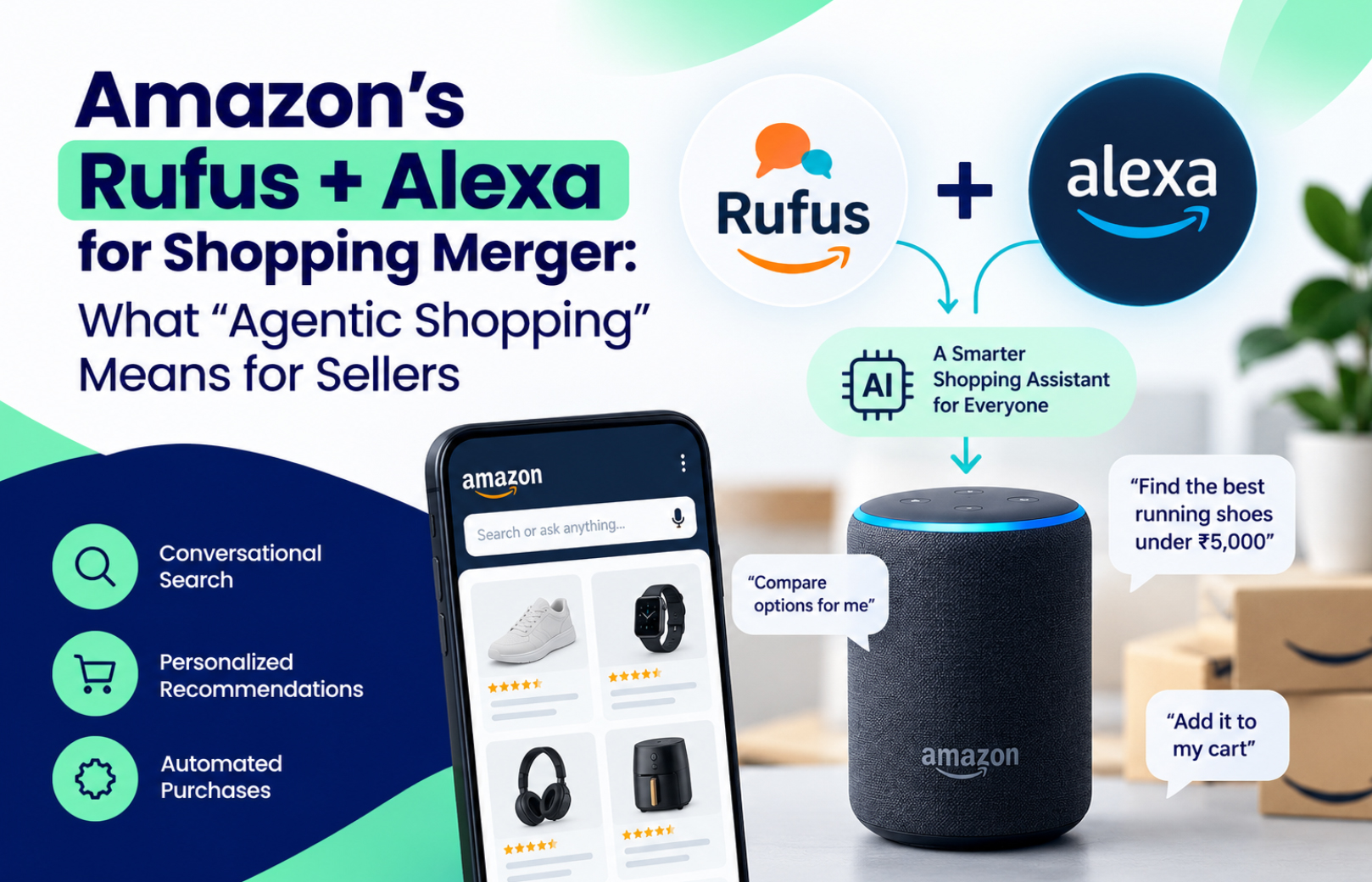
If you sell on Amazon, you may have noticed that product discovery is becoming less about typing two or three keywords and more about asking a complete question. A shopper might ask for “a protein powder for a beginner who wants low sugar and doesn’t like whey” instead of searching only for “protein powder.” Amazon’s 2026 shift from Rufus to Alexa for Shopping is designed for exactly this behaviour.
Amazon Rufus + Alexa for Shopping means Amazon is moving toward agentic shopping, where AI can understand a shopper’s intent, compare products, personalize recommendations, track prices, build carts, and take certain shopping actions. For sellers, this means your Amazon listing needs to communicate product relevance clearly to both traditional search systems and AI shopping assistants.
What happened to Amazon Rufus in 2026?
Amazon renamed Rufus as Alexa for Shopping on May 13, 2026, bringing Rufus’s product knowledge together with Alexa+’s personalization and conversational capabilities. The experience is now available across Amazon’s shopping interfaces, with features including product comparisons, personalized shopping guides, price history, deal discovery, cart building, and routine purchasing actions.
This distinction matters for sellers because you don’t need to throw away everything you’ve done for Amazon Rufus. The practical lesson is to build on your existing Amazon SEO and listing work rather than treating the update as an entirely new ranking system. Amazon itself has not published a simple “Alexa for Shopping ranking formula,” so sellers should avoid claims that a specific keyword density or formatting trick guarantees AI recommendations.
That is also why understanding the impact of Amazon Rufus AI on sellers in India is still useful, even though Amazon now uses the Alexa for Shopping name. The underlying shift toward conversational product discovery remains highly relevant.
What is agentic shopping on Amazon?
Agentic shopping means an AI assistant can move beyond answering a product question and help execute parts of the shopping journey on the customer’s behalf. Instead of simply returning search results, the assistant can understand preferences, compare options, monitor prices, find deals, build carts, and support purchases or repeat orders.
For example, imagine a customer needs a mixer grinder under ₹5,000 for a small Indian kitchen. A traditional search might return hundreds of products. An agentic shopping experience can interpret the budget, intended use, preferences and constraints, then narrow the options and explain why particular products fit.
That changes the seller’s challenge. Your product doesn’t only need to contain the right keyword. It needs enough accurate information for an AI shopping assistant to understand what the product is, who it is for, what problem it solves, and where it fits better than alternatives.
How does Amazon’s AI shopping assistant affect product listings?
Amazon’s AI shopping assistant makes listing quality more important because conversational discovery depends on context. Your title, bullet points, product description, attributes, reviews, images and other product information collectively help communicate that context.
A common mistake is to respond by stuffing more keywords into the listing. That is the wrong trade-off. You still need relevant Amazon SEO keywords, but the copy should explain the product naturally.
For example, instead of repeatedly inserting “wireless earbuds,” a stronger listing might explain that the earbuds offer active noise cancellation, are suitable for commuting, support long listening sessions and have a particular battery life. These details give an AI system more useful product context.
This is where Amazon product listing and SEO optimization becomes more than traditional keyword placement. HRL Infotechs’ service specifically covers keyword research, title optimization, image optimization, backend keywords and listing improvements, which are relevant foundations for AI-assisted product discovery.
What should Amazon sellers change in their listings for agentic shopping?
The best approach is to make your product information more complete, specific and buyer-focused. You should not rewrite every listing simply because Amazon changed the assistant’s name.
Start with these five areas:
- Clarify the product’s primary use case. Explain who should use it and what problem it solves.
- Make specifications unambiguous. Include dimensions, capacity, compatibility, materials, ingredients or other relevant attributes.
- Answer purchase objections. Address questions around durability, maintenance, compatibility, usage and limitations.
- Use natural buyer language. Include relevant conversational phrases without forcing exact-match keywords.
- Keep every product attribute consistent. Conflicting information across titles, bullets, descriptions and structured fields can create uncertainty.
The trade-off many sellers miss is that more content is not automatically better. A 2,000-word description filled with repetitive claims can be less useful than a concise listing that clearly explains five important buying decisions.
Can Amazon PPC still matter with agentic shopping?
Yes. Agentic shopping does not make Amazon advertising irrelevant. It changes how you should think about the relationship between paid visibility, organic relevance and conversion.
Amazon Ads says its advertising can help shoppers discover brands within agentic shopping experiences, including Sponsored Products and Sponsored Brands prompts associated with Alexa for Shopping.
For sellers, this means PPC should not operate separately from listing optimization. If an ad generates traffic but the product page does not clearly answer the buyer’s needs, you have paid for a visit without fixing the conversion problem.
A stronger workflow is:
Search-term data → listing improvement → PPC testing → conversion analysis → content refinement.
That approach is especially useful for D2C brands because the same product positioning can influence Amazon search, AI-assisted discovery and customer conversion.
If your advertising campaigns need the same level of attention, Amazon Advertising Services can fit naturally into this workflow by connecting campaign performance with broader marketplace growth rather than treating PPC as an isolated activity.
Why reviews and product information matter more now
AI shopping systems need evidence to understand whether a product fits a shopper’s situation. Customer reviews can provide real-world language about product performance, use cases and limitations.
Amazon says Rufus uses information including Amazon’s product catalogue, customer reviews, community Q&As and information from across the web to support its AI shopping experience.
That creates an important practical lesson: don’t manufacture language for AI. Make the underlying customer experience strong enough that real buyers naturally describe useful product outcomes.
A seller of a kitchen appliance, for example, benefits more from genuine reviews explaining capacity, ease of cleaning or performance than from hundreds of generic reviews saying “good product.”
This is also why sellers should regularly review customer questions and negative feedback. They often reveal the exact information your product page is failing to communicate.
What does the Amazon Rufus 2026 update mean for Indian sellers?
For Indian sellers, the biggest opportunity is not chasing a new “Rufus keyword.” It is improving how clearly your catalogue communicates product intent.
Amazon launched Rufus in India as an AI shopping assistant available through the Amazon Shopping app and desktop experience. The 2026 Alexa for Shopping development now takes the concept further through personalization and agentic shopping capabilities, although availability and specific functionality can vary by market.
For an Indian private-label brand selling internationally, this distinction matters. You may optimize an Amazon.in listing for Indian buyers while also selling into the US, UK or other marketplaces. Customer language, pricing, product expectations and availability can differ, so simply translating the same listing is rarely enough.
Your product data needs to remain accurate in every marketplace where you sell.
How should sellers prepare for agentic shopping in 2026?
The practical preparation is straightforward, but it needs to be done systematically.
First, audit your top-selling SKUs. Look for vague titles, incomplete bullets, missing attributes, weak use-case explanations and conflicting product information.
Next, examine customer questions and reviews. Turn repeated questions into useful listing information where Amazon policies allow it.
Then review your keyword strategy. Keep high-value search terms, but connect them to intent rather than repeating them mechanically. This supports both traditional Amazon SEO and conversational discovery.
Finally, measure business outcomes rather than trying to guess an invisible AI score. Watch organic sales, conversion rate, advertising efficiency, search-term performance and product-level profitability.
For a broader foundation, Amazon keyword research in 2026 can help connect traditional keyword research with the intent-focused approach required for AI-assisted shopping.
What should you do next?
If you’re an Amazon seller, don’t rebuild your entire catalogue overnight. Start with your top 10 to 20 revenue-generating ASINs and audit them for conversational relevance.
Check whether each listing clearly answers:
- Who is this product for?
- What problem does it solve?
- What are its important limitations?
- Which use cases does it suit?
- What specifications could affect the purchase decision?
- Are the title, bullets, attributes and images telling the same story?
Then connect those improvements with your PPC and sales data. This gives you a measurable process instead of trying to reverse-engineer Amazon’s proprietary AI.
The brands most prepared for agentic shopping on Amazon will not necessarily be the ones that publish the most content. They will be the ones that make their product information easiest to understand, verify and match to a real shopper’s need.
If your listings, PPC campaigns and marketplace strategy are not aligned with this shift, an experienced Amazon marketing agency can help you audit the gaps and prioritize the changes that are most likely to affect visibility and conversion.
FAQs
Q1. Is Amazon Rufus still available in 2026?
Ans. The Rufus name was retired as a standalone shopping experience on May 13, 2026, when Amazon introduced Alexa for Shopping. Sellers may still see “Rufus” used in older articles and searches because the technology and previous optimization discussions remain relevant. Amazon now positions Alexa for Shopping as the unified AI shopping experience.
Q2. What is Alexa for Shopping on Amazon?
Ans. Alexa for Shopping is Amazon’s personalized AI shopping assistant that combines shopping knowledge with customer context. It can answer product questions, compare products, create shopping guides, show price history, find deals and support actions such as cart building and routine purchases.
Q3. Does agentic shopping replace Amazon SEO?
Ans. No. Traditional Amazon SEO still matters because products need relevant, accurate and discoverable information. Agentic shopping adds another layer where AI interprets shopper intent and product context. Sellers should therefore combine keyword optimization with complete product information, strong conversion signals and clear use-case communication.
Q4. How can I optimize an Amazon listing for AI shopping?
Ans. Start with accurate titles, structured attributes, clear bullet points, detailed product information, useful images and natural language around genuine use cases. Avoid keyword stuffing. Amazon has not published a definitive Alexa for Shopping ranking formula, so sellers should focus on information quality rather than chasing unsupported “AI ranking hacks.”
Q5. Does Amazon PPC still matter with Alexa for Shopping?
Ans. Yes. Amazon Ads continues to position advertising as part of AI-assisted discovery, including Sponsored Products and Sponsored Brands within relevant shopping experiences. PPC should work alongside listing optimization because advertising can create visibility, while the product page must provide enough information and value to convert the shopper.
Q6. Is Alexa for Shopping available to Indian Amazon sellers?
Ans. Amazon launched Rufus for customers in India, but the rollout and specific Alexa for Shopping capabilities can vary by marketplace and customer experience. Indian sellers should therefore avoid assuming that every US feature is immediately available on Amazon.in. Monitor Amazon’s marketplace-specific announcements before changing strategy based on US-only functionality.
Ready to adapt your Amazon catalogue for AI-assisted discovery? Review your highest-value ASINs first, identify the information gaps, and then align listing optimization, Amazon SEO and PPC around actual buyer intent. HRL Infotechs can help brands build that process without abandoning the Amazon fundamentals that still drive sales.