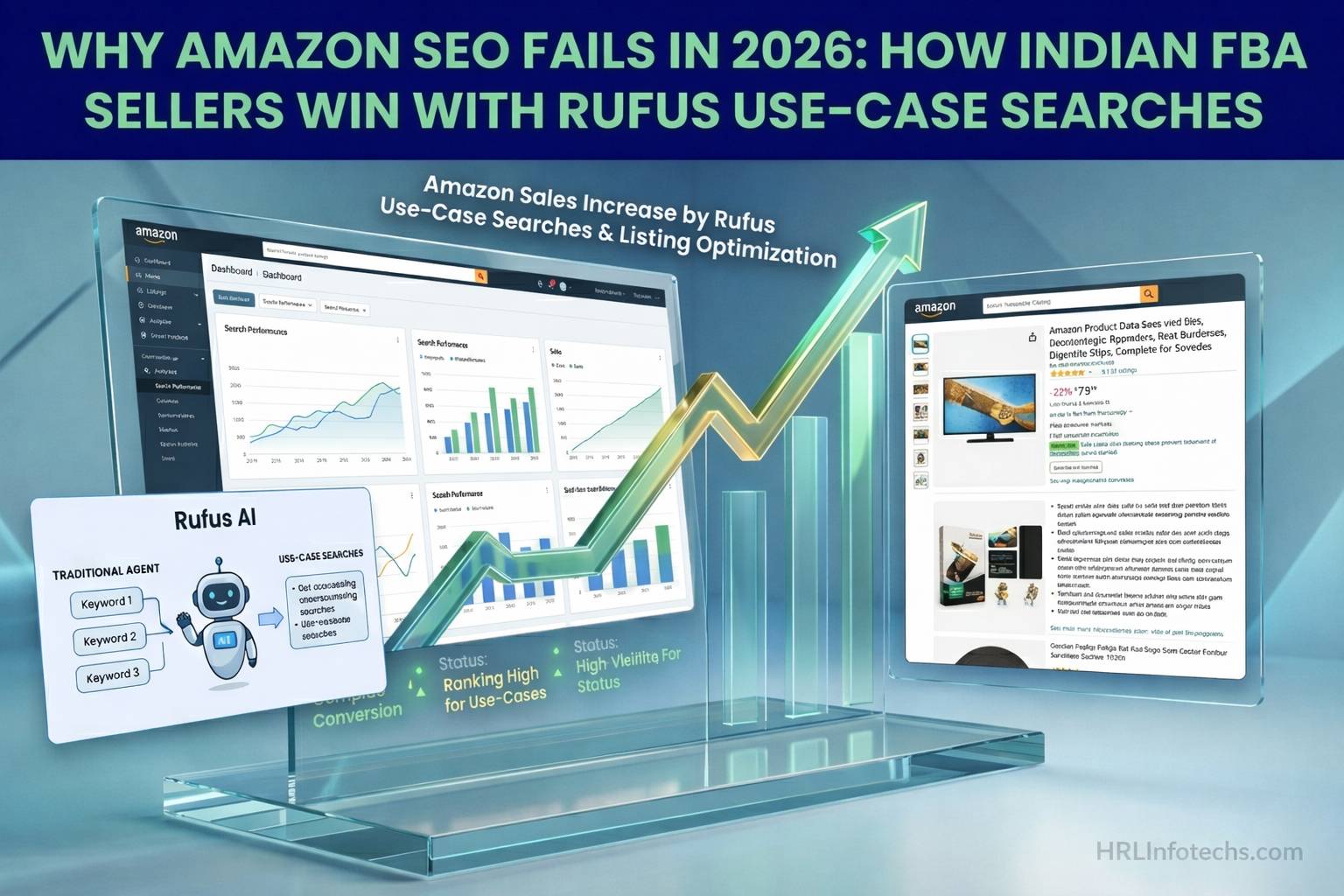
Why Amazon SEO Fails in 2026: How Indian FBA Sellers Win with Rufus Use-Case Searches


Amazon SEO is changing faster than most sellers can track. What worked in 2023 or 2024 is already losing power in 2026, especially with Amazon’s Rufus AI and use-case driven search. Indian FBA sellers who still rely only on keyword stuffing, generic titles, and broad match ads are watching their visibility drop while smarter competitors quietly take over page one.

To win now, you must treat Amazon SEO as a buyer-intent engine, not just a keyword checklist. That means understanding how customers search on Amazon in 2026, mapping real-life problems to your listings, and aligning Amazon SEO & Listing Optimization with data-driven ecommerce growth strategies. This shift is exactly where most Amazon SEO fails—and where Indian FBA sellers can win big.

Why Traditional Amazon SEO Fails in 2026

Most Amazon SEO frameworks were built for a different era, when exact match keywords and aggressive indexing were enough. In 2026, Amazon’s algorithm reads context, intent, and engagement signals, not just raw keyword density. Listings that ignore buyer language and real use cases get impressions but no clicks or conversions.

This is why many sellers complain that traffic is up but sales are flat. They optimize for search volume instead of problem solving keywords Amazon SEO actually rewards. When titles, bullets, and A+ content fail to answer a clear use case, Rufus and other AI layers push those listings down in favor of products that match how customers search on Amazon 2026.

The New Reality: Use-Case and Problem-Solving Search

Amazon search is shifting from product-first to problem-first. Instead of typing “wireless headphones,” buyers now search like, “headphones for noisy office calls” or “earbuds for gym that don’t fall out.” These are classic amazon use case search examples that reveal clear intent and context.

Amazon SEO for customer intent now means mapping your product to specific situations, pains, and outcomes. When your listing mirrors these phrases in a natural way, you send strong relevance signals. This is how to rank on Amazon with buyer intent: speak to the scenario, not just the category.

How Customers Search on Amazon 2026

Search behavior in 2026 looks more like conversations than short tags. Shoppers type full questions, detailed needs, and even mini-sentences, especially on mobile and voice. Amazon’s AI understands these patterns and surfaces listings that match the underlying use case, not just the core keyword.

To align Amazon SEO with this shift, sellers must research long-tail, intent-heavy phrases and integrate them into titles, bullets, and FAQs. Phrases like “for oily skin in humid weather” or “for small kitchens with limited space” are powerful signals when used strategically and naturally in your Amazon SEO & Listing Optimization.

Examples of Use-Case Driven Keywords

Instead of only targeting generic head terms, modern Amazon SEO requires layering in problem and outcome language. For example, a kitchen organizer can target “kitchen rack for small apartments” or “shelf organizer for under sink clutter.” These are problem solving keywords Amazon SEO tools often overlook.

By building clusters of such phrases, you create a semantic web around your listing. This helps Amazon understand that your product solves multiple micro-problems. Over time, this approach supports better organic ranking, stronger conversions, and lower dependence on pure Amazon PPC & Advertising spend.

Best Amazon SEO Strategy for Conversions, Not Just Clicks

Ranking is useless if your listing cannot convert. The best Amazon SEO strategy for conversions starts with aligning every element of the page to buyer intent. Titles attract the right click, bullets answer objections, and images prove outcomes. This creates a tight funnel from search term to purchase.

In 2026, Amazon SEO is less about tricks and more about structured persuasion. You still need keyword-rich content, but it must be framed around benefits, use cases, and social proof. When your listing reflects how customers search on Amazon 2026, your conversion rate becomes a ranking signal in itself.

Structuring Listings Around Buyer Intent

To optimize Amazon SEO for customer intent, start by mapping your top three to five use cases. For each, identify the problem, desired outcome, and emotional driver. Then, weave these into your title, bullets, and A+ modules with natural Amazon SEO keyword placement.

For example, bullets can follow a clear pattern: problem, solution, proof, and use-case scenario. This structure helps both the algorithm and the shopper understand why your product is the best fit. Over time, this approach supports higher click-through and conversion, which strengthens your Amazon SEO performance.

Integrating Amazon PPC & Advertising with Organic SEO

Many sellers treat Amazon PPC & Advertising as a separate channel from Amazon SEO, but in 2026 they are tightly connected. Paid campaigns generate data on which search terms convert, which then feeds your organic optimization strategy. Ignoring this loop is a major reason Amazon SEO fails.

By mining your PPC search term reports, you can uncover hidden amazon use case search examples and problem phrases that drive sales. These insights should guide your content updates, from titles to backend keywords. This is a key part of data-driven ecommerce growth strategies that top Indian FBA sellers now rely on.

Using PPC Data to Refine Amazon SEO

Instead of chasing vanity metrics like impressions, focus on high-conversion search terms from your ads. These phrases often reveal how to rank on Amazon with buyer intent because they show what real customers type before buying. Prioritize them in your on-page Amazon SEO & Listing Optimization.

Practical steps include updating bullet points with winning phrases, adjusting product descriptions to mirror buyer language, and testing new images that reflect key use cases. Over time, this alignment between PPC and Amazon SEO builds a powerful feedback loop that compounds your organic visibility.

Account Management, FBA Support, and Operational Signals

Even the best Amazon SEO strategy can fail if operational metrics are weak. Late shipments, stockouts, and poor customer service send negative signals to Amazon’s algorithm. In 2026, Account Management & FBA support are not back-end tasks; they are core parts of your Amazon SEO engine.

Strong inventory planning, responsive customer support, and optimized FBA workflows help maintain high seller ratings and fast delivery promises. These factors directly impact your ability to rank, especially in competitive niches. Amazon wants listings that not only match intent but also deliver a reliable experience.

Operational Excellence as an SEO Advantage

Indian FBA sellers who treat operations as a growth lever gain a real edge. Consistent stock, low return rates, and positive reviews all reinforce your Amazon SEO efforts. When combined with intent-driven content, these signals tell Amazon that your listing is a safe bet for top positions.

This is where data-driven ecommerce growth strategies go beyond keywords. Dashboards that track inventory health, review trends, and fulfillment performance help you spot risks early. Fixing these issues protects your rankings and ensures that your Amazon SEO investments keep paying off.

How Indian FBA Sellers Can Win the Rufus Era

Indian FBA sellers are uniquely positioned to leverage the Rufus use-case revolution. Many already operate in price-sensitive, problem-focused markets, which trains them to think in terms of real-life scenarios. Turning that insight into structured Amazon SEO can unlock global growth.

The path forward is clear: focus on how customers search on Amazon 2026, build listings around use cases, and integrate Amazon PPC & Advertising data into your optimization cycle. With disciplined Account Management & FBA support, this approach turns Amazon SEO into a predictable growth system rather than a guessing game.

Turning Strategy into Execution

To move from theory to action, start with an audit of your current listings. Identify where generic product language replaces clear use-case messaging. Then, rebuild titles, bullets, and A+ content around buyer intent while maintaining strong Amazon SEO fundamentals.

Next, align your PPC campaigns with these new themes and monitor which search terms drive the best conversions. Feed those insights back into your content and operational planning. If you need expert support to execute this at scale, partnering with a specialist like HRL Infotechs can help you turn Amazon SEO into a consistent, compounding growth channel.


Why Kanpur Leather Sellers Lose Sales on Amazon & Flipkart: Fix Listings, Slash Returns


Kanpur’s leather sellers have world-class products, yet many struggle to sell on Amazon and Flipkart. Listings get clicks but not orders, ads burn cash, and returns quietly eat margins. The problem usually isn’t the product quality; it’s how the product is presented, discovered, and managed on these marketplaces.

When you understand how Amazon & Flipkart marketing actually works, you can fix poor listings, reduce returns, and scale profitably. This guide breaks down why your listings are not converting, what causes low sales and high returns, and how to turn your marketplace presence into a serious revenue channel.

Understanding the Real Search Intent Behind Leather Buyers

Most Kanpur leather sellers assume buyers search only by product type, like “leather wallet” or “men’s leather belt.” In reality, buyers on marketplaces search with intent-rich phrases. These include color, use case, price range, and quality expectations. If your Amazon & Flipkart marketing ignores this, your listings will never fully match buyer intent.

To improve Amazon SEO & listing optimization, you must map your titles, bullets, and descriptions to how real customers search. When you do this well, your products start appearing for high-intent queries, not just generic ones. That shift alone can transform why Amazon listings are not converting into why they are finally selling.

Why Amazon Listings Are Not Converting for Kanpur Leather Sellers

Many sellers ask why products are not selling on Amazon India when they have good reviews and decent pricing. The truth is that conversion is rarely about one factor. It is usually a combination of weak content, poor positioning, and missing trust signals. Amazon & Flipkart marketing must address all three together.

From an optimization perspective, Amazon SEO & listing optimization is not just keyword stuffing. It is about structuring your content so buyers instantly understand value, quality, and differentiation. If your listing looks like every other leather wallet, buyers will scroll past or choose a better-presented competitor.

Weak Product Titles and Incomplete Keywords

Titles that only say “Genuine Leather Wallet” or “Leather Belt for Men” waste valuable space. You must include core attributes like material type, style, color, size, and key benefits. This is where Amazon & Flipkart marketing can directly influence visibility and click-through rate.

When you ignore long-tail phrases, you miss high-intent traffic. That is one of the main reasons why Amazon listings are not converting. Competitors who invest in Amazon SEO & listing optimization capture those searches and win the sale before buyers even see your product.

Poor Images That Do Not Match Premium Leather Positioning

Kanpur leather is known for craftsmanship, but many listings use low-light, low-resolution photos. This disconnect makes buyers doubt quality. High-quality images are a core part of conversion optimization & analytics because they directly influence add-to-cart behavior.

Use clean white backgrounds, close-ups of stitching, and lifestyle shots. Show thickness, texture, and packaging. When images tell a quality story, buyers feel safer paying a premium. This is a simple yet powerful fix for why products are not selling on Amazon India.

Missing Trust Builders: Reviews, FAQs, and Policies

Even if your product looks good, buyers hesitate without proof. Lack of reviews, unclear return policies, and no answers to common questions all reduce conversion. Effective Amazon & Flipkart marketing builds trust into the listing itself.

Add a detailed FAQ section in the description. Address durability, color variation, and care instructions. Encourage early buyers to leave honest reviews. Over time, this improves both conversion and ranking, solving a major part of why Amazon listings are not converting.

Reasons for Low Sales on Flipkart for Leather Products

Flipkart behaves differently from Amazon, yet many sellers copy-paste the same content. That is a big reason for low sales on Flipkart. The audience mix, pricing sensitivity, and search behavior can vary, especially in Tier 2 and Tier 3 cities.

Flipkart SEO & ads require tailored strategies. You must align titles, attributes, and ad campaigns with how Flipkart’s algorithm surfaces products. When you treat both platforms identically, you weaken your Amazon & Flipkart marketing impact on each.

Under-Optimized Attributes and Filters

On Flipkart, many buyers use filters like material, closure type, pattern, and discount range. If your product attributes are incomplete or inaccurate, you disappear from filtered results. That alone can explain many reasons for low sales on Flipkart.

Ensure every listing has complete attributes: leather type, lining, compartments, dimensions, and warranty. This not only improves discoverability but also reduces confusion, which supports conversion optimization & analytics efforts.

Ineffective Flipkart SEO & Ads Strategy

Running broad, unstructured ads without proper targeting is another reason for low sales on Flipkart. Many sellers bid on generic terms, burn budget, and still ask why products are not selling on Amazon India or Flipkart. The issue is not the platform; it is the strategy.

Flipkart SEO & ads work best when combined with strong organic optimization. Use ads to boost well-optimized listings, not to compensate for weak ones. Track which keywords drive conversions and feed that data back into your titles and descriptions.

High Return Rate in Ecommerce: Hidden Causes for Leather Sellers

Even when sales grow, high return rate ecommerce causes can silently kill profit. Leather products are especially vulnerable because of expectations around color, feel, and size. If buyers feel misled, they return quickly, and your account health suffers.

Many Kanpur sellers underestimate how returns affect Amazon & Flipkart marketing performance. High return rates can reduce visibility, increase penalties, and damage seller ratings. Understanding and fixing these issues is as important as driving more traffic.

Mismatch Between Photos, Description, and Real Product

Over-edited photos, vague descriptions, or missing size details create unrealistic expectations. When the product arrives, buyers feel disappointed and initiate returns. This is one of the most common high return rate ecommerce causes for leather goods.

Be precise about color variations, natural marks, and measurements. Explain that genuine leather may have minor texture differences. Clear communication reduces surprises and supports long-term Amazon & Flipkart marketing success.

Ignoring Fit, Use Case, and Care Instructions

Belts that do not fit, bags that feel smaller than expected, or wallets that do not hold enough cards all trigger returns. These are preventable reasons behind high return rate ecommerce causes. The solution lies in better content, not just better logistics.

Include detailed sizing charts, capacity information, and care tips. Guide buyers on how to choose the right size or style for their use case. This is a powerful form of conversion optimization & analytics because it improves both satisfaction and repeat purchase rates.

Leveraging Ecommerce Account Management for Sustainable Growth

Most Kanpur leather brands treat Amazon & Flipkart marketing as a one-time setup. In reality, winning on marketplaces requires ongoing ecommerce account management. Algorithms change, competitors adjust prices, and customer behavior shifts over time.

Structured ecommerce account management includes regular keyword research, listing audits, pricing reviews, and performance tracking. When you combine this with conversion optimization & analytics, you can identify exactly why Amazon listings are not converting and fix them before sales drop.

Key Elements of a Strong Marketplace Management Strategy

A solid strategy covers both visibility and profitability. It is not enough to rank; you must also protect margins and brand perception. This is where professional Amazon & Flipkart marketing support becomes a growth lever rather than a cost.

Focus on these pillars for leather products:

  • Ongoing Amazon SEO & listing optimization for top SKUs.
  • Platform-specific Flipkart SEO & ads campaigns.
  • Regular analysis of reasons for low sales on Flipkart and Amazon.
  • Deep dive into high return rate ecommerce causes and fixes.
  • Continuous conversion optimization & analytics on key listings.

When these elements work together, your marketplace presence becomes predictable, scalable, and far more profitable.

Conclusion: Turn Kanpur Leather Craft into Marketplace Revenue

Kanpur’s leather industry has the product strength to dominate Amazon and Flipkart. The real gap lies in strategic Amazon & Flipkart marketing, not in craftsmanship. By fixing weak listings, aligning with buyer intent, and tackling high return rate ecommerce causes, you can transform underperforming accounts into reliable revenue engines.

If you want expert support with Amazon SEO & listing optimization, Flipkart SEO & ads, and full-funnel ecommerce account management, partnering with HRL Infotechs can help you convert more, reduce returns, and scale your leather brand across India’s biggest marketplaces.