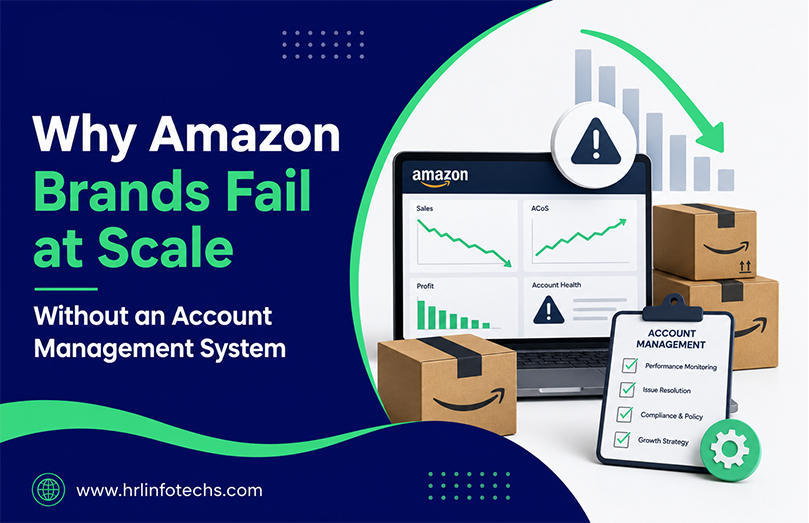
Why Amazon Brands Fail at Scale Without an Account Management System


Most Amazon brands have a good first year.

A product catches on, the ads start performing, and sales climb month over month. Everyone’s happy. Then, somewhere around month eight or nine, things that used to run smoothly start breaking quietly in the background.

Inventory runs out at the worst possible moment. Advertising costs creep up without anyone noticing why. A listing that was ranking well two months ago has slipped to page two. Customer complaints start showing up that nobody has time to chase down properly.

None of this happens because the product got worse. It happens because growth exposed gaps that were always there; they just weren’t visible when order volume was small enough to manage by memory. This is exactly the moment where real Amazon account management services stop being optional and start being the thing that decides whether a brand keeps growing or quietly stalls.

The brands that keep scaling and the ones that plateau usually aren’t separated by who has the better product. They’re separated by who built a system before they needed one.

Why Growth Creates Problems Nobody Saw Coming

In the early days, running a seller account is genuinely manageable solo. A handful of SKUs, a couple of ad campaigns, maybe an hour a day checking on things. That’s fine.

Here’s how it piles up. More ad campaigns mean more daily monitoring. Inventory guesses start carrying real financial weight. Listings demand constant tweaking instead of a one-time setup. Customer questions start overflowing whatever spare time used to exist. Account metrics deserve a much closer look than a glance. Performance data piles up faster than anyone can read it properly. Pricing decisions stop being something you can put off till next week.

Without a real Amazon seller growth strategy behind all of that, these things stop being manageable tasks and start becoming bottlenecks that quietly slow everything down.

The Costs Nobody Budgets For

A lot of sellers assume that more sales automatically mean things are going well. It’s not quite that simple.

Unmanaged growth tends to bring its own problems along with it: stock running out at the wrong time, ad spend climbing without a clear reason, account health numbers slipping, listings getting suppressed out of nowhere, conversion rates quietly dropping, and storage fees piling up on inventory that isn’t moving fast enough.

All of this works directly against sustainable Amazon business scaling, even while the top-line sales numbers might still look fine for a while. The brands without proper systems usually end up spending more time firefighting these issues than actually working on the next stage of growth.

Why Scaling Actually Requires a System

Growing a brand on Amazon isn’t just about selling more units. It’s about staying consistent while the operation gets bigger and messier.

Real growth depends on a few things working together: tight Amazon PPC management that doesn’t bleed budget, Amazon listing optimisation that treats every page as something living rather than set-and-forget, inventory planned instead of reacted to, and an honest read of the data instead of a gut-feel guess.

Without that, brands end up reactive. And here’s the part that catches people off guard: a small mistake that barely matters at ten orders a day becomes a serious problem once you’re doing a thousand. Scale doesn’t just multiply revenue. It multiplies the cost of every small thing you’ve been ignoring.

What an Account Management System Actually Does

A proper account management system puts structure around every part of the business that used to run on memory and good intentions.

Most times it involves watching how listings perform, staying aware of stock condition, tracking ad results closely, noticing price shifts before they cost money, reading what customers are actually saying, checking account numbers regularly, and keeping an eye on what competitors are doing, all gathered neatly in one place, updated consistently, rather than floating loose inside someone’s head.

With things finally clear, attention shifts naturally toward building the company, not just putting out morning emergencies.

The Marketplace Itself Keeps Getting Harder

Amazon today is a genuinely different environment than it was even two years ago.

New sellers show up in every category constantly. Advertising costs keep climbing. The search algorithm keeps shifting. Customers expect more than they used to, faster than they used to.

A sharp Amazon advertising strategy helps brands stay steady through all of that, not by avoiding the chaos, but by having enough operational consistency to absorb it without falling behind. Brands that don’t adapt tend to lose ground quietly to competitors who simply have better systems running underneath them.

Building Something That Actually Lasts

Short-term promotions and discount sprints can move the needle for a week. They don’t build a business.

Real Amazon sales optimisation is built around things that compound profitability, repeat customers, ad spend that’s actually efficient, inventory that’s planned instead of reactive, listings that keep improving, and a brand that’s actually building something recognisable over time.

The brands that focus on operational stability tend to outperform the ones chasing aggressive discounting or ad spend spikes, simply because stability is what survives past the first good quarter.

Why the Small Stuff Matters More Than It Seems

It’s rarely one big disaster that tanks an account. It’s usually a handful of small things compounding quietly.

A weak product title here. Incomplete backend keywords there. Inventory is running a little too low too often. Conversion rates are slowly drifting down. Ad costs are creeping up. A few unanswered negative reviews.

Catching these early is exactly what proper Amazon brand management is supposed to do, not after a quarterly review shows the damage already done, but continuously, before small issues turn into lost sales nobody noticed slipping away.

When It’s Time to Bring in Real Expertise

At some point, the operational demands of running an Amazon brand outgrow what an internal team can reasonably handle alone.

Most times, this is where real expertise across Amazon A+ Content Design, Amazon Storefront Design, advertising, inventory, and account standing actually starts mattering. The goal isn’t to swap out the people who built the brand. It’s to free them up to stay focused on products and customers, while someone else takes charge of the daily operational demands that have grown too heavy to juggle part-time.

A storefront that actually looks built, and A+ Content that actually explains the product properly, are the kind of things that get pushed aside when the team is stretched thin, and they’re exactly the things that quietly cost conversions when they’re missing.

Why This Never Really Stops

Amazon doesn’t sit still. Algorithms shift. Competitors adjust pricing overnight. What customers want changes. Ad costs go up and down without warning.

Real growth management isn’t a project you finish and walk away from. It’s ongoing, constant monitoring, constant small adjustments. The brands still growing two or three years from now will almost certainly be the ones that kept adapting the whole way through, not the ones that set something up once and assumed it would keep working forever.

Conclusion

Most Amazon brands that hit a wall didn’t fail because of a bad product or weak demand. They failed because growth introduced problems that a system would have caught, and they didn’t have one.

Real Amazon account management services give you the structure to handle inventory properly, keep listings sharp, run advertising efficiently, and protect account health before small issues turn into expensive ones.

At HRL Infotechs, this is genuinely what we help brands build: scalable systems backed by real account management, sharp PPC and listing strategy, strong A+ Content and Storefront work, and the kind of operational support that lets a brand grow without quietly falling apart in the background. As the marketplace keeps getting more competitive, the brands that invest properly in this now are the ones that’ll still be growing profitably a few years from today.


How Top Indian Sellers Are Scaling Faster with Amazon Business Bulk Orders


Many Indian sellers on Amazon reach a revenue plateau after some initial success with regular B2C orders. The real breakthrough often comes when they tap into Amazon B2B selling and start winning consistent bulk orders from businesses, institutions, and resellers across India.

By understanding how Amazon Business India for sellers actually works, and by aligning your catalog, pricing, and marketing to B2B demand, you can turn your existing Amazon presence into a powerful wholesale channel. Let’s explore how top Indian sellers are using Amazon Business bulk orders to scale faster and more profitably.

Why Amazon B2B Selling Is a Game Changer for Indian Sellers

Amazon B2B selling opens access to lakhs of registered business buyers who purchase in higher quantities and with greater frequency than typical retail customers. These buyers include offices, schools, hospitals, retailers, manufacturers, and startups looking for reliable suppliers on Amazon India.

Unlike standard B2C orders, bulk orders often have higher average order value, better repeat potential, and more predictable demand. This makes Amazon Business opportunities for wholesalers especially attractive, as they can plan inventory, negotiate better rates with suppliers, and build long-term relationships with business customers.

Understanding Amazon Business India For Sellers

To leverage Amazon B2B selling effectively, you first need to understand how Amazon Business India for sellers is structured. When you enable a Business account and B2B features, your listings become visible to business buyers with special pricing, quantity discounts, and tax benefits.

Business customers can filter for Business-only offers, GST-compliant invoices, and bulk quantity options. If your catalog is optimized for these filters, you stand a much better chance of appearing in front of high-intent buyers searching for how to get bulk orders on Amazon India.

Key Benefits Of Amazon Business Account For Sellers

The benefits of Amazon Business account for sellers go beyond just visibility. You gain access to tools designed specifically for B2B selling strategies for Amazon India, helping you stand out in competitive categories.

Some of the most impactful benefits include:

  • Ability to set Business-only pricing and quantity-based discounts
  • Access to business analytics and purchase patterns
  • Eligibility for bulk purchase recommendations and B2B badges
  • Better trust with buyers through GST-compliant invoicing

How Business Buyers Search And Compare Sellers

Business buyers usually search with clear intent, often including terms like bulk, wholesale, or pack of in their queries. They compare sellers based on price per unit, delivery timelines, ratings, and invoice compliance rather than just lowest price alone.

When planning your Amazon seller growth strategy, it is important to study how these buyers behave in your category. Look at top listings, analyze their pack sizes, and observe how they structure titles and bullet points to attract bulk buyers.

How To Sell Products In Bulk On Amazon India Effectively

Many sellers ask how to sell products in bulk on Amazon and assume it is only about offering larger quantities. In reality, success with Amazon B2B selling requires a combination of catalog design, pricing logic, and operational readiness.

To start, identify SKUs that already have steady B2C demand and can logically be sold in multipacks or cartons. Then, create separate B2B-friendly listings or variations that clearly communicate value for business buyers.

Optimizing Listings For Bulk And Wholesale Buyers

Listing optimization is one of the best ways to sell wholesale on Amazon India. Your titles, images, and bullet points must clearly highlight pack size, per-unit cost, and suitability for business use, such as office supplies, resale, or institutional consumption.

Consider these optimization tips for Amazon B2B selling:

  • Include terms like bulk pack, wholesale, or value pack where relevant
  • Mention carton quantity and total units clearly in the title and bullets
  • Show usage scenarios for offices, retailers, or facilities in the description
  • Highlight GST invoice availability and any compliance certifications

Pricing And Quantity Discount Strategies

Pricing strategy is central to how to get bulk orders on Amazon India. Business buyers expect better per-unit pricing at higher quantities, but they also value reliability and service. Your goal is to balance margins with attractive discounts.

Use Business Pricing and Quantity Discounts to set tiered offers, such as lower rates for 10, 25, or 50 units. This structure encourages larger orders and helps you forecast demand, which is crucial for building a sustainable Amazon seller growth strategy.

Practical B2B Selling Strategies For Amazon India

Once your catalog is B2B-ready, you need a clear action plan to drive visibility and conversions. Effective B2B selling strategies for Amazon India combine organic optimization, paid visibility, and strong account health.

Instead of relying only on organic traffic, many top sellers invest in targeted advertising and structured promotions to reach decision-makers who are actively searching for bulk solutions in their category.

Using Advertising And Promotions To Attract Bulk Buyers

Sponsored Products and Sponsored Brands can be tailored to highlight your bulk and wholesale listings. When planned correctly, these campaigns help you appear for high-intent searches related to how to sell products in bulk on Amazon and category-specific B2B queries.

Promotions like percentage-off deals on higher quantities, business-only coupons, and limited-time bulk discounts can further push buyers to place larger orders. The key is to track performance and refine campaigns based on which keywords and placements drive the most profitable bulk orders.

Improving Operations To Handle Large Orders Smoothly

Winning bulk orders is only half the battle; fulfilling them reliably is what keeps business buyers coming back. Ensure your inventory planning, packaging, and logistics can handle sudden spikes in order volume without delays or cancellations.

Many successful B2B sellers use a mix of Fulfilment by Amazon and self-fulfilment, depending on product type and margins. Clear communication on handling times, packaging standards, and replacement policies builds trust and supports long-term B2B relationships.

Leveraging External Support For Faster B2B Growth

As competition grows, many sellers look for expert support to accelerate Amazon B2B selling performance. This is where partnering with an experienced amazon marketing agency or specialized amazon account management services can make a measurable difference.

These partners help refine catalog strategy, optimize advertising, and maintain strong account health, so you can focus on sourcing and operations. For sellers who are serious about scaling bulk orders, this external expertise often shortens the learning curve significantly.

Role Of Amazon Marketing And Account Management Services

A capable amazon marketing agency will analyze your category, identify Amazon Business opportunities for wholesalers, and design campaigns that specifically target B2B search behavior. They align keyword strategy with bulk and wholesale intent, not just retail traffic.

Meanwhile, amazon account management services monitor pricing, stock levels, policy compliance, and performance metrics. This proactive approach helps protect your visibility in search results and reduces the risk of disruptions that could affect large business customers.

Actionable Amazon India Seller Tips To Start Getting Bulk Orders

To move from theory to execution, it helps to follow a simple checklist. These Amazon India seller tips are designed to get you started quickly while keeping long-term scalability in mind.

Begin with a focused set of SKUs, test your approach, and then expand based on data. This controlled method reduces risk while still allowing you to tap into the growing demand for Amazon B2B selling in India.

Quick Checklist To Launch Or Improve B2B Selling

Use the following steps as a practical roadmap for how to get bulk orders on Amazon India and grow them consistently over time.

Key actions include:

  • Enable Amazon Business features and verify GST compliance
  • Identify high-potential SKUs and create bulk or wholesale variations
  • Optimize titles, bullets, and images for business and bulk intent
  • Set business pricing and quantity discounts with clear margins
  • Launch targeted ads focusing on B2B and bulk-related keywords
  • Monitor performance, reviews, and repeat purchase patterns

Conclusion: Turning Amazon B2B Selling Into A Scalable Growth Engine

Scaling faster with Amazon Business bulk orders is not reserved for a few large brands. Any disciplined seller who understands how to sell products in bulk on Amazon, optimizes for business buyers, and maintains strong operations can build a reliable B2B revenue stream.

By combining smart catalog planning, competitive yet sustainable pricing, and expert guidance from partners like HRL Infotechs, Indian sellers can transform Amazon B2B selling into a long-term growth engine that attracts repeat business buyers across the country.