Fifty products used to compete for one shopper’s attention. Now it’s five.
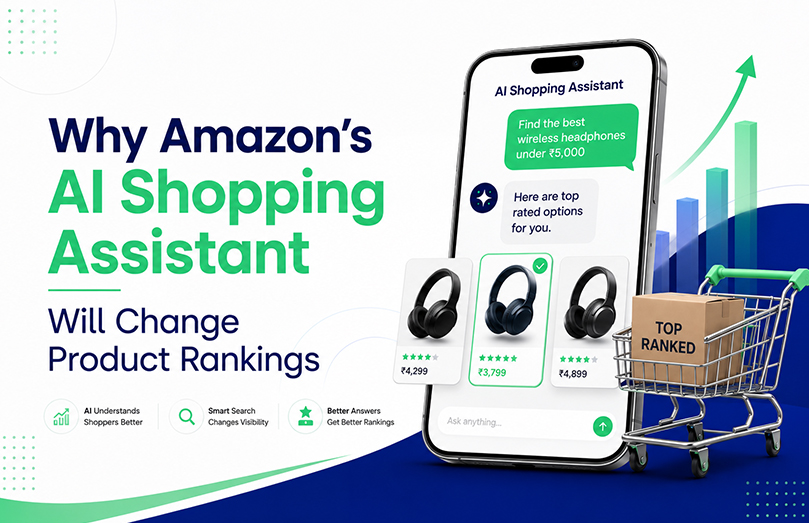
That’s the actual shift happening on Amazon right now, and most sellers still haven’t registered how large it is. A traditional Amazon search returns a full page of results dozens of products, endless scroll, plenty of room for a mediocre listing to still get found eventually. Amazon AI shopping assistant does something fundamentally different: ask it a question, and it narrows that same field down to roughly five named products. If your product isn’t one of those five, it simply doesn’t exist for that shopper; there’s no scroll to fall back on.
As of May 2026, Amazon officially renamed this assistant from Rufus to Alexa for Shopping, unifying it with Alexa+’s personalisation across the app, website, and Echo devices. The underlying system the one reading listings, reviews, and Q&A to decide who makes that shortlist of five hasn’t changed. What’s changed is how central it’s becoming to how Indian shoppers actually find products.
Why This Isn’t Just Another Feature Update
Amazon reported over 300 million monthly users engaging with this assistant by the end of 2025, and during Black Friday alone, it was involved in 38% of all Amazon shopping sessions. This isn’t a niche feature a handful of early adopters are testing; it is the new frontier for Amazon product ranking optimisation. It’s rapidly becoming a primary discovery channel, sitting alongside and, in growing cases, replacing traditional search entirely.
For sellers, the implication is straightforward and slightly uncomfortable: the rules that got a product ranking well in classic search results don’t automatically translate into getting recommended by an AI system deciding who makes a shortlist of five.
How the Underlying Logic Actually Differs
Amazon’s traditional Amazon search algorithm, the system most sellers spent years learning to optimise for, is heavily driven by keyword matching, sales velocity, and click-through data. It’s mechanical in a genuinely learnable way.
The AI shopping assistant works differently. Instead of matching typed keywords, it interprets intent from a conversational question, then reads across your entire listing title, bullets, description, A+ content, customer reviews, and the Q&A section to synthesise whether your product genuinely fits what the shopper actually asked. A listing stuffed with repeated keywords but thin on real explanation tends to get recommended less. A listing that reads naturally and actually answers the kind of question a real person would ask tends to surface more often.
This is precisely why real product ranking optimisation in 2026 can’t stop at backend keyword fields the way it used to. The system is reading for meaning now, not just matching strings of text.
What Actually Changes in How Listings Get Built
Solid Amazon listing optimisation going forward means writing content that could genuinely answer a spoken question, not just satisfy a search algorithm scanning for keyword density.
If someone asks the assistant “which of these blenders is quiet enough to use early morning without waking the house,” a listing that’s proactively addressed noise level in the bullets, in the A+ content, ideally reinforced by review content mentioning it has a real shot at being one of the five names returned. A listing that only lists wattage and blade count, however keyword-optimised, genuinely doesn’t.
Why Reviews and Q&A Matter More Than They Used To
Here’s a detail most sellers haven’t fully internalised yet: this assistant doesn’t rely solely on what the seller wrote. It’s actively reading review content and Q&A sections as source material for its own answers.
That means a thin Q&A section the one most sellers genuinely ignore after launch is now a real ranking gap, not just a minor oversight. Proactively seeding a handful of genuinely useful Q&A entries, and actively encouraging detailed reviews that mention specific use cases, has become a real lever for visibility, not just a nice-to-have for social proof.
Why This Reshapes Advertising Strategy Too
Getting genuine Amazon advertising optimisation right now means thinking beyond simply winning a sponsored placement in a search results grid.
If the AI assistant is increasingly deciding the shortlist a shopper actually sees, ad spend that only targets classic search placement is fighting for a shrinking share of real discovery. Smart advertising strategy in 2026 increasingly means making sure the listing itself is strong enough to earn assistant recommendations organically, with paid placement supporting that visibility rather than trying to substitute for it entirely.
Why Account Health Quietly Feeds Into This Too
Sound Amazon seller account management affects this system just as directly as it always affected classic search. Inconsistent stock, unresolved account health flags, or thin catalogue data all undermine the confidence signals the AI assistant is reading before it decides whether to recommend a product at all.
A technically strong listing sitting inside a poorly managed account doesn’t get the benefit of the doubt. The assistant is synthesising trust signals across the whole account experience, not evaluating one listing in complete isolation from everything else.
Why This Extends Well Beyond a Single Listing
This shift is really part of a much broader move toward genuine Amazon marketplace optimisation because a shopper’s experience spans the whole account, not one product page in isolation.
Brands with consistent quality across their entire catalogue, not just their single bestseller, tend to build the kind of trust signals an AI system can actually pick up on across multiple interactions, rather than betting everything on one hero listing carrying the whole brand.
What This Means Beyond Amazon Specifically
The pattern showing up here AI systems narrowing choice down to a handful of recommendations instead of a full results page isn’t unique to Amazon. It’s the same shift reshaping ecommerce marketplace optimisation broadly, as Flipkart, Myntra, and other platforms increasingly build their own AI-assisted discovery layers following the same logic.
Brands that learn to write for genuine intent now, rather than pure keyword density, are building a skill that transfers directly across every marketplace moving in this direction, not just the one that got there first.
Conclusion
The shift from fifty visible results to five AI-recommended ones is the biggest change to Amazon discoverability since the platform introduced sponsored ads. Sellers still optimising purely for classic keyword-matching are optimising for a shrinking share of how shoppers actually find products in 2026.
At HRL Infotechs, real Amazon SEO services now mean building listings, review strategy, and account health together, treating the AI shopping assistant as the primary discovery layer it’s rapidly becoming, not an experimental feature to revisit later once it’s “proven itself.” By the time it’s proven itself to everyone, the sellers who prepared early will already own the shortlist.