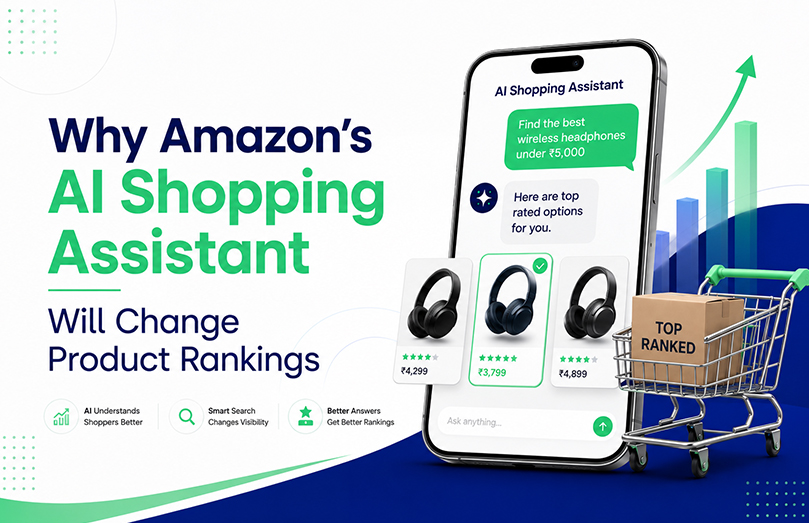
Why Amazon’s AI Shopping Assistant Will Change Product Rankings


Fifty products used to compete for one shopper’s attention. Now it’s five.

That’s the actual shift happening on Amazon right now, and most sellers still haven’t registered how large it is. A traditional Amazon search returns a full page of results dozens of products, endless scroll, plenty of room for a mediocre listing to still get found eventually. Amazon AI shopping assistant does something fundamentally different: ask it a question, and it narrows that same field down to roughly five named products. If your product isn’t one of those five, it simply doesn’t exist for that shopper; there’s no scroll to fall back on.

As of May 2026, Amazon officially renamed this assistant from Rufus to Alexa for Shopping, unifying it with Alexa+’s personalisation across the app, website, and Echo devices. The underlying system the one reading listings, reviews, and Q&A to decide who makes that shortlist of five hasn’t changed. What’s changed is how central it’s becoming to how Indian shoppers actually find products.

Why This Isn’t Just Another Feature Update

Amazon reported over 300 million monthly users engaging with this assistant by the end of 2025, and during Black Friday alone, it was involved in 38% of all Amazon shopping sessions. This isn’t a niche feature a handful of early adopters are testing; it is the new frontier for Amazon product ranking optimisation. It’s rapidly becoming a primary discovery channel, sitting alongside and, in growing cases, replacing traditional search entirely.

For sellers, the implication is straightforward and slightly uncomfortable: the rules that got a product ranking well in classic search results don’t automatically translate into getting recommended by an AI system deciding who makes a shortlist of five.

How the Underlying Logic Actually Differs

Amazon’s traditional Amazon search algorithm, the system most sellers spent years learning to optimise for, is heavily driven by keyword matching, sales velocity, and click-through data. It’s mechanical in a genuinely learnable way.

The AI shopping assistant works differently. Instead of matching typed keywords, it interprets intent from a conversational question, then reads across your entire listing title, bullets, description, A+ content, customer reviews, and the Q&A section to synthesise whether your product genuinely fits what the shopper actually asked. A listing stuffed with repeated keywords but thin on real explanation tends to get recommended less. A listing that reads naturally and actually answers the kind of question a real person would ask tends to surface more often.

This is precisely why real product ranking optimisation in 2026 can’t stop at backend keyword fields the way it used to. The system is reading for meaning now, not just matching strings of text.

What Actually Changes in How Listings Get Built

Solid Amazon listing optimisation going forward means writing content that could genuinely answer a spoken question, not just satisfy a search algorithm scanning for keyword density.

If someone asks the assistant “which of these blenders is quiet enough to use early morning without waking the house,” a listing that’s proactively addressed noise level in the bullets, in the A+ content, ideally reinforced by review content mentioning it has a real shot at being one of the five names returned. A listing that only lists wattage and blade count, however keyword-optimised, genuinely doesn’t.

Why Reviews and Q&A Matter More Than They Used To

Here’s a detail most sellers haven’t fully internalised yet: this assistant doesn’t rely solely on what the seller wrote. It’s actively reading review content and Q&A sections as source material for its own answers.

That means a thin Q&A section the one most sellers genuinely ignore after launch is now a real ranking gap, not just a minor oversight. Proactively seeding a handful of genuinely useful Q&A entries, and actively encouraging detailed reviews that mention specific use cases, has become a real lever for visibility, not just a nice-to-have for social proof.

Why This Reshapes Advertising Strategy Too

Getting genuine Amazon advertising optimisation right now means thinking beyond simply winning a sponsored placement in a search results grid.

If the AI assistant is increasingly deciding the shortlist a shopper actually sees, ad spend that only targets classic search placement is fighting for a shrinking share of real discovery. Smart advertising strategy in 2026 increasingly means making sure the listing itself is strong enough to earn assistant recommendations organically, with paid placement supporting that visibility rather than trying to substitute for it entirely.

Why Account Health Quietly Feeds Into This Too

Sound Amazon seller account management affects this system just as directly as it always affected classic search. Inconsistent stock, unresolved account health flags, or thin catalogue data all undermine the confidence signals the AI assistant is reading before it decides whether to recommend a product at all.

A technically strong listing sitting inside a poorly managed account doesn’t get the benefit of the doubt. The assistant is synthesising trust signals across the whole account experience, not evaluating one listing in complete isolation from everything else.

Why This Extends Well Beyond a Single Listing

This shift is really part of a much broader move toward genuine Amazon marketplace optimisation because a shopper’s experience spans the whole account, not one product page in isolation.

Brands with consistent quality across their entire catalogue, not just their single bestseller, tend to build the kind of trust signals an AI system can actually pick up on across multiple interactions, rather than betting everything on one hero listing carrying the whole brand.

What This Means Beyond Amazon Specifically

The pattern showing up here AI systems narrowing choice down to a handful of recommendations instead of a full results page isn’t unique to Amazon. It’s the same shift reshaping ecommerce marketplace optimisation broadly, as Flipkart, Myntra, and other platforms increasingly build their own AI-assisted discovery layers following the same logic.

Brands that learn to write for genuine intent now, rather than pure keyword density, are building a skill that transfers directly across every marketplace moving in this direction, not just the one that got there first.

Conclusion

The shift from fifty visible results to five AI-recommended ones is the biggest change to Amazon discoverability since the platform introduced sponsored ads. Sellers still optimising purely for classic keyword-matching are optimising for a shrinking share of how shoppers actually find products in 2026.

At HRL Infotechs, real Amazon SEO services now mean building listings, review strategy, and account health together, treating the AI shopping assistant as the primary discovery layer it’s rapidly becoming, not an experimental feature to revisit later once it’s “proven itself.” By the time it’s proven itself to everyone, the sellers who prepared early will already own the shortlist.
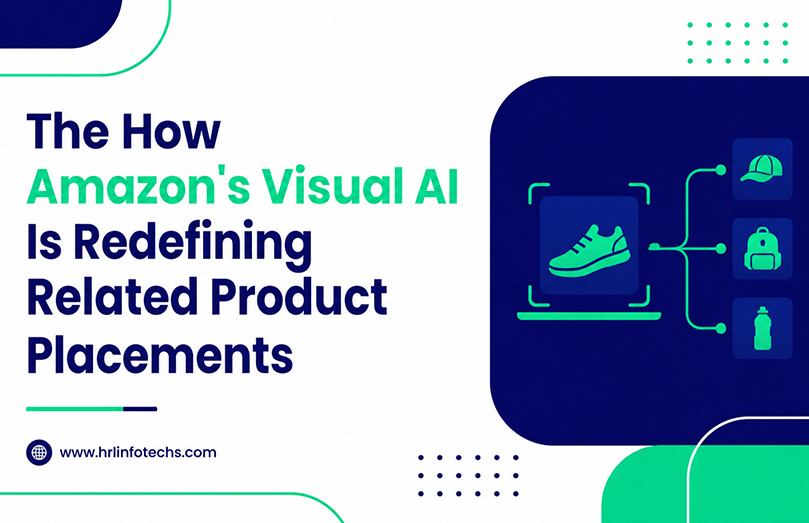

The Cosine Similarity Trap: How Amazon’s Visual AI Is Redefining Related Product Placements explains this


Most sellers building an Amazon product listing optimisation strategy spend months refining keywords, adjusting bids, and polishing copy, then wonder why visibility plateaus despite doing everything right. What they are missing sits in plain sight: the images themselves. Amazon visual AI now evaluates listings the same way shoppers do visually, instantly, and with increasingly sophisticated pattern recognition that determines which products get discovered and which disappear into a crowded cluster of near-identical competitors.

Breaking the Similarity Trap: Five Pillars of Visual Differentiation

The traditional marketplace reliance on text keywords alone is no longer enough to win the category. As search engines evolve into visual recognition ecosystems, brands that rely on look-alike designs face severe visibility caps. True market dominance requires breaking away from the category standard to give algorithmic indexing models a distinct signal. By aligning product aesthetics with visual discovery metrics, we turn baseline listings into high-converting, asset-driven flagships. 

1. Develop Distinctive Packaging

Many sellers unintentionally mirror category leaders. When packaging shares the same shades, shapes, or structural design as the top ten results, it does not signal quality to Amazon’s search algorithm; it signals similarity. And similarity means competition for the same cluster placement rather than discovery in new ones.

2. Invest in Original Lifestyle Photography

Amazon product image optimisation goes considerably further than clean white backgrounds and accurate product representation. The listings that perform best in visual AI indexing are the ones that show something other listings in the category consistently do not.

3. Create Branded Infographics

Infographics have grown well beyond simple conversion tools. They now play a measurable role in how Amazon’s visual recognition systems categorise and cluster products within Amazon marketplace optimisation environments.

This matters for Amazon SEO services performance because visual differentiation feeds click-through rate, which feeds conversion data, which feeds organic ranking signals. Branded infographics are not a cosmetic decision. They are an algorithmic one.

4. Highlight Product Differentiators Visually

Shoppers and Amazon visual AI both rely on what is immediately visible to understand how one product differs from another. Features that are buried in bullet points and never communicated through imagery are effectively invisible to both audiences.

The listings that earn strong positions in discovery and Amazon marketing services for sellers placement programmes are the ones where visual communication does the heavy lifting. Unique features shown clearly in primary and secondary images. Differentiating specifications visualised rather than described.

5. Build a Consistent Visual Identity

Every product in a catalogue tells part of the same story, or it should. From Amazon storefront design services to individual listing images, from Amazon PPC services creative to sponsored brand headers, visual consistency creates the kind of brand recognition that compounds over time.

This consistency directly supports long-term Amazon conversion rate optimisation. Shoppers who recognise a brand convert at higher rates than those encountering it cold. 

A Real-World Look at Visual Similarity on Amazon

Picture three supplement brands selling nearly identical products.

Each listing features:

  • White bottles
  • Green labels
  • Similar typography
  • Matching infographic layouts
  • Comparable lifestyle images

A twist comes with one more name on the shelf. Bright colours catch the eye first. Instead of blending in, it stands apart through images that show real-life moments. Picture after picture tells a quiet tale. Recognition grows without effort because shapes and shades stick in memory. Even though what’s inside works just like the others, how it looks changes everything.

This is what the cosine similarity trap costs in measurable terms. And this is why Amazon SEO services built exclusively around keywords cannot deliver sustainable discovery in categories where visual clustering determines who gets found.

How Amazon Visual AI Influences Customer Purchase Decisions

Most sellers view product images primarily as conversion assets; that is how buyers react. Most sellers think of photos only as tools to close sales, yet their role runs deeper. A shopper decides in seconds, long before checking titles, scanning details, or weighing prices. Eyes land on visuals instantly, shaping choices without words. Because Amazon sees this pattern clearly, it adjusts algorithms steadily, giving space to listings where pictures spark quicker attention. Later on, when shopping online feels different, Amazon’s smart image tools start shaping how things get seen. Instead of people alone deciding what stands out, computers study colours, shapes, and layouts to spot patterns in taste and use. One brand might rise because its photos feel unique – sharp details, clear scenes, or bold framing pull eyes without shouting.

Why Brand Differentiation Is Becoming an Amazon Ranking Advantage

Crowded marketplaces often pack together items that look too much alike – same prices, same functions, same everything. What shifts attention? A product that simply looks different. When everyone speaks the same language online, eyes go to what breaks the pattern. Instead of just tweaking words or chasing clicks, smart sellers shape how things appear. Standing apart visually can matter more than ranking higher. Familiarity fades fast when every listing mirrors the next. Difference sticks. Most people spot a product faster when it looks familiar. Colours stay the same, packages feel alike, pictures match – these things build recognition slowly. Trust grows without saying much, just by showing up consistently.

Why Amazon Visual AI Matters More in 2026 and Beyond

Amazon continues to invest heavily in machine learning, computer vision, and recommendation technologies. As these systems grow more sophisticated, visual signals will carry even greater weight in Amazon product visibility and discovery.

Sellers who adapt their Amazon marketplace optimisation approach to include visual differentiation as a core strategic input, not a design afterthought, will be better positioned as the Amazon search algorithm continues evolving toward richer, more visual forms of product understanding.

Conclusion

As Amazon product listing optimisation becomes increasingly shaped by visual recognition and machine learning, sellers must think beyond traditional text-first tactics. Keywords, pricing, and reviews still matter. But visual differentiation now determines how products are discovered through Amazon AI-powered recommendations, remembered by shoppers, and rewarded by the platform’s recommendation systems.

The cosine similarity trap highlights the real cost of blending in. Brands that invest in distinctive packaging, original lifestyle photography, branded infographics, and consistent visual identity across their catalogue create the algorithmic signals that drive sustainable discovery while building the shopper recognition that drives sustainable conversion.

At HRL, we help Amazon sellers build the visual and strategic differentiation that Amazon’s evolving systems reward, combining Amazon product image optimisation, catalogue positioning, and data-driven marketplace expertise to improve visibility, engagement, and long-term growth. The sellers who treat visual identity as a core part of their growth strategy, not an afterthought, are the ones who will compete effectively as Amazon’s AI continues to see more clearly than ever before.