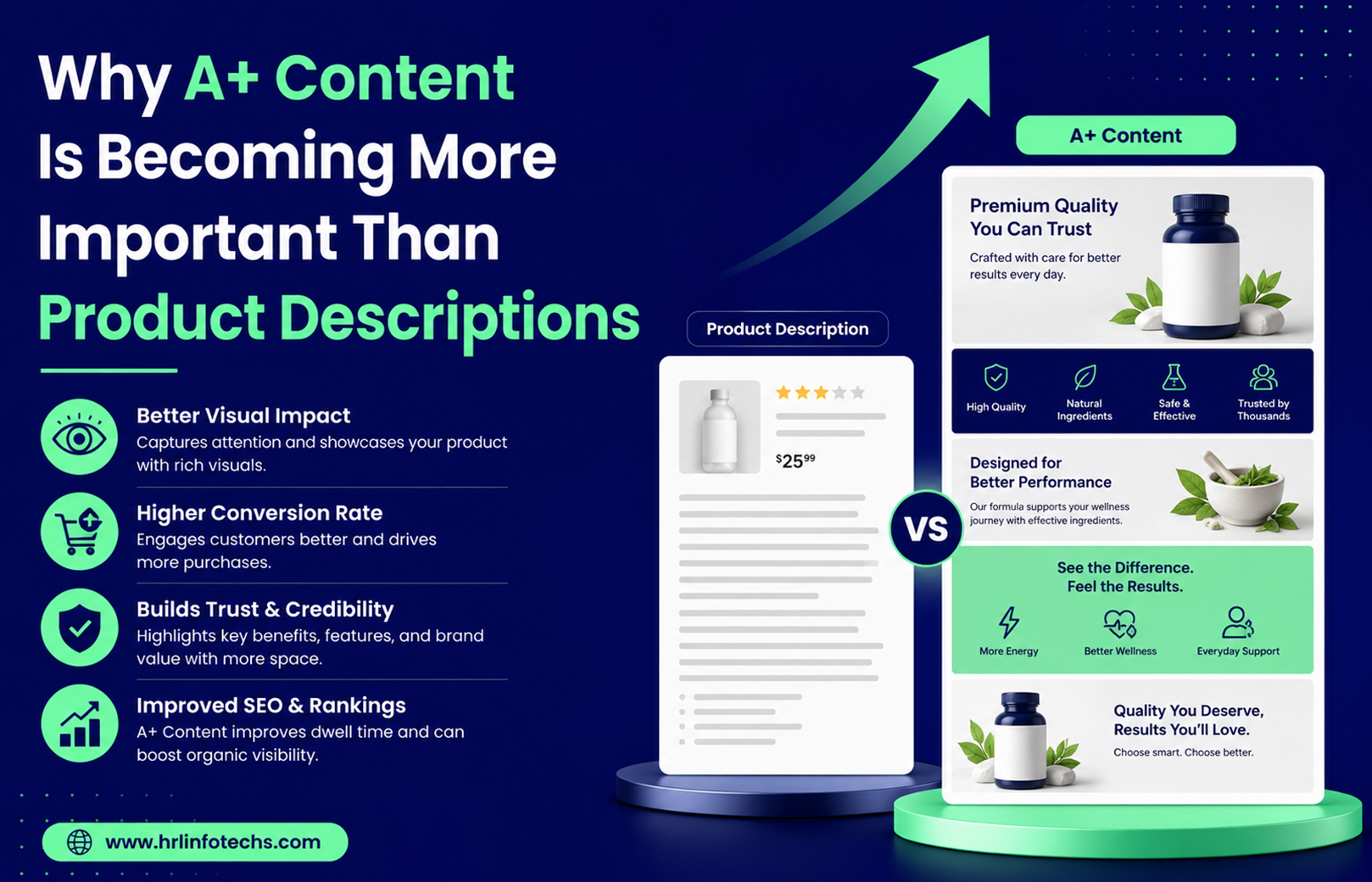
An e-commerce brand selling on Amazon India noticed something unusual in its conversion data in late 2024. Two products with nearly identical manufacturing costs, similar pricing, and comparable review counts were converting at dramatically different rates. One converted at 6.8%. The other sat at a mere 2.1%.
The difference was not the product. It was the listing. The higher-converting product had Amazon A+ Content Design lifestyle imagery showing the product in use, a comparison module explaining why the formula worked differently from alternatives, a brand story section establishing the founders’ credibility, and a clear benefit breakdown structured for scanning rather than reading.
The lower-converting product had a 200-word description listing ingredients and a standard five-bullet feature rundown.
Same product category. Same price point. Same platform. Three times the conversion rate. The gap between them was entirely in how the product was communicated to a buyer who had already decided to consider it.
The Changing Behaviour of Amazon Shoppers
Amazon customers in 2026 do not read listings. They evaluate them.
The average time spent on a product page before a purchase decision is made has dropped consistently year on year as mobile shopping has become the dominant format. A buyer arrives at a listing having already seen thumbnail images in search results. They have already formed a visual first impression. What the listing needs to do is confirm that impression and resolve any remaining hesitation in seconds, not paragraphs.
Amazon A+ Content exists precisely because text alone cannot do this job efficiently. A 200-word description requires a buyer to read and construct a mental model of the product. A well-designed A+ module communicates the same information visually in five seconds. For a buyer comparing three similar products simultaneously, that difference in cognitive load is the difference between staying on the page and clicking back.
Why Product Descriptions Alone Are No Longer Enough
Amazon product descriptions were built for a search environment where buyers arrived with a specific product in mind and needed detailed specification information to confirm their choice. That buying journey still exists, but it is no longer the dominant one.
Most Amazon purchases today begin with a category search, produce a results page with twenty similar options, and require a buyer to differentiate between products that appear nearly identical at thumbnail scale. The buyer who arrives on your listing is not certain they want your product. They are deciding whether your product deserves the thirty seconds of evaluation they are about to give it.
A text description that leads with dimensions and materials loses that decision. A+ Content that leads with the specific problem the product solves, visually, wins it.
Building Stronger Brand Experiences
Amazon brand content is not a design preference. It is a trust mechanism.
Indian buyers on Amazon have become significantly more sophisticated about evaluating brand credibility before purchasing. A listing that looks professionally designed signals a brand that takes its products seriously. A listing that relies on a plain text description against a white background signals the opposite, regardless of the actual product quality behind it.
The brand story, the founder’s credibility, the manufacturing process, and the quality commitment none of these things can be communicated effectively in a bullet point. A+ Content modules give brands the space to communicate who they are and why that matters to the buyer evaluating them, which is the conversion decision that price and specification comparisons alone never resolve.
Improving Amazon Customer Experience
Amazon customer experience on the listing page is determined by how quickly and confidently a buyer can answer three questions: does this product do what I need, is it better than the alternatives, and can I trust the brand selling it?
Standard listings answer the first question adequately through titles and bullets. They rarely answer the second or third effectively. A+ Content addresses all three simultaneously, benefiting communication through lifestyle imagery, competitive differentiation through comparison modules, and trust building through brand story and quality signals.
The e-commerce brand’s higher-converting listing answered all three questions before the buyer reached the reviews section. The lower-converting listing answered only the first and left the buyer to resolve the remaining uncertainty through competitor comparisons, which they often did.
How A+ Content Supports Conversion Rates
Amazon conversion optimisation through A+ Content works through a specific mechanism that is worth understanding clearly.
Conversion rate depends on visitors who buy versus those who leave due to hesitation, product uncertainty, or lack of trust. A+ Content directly addresses these friction points, using impactful visual communication to resolve consumer hesitation faster than text alone.
That extra detail on Amazon pages? It often leads to more buys – between 3% and 10%, based on what’s being sold and how well it’s shown. If a product gets a thousand views each month, just a 5% bump could turn into fifty new sales without spending another dollar on ads.
Enhanced Brand Content and Brand Building
Enhanced Brand Content, the term Amazon used before rebranding to A+ Content, was built around a simple insight: customers buy from brands they recognise and trust more readily than from brands they are encountering for the first time.
A+ modules sharing brand values, standards, or founder stories reduce the psychological distance to purchase, creating a compounding trust loop. Shoppers who connect with a strong A+ presence remember the brand, leading to repeat purchases and higher catalogue exploration. This is why pairing Amazon brand Storefront investment with A+ Content drives conversion improvements across your entire product ecosystem, not just individual listings.
The Role of Amazon Listing Optimisation
Amazon listing optimization is not a single lever. It is a system where each element supports the others.
Keyword-optimised titles and bullets drive traffic by improving search visibility. High-quality primary images drive click-through by winning the thumbnail evaluation. A+ Content drives conversion by resolving purchase hesitation once a buyer arrives. Amazon sales optimisation requires all three layers working together; traffic without conversion infrastructure wastes advertising spend, and conversion infrastructure without traffic visibility produces nothing.
One wrong move here kills visibility. Skip strong keywords, get lost in search. Rely only on fancy visuals, and watch clicks vanish without sales. Winning pages on Amazon India nail both. They guide shoppers step by step. Every phase gets what it needs.
Why A+ Content Works Harder When Your Entire Account Is Managed Strategically
Amazon Marketing Services amplifies A+ Content by converting ad traffic more efficiently. Driving a Sponsored Products campaign to an optimised listing yields measurably higher conversions than targeting a text-only page. Brands building this conversion infrastructure first make every rupee of paid spend highly productive, while those who advertise before optimising simply pay for traffic they cannot convert.
The fastest-growing brands on Amazon India don’t just optimise single listings; they treat every element as an interconnected system. Even elite A+ Content loses its conversion edge if stock runs out or ads target the wrong buyers. This is why Amazon Account Management makes the structural difference: it ensures your content, advertising campaigns, inventory logistics, and performance metrics work in perfect sync.
Why Indian Brands Should Prioritise A+ Content Now
Indian ecommerce is at an inflexion point. Category competition on Amazon India has intensified significantly since 2022 as both domestic brands and international sellers have professionalised their marketplace presence.
The listing quality gap that once existed between premium international brands and domestic Indian sellers has largely closed at the product and pricing level. What has not closed equally quickly is the A+ Content gap. A significant proportion of Indian sellers are still relying on text-first listings in categories where buyers are making visual-first decisions.
Amazon brand content investment now, before category competitors close the gap, builds a conversion rate advantage that is expensive to replicate quickly. A brand whose listing converts at 7% while competitors convert at 3% can sustain a lower advertising bid and still achieve the same sales velocity, which is the margin and growth advantage that compounds most powerfully over time.
Conclusion
The e-commerce brand that discovered the conversion gap between its two listings fixed it in six weeks. The lower-converting product received full Amazon A+ Content Design lifestyle modules, comparison charts, brand story section, and benefit-led visual hierarchy. Its conversion rate moved from 2.1% to 6.4% within thirty days of the update going live. No price change. No advertising increase. No review campaign.
At HRL Infotechs, we help Indian brands build the A+ Content, listing optimisation, and Amazon customer experience infrastructure that turns qualified traffic into consistent sales. The brands growing most efficiently on Amazon right now are not the ones spending the most on advertising. They are the ones converting most effectively once buyers arrive.