Amazon Product Launch Strategy: How to Build Organic Ranking Before Scaling PPC


A new Amazon product goes live. The listing looks polished, the inventory is ready, and the seller is eager to start advertising. Within a few days, the PPC dashboard shows clicks, but organic visibility is barely moving. The seller responds by increasing bids. That usually creates a more expensive problem, not a better launch.

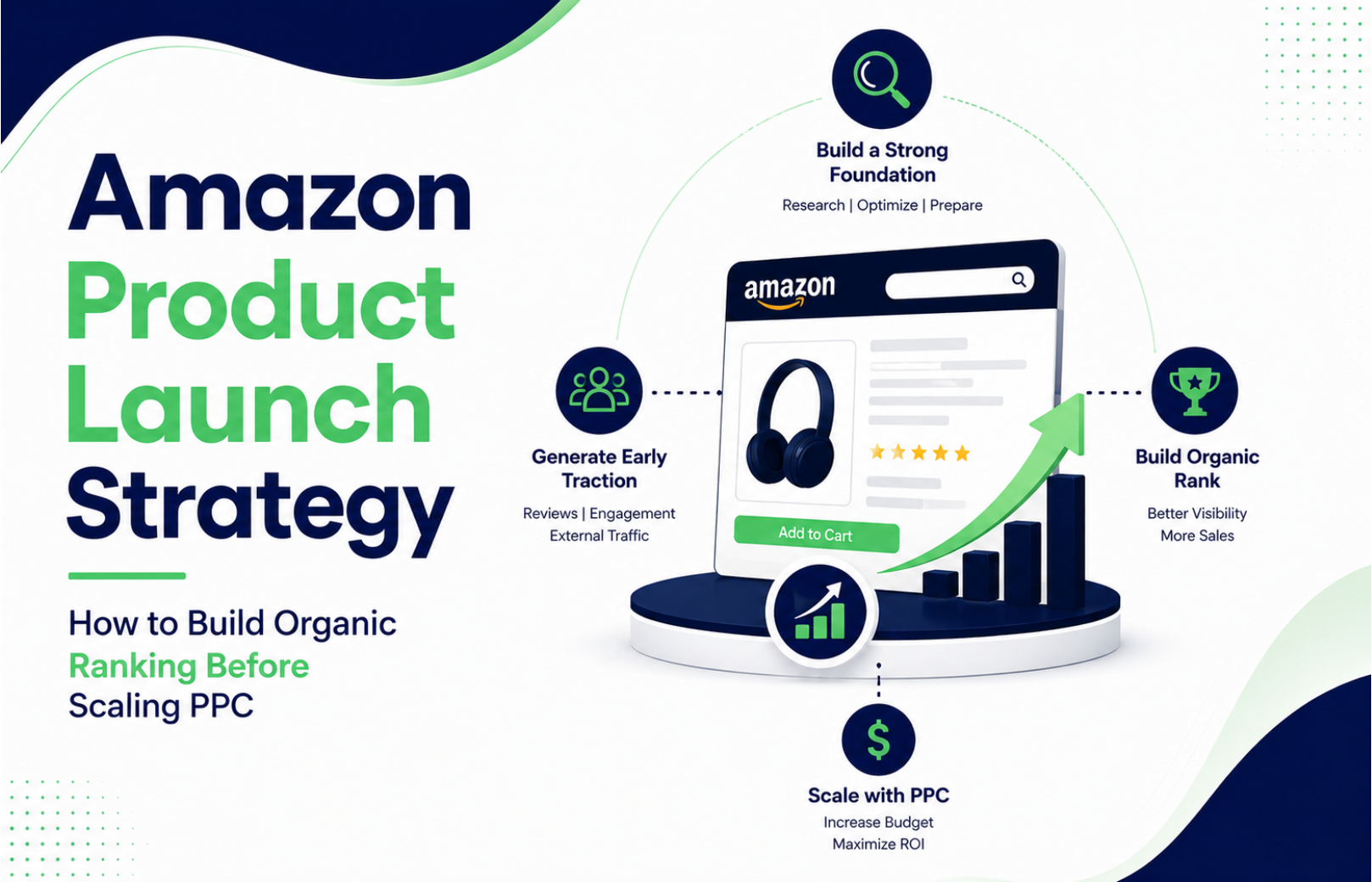
A stronger Amazon product launch strategy starts before serious ad scaling. First, make the product detail page relevant to the searches you want to win, make the offer competitive enough to convert, and establish a clean keyword and measurement baseline. Then use PPC to accelerate discovery, collect useful search-term data, and build sales momentum. The goal isn’t to avoid Amazon PPC. It’s to make every paid click work harder while your organic ranking develops.

What Should You Do Before Launching Amazon PPC?

Before increasing Amazon PPC spend, make sure the product listing can convert the traffic you’re about to buy. Your title, images, bullet points, product description, pricing, inventory, relevant search terms, and overall offer should be ready before you attempt to scale advertising.

Amazon itself recommends auditing product detail pages before launching Sponsored Products and using relevant search terms that reflect how shoppers search for the product.

For a new product, your first priority should be relevance and conversion readiness, not ranking for every possible keyword.

Build the Amazon Listing Around Buyer Search Intent

Amazon product listing optimization means structuring the product detail page so shoppers can discover the product and understand why it fits their needs. Amazon describes the product detail page as the place where customers see product information such as the name, images, description, and offer details.

Start with three keyword groups:

  • Primary category keywords
  • High-intent long-tail keywords
  • Product-specific attributes and use cases

Don’t stuff every keyword into the title. A title that reads unnaturally can reduce shopper confidence even if it contains more search terms.

This is where a proper Amazon SEO launch differs from simply uploading a listing. Your keyword research should determine the search language, while the listing should turn that language into useful product information.

For brands that need this foundation built systematically, HRL Infotechs’ Amazon SEO and Listing Optimization Services cover keyword research, title optimization, bullet points, backend search terms, visual optimization, and ongoing performance analysis.

How Do You Build Organic Ranking Before Scaling PPC?

Build organic ranking by combining strong listing relevance with genuine sales and conversion activity, then use PPC selectively to accelerate visibility for the most commercially important searches. Organic ranking should be treated as an outcome of relevance, shopper response, and sustained performance rather than something that can be guaranteed through advertising alone.

This is one of the most important judgement calls in a new Amazon launch: don’t try to rank for your broadest keyword first.

If your new product is a premium stainless-steel lunch box, for example, competing immediately for an extremely broad term such as “lunch box” may consume substantial budget while attracting shoppers with very different requirements.

A more sensible launch sequence might start with specific searches such as:

  • stainless steel lunch box for office
  • leakproof lunch box for adults
  • insulated stainless steel lunch container
  • lunch box for working professionals

Once you identify which terms generate qualified clicks and conversions, you can gradually expand your targeting.

HRL Infotechs has previously covered this principle in its guide to Amazon keyword research and ranking strategy, which explains why keyword selection should be based on buyer intent rather than search volume alone.

When Should You Start Amazon PPC for a New Product?

You should start Amazon PPC once the product is buyable, the detail page is properly optimized, inventory is available, and the offer is capable of converting. The mistake is not starting PPC early. The mistake is scaling PPC aggressively before you know whether the listing can convert paid traffic.

Amazon Sponsored Products are CPC ads that promote individual product listings and can target keywords or products. Amazon states that advertisers control bids and budgets and can use campaign reporting to optimize performance.

That makes PPC useful during a launch, but your first campaigns should be treated as controlled discovery.

Start with:

  1. High-intent exact keywords
  2. Relevant phrase and discovery targeting
  3. Carefully selected product targets
  4. Brand terms where appropriate
  5. Controlled budgets
  6. Search-term analysis

Don’t interpret the first few days of impressions as proof that a campaign is working. Look for qualified traffic, clicks, conversions, search-term relevance, and movement in the product’s organic visibility.

How Should You Structure Amazon PPC During a Product Launch?

A new-product Amazon PPC launch should separate discovery from proven demand. Keep high-intent keywords, exploratory targeting, and product targeting sufficiently organized that you can identify what is actually producing useful traffic and sales.

Sponsored Products can use keyword or product targeting, and Amazon recommends monitoring campaign performance and adjusting budgets and keywords as campaigns develop.

A practical launch structure can include:

Exact campaign: Your strongest high-intent keywords.

Phrase campaign: Closely related variations and search discovery.

Auto campaign: Controlled discovery of search terms you may not have identified manually.

Product targeting: Relevant competitor or complementary product detail pages.

The important part isn’t creating the maximum number of campaigns. It’s maintaining enough separation to make decisions.

We’ve seen sellers create dozens of campaigns for a single new ASIN, then struggle to understand where the money is going. A smaller, cleaner structure often gives you better visibility into what deserves more budget.

Which Metrics Should You Track During the First 30 Days?

During the first 30 days, track impressions, clicks, CTR, conversion rate, advertising cost of sales, sales, search-term performance, and organic keyword movement. No single metric should determine whether you scale or reduce spend.

A useful launch review asks four questions:

  1. Are relevant shoppers seeing the product?
  2. Are they clicking?
  3. Are they converting after clicking?
  4. Are important keywords showing organic movement?

Amazon’s advertising system provides campaign reporting that lets advertisers evaluate performance and adjust targeting, bids, and budgets.

Don’t chase ACoS in isolation. A new product can have a higher initial ACoS while you’re gathering data and establishing demand. On the other hand, a campaign with excellent ACoS but almost no sales volume may not be contributing meaningfully to growth.

The better metric depends on your launch objective.

Should You Increase PPC Budget When Organic Ranking Improves?

Increase PPC when the data shows that additional spend can generate profitable or strategically valuable sales without overwhelming your margins. Improving organic ranking is a positive signal, but it isn’t automatically a reason to double the advertising budget.

This is where Amazon launch strategy becomes different from a simple PPC strategy.

Suppose your product begins ranking organically for several long-tail terms after four weeks. You may decide to maintain paid coverage on those valuable terms while redirecting incremental budget toward terms where organic visibility is still weak.

Amazon’s current new-product advertising guidance specifically recommends using advertising to promote new products and adjusting budgets and keywords as the product moves through its lifecycle.

The objective is to make paid and organic visibility reinforce each other, not to make PPC permanently responsible for every sale.

How Does Amazon Account Management Affect a New Product Launch?

Amazon account management keeps the operational side of a launch from undermining the marketing strategy. Inventory, account health, listing issues, pricing, catalog changes, advertising performance, and ongoing marketplace tasks all need attention while the product is gaining traction.

A ranking strategy cannot compensate for operational problems. If your product goes out of stock, the listing develops a compliance issue, or important catalog information is incorrect, your advertising plan can quickly become irrelevant.

This is why Amazon account management becomes particularly useful when you’re launching multiple ASINs or managing Amazon alongside other marketplaces. HRL Infotechs provides Amazon Account Management Services that cover ongoing marketplace operations and performance monitoring as part of its broader ecommerce management approach.

What Should You Do in the First 30 Days of an Amazon Product Launch?

Use the first 30 days to establish relevance, gather search data, identify conversion problems, and progressively shift budget toward proven opportunities. Don’t treat the launch as one fixed campaign that runs unchanged for a month.

A practical sequence is:

Days 1–7:
Check listing indexing, impressions, CTR, search-term relevance, price competitiveness, inventory, and initial conversion signals.

Days 8–14:
Review search-term data, identify irrelevant traffic, add negative targeting where appropriate, and refine bids.

Days 15–21:
Separate proven converting terms from discovery terms and evaluate organic keyword movement.

Days 22–30:
Increase investment in proven opportunities, reduce inefficient targeting, and identify the next set of keywords worth testing.

HRL Infotechs has also examined why Amazon PPC campaigns waste budget during the first 30 days, including problems such as weak campaign structures, broad targeting, and poorly controlled bids.

When Should You Scale Amazon Advertising?

Scale Amazon advertising after you have evidence that the listing, offer, targeting, and conversion process can support additional traffic. Scaling should follow validated performance, not simply the passage of time.

Amazon provides several advertising options beyond Sponsored Products, including Sponsored Brands and other formats. Its new-product advertising guidance recommends combining targeting approaches and using different campaign types according to launch objectives.

For most sellers, however, the first scaling decision shouldn’t be “Which new ad format should I launch?”

It should be:

Which search terms, products, audiences, and placements have already demonstrated commercial value?

Then increase investment there.

If managing bids, search terms, campaign structures, listing optimization, and performance reporting is taking more time than your team can realistically give it, Amazon Advertising Services from HRL Infotechs can fit naturally into the next stage of the workflow.

What Is the Right Amazon Product Launch Strategy?

The right Amazon product launch strategy is a staged process: optimize the listing, establish keyword relevance, make the offer conversion-ready, launch controlled PPC, analyze search-term and conversion data, improve the listing, and only then scale the campaigns that demonstrate value.

You don’t need to choose between Amazon SEO and Amazon PPC. You need to sequence them correctly.

PPC can create the initial traffic and provide valuable performance data. SEO and listing optimization create the foundation for sustainable organic discovery. Account management keeps operational issues from disrupting the process.

For a new product, that combination is usually more sensible than simply increasing the daily ad budget and hoping Amazon ranking follows.

If you’re preparing a new ASIN and aren’t sure whether your listing, keyword strategy, or PPC structure is ready for launch, HRL Infotechs can review the gaps and help you build the launch sequence before you commit more advertising budget.

Frequently Asked Questions

How long does it take for a new Amazon product to rank organically?

There is no fixed Amazon ranking timeline for a new product. Initial indexing and ranking movement can happen relatively quickly, but meaningful organic visibility depends on relevance, competition, conversion performance, sales activity, and other marketplace factors. Treat the first several weeks as a measurement period rather than expecting a guaranteed ranking date.

Should I run Amazon PPC immediately after launching a new product?

You can start PPC after the product is buyable and the listing is properly prepared. Starting advertising early can help generate visibility and collect useful search-term data. However, aggressive scaling before validating the listing’s conversion performance can waste budget. Start with controlled targeting, measure the results, and scale based on evidence.

Can Amazon PPC improve organic ranking?

PPC and organic ranking are separate mechanisms, so advertising should not be treated as a guaranteed way to buy an organic position. PPC can generate product detail page traffic and sales, while successful customer interactions may contribute to the broader performance picture. The practical goal is to use PPC to support product discovery while building sustainable organic demand.

What keywords should I target for a new Amazon product launch?

Start with relevant, high-intent keywords that closely describe the product, its features, use case, and buyer need. Include specific long-tail terms before aggressively targeting broad, highly competitive keywords. Search-term performance from early campaigns can then help you identify which queries deserve greater attention in your Amazon SEO launch.

How much should I spend on Amazon PPC for a new product?

There is no universal launch budget because CPCs, category competition, margins, conversion rates, and sales targets differ significantly. Set a test budget that your business can afford to learn from, then evaluate spend against clicks, conversions, sales, ACoS, and organic movement. Increase budget only when the underlying economics support it.

Should I optimize my Amazon listing before starting PPC?

Yes. Listing optimization should happen before serious PPC scaling because your ads send shoppers to the product detail page. If the title, images, bullets, pricing, product information, or overall offer are weak, additional traffic may simply expose those problems faster. Amazon also recommends auditing product detail pages before launching Sponsored Products.
Why A+ Content Is Becoming More Important Than Product Descriptions


An e-commerce brand selling on Amazon India noticed something unusual in its conversion data in late 2024. Two products with nearly identical manufacturing costs, similar pricing, and comparable review counts were converting at dramatically different rates. One converted at 6.8%. The other sat at a mere 2.1%.

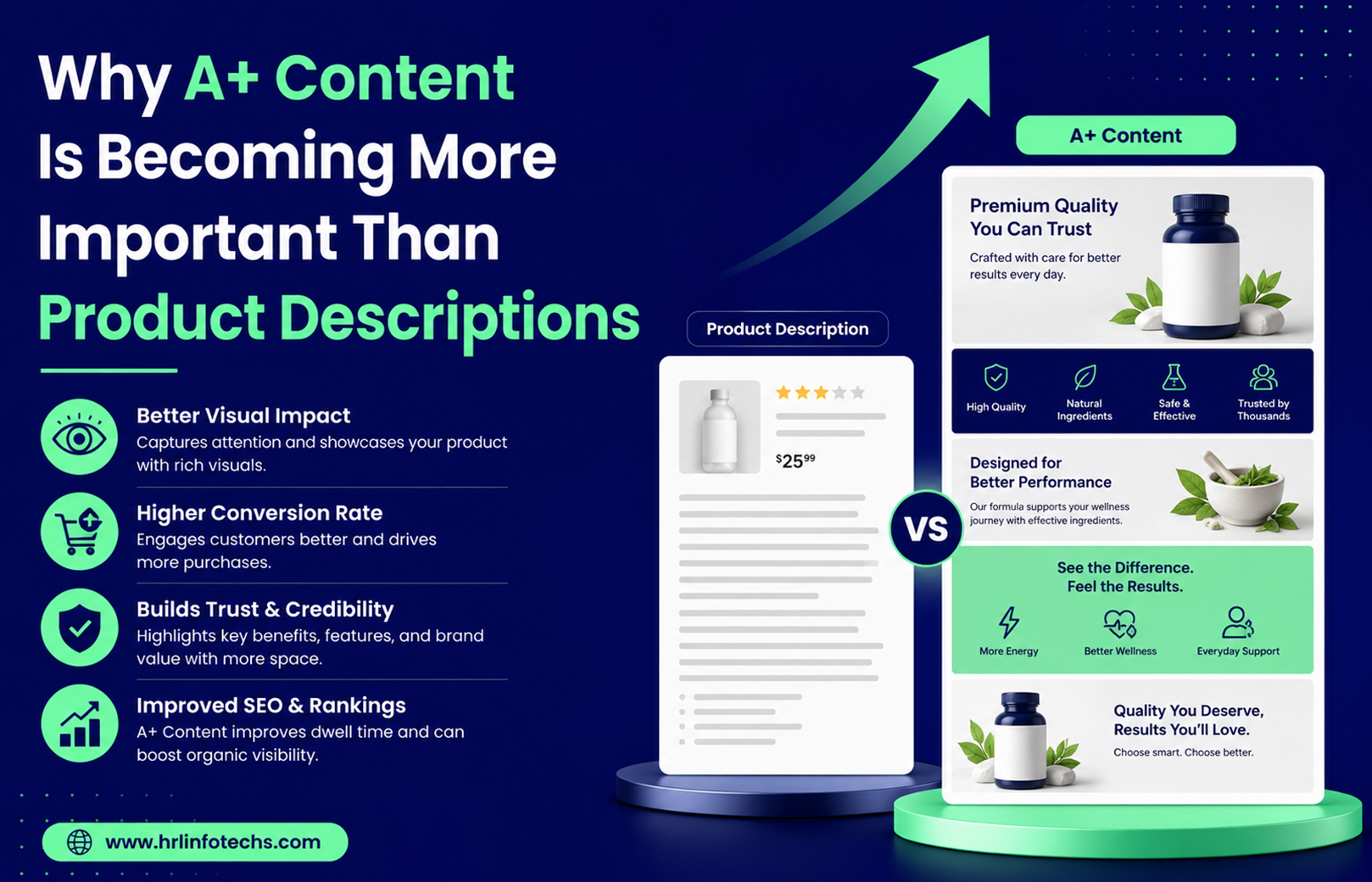
The difference was not the product. It was the listing. The higher-converting product had Amazon A+ Content Design lifestyle imagery showing the product in use, a comparison module explaining why the formula worked differently from alternatives, a brand story section establishing the founders’ credibility, and a clear benefit breakdown structured for scanning rather than reading.

The lower-converting product had a 200-word description listing ingredients and a standard five-bullet feature rundown.

Same product category. Same price point. Same platform. Three times the conversion rate. The gap between them was entirely in how the product was communicated to a buyer who had already decided to consider it.

The Changing Behaviour of Amazon Shoppers

Amazon customers in 2026 do not read listings. They evaluate them.

The average time spent on a product page before a purchase decision is made has dropped consistently year on year as mobile shopping has become the dominant format. A buyer arrives at a listing having already seen thumbnail images in search results. They have already formed a visual first impression. What the listing needs to do is confirm that impression and resolve any remaining hesitation in seconds, not paragraphs.

Amazon A+ Content exists precisely because text alone cannot do this job efficiently. A 200-word description requires a buyer to read and construct a mental model of the product. A well-designed A+ module communicates the same information visually in five seconds. For a buyer comparing three similar products simultaneously, that difference in cognitive load is the difference between staying on the page and clicking back.

Why Product Descriptions Alone Are No Longer Enough

Amazon product descriptions were built for a search environment where buyers arrived with a specific product in mind and needed detailed specification information to confirm their choice. That buying journey still exists, but it is no longer the dominant one.

Most Amazon purchases today begin with a category search, produce a results page with twenty similar options, and require a buyer to differentiate between products that appear nearly identical at thumbnail scale. The buyer who arrives on your listing is not certain they want your product. They are deciding whether your product deserves the thirty seconds of evaluation they are about to give it.

A text description that leads with dimensions and materials loses that decision. A+ Content that leads with the specific problem the product solves, visually, wins it.

Building Stronger Brand Experiences

Amazon brand content is not a design preference. It is a trust mechanism.

Indian buyers on Amazon have become significantly more sophisticated about evaluating brand credibility before purchasing. A listing that looks professionally designed signals a brand that takes its products seriously. A listing that relies on a plain text description against a white background signals the opposite, regardless of the actual product quality behind it.

The brand story, the founder’s credibility, the manufacturing process, and the quality commitment none of these things can be communicated effectively in a bullet point. A+ Content modules give brands the space to communicate who they are and why that matters to the buyer evaluating them, which is the conversion decision that price and specification comparisons alone never resolve.

Improving Amazon Customer Experience

Amazon customer experience on the listing page is determined by how quickly and confidently a buyer can answer three questions: does this product do what I need, is it better than the alternatives, and can I trust the brand selling it?

Standard listings answer the first question adequately through titles and bullets. They rarely answer the second or third effectively. A+ Content addresses all three simultaneously, benefiting communication through lifestyle imagery, competitive differentiation through comparison modules, and trust building through brand story and quality signals.

The e-commerce brand’s higher-converting listing answered all three questions before the buyer reached the reviews section. The lower-converting listing answered only the first and left the buyer to resolve the remaining uncertainty through competitor comparisons, which they often did.

How A+ Content Supports Conversion Rates

Amazon conversion optimisation through A+ Content works through a specific mechanism that is worth understanding clearly.

Conversion rate depends on visitors who buy versus those who leave due to hesitation, product uncertainty, or lack of trust. A+ Content directly addresses these friction points, using impactful visual communication to resolve consumer hesitation faster than text alone.

That extra detail on Amazon pages? It often leads to more buys – between 3% and 10%, based on what’s being sold and how well it’s shown. If a product gets a thousand views each month, just a 5% bump could turn into fifty new sales without spending another dollar on ads.

Enhanced Brand Content and Brand Building

Enhanced Brand Content, the term Amazon used before rebranding to A+ Content, was built around a simple insight: customers buy from brands they recognise and trust more readily than from brands they are encountering for the first time.

A+ modules sharing brand values, standards, or founder stories reduce the psychological distance to purchase, creating a compounding trust loop. Shoppers who connect with a strong A+ presence remember the brand, leading to repeat purchases and higher catalogue exploration. This is why pairing Amazon brand Storefront investment with A+ Content drives conversion improvements across your entire product ecosystem, not just individual listings.

The Role of Amazon Listing Optimisation

Amazon listing optimization is not a single lever. It is a system where each element supports the others.

Keyword-optimised titles and bullets drive traffic by improving search visibility. High-quality primary images drive click-through by winning the thumbnail evaluation. A+ Content drives conversion by resolving purchase hesitation once a buyer arrives. Amazon sales optimisation requires all three layers working together; traffic without conversion infrastructure wastes advertising spend, and conversion infrastructure without traffic visibility produces nothing.

One wrong move here kills visibility. Skip strong keywords, get lost in search. Rely only on fancy visuals, and watch clicks vanish without sales. Winning pages on Amazon India nail both. They guide shoppers step by step. Every phase gets what it needs.

Why A+ Content Works Harder When Your Entire Account Is Managed Strategically

Amazon Marketing Services amplifies A+ Content by converting ad traffic more efficiently. Driving a Sponsored Products campaign to an optimised listing yields measurably higher conversions than targeting a text-only page. Brands building this conversion infrastructure first make every rupee of paid spend highly productive, while those who advertise before optimising simply pay for traffic they cannot convert.

The fastest-growing brands on Amazon India don’t just optimise single listings; they treat every element as an interconnected system. Even elite A+ Content loses its conversion edge if stock runs out or ads target the wrong buyers. This is why Amazon Account Management makes the structural difference: it ensures your content, advertising campaigns, inventory logistics, and performance metrics work in perfect sync.

Why Indian Brands Should Prioritise A+ Content Now

Indian ecommerce is at an inflexion point. Category competition on Amazon India has intensified significantly since 2022 as both domestic brands and international sellers have professionalised their marketplace presence.

The listing quality gap that once existed between premium international brands and domestic Indian sellers has largely closed at the product and pricing level. What has not closed equally quickly is the A+ Content gap. A significant proportion of Indian sellers are still relying on text-first listings in categories where buyers are making visual-first decisions.

Amazon brand content investment now, before category competitors close the gap, builds a conversion rate advantage that is expensive to replicate quickly. A brand whose listing converts at 7% while competitors convert at 3% can sustain a lower advertising bid and still achieve the same sales velocity, which is the margin and growth advantage that compounds most powerfully over time.

Conclusion

The e-commerce brand that discovered the conversion gap between its two listings fixed it in six weeks. The lower-converting product received full Amazon A+ Content Design lifestyle modules, comparison charts, brand story section, and benefit-led visual hierarchy. Its conversion rate moved from 2.1% to 6.4% within thirty days of the update going live. No price change. No advertising increase. No review campaign.

At HRL Infotechs, we help Indian brands build the A+ Content, listing optimisation, and Amazon customer experience infrastructure that turns qualified traffic into consistent sales. The brands growing most efficiently on Amazon right now are not the ones spending the most on advertising. They are the ones converting most effectively once buyers arrive.

Expert Amazon Account Management Services to Boost Your Sales


Selling on Amazon can be exciting and profitable, but sometimes it is not that simple. With so many sellers competing for the attention of shoppers, you are going to need more than just a great product to succeed.

You’ll need to have professional Amazon account management services that will differentiate you, bring customers to you, and get you consistent increases in sales.

Here, in this blog, we are going to talk about why professional account management is required, the best ways to boost sales, and how the right partner can handle everything, from product listings to customer support, so that you can focus on business growth.

Why Amazon Account Management Services Matter

Selling on an Amazon store is so much more than listing products and waiting for the orders to roll in. You have to optimised listings, good advertising, well-managed inventory, and happy customers. That’s where Amazon account management services come in.

It is all taken care of by a professional account management team that is responsible for all the day-to-day operations and strategic choices that impact your sales. You can focus on discovering good products and establishing your brand, while experts take care of the technical, creative, and operational tasks.

The Importance of Sales Growth Strategies on Amazon

To be successful at Amazon, you can’t do it through trial and error. You have to apply proven Amazon sales enhancers that are effective in conjunction with the marketplace algorithms and shopper behaviour. They are:

Product listings optimised, covering high-quality keywords and compelling copy.

Utilising Amazon advertising to send targeted traffic.

To research competitor performance to determine opportunities.

If used by professionals as one of your Amazon account management services, such tactics can drive your visibility and sales.

Amazon Product Listing Management to Get More Visibility

Your Amazon product listings are your virtual shop. If they aren’t optimised, then you’re losing potential customers. Best-in-class Amazon product listing management makes sure all your listings are optimised to receive clicks and convert visitors into customers.

That includes

  • Creating keyword-rich headings and bullets.
  • Adding high-quality images highlighting product specifications.
  • Utilising A+ content to share your brand story.

If your professional listing management is handled well, you are giving your products the most incredible opportunity to rank higher and sell more.

Grow revenue with proactive Amazon seller support services

Even the most optimised listings and promotions can still experience unexpected issues, including an unexpected policy violation, account suspension or unhappy customer.

That is where the Amazon seller support services are worth their weight in gold. A reputable Amazon seller support service knows how to handle every situation like the pros they are, fixing issues quickly, dealing with Amazon on your behalf and keeping your account healthy.

By acting quickly and being proactive, they save you from costly downtime, angry customers, and most importantly, maintain your sales momentum.

With ongoing optimisation, you can provide seamless operations and prevent disruptions that are counterproductive to your sales.

How Professional Amazon Account Management Services Work

When you engage a team of experts, the Amazon account management services generally operate in a straightforward, outlined approach designed to grow your business rapidly:

  • Account Audit & Strategy – First, they perform a detailed analysis of your Amazon account to ascertain what is working, what is not working, and what the most significant opportunities are.
  • Listing Optimisation – Then, they will optimise your product titles, descriptions, keywords, and images to increase conversions and search rankings.
  • Advertising Service Management – Your team will plan, create, and optimise your Amazon PPC campaigns, so you get the traffic you’re looking for – people who want to buy.
  • Performance Tracking – They will measure sales, inventory, and performance metrics to ensure that everything is working well for you.
  • Ongoing Services – When you have dedicated Amazon seller services, any issue that may arise – listing errors, policies, etc. can be resolved quickly and efficiently.

It is a complete, end-to-end system of services that always has one focus: increasing your sales on Amazon.

Major Advantages of Using Professional Account Management Services on Amazon

When you enlist help from professionals, it is not just a matter of convenience; it is about achieving results. Here is what you can expect.

  • Save Time: Let professionals worry about the minutiae, so you can concentrate on sourcing products or scaling your brand!
  • Grow Faster: With well-regarded sales boosting strategies for Amazon, your business and brand can scale faster than you ever thought possible.
  • Less Risk: Seasoned managers know how to steer clear of expensive mistakes that are all too common, whether it’s a policy violation, poorly optimized ad, or overlooked keyword.

When your Amazon store is professionally managed, you can keep an eye on the bigger picture of a sustainable brand.

Better ROI: Better listings and advertisements lead to more sales and better profit margins.

Real-Life Application: Maximising Amazon Sales Strategies in Practice

Assume that you have a great product, but your sales aren’t increasing. A good management team can implement sales-driving strategies for Amazon, such as:

  • Keyword optimisation to enhance search results ranking. 
  • Better product images to induce click-throughs.
  • Targeted advertising efforts to attract your ideal customers.

The result? More traffic, more conversions, and more sales – and you have accomplished this through expert Amazon account management services.

The Importance of Continuous Optimisation

Amazon is continuously evolving, as is the behaviour of customers on the site. For this reason, Amazon account management needs ongoing optimisation.

This is why Amazon account management services focus on ongoing optimisation. Ongoing changes to keywords, tests of new images, and optimisations of advertising campaigns ensure your store is competitive.

By having ongoing Amazon product listing management services, you can quickly react to changes in the market and create sustainability for long-term growth.

Choosing the Right Partner

Not all Amazon service providers are equal. As you evaluate potential companies to partner with, consider the following:

An established history of working with vendors in your category.

Offer transparent reporting so that you can manage and track performance.

Full-service solutions such as listings, advertising, support, and strategy.

A suitable partner will be an extension of your team, dedicated to helping you grow sales and build your brand.

Final Thoughts

Amazon’s success is not about marketing an incredible product but having the right systems, strategies, and support. Expert Amazon account management services combine everything you need: optimised listings, successful ad campaigns, problem-solving know-how, and future-focused strategy to have your sales continue to soar.

With the proper Amazon sales promotion methods, focused Amazon product listing management, and engaging Amazon seller support services, you can turn your Amazon store into a thriving, booming business. If you’re ready to take your store to the next level, now is the time to put the right strategies in place and start achieving the sales growth you’ve always dreamed of!

Top 7 Amazon Account Management Services You Can Avail in 2022


The success of your business on Amazon depends on how efficiently you manage your Amazon seller account. And though Amazon account management services  may seem quite easy, selling through comprehensive management while adhering to the guidelines is a highly daunting task. You can delegate this task to an account manager.

If you are a registered Amazon Seller, these 7 account management services can help you stand out of the crowd. Keep reading this blog to know about the top 7 services you can avail of in 2022. 

Top 7 Amazon Account Management Services

1. Amazon Seller account

One of the first things an agency will discuss with you is setting up your Amazon Seller account. The thing might seem overwhelming, especially if you are new to the Amazon marketplace. But building a great business needs you to figure out your business model and products with your account manager.

Research helps them sort out what products or strategies your business needs to stand out in the Amazon marketplace. 

Creating your Amazon Seller Account

Opening an Amazon Account is similar to other registration processes. One just needs to type in the details and necessary info about the business. You will have to create identification documents for the background checks.

With your Amazon Seller Account, you can choose to go as a professional or even as an individual account. A professional account helps if you are selling a large volume of products every day.

Amazon Account Management

2.Amazon Listing Optimization

As an Amazon Seller, it’s crucial that your business consider optimizing its Amazon listings. Ticking off this service from your list means your customer doesn’t find your product listings and moves on to your competitors making their purchase. 

Optimizing listings help your product rank higher in Amazon’s search results and thus add to your sales number. Several factors count for making your product listing successful with optimization, like keywords, quality photos, optimized titles and descriptions, and more.

Here’re the aspects your account manager will use to help you succeed on Amazon:

  • Optimize your product title and description on Amazon
  • Use visually appealing images on your product’s detail page
  • Optimize the bullet points
  • Leverage A+ content
  • Optimize Amazon backend keywords for better reach

3.Enhanced Brand Content

If you want your products to grab the attention of consumers, Enhanced Brand Content (or EBC) is there to help you out. Amazon EBC is open to all sellers who are registered through the Amazon Brand Registry process. So there’s no reason your account manager wouldn’t leverage this function.

Benefits of Amazon EBC

  • Your product stands out among the competition.
  • Buyers’ eyes get attracted to your listings.
  • Reduced bounce rates on your products.
  • Your product’s info is accurately conveyed to customers.
  • Seamless user experience on all devices for users.

4.Product Listing Management

Competition on Amazon is becoming tougher and tougher. So, going on the platform without a proper listing management strategy will only end you up in a situation where you’ll find it difficult to drive sales. It is better to delegate product listing management if: 

  • You don’t have enough time to check your Amazon business.
  • Have numerous product listings making it difficult to monitor all.
  • You are not well-versed in Amazon product management.
  • And not keen on taking risks while experimenting.

Hiring an account manager is your best option. Your product listing manager will offer you the following services:

  • Add listings to the right category
  • SKU (Stock-keeping Unit) for every inventory item
  • Product listing optimization
  • Content management for listings
amazon store management

5. Brand Registry

Amazon Brand Registry was initially launched as a program to help sellers protect their brands from false brands. But over time, it has evolved into a whole suite of services.

The foremost advantage of your account manager offering Brand registry as a service is that you get direct influence on detail pages. Furthermore, your business gets access to top tools like Amazon EBC, Sponsored Brands Ads, Amazon Attribution tool, Amazon Live Creator, etc., which will help you stand out on the platform.

Benefits of Amazon Brand Registry

  • Greater control over product detail pages.
  • Listing with multiple product identifications (outside EAN & UPC codes.
  • Ability to offer advanced seller support.
  • Access to ML-based predictive automation.

6.Amazon Advertising PPC

Amazon advertising PPC is another great service you can opt for. Since customer shopping preferences are increasingly shifting online, sellers have a greater competition to capture sales. Though organic rankings are important for your business, advertising on the platform can help you reach more customers. 

An effective Amazon advertising PPC strategy helps all sizes of businesses. Without one, your listings may be lost in about 350 million products on Amazon. 

amazon account management

7. Preparation and Logistics

Amazon logistics is a delivery & shipping service that complements other services offered in Amazon Full Account Management.

The assigned manager for your Amazon Store Management will assist you in preparing for the things once you get sales. They will ensure your packaging abides by the guidelines, whether local or international. You will also be provided with a computation on tax & duty rates to allow smooth transactions of your shipment.

Conclusion

To summarize, you can avail yourself of countless Amazon account management services to boost your sales. You can also look out for the Amazon account manager to see the services we have discussed here. Remember, an account manager will handle all your work, so choose an experienced person for the job. We at HRL Infotech have an efficient team who can help you with your account.