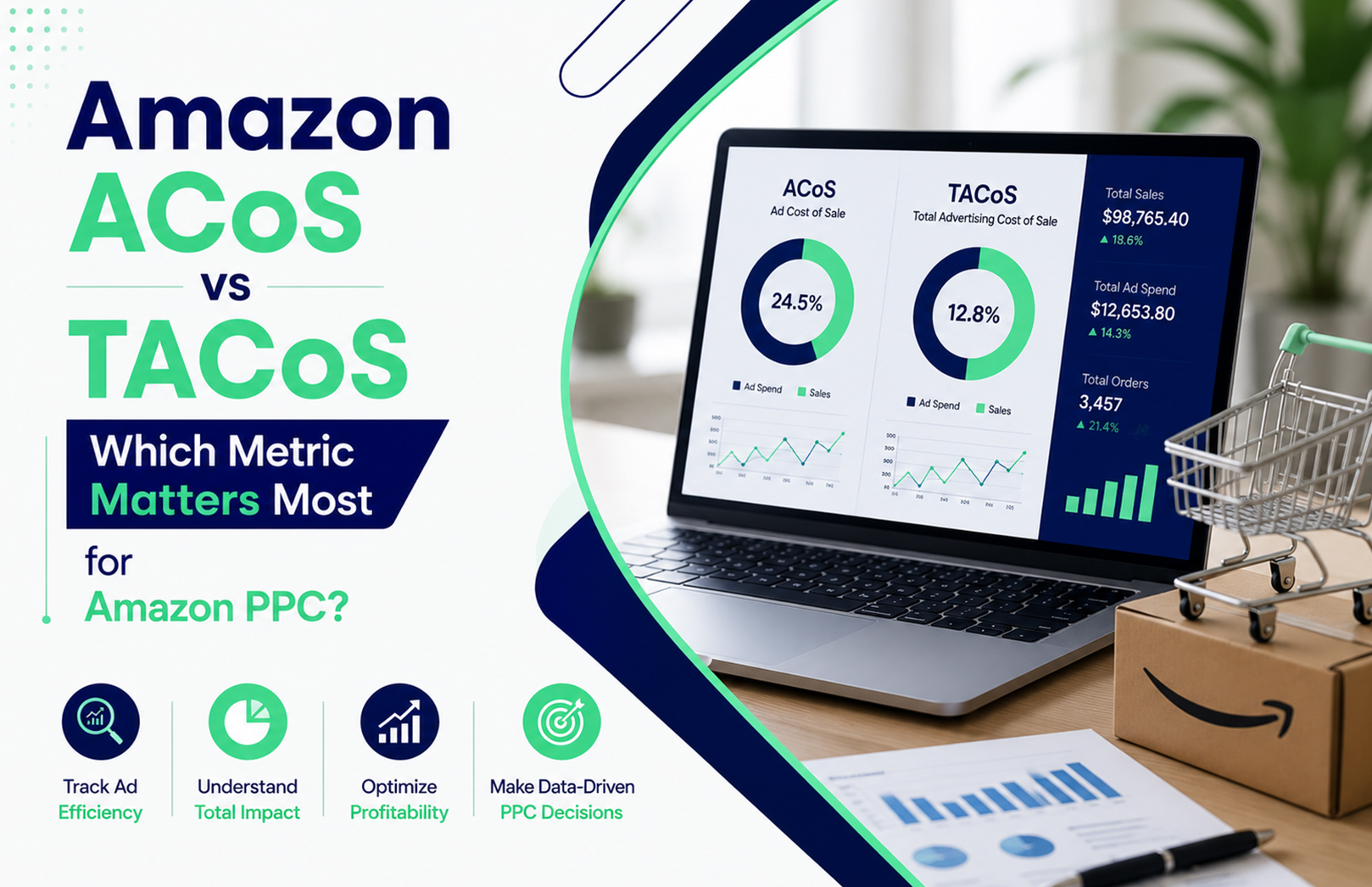
Amazon ACoS vs TACoS: Which Metric Actually Matters?


Ask ten Amazon sellers about their ad performance, and at least nine will be able to quote an ACoS figure without hesitation – 18%, 22% or perhaps a particularly impressive 12% for their best-performing campaign. Ask the same sellers about their TACoS, however, and you’ll be met with blank looks. This information asymmetry is costing Indian sellers millions of rupees in lost profits, as they optimise based on an incomplete view of their advertising costs.

Both metrics matter. But they answer completely different questions, and confusing them is one of the most common reasons Amazon PPC management decisions end up working against a seller’s actual profitability instead of for it.

What ACoS Actually Tells You

Advertising Cost of Sales (ACoS) is a metric that reflects the ratio of advertising spend to the revenue generated by those advertisements. For example, if you spend 10,000 INR on Sponsored Products ads and get 50,000 INR in sales, your ACoS will be 20%.

This figure is useful at the campaign level and really helps understand how a given campaign, ad group, or keyword is performing in terms of profitability. But sellers sometimes make a big mistake applying ACoS as the ultimate indicator of business performance, which it actually was never meant to be.

What TACoS Actually Tells You

Total Advertising Cost of Sales flips the denominator. Instead of comparing ad spend to ad-attributed sales alone, TACoS compares ad spend to your total sales, organic and paid combined. Same ₹10,000 ad spend, but now measured against your entire revenue for that period, including sales that came from organic search, repeat customers, or external traffic.

This is the metric that determines if your advertising is driving actual business growth for you – for the money you’re spending on ads. A campaign might demonstrate a healthy ACoS while failing to provide tangible value if your overall sales are stagnant – in other words, if your ad spend isn’t fueling real growth, but rather simply redirecting would-be organic sales to your ads, making effective marketplace performance optimisation critical to true long-term profitability. 

Why This Distinction Actually Matters for Amazon ACoS vs TACoS

Here’s where the confusion causes real damage. A seller chasing a lower ACoS will often decrease spend on marketing campaigns as soon as the metric begins to rise, even if a particular channel was responsible for bringing new customers to the brand, which then begin to contribute organically to the overall TACoS in the long run.

Amazon ACoS vs TACoS isn’t really a competition between two metrics; it’s a question of timeframe and purpose. ACoS answers “was this specific ad spend efficient?” TACoS answers “is my advertising, taken as a whole, actually reducing my dependency on paid traffic as my organic presence strengthens?” Sellers optimising for ACoS alone frequently end up trapped paying for the same sales indefinitely because they never let campaigns build the organic momentum that would eventually allow them to spend less.

Where Amazon Sponsored Products Fits Into Both Numbers

Amazon Sponsored Products campaigns are usually the biggest lever pulling both metrics in either direction, since they typically represent the largest share of a seller’s ad spend. A properly executed Sponsored Products campaign, which targets the right set of keywords, should be able to generate a healthy ACoS, on its own, while simultaneously boosting organic ranks (thereby driving sales via non-paid channels) due to the inherent velocity of sales that Sponsored Products campaigns are capable of generating, thus further lowering your ACoS months down the line, despite the same level of ad spend.

This is why judging a Sponsored Products campaign purely on its 30-day ACoS misses the longer compounding effect it may be having on organic visibility, an effect that only shows up when you’re actually tracking TACoS alongside it.

Why Advertising Optimisation Needs Both Numbers, Not One

Genuine Amazon advertising optimisation requires holding both metrics in view simultaneously rather than picking a favourite. ACoS tells you where to trim inefficient spend at the keyword and campaign level. TACoS tells you whether your overall advertising strategy is building sustainable, less ad-dependent growth or simply maintaining an expensive treadmill.

Sellers who fixate on ACoS optimise themselves into a smaller and smaller set of campaigns that shrink towards an ever-lower ACoS, potentially sacrificing long-term organic growth by reducing spend that would build future volume. Sellers who fixate on TACoS miss the nuanced ability to identify truly wasteful spend at the keyword level.

The Role of PPC Optimisation in Balancing Both Metrics

Effective Amazon PPC optimisation isn’t about hitting an arbitrary ACoS target in isolation; it’s about understanding which campaigns are worth a temporarily higher ACoS because of what they’re doing for TACoS, and which campaigns show a low ACoS but are contributing nothing to genuine business growth.

A product launch campaign, for instance, often runs a deliberately higher ACoS in its first sixty days, which is expected and often correct, provided TACoS shows organic sales beginning to climb as a result. Cutting that campaign early because ACoS looks uncomfortable can quietly kill the exact momentum that campaign was meant to build.

Why Listing Quality Determines How Efficiently Either Metric Improves

No advertising strategy compensates for a weak product page. Strong Amazon products listing optimisation clear titles, complete bullet points, quality imagery, solid reviews directly improves conversion rate, and conversion rate improvement is one of the few levers that genuinely improves both ACoS and TACoS simultaneously, since better-converting traffic requires less spend to produce the same sales.

Sellers chasing metric improvements purely through bid adjustments while ignoring listing quality are optimising the wrong end of the funnel.

Why This Requires Ongoing Account-Level Attention

Getting this balance right isn’t a one-time calculation; it requires consistent Amazon seller account management that tracks both metrics together over rolling periods, not isolated snapshots. A single week’s ACoS spike means little in isolation. A sustained TACoS trend over several months tells a genuinely useful story about whether the business is becoming healthier or more dependent on ad spend.

This is exactly the kind of performance optimisation that separates sellers scaling sustainably from sellers stuck spending more each year just to maintain the same sales level.

Conclusion

ACoS and TACoS were never meant to compete for your attention; they’re meant to work together, each answering a question the other one can’t. Chase ACoS alone and you risk starving the campaigns quietly building your organic future. Chase TACoS alone and you lose the precision needed to catch real waste before it adds up.

At HRL Infotechs, this dual-metric approach is exactly what shapes how we build ecommerce growth services for Amazon sellers because sustainable growth on the platform has never been about optimising one number in isolation. It’s about understanding what each one is actually telling you, and building a strategy around both.
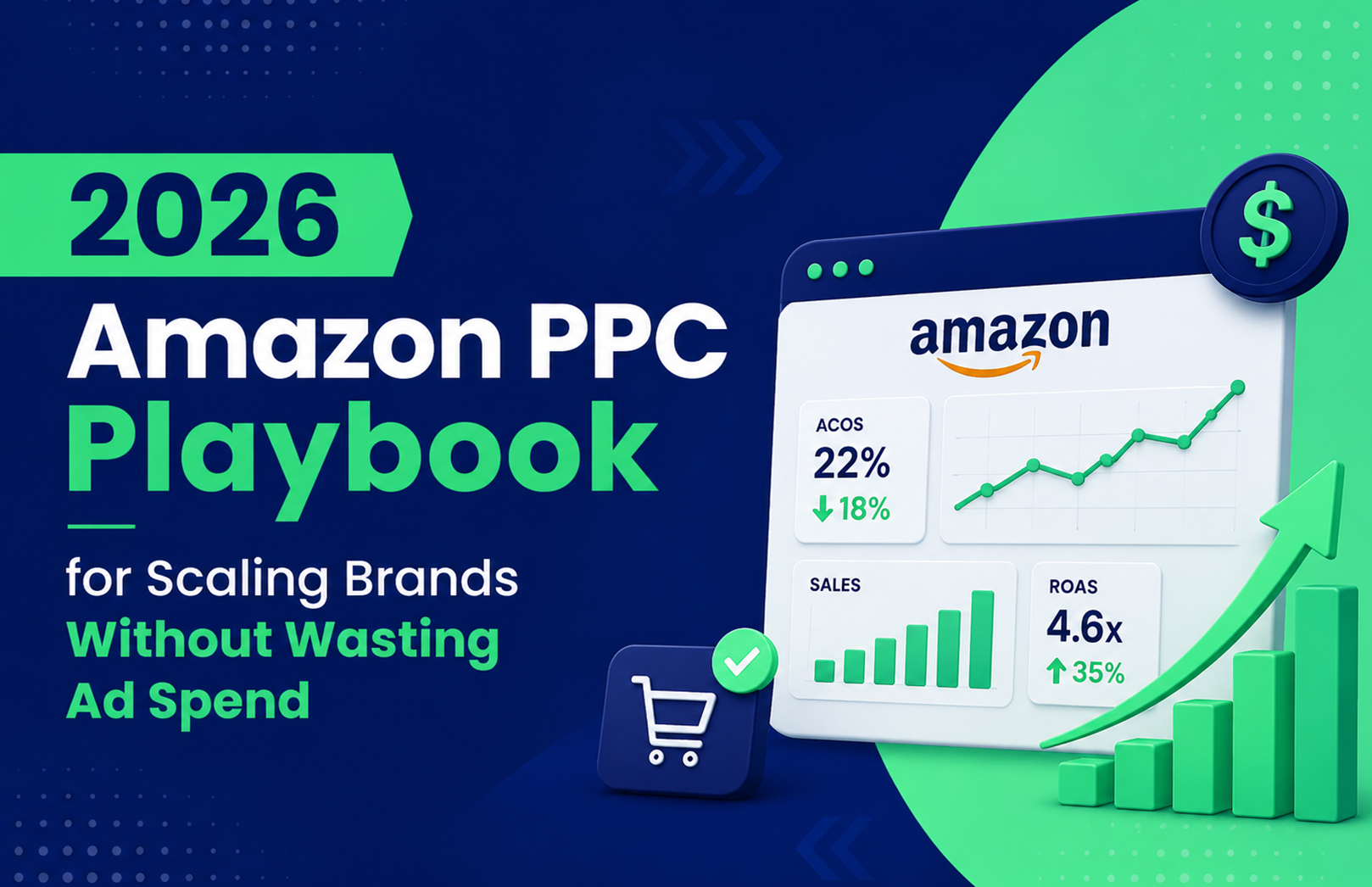

The 2026 Amazon PPC Playbook for Scaling Brands Without Wasting Ad Spend


A kitchenware brand selling on Amazon doubled its monthly ad spend between January and March 2025. Their revenue did not double. It grew 11%. Their ACoS climbed from 18% to 31%. By April, they were generating more gross sales than ever before and taking home less profit than the previous year.

This is the trap most Amazon sellers walk into when competition increases. The instinct is to spend more. The data almost always says spend smarter.

In 2026, the brands outperforming their categories are not the ones with the largest advertising budgets. They are the ones operating with a clear Amazon advertising strategy built around profitability, campaign structure, and continuous optimisation rather than budget increases alone.

Why Traditional Amazon Advertising No Longer Works

Back then, firing up large-scale automated ad runs worked just fine if you bumped budgets toward items showing sales. Less noise in the space meant cheaper clicks. Speed to rank leaned heavily on how much money moved, more than now. Spending power opened doors faster.

That environment no longer exists. Amazon PPC management in 2026 requires structure, intent alignment, and weekly optimisation discipline, as the cost of running unstructured campaigns has compounded alongside rising competition. Brands still running 2022-era campaign architecture in a 2026 competitive environment consistently experience the same outcomes: rising CPCs, declining ROAS, and budgets that generate activity without generating profit.

The playbook has changed. Most sellers have not changed with it.

Build Campaigns Around Business Goals First

The most common structural mistake is building campaigns before defining what success actually means for each product.

A product in the launch phase needs velocity and ranking data, not profitability optimisation. A mature hero product needs margin protection, not aggressive keyword expansion. A seasonal product needs structured planning, not year-round bid stability. Effective Amazon product listing and SEO management starts by defining the objective. Before opening any tools, figure out the goal. A single keyword can shift direction entirely – bidding too high when awareness isn’t needed pulls resources off track. Match type choices behave differently if growth or conversion is the target. Budget spread matters most when aligned with intent. Outcomes hinge not on setup alone but on whether strategy matches actual product stage.

Structure Amazon Sponsored Ads for Control and Measurement

Major difficulties start when every keyword gets dumped into one pile. Budgets get eaten by winners too fast, leaving little for newer ones trying to grow. Losing terms slip through because numbers look okay on paper – until money vanishes. Fixing it late costs more than planning early.

High-performing brands segment Amazon sponsored ads into four distinct layers. Automatic campaigns run continuously to capture new search term data without manual keyword input. Manual exact match campaigns isolate top-performing terms with dedicated budgets and precise bid control. Product targeting campaigns use competitor ASINs and complementary listings to intercept buyers mid-comparison. Brand defence campaigns protect branded search terms from competitor conquest.

One level handles one kind of goal. When needed, it can run faster, slower, or stop altogether. Put together, the pieces form a structure that tracks clearly, responds when nudged, and uses resources far better than lumped-together methods ever could.

Prioritise Amazon ACoS Optimisation Over Raw Spend Reduction

Amazon ACoS optimisation is widely misunderstood. Lower ACoS is not always the goal; it depends entirely on what the product needs at its current stage.

A launch into fresh categories might carry a 45% ACoS for two months – just long enough to gather reviews, lift visibility. Stop ads too soon, though, and the slow climb in natural search fades fast. Chasing the smallest number on performance reports misses the point entirely. What matters sits upstream: decide the correct cost per sale based on where the item stands now, well ahead of any ad run, rather than adjusting later under pressure.

Weekly search term report reviews, negative keyword additions, and bid adjustments based on conversion data rather than impression volume are what move ACoS in the right direction sustainably.

Listing Quality Determines How Far Your Budget Goes

No Amazon sales growth strategy survives a weak product listing. A perfectly structured campaign sending qualified traffic to a listing with poor images, a generic title, and missing social proof is simply an expensive way to generate impressions that do not convert.

Conversion rate is the multiplier on every advertising dollar. A listing converting at 12% generates three times the sales from the same traffic as one converting at 4% at identical ad spend. Start by making sure the product earns more spend first. An effective title packed with clear intent matters most. The main photo must show its worth even when tiny on screen. Bullet points work better when they ease concerns instead of just stating what’s included. Rich visuals and explanations build trust before checkout. Good ratings lower resistance to click buy now.  These are the conversion foundations that make Amazon PPC optimisation produce returns worth measuring.

Make Decisions From Data, Not Assumptions

The gap between brands that scale profitably and those that plateau at unprofitable scale is almost always data discipline, not budget size.

Weekly analysis of placement performance, top of search versus product pages versus the rest of search, reveals where conversion is strongest and where spend should concentrate. Click-through rate analysis identifies titles and primary images, creating search result friction before the listing even gets a chance to convert. Keyword profitability analysis at the individual term level surfaces the 20% of search terms generating 80% of profitable conversions, and the terms consuming budget without contributing revenue.

Small, consistent adjustments made weekly compound into significantly better performance than quarterly campaign overhauls made reactively when results have already deteriorated.

Why Professional Amazon Advertising Services Matter

As campaigns grow in complexity, the management overhead grows proportionally. Brands managing ten SKUs across four campaign types with weekly optimisation requirements across multiple marketplaces are running a specialist operation, not a side function of the marketing manager’s role.

Professional Amazon advertising services bring the structural expertise, platform access, and optimisation discipline that produce consistent performance improvement without requiring internal headcount to develop those capabilities from scratch. Combined with Amazon account management services that keep inventory, listing health, and account compliance supporting rather than undermining campaign performance, professional management typically pays for itself within the first ninety days of engagement.

The 2026 Amazon PPC Playbook

  1. Define the product-level objective before building any campaign
  2. Separate campaigns by intent: auto, manual exact, product targeting, brand defence
  3. Fix the listing conversion rate before scaling the budget
  4. Set ACoS targets based on product stage, not category averages
  5. Review search term reports and adjust bids weekly without exception
  6. Concentrate spending on the 20% of keywords driving 80% of profitable conversions
  7. Measure profitability at the product level, not blended account averages

Conclusion

The kitchenware brand, from the opening, restructured its campaign architecture in May 2025. Same products. Same marketplace. Reduced total ad spend by 22%. Revenue held within 8% of the previous peak. Profit margin returned to target within sixty days.

At HRL Infotechs, we help Amazon brands build exactly this kind of structured, profitable advertising operation combining strategic Amazon campaign management, continuous Amazon ACoS optimisation, and complete marketplace oversight into a growth system that scales revenue without proportionally scaling waste. The brands winning in 2026 are not outspending competitors. They are outthinking them.